Key Takeaways
- A practical bulk kids water bottle MOQ is usually 3,000-5,000 pcs per SKU, with 30-45 days lead time after sample approval.
- For school use, 350-500 ml is the most workable range; 500 ml is easier for older kids, while 350-380 ml fits younger grades and smaller bags.
- Food-contact compliance matters: ask for LFGB, REACH, FDA, and silicone seal documentation before you approve a custom children water bottle.
- A good children water bottle custom project should specify lid cycle testing, drop testing from 1.2 m, and carton strength, not just logo placement.
For school water bottle distributors, the hard part is not finding a bottle. It is buying a kids bottle that survives a 30 kg backpack, a dishwasher run, a cap dropped at the classroom door, and still does not come back as a claim. We run a 1.2 m drop test on the bench. A 420 ml or 500 ml bottle can still fail on a weak lid thread, a thin seal, or print that scuffs in 30 days. Cheap samples fool people.
If you buy bulk kids bottle programs for schools, districts, clubs, or retail sets, read the spec line by line: material, capacity, wall thickness, lid type, leak test, decoration, carton pack, and compliance. The buyer flagged one PO typo last season—500 ml written as 50 ml—and that kind of miss burns a week. QC pulled the sample, checked the cap torque, and found the carton count was off by 12 pcs. In Zhejiang, the factories that know this trade quote MOQ, lead time, and test standard before they talk about color charts. That is the right order.
Start with school use case
Start with the school use case before you look at colors or artwork. A bulk school water bottle for kindergarten is a different job from a bottle for grades 4-6 or a district wellness program. We run this on the line every week. Younger kids need a lighter body, a smaller grip, and a lid they can open without a fight. Older students can handle a 500 ml body and a stronger carry loop. Skip that step, and you get a nice mockup that fails in the classroom by week two.
For school water bottle distributors, the clean buyer spec starts with age band, daily use, and wash method. Ask if the bottles will see hand wash only, low-heat dishwasher cycles, or school-side rinsing in a sink basin. Then lock the volume: 350 ml, 400 ml, 450 ml, or 500 ml. QC pulled the sample with a 42 mm lid opening, and the buyer still said the bottle was too bulky for small hands. Fair pushback. In our Hangzhou factory, the lowest complaint rate comes when we set the spec by age group first; the math does not work the other way around.
- Kindergarten: 350-380 ml, lighter lid, wide opening for easy cleaning
- Primary school: 400-450 ml, leak-resistant flip lid or straw lid
- Older kids: 500 ml, stronger carry loop, more durable base
Material choice decides failure rate
Material is the first gate. For a custom kids water bottle, we quote Tritan, PP, stainless steel, or glass with a sleeve. Tritan and PP are the two we ship most for school programs. Tritan looks clearer on sample day, and that matters when the buyer is lining up six SKUs on one desk. PP wins on cost for children water bottle wholesale orders; the math works when the target is tight by $0.18 a piece. Stainless steel fits temperature-retention jobs, but the bottle jumps in weight. Glass stays niche, mostly for older kids with a sleeve and a buyer who accepts breakage risk. One distributor flagged a 280 g target, and glass was off the table by 3 p.m.
Wall thickness decides how the line behaves. A Tritan body at 2.0-2.5 mm is the range we run for a durable kids bottle. Below that, QC pulled the sample and the shoulder flexed too much on the drop table. Above that, the bottle starts to feel dense in a school bag and the unit cost climbs. If you want a bulk children water bottle with a matte body, ask whether the finish is molded-in or sprayed on; sprayed texture can scuff after 300 cycles in the carton test. A serious children water bottle factory will state the resin grade and send the test file, not just stamp “BPA free” on the spec sheet. Ask for FDA food-contact, REACH, and, if needed, LFGB reports for the full drinking system, lid and gasket included. We’ve seen a PO typo turn “2.2 mm” into “2.0 mm,” and that 0.2 mm changed the whole feel.
A cheap bottle with weak paperwork fails twice. The PO gets held, then the shipment sits at the dock.
Lids are where claims start
Most claims in children water bottle customized programs start at the lid. We see it on the line every week. Pick the mechanism by age and by how the bottle gets beaten up at school. A straw lid suits younger children, but the tube adds two cleaning points and can hold lunch residue. A flip-top lid drinks fast, yet the hinge and lock need to survive 30 slams in a backpack. A screw cap is the simplest build and often the lowest-risk choice for children water bottle bulk orders. It is slower at the desk or on the bus.
Do not approve a lid before cycle testing. For school use, we ask for 3,000-5,000 open-close cycles on the main hinge or thread, then a 1.2 m drop test onto hard floor with the bottle full and the lid shut. If the cap pops open after three drops, the spec is wrong. We had a buyer flag a cap that loosened after 400 cycles. The math does not work. School water bottle distributors need a factory that knows abuse on the line, not just carton packing. QC pulled the sample, checked the gasket, and matched it against the spare seal plan when the district asked for replacement straws or rings in the PO.
- Straw lid: best for younger students
- Flip lid: best for faster hydration, but test hinge strength
- Screw cap: best for durability and simplest cleaning
Decoration should survive handling
Buyers usually ask for the logo first and the spec later. Wrong order. We had a school PO where the logo was signed off on Monday, then QC pulled the sample and found the bottles were being washed with alkaline detergent. The ink choice was off from day one. For a custom kids bottle, we match decoration to the body, the ink, and the cleaning method before the line starts. Silk screen is the low-cost pick for 1-2 spot colors on bulk school water bottle orders. Laser engraving holds on stainless steel. On every other body, it can be dead money. UV printing gives sharper detail, but we still run abrasion checks and dishwasher tests when the bottle gets washed every day.
If you are buying custom children water bottle stock for schools, match the decoration method to the volume and price point. A one-color print on a 500 ml Tritan bottle might add USD 0.15-0.30 per piece; a full wrap print costs more, and the math does not work if the margin is thin. The right children water bottle manufacturer will tell you the print area in millimeters, the Pantone match tolerance, and whether the logo sits in the grip zone where hands rub it raw. Ask for a rub test on the machine, not a promise. We ship this kind of job every week, and the buyer flagged a 2 mm shift on the handle side before packing. For a district campaign or retailer bundle, children water bottle custom art should be approved on a print proof, not a screenshot.
Compliance is not optional paperwork
For school water bottle distributors in Europe and North America, compliance sits inside product cost, not beside it. We ask for the material declaration, food-contact test report, and spec pack before we quote 500 pcs or 5,000 pcs. If the bottle uses a silicone straw or gasket, QC pulls those parts too, and the caliper on the line does not lie. A one-line promise means nothing.
Ask which migration standard was used and what the test conditions were. A report that shows 10 days at elevated temperature tells us more than a clean certificate with no method, no media, and no resin code. For a school district order, ASTM-related material references can matter on impact or safety, depending on the buyer’s spec. This is the wrong question to ask if the paperwork is missing. We have seen PO typos like “item no. 5688A” on one page and “5568A” on the next, and customs will flag that fast.
- Request test reports for body, lid, gasket, and straw
- Confirm the exact SKU and resin code on the file
- Match carton markings to the approved item number
MOQ and pricing logic
For a custom kids bottle program, the money sits in tooling, print setup, and carton packing. The bottle body is not the main bill. On a new bulk children water bottle SKU, we usually run MOQ at 3,000 pcs, and 5,000 pcs once the buyer wants a matched Pantone lid or a new flip-top. Stock shapes with logo only can start lower, but drop under 1,000 pcs and the unit price jumps fast. The math does not work.
For planning, a plain PP children water bottle bulk order often lands around USD 1.20-2.20 per piece FOB China, depending on volume and print. Tritan sits more around USD 2.10-4.20 per piece FOB, and the lid design can move it more than the cup wall. Stainless steel custom school water bottle orders usually sit above that. We quote the mold fee, sample fee, and carton spec separately; a 5-layer export carton is not the same as a retail box. A buyer once sent a PO with “carton 5 layer” typed as “5 layor” and then asked why the ship mark was wrong. We checked the lid, insert card, and spare parts first. That is where the cheap quote usually hides the gap.
Lead time matters as much as price. Our normal production window is 30-45 days after sample approval, and that only holds when the artwork comes back clean. QC pulled the sample on one March order and found a 2 mm print shift on the logo, which pushed the line back by 4 days. A distributor who books school-season stock in March for August delivery has room. A buyer who starts in July does not. We have seen that go sideways more than once.
Packaging affects damage and margin
Packaging is where a lot of bulk school water bottle programs lose margin quietly. We have watched a $0.18 carton saving turn into $0.42 in breakage, rework, and repacking. On school shipments, we run carton specs against bottle weight and drop risk, then check whether the master carton still passes a 5-layer compression test. If you are mixing SKUs, ask for stacking strength and confirm whether the inner box is single-wall or double-wall. One molded insert or a simple bag sleeve stops scuffing on glossy bottles and keeps the custom children water bottle print from rubbing in transit. The math does not work any other way. We had one buyer push back on insert cost until the 3 kg drop test showed three lids popped loose.
Retail-ready packaging is a different job from school bulk pack. QC pulled the sample on one order because the barcode sat 8 mm too low and the scanner missed it. If you are a children water bottle distributor serving both channels, spell out which orders need FNSKU, barcode placement, and unit carton labels. The same SKU going to a school district and an e-commerce warehouse may need two outer packs, and we have seen this go sideways when a retail carton shows up inside a district case pack. This is the wrong question to ask if someone says, "just use one pack for all." A good children water bottle vendor keeps the production route separate by channel, so receiving does not spend 12 minutes opening and relabeling each carton. We run that split on the line with a red-bin check at packing.
- School bulk: plain inner pack, efficient master carton, lower carton cost
- Retail: hangtag, barcode, branded insert, stronger shelf appeal
- E-commerce: FNSKU, case packing, prep for fulfillment centers
What a real factory should show you
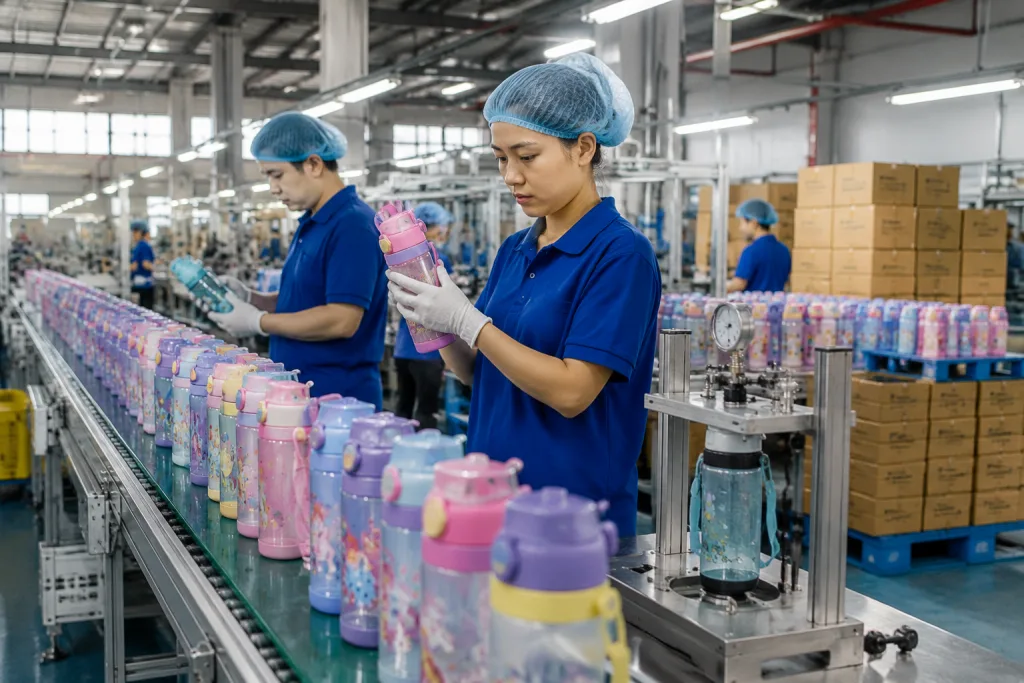
Ask a children water bottle factory for more than a catalog and a quote. We run about 600,000 units a month in Hangzhou, and the line only stays honest when the factory can show production photos, current output, and which steps stay in-house. Ask for the injection molding machine model, the leak test fixture, and the packing table layout. If the answer is slow, the math does not work for school water bottle distributor orders.
You also need the inspection record, not a sales promise. Ask what AQL level the factory uses at final check; for bulk orders, AQL 2.5 for major defects and 4.0 for minor defects is a normal start. QC pulled the sample on a 2 mm cap gap once, then the next PO came in with a typo on the color code, so we keep a repeat sample for matching and tag spare parts by SKU. This is the part buyers skip, and it is the wrong question to ask. We have seen shipments slip on less.
Send your bottle spec, not just your logo
We can quote material, lid, print, carton, and compliance together so you see the real landed cost before you place a school order.
Frequently asked questions
What is the best size for a school water bottle bulk order?
For most school water bottle distributors, 400-500 ml is the safest range. Younger children usually do better with 350-380 ml because the bottle is lighter and easier to hold. Older kids can handle 450-500 ml without the bottle feeling oversized in a backpack side pocket. If the program includes field trips or sports days, 500 ml is often the better choice. The right answer depends on age band, lid type, and whether the bottle will be used all day or only at school. For a children water bottle custom project, size should be fixed before artwork starts, because diameter changes affect labels, carton layout, and shipping efficiency.
What MOQ should I expect for custom kids bottles?
For a new custom kids water bottle, expect 3,000-5,000 pcs per SKU if you want a meaningful factory price. A simple logo on a stock shape can sometimes go lower, but unit cost usually rises below 1,000 pcs. If you need a custom mold, custom color, or a special lid, the MOQ can move higher. A children water bottle manufacturer in Zhejiang will usually ask for target volume, decoration method, and destination market before confirming the number. For school district buyers, it is better to lock one spec and scale it than to split the budget into five tiny SKUs.
Which material is safest for children water bottle wholesale orders?
There is no single winner. Tritan is popular because it is clear, tough, and light, which works well for bulk children water bottle programs. PP is lower cost and fine for many school uses if the lid and seal are properly made. Stainless steel is durable and premium, but heavier and more expensive. Glass is usually too fragile for younger students. Whatever you choose, ask for food-contact paperwork for the full system, including body, lid, silicone gasket, and straw if present. A safe bottle is not just about the resin. It is about the complete assembled SKU and whether the factory can prove consistency across batches.
How do I check whether a custom school water bottle will leak?
Ask for a closed-lid leak test on filled bottles and a drop test from 1.2 m onto a hard surface. Do not accept a claim that the lid is “tight” without a test report or sample video. For a bulk school water bottle, the seal, thread alignment, and hinge all matter. If there is a straw, check the valve area as well. The best children water bottle suppliers will test sample units from production, not just hand-built prototypes. In procurement terms, you want a repeatable pass rate, not a perfect one-off sample that never matches mass production.
Can I get custom logo kids bottle pricing for both school and retail?
Yes, but you should treat them as two packaging programs even if the bottle body is the same. A school district order might use plain cartons and a lower-cost print, while retail or Amazon FBA needs barcode labels, stronger packaging, and often different carton counts. A children water bottle distributor can keep one core mold and change only the outer presentation. That is usually the most efficient route. For pricing, simple logo print on a 500 ml Tritan bottle often starts in the low single dollars FOB China at higher volume, while more complex decoration and premium packaging increase the landed cost quickly.