Key Takeaways
- MOQ for most review water bottles wholesale programs starts at 300 to 1,000 pcs, depending on print method and lid type
- A practical retail-ready bottle usually needs 18/8 stainless steel, 0.5-0.7 mm wall thickness, and leak testing to 24 hours
- FOB China pricing commonly lands at USD 2.10 to 6.80 per piece before freight, depending on finish and packaging
- For branded programs, ask for AQL 2.5 inspection, REACH documentation, and carton drop-test results before you place bulk drinkware orders
If you are sourcing review water bottles wholesale, most supplier pages look the same on paper. Same photos. Same claims. Different results on MOQ, coating wear, cap leakage, and carton packing. We see this every week on the line. The better buy is by use case, material, and a spec sheet the factory has to sign off on.
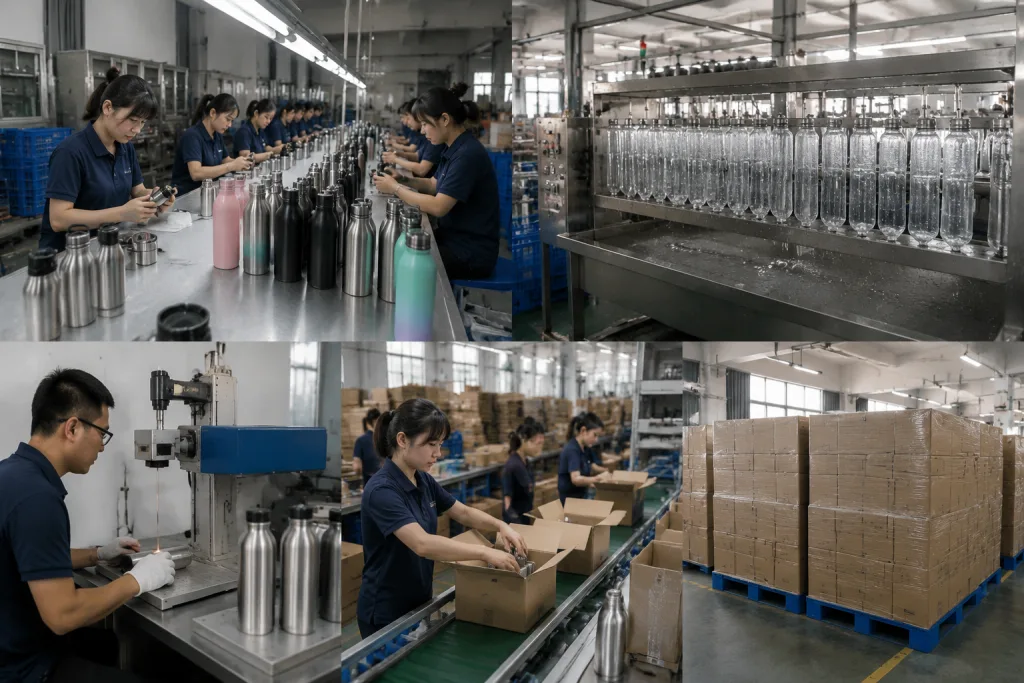
That point matters more than most buyers admit. A 500 ml stainless bottle for retail review kits is a different job from a 32 oz sports bottle for promo distribution, and neither matches a canteen bulk order or a growler wholesale program. At our Zhejiang factory, we run 300,000 units per month across drinkware bulk and custom runs, with lead times of 18 to 25 days after sample approval. QC pulled the sample on a 1.2 mm wall check last week, and the buyer flagged a carton typo before shipment. Start with the table, not the catalog. That is the right filter.
Start With the Use Case
Buyers asking for review water bottles wholesale usually need a short list that can be handled, packed, photographed, and opened on camera without the brand looking sloppy. Cheap by the thousand is the wrong target. What job does the bottle do?
We saw this on the line last month. A 28 mm cap looked fine in photos, but QC pulled the sample because the tamper ring sat 1.5 mm off, and reviewers catch that fast. A review sample run needs color match, low defect counts, and cartons that open cleanly. A promo drop cares about landed cost and a lid that stays shut in transit. Retail stock needs shelf appeal and repeatable decoration. Bulk canteen orders for outdoor channels need impact resistance and a plain lid system. Bulk growler or beer growler wholesale needs a wider mouth, stronger threads, and tighter seal control. Skip the use case, and you end up comparing quotes that should never sit on the same sheet.
Use a simple filter before you ask for quotes:
- Retail review bottle: 500 ml to 750 ml, premium finish, gift box or color box, laser or silk decoration
- Promo bottle: 400 ml to 1,000 ml, lower unit cost, single-color print, bulk carton pack
- Outdoor canteen: durable body, carabiner or loop lid, dent resistance
- Growler program: larger capacity, reinforced neck, leak control for beer growler bulk orders
That first split saves time. It also stops the buyer from chasing a quote that only looked good because the supplier guessed the wrong product category. We've seen that go sideways, and the math does not work.
The Spec Table That Matters
Build your own spec table and make every supplier fill it out the same way. PDF gloss hides gaps. We run this on the line all the time: if a factory can answer a 0.5 mm question cleanly, it can quote real production, not stock talk, and the buyer sees the mismatch fast.
| Spec | Good retail review bottle | Promo/bulk version | What to check |
|---|---|---|---|
| Material | 18/8 stainless steel or Tritan | 304 stainless or PET | REACH, LFGB, BPA-free declaration |
| Wall thickness | 0.5-0.7 mm | 0.4-0.5 mm | Feel, dent resistance, weight consistency |
| Capacity | 500-750 ml | 350 ml to 1,000 ml | Exact fill line, not just nominal size |
| Lid seal | Silicone gasket, leak test 24 h | Basic gasket acceptable | Torque, drop, and inverted soak results |
| Decoration | Laser, wrap print, or durable silk screen | Single-color print | Adhesion after 50 wash cycles |
For review water bottles wholesale, finish decides the order. A weak powder coat chips in a week. A loose lid turns one-star comments into a pattern. We had one PO where the buyer flagged a 60 cm carton drop test after QC pulled the sample and found corner crush on the inner box; the math does not work if you skip that check. Ask for samples with the exact decoration method and the final lid, not a “similar” prototype. We’ve seen that go sideways on a 500 ml bottle with a 38 mm mouth and a lid typo on the PO. Good sourcing starts there.
Water Bottles Versus Canteens
People mix up bottle programs and canteen wholesale orders. They are different buys. A canteen bulk order usually goes to hiking shops, military-style retail, school resale, or field use. A review bottle is built for ecommerce, distributor channels, and brand campaigns. On our line, that split shows up fast at MOQ 5000 versus 3000, and the buyer usually catches it after the first sample photo.
Here is the blunt version. If your channel lives on photos, unboxing, and product ratings, choose a cleaner silhouette and a tighter finish. If your channel cares about abuse, grip, and transport, the wholesale canteen spec wins. A canteen bottle can take a harder life with a simple lid and a wall that is 0.3 mm thicker. A review bottle needs the parts buyers check in hand: lid fit, coating uniformity, thread smoothness, and whether the bottle sits flat on the table. QC pulled the sample once on a 1 mm wobble. The buyer flagged it, and they were right.
Do not ask one supplier to quote a review bottle and a wholesale canteen at the same time without splitting the spec. The math does not work. The factory will price both at the higher build, or they will quietly trim the structure. We have seen that go sideways on a PO with one typo: “matte black” became “matt black,” and the approval thread stalled for 4 days. If you need both, run them as two SKUs. That is the clean way to buy bulk drinkware in China and keep the sample stage under control.
Growlers Need Different Discipline
Growler programs run on their own rules. A bulk growler or beer growler bulk order is about seal integrity, neck strength, and transport safety, not looks. We run leak checks on the line with 50 ml of water and a 2 m drop test for cartons; if the liquid moves, the promise is broken. For wholesale growler or beer growler wholesale units going into craft beverage, taproom, or gift sets, the tolerance stack has to be set on day one.
For glass growlers, ask about bottle wall consistency, annealing, and carton separators. Last month QC pulled the sample at 3.2 mm wall thickness, and the buyer flagged a cold spot near the shoulder. For stainless growlers, ask about seam quality, interior polish, and whether the lid is pressure-tested at 0.6 bar. A beer growler in bulk is not a generic bottle with a wider mouth. It needs a better cap system and tighter foam control if it will be filled on-site. A beer growler wholesale bulk order also needs stronger outer cartons, because these boxes ship heavier than standard drinkware cartons. This is the wrong question to ask: "Can it hold liquid?" It has to hold up in transit too.
Practical numbers help. For a 64 oz growler, FOB China pricing often sits above a 500 ml bottle because the body uses more material and the packaging is heavier. We see USD 4.20 to 8.50 depending on material, lid, and print method. On one PO, the buyer wrote "64oz" as "640z", and the supplier almost built the wrong carton insert. If a quote lands far below that range, check whether the lid upgrade is missing or the wall is too thin. The math doesn't work.
Alcohol Flask Orders Are Tricky
Alcohol flask bulk sourcing looks simple until the finish catches the light. We checked one brushed 8 oz flask with a 10x loupe, and the buyer flagged finger marks before we had touched the hinge. Clean shells sell. Sloppy ones come back.
For an alcohol flask wholesale program, I keep the spec tight: 6 oz or 8 oz capacity, 0.5 mm stainless for economy, 0.6-0.7 mm for gift sets, and a leak test with the cap closed for 12 to 24 hours. QC pulled the sample after a 24-hour soak and found a slow seep at the neck. Test the insert fit too. If the flask rattles in the box, the math does not work.
Some importers try to bundle flask and bottle sourcing into one drinkware wholesale order to save a week. That is the wrong question to ask. We run separate lines for different shapes, and once a line change starts, polish drifts and seam alignment slips. Ask which line is set for flasks, which one runs bottles, then split the inspection plan. A Zhejiang factory that ships export orders every week will answer that without hesitation.
Ranking by Buying Priority
Do not pick a winner by taste. Rank by the job. That is how review water bottles wholesale stays usable when the buyer flags the spec sheet on day 2.
- Best for product reviews and ecommerce: 500 ml stainless bottle with matte powder coat and laser logo. It shoots clean on a phone rig, and QC pulled the sample for a 0.3 mm logo shift before the line went live.
- Best for promo volume: 750 ml single-wall or entry-level insulated bottle with one-color silk print. Low landed cost, fast to ship, and the MOQ stays friendly when the PO says 3,000 pcs.
- Best for outdoor and utility: bulk canteen format with reinforced body and simple loop lid. It takes abuse, and the 1.2 mm wall spec is the part buyers stop arguing about after they see the drop test.
- Best for beverage brands: wholesale growler or beer tumbler bulk format with tight seal control and heavier carton packing. We run this with leak checks at the cap station, because the math does not work if cartons arrive wet.
- Best for gift sets: alcohol flask wholesale bulk with premium packaging and tighter cosmetic inspection. A small scratch on a brushed shell will get the buyer flagged in one minute, so we keep the AQL table close.
This ranking is not about mood. It follows shelf expectations, carton damage rates, and what each channel can absorb. A distributor asking for low returns and 12-day replenishment does not want the same build as an Amazon team that needs FNSKU-ready cartons and barcode placement within 2 mm. We have seen this go sideways when a buyer wrote “750ml” on the PO but wanted 500 ml pricing. A factory in China can make all of them; the line setup is the part that decides whether the order ships clean.
Inspection and Compliance First
Do not skip QC because the order looks small. We saw a 1,200-piece trial turn into 18,000 pieces after the first ship cleared, and weak control showed up on the second run. Ask for AQL 2.5 for major defects and AQL 4.0 for minor defects on the standard sampling plan. For coated or printed bottles, ask for an adhesion test and a cross-hatch result. For food contact use, keep REACH and LFGB in the file if you sell into Europe, and ask for ASTM or ISO references when the buyer wants formal test language. This is the wrong question to ask after the cargo lands.
A decent factory in Zhejiang should hand over material declarations, carton dimensions, and a production photo set without drama. We run a tape check on carton size, and if the outer box is 52 x 35 x 28 cm on the sample but the PO says 50 x 33 x 26 cm, the buyer will flag it later. Ask for leak testing on every batch of insulated bottles and a documented spot-check on non-insulated drinkware bulk orders. If a supplier claims 300,000 units a month but cannot show batch records, that number is just decoration. The math does not work.
Good sourcing is less about chasing the cheapest bottle and more about proving the bottle you buy is the bottle you will receive 8 weeks later.
For brands selling through Amazon or similar channels, carton labels, FNSKU placement, and inner-pack count need to be written into the PO. QC pulled the sample on a line run last month and found a typo in the FNSKU, one digit off. That kind of miss turns into chargebacks fast. Boring work, yes. But it keeps warehouse rejections off your plate. We ship these cases with a barcode scan before packing, and that extra 2 minutes saves a lot of noise later.
How To Quote Like A Buyer
Send a review water bottles wholesale RFQ like you run the line yourself. First line only: material, capacity, lid style, print method, finish, carton count, shipping term. We quoted a 24 oz bottle three ways because the buyer wrote “metal bottle” and left the lid and finish blank. That kind of brief burns time. Vague request, vague price.
Keep page one tight: product name, use channel, color, logo file, target MOQ, sample timing, mass production lead time, destination market, and whether you need FOB, CIF, or DDP. If you are comparing bulk growler, beer tumbler wholesale bulk, or alcohol flask wholesale bulk items, split them into separate line items. One PO typo can wreck the quote; the buyer flagged “DDP Hamburg” on a carton-only request, and the math did not work. We’ve seen that go sideways in 12 days, not 18.
A clean quote needs price breaks. 300 pcs, 1,000 pcs, and 3,000 pcs should not land on the same number. On our line, QC pulled the sample with a caliper, and the 0.35 mm wall looked fine, but the setup fee still had to stay separate from unit price. Ask for that split. This is the right question to ask, because hidden costs show up fast when you compare drinkware wholesale offers from a China factory that actually ships.
Request a spec-matched quote today
Send your target capacity, lid style, and monthly forecast. We will price the exact bulk drinkware build, not a guess, from Zhejiang.
Frequently asked questions
What MOQ should I expect for review water bottles wholesale?
For standard review water bottles wholesale orders, a realistic MOQ is 300 to 1,000 pcs per SKU. Simple single-color print can start at 300 pcs, while custom color coating, laser engraving, or special lids usually push the MOQ to 500 or 1,000 pcs. If you need mixed colors under one SKU, expect a higher setup charge or a longer lead time. In Zhejiang, a well-run factory can usually sample in 7 to 10 days and move to production in 18 to 25 days after approval. For bulk drinkware with packaging changes, add 5 to 7 days.
How do I compare a bottle quote from China fairly?
Compare by identical spec, not by photo. Ask every supplier for the same material grade, wall thickness, capacity, lid, print method, and carton count. Then compare FOB China prices at 300, 1,000, and 3,000 pcs. A bottle that looks cheaper by USD 0.30 may cost more after a better lid, thicker wall, or proper inner box is added. For drinkware wholesale orders, I also check whether the supplier includes drop test results, leak test records, and AQL 2.5 inspection. Without those, the price is incomplete, especially for review-focused retail programs.
Is stainless steel better than Tritan for wholesale drink bottles?
It depends on the channel. Stainless steel is better when you want premium retail appeal, insulation options, and a more durable surface. Tritan can be better when you need a lighter bottle, visible liquid volume, or a lower unit cost. For review water bottles wholesale, stainless usually wins if the buyer expects a higher perceived value. For canteen bulk or school-style distribution, Tritan can be the easier sell. In China, stainless 304 or 18/8 with 0.5-0.7 mm wall thickness is the most common export spec. For Europe, keep REACH and food-contact files ready.
Can I mix canteen, growler, and flask items in one order?
You can, but only if you separate the SKUs and accept different lead times. A bulk canteen, wholesale growler, and alcohol flask wholesale bulk item usually run on different molds, lids, and packaging lines. Mixing them in one PO is fine for logistics, but not for spec control. The better method is to keep one PO with multiple line items and one inspection standard. For example, use AQL 2.5 on major defects and require the correct carton count for each SKU. That is cleaner than forcing one factory setup to behave like a universal product line.
What shipping terms do most buyers use for bulk drinkware?
FOB China is the most common starting point because it lets you compare suppliers on the same basis before freight. For smaller review water bottles wholesale programs, some buyers ask for CIF to a specific port, but that can hide freight differences. DDP is useful if you want one landed price for an ecommerce launch, especially with FNSKU labeling or retail-ready packaging. Still, I prefer you request FOB first, then compare ocean freight separately. That keeps the China factory price visible and avoids fake savings caused by shipping assumptions.