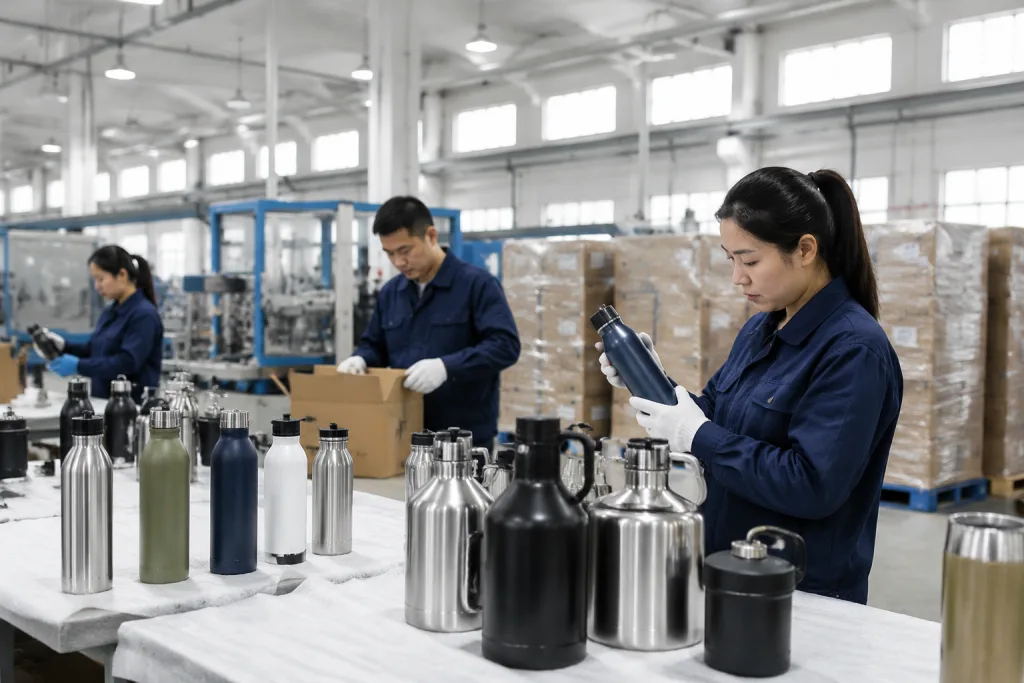
Key Takeaways
- Most wholesale drinkware programs start at MOQ 1,000-3,000 units, with 25-35 day lead times after sample approval.
- 304 stainless is the default for bulk drinkware; for harsher use, ask for 18/8 steel, 0.5-0.7 mm wall, and verified passivation.
- FOB China pricing for standard canteen wholesale or beer tumbler wholesale often starts around USD 1.20-3.80 per unit depending on capacity and decoration.
- For review drinkware wholesale, insist on AQL 2.5/4.0 inspection, REACH paperwork, and closure leak testing before you place repeat orders.
Buying review drinkware wholesale looks simple. It is not. QC can pull 20 samples in an hour, and a bottle that looks fine at 0.4 mm wall thickness can crack on the line while the 0.8 mm version keeps moving through retail, Amazon FBA, corporate gifting, or foodservice. Same listing. Different behavior.
From our Zhejiang factory, we see the same miss every week. A buyer flags the closure code after the PO is already typed, or the MOQ lands 500 pieces short, and the math does not work. We run that check before sample sign-off. This is the wrong question to ask if you only compare shapes. Bulk canteen, bulk growler, and alcohol flask wholesale bulk orders live or die on details like a 2 mm lid gap, coating adhesion, and whether the carton survives a 1.2 m drop test.
Start with the spec table
If you are buying review drinkware wholesale, start with the spec table. Photos lie. The table does not. Put each SKU against capacity, steel grade, wall thickness, lid type, decoration method, carton count, and target use case, then you can compare a canteen bulk order with a beer growler bulk program on numbers that hold up on the line. A buyer in Europe or North America usually wants the same thing we do: fewer surprises, no last-minute rework, and no PO typo like “5000 pc” when the MOQ was 1,000.
Here is the kind of table that works. QC pulled the sample at 0.58 mm with a caliper, and that one reading tells you more than a hero shot ever will:
| Type | Typical capacity | Material | Wall thickness | MOQ | FOB range |
|---|---|---|---|---|---|
| Wholesale canteen | 500-750 ml | 304 stainless | 0.5-0.6 mm | 1,000 pcs | USD 1.25-2.20 |
| Wholesale growler | 32-64 oz | 304/316 stainless | 0.6-0.8 mm | 2,000 pcs | USD 2.80-5.90 |
| Alcohol flask wholesale | 4-8 oz | 304 stainless | 0.4-0.5 mm | 3,000 pcs | USD 0.95-1.80 |
What matters is how you use it. If a supplier cannot give you gauge, coating system, and test standard in one reply, they are not ready for bulk drinkware. We have seen this go sideways on a 2,000-piece growler order when the buyer flagged an unverified coating claim and the shipment sat 12 days on hold; the math does not work. Zhejiang factories that ship at export scale should quote these numbers straight, without making the customer chase a second email.
Canteen bulk versus tumbler bulk
Canteen bulk and beer tumbler bulk serve different buyers, even if the same line uses the same jigs. A wholesale canteen is built for carry weight, hard use, and repeat filling on the move. A beer tumbler wholesale item is built for shelf appeal, hand feel, and insulation. Mix them up and the cost sheet goes sideways fast.
For a standard bulk canteen, we run 304 stainless at 0.5-0.6 mm wall thickness, check TIG or seam welds at the heel, and test the lid at 1,000 opening cycles. For beer tumbler in bulk, we want double-wall insulation, 12-24 hours of cold retention, and a powder coat that survives cross-hatch after abrasion. QC pulled the sample on a 2 mm rim chip last month, and the buyer flagged it on the same call. For review drinkware wholesale, that is the issue. A dull laser mark is noise.
Use-case fit:
- Wholesale canteen: school, hiking, club kits, military-style promo, utility packs
- Beer tumbler wholesale bulk: hospitality, brewery merch, bar retail, gifts
- Bulk drinkware general: mixed assortment programs where carton density and freight cost matter
The price gap is not small. In Zhejiang, a simple canteen bulk order can land 30-40% below a vacuum tumbler with the same print area, because the structure is simpler and scrap stays lower on the line. One buyer pushed back on a PO that said 3,000 pcs but needed 2,800 pcs packed in 10 cartons; that typo changed the freight math. The math does not work any other way.
Growler and flask tradeoffs
Growler wholesale and alcohol flask wholesale bulk are easy to over-spec. We see it on the line. Buyers hear “heavier” and assume stronger. The math does not work. For a beer growler wholesale program, the real check is closure sealing, carbonation hold, and whether the neck finish matches the cap or swing-top we run. For alcohol flask bulk, the weak points are seam quality, cap leakage, and whether the surface will take engraving or silk screen without smearing. QC pulled a sample last month, and the buyer flagged a tiny weld ripple; that kind of miss kills a reorder.
A practical beer growler bulk spec usually starts with 304 stainless, 0.6-0.8 mm body thickness, and a leak test held at 90-120 kPa depending on closure design. If the buyer asks for 316 stainless, we quote it, but only when the target price can carry it. For alcohol flask in bulk, a 4-6 oz body with 0.4-0.5 mm thickness is normal. Push thicker than that and you pay twice: more freight, more forming trouble, and more press marks at the shoulder. We have seen a 0.8 mm flask jam the trimming die on a Friday run. That was a slow fix.
Do not buy growler wholesale or flask wholesale on catalog descriptions alone. Ask for the closure drawing, tolerance on the neck thread or swing-top, and the leak test method in writing.
This is the wrong question to ask: “Can you make it heavier?” A Zhejiang factory with export habits should answer the cap material too, not just the bottle body. We want to know if the cap is PP, ABS, or stainless-clad, if the gasket is silicone or EPDM, and whether the packing line can survive carton drop testing without scuffing the finish. We once shipped a lot where the PO typo said “EPDM” and the buyer meant “EPDM black”; one line item, one missed shade, and the batch got held. That is the detail that saves a trade program.
What quality checks matter
For wholesale drinkware, quality starts with repeatability. A clean sample means nothing if the line drifts on day 3 or the 3,000th unit. We ask for a written inspection plan, not a sales promise. For repeat orders, we set AQL 2.5 for critical defects and AQL 4.0 for minor defects unless your brand spec is tighter. On coated cups or printed logos, QC pulled the sample from the first 3 pieces, the middle stack, and the last tray, then checked adhesion, color tolerance, and finish match with a cross-cut tester. That is the real question. A buyer once waved off the plan and said the sample looked fine; the lot still failed on ink peel at the packing table.
For stainless products, ask about passivation and whether the factory has salt spray or corrosion test records where the item calls for them. We run those checks on the bench. Not in theory. For EU or North America, REACH comes up early, and it should. For food-contact retail drinkware wholesale, the supplier should hand over food-contact declarations plus a traceable batch record. ISO 9001 is common. BSCI matters when the buyer’s compliance team asks for it. One buyer pushed back on a 72-hour salt spray report, then the first rusty spot showed up on day 5. A 304 stainless bottle with a bad weld bead will fail fast, and the buyer will flag it before the truck leaves.
- Leak test: 100% for flasks, growlers, and vacuum lids, using the air-pressure rig
- Drop test: carton and unit level, especially for e-commerce, from 76 cm onto concrete
- Odor check: important for coatings, gaskets, and plastic lids, with a 24-hour soak
- Logo durability: rub test and dishwasher exposure if needed, checked after 50 cycles
In practice, the best wholesale drink bottle programs are locked down before production starts. We have seen this go sideways when a PO typo turned 500 ml into 50 ml and nobody caught it until packing. The math does not work after that. That miss costs more than shaving 5 cents off unit price after the first shipment lands damaged, and a 2 mm wall-thickness callout on the drawing would have stopped it. We ship these jobs every week, and the tape measure on the line does not forgive sloppy specs.
MOQ, lead time, and freight
Buyers often ask for the best wholesale drink bottle. That is the wrong question to ask. MOQ and freight density decide the deal. On our Hangzhou, Zhejiang line, we run 1,000 pcs MOQ for plain canteen wholesale items, 2,000 pcs for vacuum growler wholesale, and 3,000 pcs for alcohol flask wholesale bulk once custom tooling or a custom color enters the job. Lead time is 25-35 days after sample sign-off for standard runs, then 35-45 days if you add custom packaging or a new lid. QC pulled the sample at 3 p.m., checked the lid torque gauge, and the buyer still tried to push MOQ down by 20%.
That timing matters because freight can wipe out a cheap unit price. A bottle that nests well often beats a heavier shape, even if the unit cost is 8-12% higher. We shipped one order where the carton saved 18 kg per master case, and the ocean math beat the lower ex-factory quote. If you ship to Amazon FBA, carton size, barcode placement, and master carton labeling matter as much as the bottle. Check FNSKU placement before the first run, not after cartons are already on the water. The buyer flagged it once after the pallet wrap was done. Bad day.
For drinkware bulk buying, ask for these three numbers in the first quote:
- Unit price at 1,000, 3,000, and 5,000 pcs
- Carton dimensions and gross weight
- Production lead time from approved sample
Factories in China that export every week can quote this cleanly. If a Zhejiang supplier cannot give you the freight-efficient carton plan, the landed cost comparison is already broken. We have seen this go sideways on a PO typo, too: one buyer wrote 3000 pcs, then asked why the pack-out came back short by 120 cartons. The math does not work.
Decoration changes the math
Decoration is where a lot of wholesale drinkware deals go sideways. The body can look cheap on paper, then the logo method adds labor, scrap, and compliance checks. Silk screen is usually the lowest-cost route for a one-color mark on canteen wholesale and bulk canteen orders. We run 2-pad and 3-pad fixtures on the line for that. Laser engraving costs more per piece, but it holds up better and looks cleaner at retail. Full-wrap printing brings setup headaches fast, and if the buyer wants tight color matching, landed price can jump 10-20% before you notice.
If you are buying review drinkware wholesale for brand retail, decide early whether the mark is for function or for promotion. That is the right question. For alcohol flask wholesale bulk, a small laser mark usually beats a big print. For beer tumbler wholesale bulk, powder coat plus laser detail is a standard premium spec, and QC pulled the sample at 0.3 mm edge tolerance when the buyer flagged the logo size. For travel-heavy bulk drinkware, printed logos wear faster than buyers expect unless you test abrasion and dishwasher cycles, and we have seen that fail on a 12-day test while the laser sample stayed clean at 18 days.
The practical rule is simple: pick the cheapest decoration that still survives the channel. A trade show gift and a retail shelf item do not need the same finish. Ask your supplier in China to quote decoration separately from body cost, with the PO split out line by line, so you can see where the margin goes. A typo on a PO once turned "laser" into "label" for a 5,000-piece order, and the math did not work. That is the gap between buying drinkware wholesale and opening a box of surprises.
Best fit by channel
Start with channel fit, not brand copy. A wholesale canteen fits promo kits, outdoor runs, and utility bundles. Beer growler wholesale works for brewery retail, taproom merch, and event packs. A beer tumbler in bulk is a cleaner match for gift sets and hotel resale. Alcohol flask in bulk belongs in gifting, travel accessories, and small lifestyle retail where 1 mm on the finish can decide the sale. We run that check on the packing table with a tape measure. The buyer flags the same thing every time: the channel picks the SKU.
For procurement managers, the question is channel math. A bulk growler with a 64 oz body can look fine on a spec sheet, but if the carton cube is weak and the lid fails leak testing, the math doesn't work. A canteen bulk order can look plain, yet it still holds margin if the box packs tight and the print stays stable on the line. The same goes for wholesale drink bottle sourcing across Europe and North America: the right item passes audit, ships clean, and comes back under 2%. QC pulled the sample, checked cap torque, and the job moved on.
Simple ranking criteria: landed cost, defect risk, logo durability, freight density, shelf appeal. Use those five checks before you compare a best wholesale drink bottle candidate with any other bulk drinkware option. This is the wrong question to ask if the MOQ is off by 500 pcs or the PO shows a lid color typo.
How to order without surprises
Good sourcing runs on procedure. Start with drawings, not product photos. We check capacity tolerance, wall thickness, closure spec, and decoration area in one file, then QC pulls a sample from the exact line, not a hand-finished show piece. For review drinkware wholesale, that sample has to match the run we ship in 25-35 days, not a lab piece built by a senior tech on a slow afternoon. We’ve seen that go sideways.
Before PO release, lock these items in writing: color standard, carton pack, label format, REACH or food-contact documents, AQL target, and replacement policy for visible defects. One buyer once sent a PO with the carton height typoed by 10 mm; the buyer flagged it, and we stopped the line before it became a claim. If you are buying from China into the EU or the US, get the supplier to confirm the incoterm, usually FOB China for first comparison and sometimes DDP only after the program is stable. This is the wrong question to leave vague.
Ask for production photos at the first 500 units and a final inspection report before balance payment. We run that check on every export lot, and the inspection sheet should show the actual defect count, not a clean summary with no numbers. That is not bureaucracy. It is how you keep a wholesale drinkware order from turning into a margin problem after the ship date.
Send your spec sheet for a clean quote
We can price your drinkware wholesale program by use case, MOQ, and decoration method, then flag the risks before production starts.
Frequently asked questions
What MOQ should I expect for review drinkware wholesale orders?
For standard wholesale drinkware, expect MOQ around 1,000 pcs for simple canteens, 2,000 pcs for vacuum tumblers or growlers, and 3,000 pcs for custom alcohol flask wholesale bulk. If you want a custom lid, new color, or embossed logo, the MOQ can move up by 20-30%. In Zhejiang, the better-run factories will quote tiered pricing at 1,000/3,000/5,000 pcs so you can see where the landed-cost break actually is. Always ask whether the MOQ is per SKU or per order family, because that changes your assortment strategy fast.
How do I compare canteen wholesale and growler wholesale pricing?
Compare by structure, not just body size. A 500-750 ml canteen wholesale item in 304 stainless often lands around USD 1.25-2.20 FOB China, while a 32-64 oz beer growler wholesale item is more often USD 2.80-5.90 because it needs thicker walls, better sealing, and more complex closures. If you are buying beer growler wholesale bulk for retail, add decoration cost, carton strength, and leak-testing labor. A cheap growler that fails in transit is expensive. Ask for unit price, packaging cost, and carton dimensions in one quote, or your comparison is incomplete.
What certificates matter for wholesale drinkware into the EU or US?
At minimum, ask for food-contact declarations, REACH documentation for the EU, and material traceability. For stainless steel products, suppliers should state the grade, usually 304 or 316, and show batch records. If your retailer or platform requires it, BSCI helps on social compliance. ISO 9001 is useful but not enough by itself. For drinkware wholesale on Amazon or in US retail, you may also need product labeling support, including carton marks and FNSKU placement for fulfillment. Certificates do not replace testing, but they do reduce customs and buyer-audit friction.
Is laser engraving better than silk screen for bulk drinkware?
Not always. Silk screen is usually cheaper and works well for one-color logos on canteen bulk and bulk drinkware orders. Laser engraving is more durable, cleaner-looking, and better for premium beer tumbler wholesale bulk or alcohol flask wholesale bulk programs. The choice should follow the channel. If the product is for promotions or kits, silk screen usually wins on cost. If it is retail shelf or gift-ready, laser often looks better and lasts longer. Ask for abrasion testing and dishwasher-cycle exposure if your customer will reuse the item heavily.
What lead time should I plan for China sourcing?
For a stable order from China, plan on 25-35 days after sample approval for standard wholesale drinkware and 35-45 days if you add custom packaging, a new lid, or a custom color. If you need a first article inspection, sample revision, and freight booking, add another week. In Zhejiang, factories that run 50,000-100,000 units per month can usually keep to that schedule if you confirm specs quickly. The real delay is usually not production; it is late artwork, unclear carton marks, or a closure spec that changes after sampling.