Key Takeaways
- Verify factory audits (BSCI/ISO) directly; do not rely solely on platform badges.
- Standard MOQ for custom drinkware is 3,000 units; lower runs raise unit cost by 20-40%.
- Lead times from a Zhejiang canteen factory typically run 35-45 days for initial orders.
- Laser engraving offers durability but limits color contrast on stainless steel.
- Request a physical 'golden sample' to lock in wall thickness and finish specifications.
You have probably scrolled past 200 supplier profiles on B2B platforms and seen the same bottle photo on five pages. That is the first filter. The harder part is separating a real reusable water bottle vendor from a trade desk with a polished catalog. We run into this every week. Then you need proof they can print your logo, match cap color, and hit the packing spec without turning a 15-day lead time into 28.
This guide breaks the vetting job into the questions we ask on the line. We look at the details that decide whether a canteen factory is steady or a headache: wall thickness, mold ownership, MOQ, and how they answer when QC pulled the sample and found a 0.3 mm gap at the seam. A buyer once pushed back on a 50 mm cap drawing because the PO typo changed the neck finish, and the math did not work. That is the wrong question to ask if you start with price alone. Price without process does not hold.
Is the supplier a manufacturer or a trading company?
This is the first question we ask, and for good reason. A lot of canteen suppliers on Alibaba or Global Sources are traders. They add margin, then pass your PO to a factory they do not control. Last month a buyer flagged “carton mark” as “carton marks” on a 2,000-unit PO, and two desks started arguing while the line kept running. You feel that delay fast.
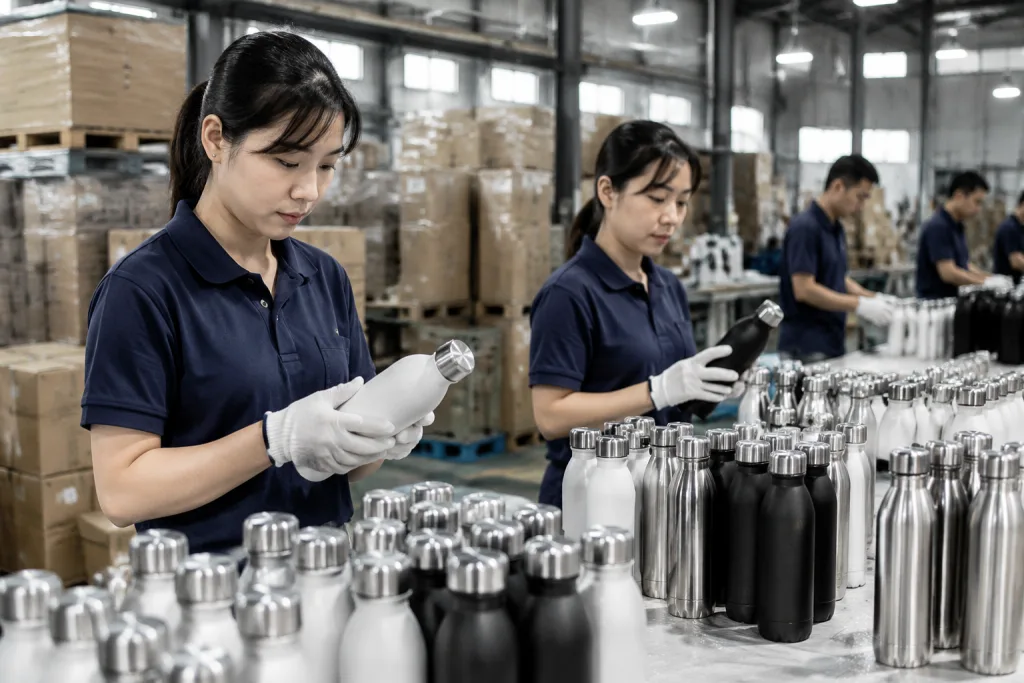
Ask for a live video call from the production floor. A real canteen factory in Zhejiang will show welding lines, polishing booths, and injection molding machines in the same building. If all you see is a showroom and a desk, you are probably talking to a trading company. We checked one supplier that claimed factory status, and QC pulled the sample from a 38 mm neck ring gauge on the spot; the math did not work. Traders can quote a lower MOQ by pooling orders, but that comes with a price. For orders above 10,000 units, working directly with a canteen manufacturer usually gives tighter pricing and faster fixes on cap fit, leak tests, and print alignment.
Why it matters for your brand
Direct factory access lets you talk mold ownership before the deposit clears. If you pay for a custom shape, put the mold clause in writing. We have seen this go sideways when a buyer assumed the tooling was theirs and the supplier reused the design for another canteen vendors account. That is the wrong question to leave open. A 6-cavity mold is not a lunch receipt.
What is the true Minimum Order Quantity (MOQ)?
Most reusable water bottle vendors start at 3,000 units per size and color. That number comes from the line: one stainless coil, one cap mold, one print setup. If you are a canteen distributor trying a new SKU, 3,000 feels like a hard stop.
Lower MOQs do exist, usually 500-1,000 units, but the price moves fast. Short runs lose efficiency, and a 1.5 mm silk screen frame or laser jig still has the same setup cost. We had a buyer flag a PO typo once, 1,000 typed as 10,000, and QC pulled the sample before the line moved. Ask for quotes at 1,000, 3,000, and 10,000 units; that is the clean way to read landed cost. Anything else hides the real number.
Pro Tip: If you need a custom growler or a special shape, the MOQ is usually 5,000+ units. The mold is the expensive part, and welding defects show up faster on odd geometry. We saw this go sideways when a buyer pushed for 800 pcs on a new mold, and the scrap rate ate the margin. The math does not work.
Can they handle your specific customization needs?
Customization is not a logo slapped on steel. For a canteen custom order, we check what the line can run: double-wall vacuum insulation, powder coating, wet paint, and cap thread fit. A customizable canteen with a 25 oz body and matte finish runs a different setup from a plain promo piece. Ask for a cheap mockup first? That is the wrong question.
Fix the decoration method early. Silk screening works for a simple mark, but we saw it rub off after 18 dishwasher cycles on the test rack. Laser engraving holds, but it exposes the steel and kills darker artwork. For a customized canteen with full-wrap print, heat transfer is the usual route, and QC pulled the sample after a UV cabinet test showed fading at 72 hours. If you are sourcing a custom drinkware line for outdoor use, ask for that test report before you place the PO. We ship this kind of order every week.
For complex shapes, like a customized growler with a handle and swing top, ask for a 3D rendering before we cut steel. We had one buyer flag a 2 mm handle offset on the drawing; fixing it before mold cutting saved 12 days and a useless tool change. Once the mold is opened, the math does not work in your favor. One typo on the PO, one wrong radius, and the line stalls.
What quality control measures are in place?
Quality control is where distributor drinkware orders go off the rails first. You cannot inspect every bottle on the pallet before shipment, so we run line checks, QC pulls samples, then a third-party inspector signs off. A serious canteen manufacturer works to AQL (Acceptable Quality Limit) standards, usually AQL 2.5 for major defects and 4.0 for minor defects. That is the baseline. On a 5,000-piece run, we still pull cartons from three spots on the line, and the gauge blocks stay on the bench.
Ask for the test plan, not the sales talk. Do they run vacuum retention on every flask, or only a random sample from the line? We had a buyer flag a 3% leak rate on a promo order, and that order got held. The math does not work for retail. Third-party inspection before shipment is normal, and in Zhejiang the cost sits around $300 USD per man-day. Cheap insurance when you ship 20,000 units at a time. We've seen that one go sideways.
Common defects to watch for
- Vacuum failure: Heat loss shows up fast when the cap seal or inner wall is off by even 0.2 mm.
- Surface blemishes: Dents, scratches, or polish marks show up after tumbling, especially on 18/8 stainless parts.
- Logo misalignment: Silk screening shifts when the fixture is loose, and a 1.5 mm offset is enough to get rejected.
Ask your canteen supplier for a photo report with defect counts, carton marks, and the PO number. We once saw a typo on a purchase order turn into the wrong lid color. QC pulled the sample, spotted it before packing, and that saved a rework. Small mistake. Big mess.
What are the payment terms and lead times?
For canteen manufacturers in China, the usual split is 30% deposit and 70% balance before shipment. On a 5,000-piece PO, we have seen a new buyer pushed to pay 100% upfront because the factory had zero history with that account. Fair enough. Once one clean order ships, 30% deposit and 70% against the Bill of Lading is the normal setup. QC pulled the sample at 3.2 mm wall thickness before the line moved on.
Lead time changes with the season. From our Zhejiang plant, a normal run is 35-45 days, and the packing table sits at the end of the line while QC checks random pulls. From August to November, the same order can stretch to 60 days because molding machines, carton sealing, and inspection slots are already booked. A canteen distributor planning Q4 sales needs to place the order by July, not September. Ocean freight is separate. The US West Coast usually takes 20-30 days, and Europe runs 35-45 days. We ship by booking window, not guesswork.
If a canteen vendor says a custom order will be ready in 15 days, the math does not work. We've seen that go sideways with missing labels, rushed carton packing, and one PO typo that sent 304 lids to the wrong finish. This is the wrong question to ask. Fast is fine. 15 days on custom work is a red flag, and the buyer flagged it for a reason.
Do they hold relevant certifications?
Certifications decide whether a buyer keeps talking. For Europe, your customized drinkware needs REACH on file. For the US, FDA food-contact paperwork has to match the material, not the sales sheet. We had one buyer flag a carton of 500 mL bottles because the file set belonged to a different SKU, and the shipment sat for 12 days while the docs got fixed. The math does not work if the paper trail is loose.
Ask for the actual certificate PDFs and check the issue date, scope, and lab name. Some canteen suppliers send an old ISO 9001 file and call it coverage. It is not. ISO 9001 says the factory runs a management system; it does not tell you whether the 304 stainless on the line is food-grade. QC pulled the sample, and we still ask for the MSDS on the raw material before we ship. One typo on a PO is common; a wrong certification scope is a bigger problem, and we have seen that go sideways on a 3,000-piece MOQ.
How is packaging handled?
Packaging is not a side issue. We see damage claims after cartons land, and by then the line is booked for the next run. For a customizable canteen, the default is a white box. Simple. It keeps unit cost down, but a 3-layer carton has limited crush resistance in ocean freight. If the buyer wants Amazon FBA, the carton needs FNSKU barcodes and suffocation warnings. The PO typo we see most is a missing label code on one line.
A distributor canteen going to retail stores needs color boxes or display units. Bring that up before sampling. Color printing means a separate plate setup and 7 to 12 extra days on the schedule, so waiting until the order is locked is the wrong question to ask. We run packing density checks on the line with a tape measure. A standard 20-foot container holds about 15,000 to 20,000 units of 500ml bottles, and a carton that saves 5 mm on each side can cut freight cost per piece; QC pulled the sample once and found the master carton was 2 mm too loose, which is enough to cause trouble.
What happens if there is a defect?
No line runs perfect. QC pulled a bad sample at the table, and that is where the contract gets tested. Before you sign, lock down a remediation clause. If the defect rate goes over the agreed AQL, who pays for replacement goods, and who covers freight back to your port? On a 5,000-piece run, even 38 bad lids can turn into a real cost line fast.
A solid canteen factory will own the miss and put a credit note or a replacement order on paper. We saw a buyer flag 38 cracked lids in a 5,000-piece run, then the PO had a typo on the carton mark, and the whole dispute got messy. The math does not work any other way. Get the liability terms in writing. A factory that ducks quality liability is the wrong partner.
Ready to source high-quality custom drinkware?
Contact our team in Zhejiang to discuss your project specs, MOQs, and get a detailed quote within 24 hours.
Frequently asked questions
How do I verify if a canteen factory is legitimate?
Request a video call to inspect the production floor. Look for welding lines, polishing machines, and raw material storage. Ask for their business license and cross-check the address. Legitimate canteen manufacturers in Zhejiang will usually welcome an audit, whether virtual or in-person by a third-party inspection agency.
What is the typical lead time for a custom drinkware order?
For an initial order, expect 35-45 days for production after the deposit is received and samples are approved. Repeat orders may be faster. Add 30-45 days for ocean freight to North America or Europe. Always plan 3-4 months ahead for a new product launch.
Can I get a sample before placing a large order?
Yes. Most suppliers provide existing samples for free, with you covering the shipping cost. For a custom canteen with your logo, expect to pay a setup fee ($50-$150) and sample cost. This ensures the factory can execute your design before you commit to a 3,000-unit MOQ.
What is the difference between 18/8 and 18/10 stainless steel?
Both are food-grade (304 series). 18/8 contains 18% chromium and 8% nickel, while 18/10 has 10% nickel. Higher nickel content offers slightly better corrosion resistance and shine. For most reusable water bottle vendors, 18/8 is the industry standard and offers excellent durability at a lower cost.
How do I calculate the landed cost per unit?
Landed cost = Unit price + Setup fees + Packaging costs + Ocean freight + Customs duties + Insurance + Local delivery. Do not forget to factor in a 3-5% buffer for defects or damage. Many buyers underestimate freight, which can add $0.50 to $1.50 per unit depending on volume.