Key Takeaways
- A serious reusable water bottle vendor should quote MOQ, lead time, and FOB in writing; common production starts at 3,000 to 5,000 units with 25 to 35 days for standard SKUs.
- For stainless steel bottles, 304 is the normal baseline, while 316 is worth paying for only when the use case justifies the extra 12% to 20% material cost.
- Ask for REACH, food-contact, and coating test reports before payment; one missing report can cost you 2 to 6 weeks at import clearance.
- A usable sample should match mass, lid torque, print placement, and leak performance within your approved tolerance, not just look close in photos.
If you are buying reusable drinkware for retail, corporate gifting, or channel distribution, finding a supplier is the easy part. The hard part is finding a reusable water bottle vendor that ships to spec, on time, with paperwork that does not blow up in customs or QC. We once had a PO typo on cap color turn into a 12-day delay. That is the real problem.
In China, especially Zhejiang, you will see plenty of canteen factory options, but not every canteen manufacturer is set up for export discipline. The gap shows up in MOQ, wall thickness control, coating consistency, leak testing, and whether the vendor can quote FOB terms cleanly instead of adding accessories and rework after the fact. QC pulled the sample on a 0.3 mm wall variance before packing. The math does not work if you want a catalog-only supplier. You want a partner that runs the line like it matters.
What Are You Really Buying?
Most buyers say they need a bottle. What they really need is a spec that still holds after freight, pallet stacking, shelf display, and 3 months in a customer’s hand. A reusable water bottle vendor should turn your brief into something the line can run: body material, lid type, finish, color code, decoration method, packaging, carton loading, test standards. If that handoff is weak, the cost shows up fast. We had one PO with the lid code missing by one digit, and QC pulled the wrong cap sample for 2 days.
Start with the use case. A trade show giveaway and a retail program are different jobs. A custom canteen for outdoor channels may need a carry loop, powder coat, and a wider mouth. A custom growler for brewery distribution usually needs thicker walls, tighter cap sealing, and better drop resistance. A buyer once pushed back on the carry loop as “extra cost”; the math did not work after the first complaint batch came back cracked at the loop weld.
Ask the vendor to define the product in measurable terms:
- Capacity: 500 ml, 750 ml, 1 L, or 64 oz
- Material: 304 stainless steel, 316 stainless steel, Tritan, or aluminum
- Wall thickness: for stainless, 0.4 mm to 0.8 mm depending on structure
- Finish: matte powder coat, glossy paint, brushed steel, or printed wrap
- Test targets: 24-hour leak test, 1.2 m drop test, and dishwasher resistance if required
If your reusable water bottle vendor cannot lock these down before sampling, you are still shopping, not sourcing. We run export orders out of Zhejiang all week, and factories that ship well ask for this clarity on day one because tooling, MOQs, and QC checks all change once the spec is fixed.
Which Material Fits The Job?
Material choice sets price, weight, and failure rate. That is where we start on the line. For metal bottles, 304 stainless steel is the standard workhorse. We run it on most distributor orders because it is food-safe when processed right and holds up across normal retail use. If you need a premium line or better resistance to acidic drinks, 316 makes sense, but the unit cost goes up and the branding bump is small.
For plastic, Tritan is the practical pick for clear custom drinkware when impact resistance and a clean look matter. It is not the cheapest route, and QC will ask for the compliance file before we ship a sample, but it beats bargain plastics in retail handling. Aluminum still works for lightweight canteen programs, though the liner is the part that decides the life of the bottle. We saw one batch fail after the buyer flagged pinholes in the coating at 100% leak test; the shell was fine, the liner was not.
Here is the buyer logic we use:
- 304 stainless: best balance for most canteen manufacturer programs
- 316 stainless: better for harsher conditions or premium positioning
- Tritan: good for visibility, light weight, and custom print value
- Aluminum: suitable for low-weight campaigns if liner testing is documented
Do not let a canteen supplier sell you on material names alone. Ask for the grade, the test basis, and the wall thickness. A 0.4 mm stainless body behaves differently from a 0.6 mm after crimping and coating, and the math does not work any other way. We had a PO last month with a typo on the thickness line, and the buyer caught it before tooling started; that kind of miss is expensive, especially on a 3,000-piece MOQ.
How Much MOQ Is Normal?
This is where a lot of new buyers lose a week. A real reusable water bottle vendor puts the MOQ on the table before print positions or logo placement. For a stock-shaped custom drinkware program, 3,000 units per color or print is normal. For full tooling, we run 5,000 to 10,000 units. A buyer once pushed for 300 units with full customization and a low tool fee. The math does not work, and the problem shows up later in color drift or a line that cannot hold spec.
We run multiple lines in Hangzhou, Zhejiang, and our monthly output is over 300,000 units across bottle categories. That scale keeps lead time steady. A proper canteen factory should give you 25 to 35 days for standard items, and 35 to 50 days if you need custom color matching, mixed lids, or special packaging. On our line, QC pulled a 0.2 mm neck-gauge check after the buyer flagged a PO typo once, “fist batch” instead of “first batch,” and the sample got held before packing. If a vendor will not give a date, they do not control scheduling.
Use this checklist when comparing canteen vendors:
- MOQ by SKU, color, and decoration method
- Tooling fee and whether it is refundable above a volume threshold
- Sampling lead time, usually 5 to 10 days
- Mass production lead time, broken down by process
- Spare parts availability for caps, seals, and straws
For distributors, MOQ is not only a factory issue. It hits warehouse turns and cash flow. A canteen distributor should not stack too many colors or lid combinations unless the sell-through data backs it up. We saw this go sideways with a 12-color order that sat for 18 days in the warehouse. Narrower assortments move faster, and the math works better. We ship better when the range stays tight.
What Compliance Papers Matter?
Paperwork is not decoration. It is the gap between a clean booking and a truck idling at the port while the broker asks for one more file. A reusable water bottle vendor should hand over the right test set for your market: REACH for Europe, FDA-related food-contact declarations for the US, plus material reports that name the substrate, coating, and inks. If the bottle has a straw, silicone valve, or painted finish, we treat those as separate parts. One cap change can sink the file. We have seen that go sideways on a 750 ml bottle with a soft-touch spray.
Ask for the actual scope, not a loose “safe to use” line. You need batch number, sample ID, test date, and lab name so QC can trace the paper back to the lot on the line. If the vendor gives you an ASTM or ISO summary, read the method, not the cover page. Common checks are total migration, heavy metals, and coating adhesion. For printed bottles, ink migration and abrasion resistance often matter more than the body itself. The buyer flagged a PO typo on “stainles” once, and the lab still asked for a resample.
Practical procurement standard:
Do not approve mass production until the pre-production sample matches the compliance sample and the carton spec. One change in seal compound or coating can void the old file. We run into this with 2 mm gasket swaps.
This is where an export canteen manufacturer separates itself from a local-only shop. A China factory that ships to North America and Europe knows which declarations customs brokers actually ask for, and which ones sit in the folder. Zhejiang suppliers with mature export teams usually keep document packs by product family, which cuts reorder time when you add a new lid or switch from 500 ml to 750 ml. The math does not work any other way.
What Custom Options Are Worth Paying For?
Not every custom choice lifts sell-through. Some just add cost and push the ship date out. Buyers notice the parts they can see or touch: logo placement, color, finish, lid function, packaging. We ran one canteen job with a 3-color logo that stayed clean, then the buyer asked for a second lid color and a paper sleeve, and the MOQ math stopped working. The base model has to be proven first. Stack too much onto one PO, and it goes sideways fast.
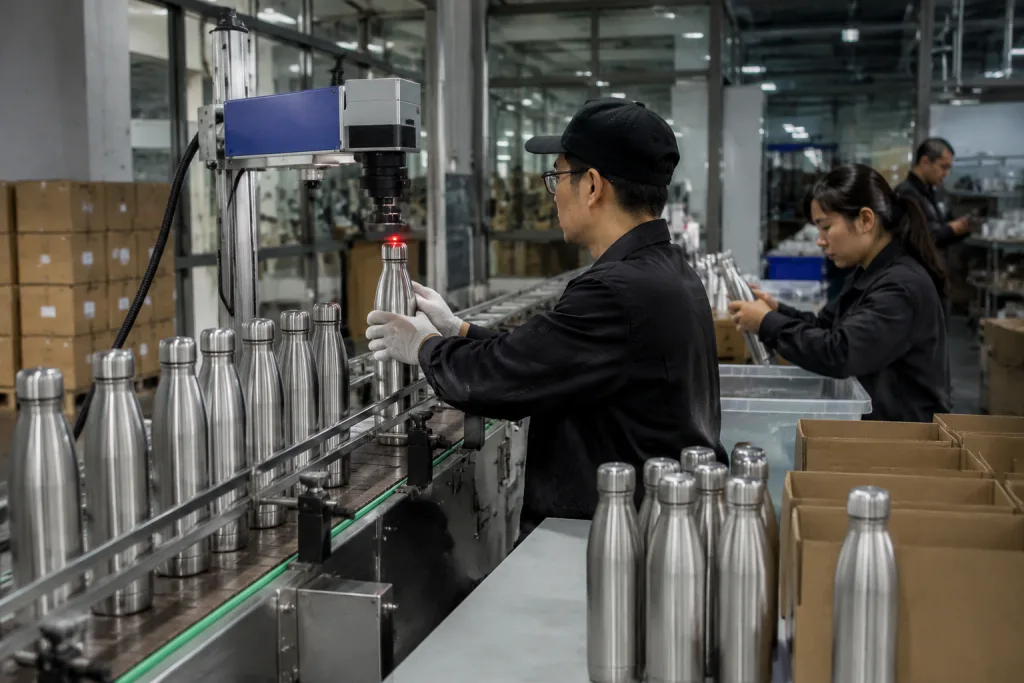
For logo methods, match the process to the surface. Silkscreen works on flat, bold logos. Laser engraving leaves a permanent mark on metal, and QC pulled the sample at 0.3 mm depth because the mark was too shallow. Full-wrap printing can turn a plain canteen into a stronger retail piece, but only when artwork and color control stay tight. If you need guidance on decoration choice, [silkscreen versus laser engraving](blog/silkscreen-vs-laser-engraving.html) is a sensible comparison point before you lock artwork. The buyer flagged the PMS code once because the file was off by one digit.
Pay for these custom features only when they support the channel:
- Powder coat color: useful for retail segmentation
- Lid style: worth changing if it improves usability or leakage control
- Packaging insert: useful for distributor drinkware and e-commerce
- Gift box: useful for canteen promotional sets
A good canteen supplier will tell you where custom starts to hurt yield. That is not sales talk. It is line reality. The more you alter the bottle, the more tooling, tolerance, and QC pressure you add, and we have seen a 12-day sample lead time turn into 18 days after one lid insert changed by 2 mm. In Zhejiang, the better vendors push back before production starts because they know which details break at volume.
How Should You Check Quality?
Quality checks start before the line runs. A serious reusable water bottle vendor should show incoming material checks, first article inspection, in-line checks, and final random inspection, with the QC desk logging every lot number. Ask straight about AQL 2.5 for major defects and AQL 4.0 for minor defects, or the standard your market uses. If the answer stays fuzzy, the control plan is fuzzy too. We’ve seen that go sideways on a 5000 pcs run when the coating lot passed at arrival and turned patchy after curing in the oven.
For a normal order, we expect these checks on the line:
- Visual inspection: print alignment, scratches, dents, coating haze
- Functional test: leak test with cap torque verification
- Fit check: lid thread match, gasket placement, straw alignment
- Packaging check: barcode, FNSKU, carton drop resistance if relevant
Buyers often skip the carton. Bad move. A clean bottle in a weak mailer still comes back as a claim. For Amazon or retail prep, carton dimensions, inner packing, and label placement matter as much as the bottle. We had one PO where the buyer flagged a 2 mm carton overhang and the whole case pack got reworked on the packing table. That was the right call. If you sell through e-commerce, [Amazon FBA drinkware preparation](blog/amazon-fba-drinkware.html) is worth reviewing before you freeze the pack plan.
Ask the canteen factory for sample retention and defect photo records. A factory that keeps traceable samples settles disputes faster on the second or third order. We keep retained samples for 12 months in the QC cabinet, and QC pulled the sample more than once when a lid mismatch showed up after shipment. We use that record on a 304 stainless program all the time. A one-off shipment is one game. Replenishment is another.
How Do You Compare Vendors?
Do not compare unit price by itself. Compare landed risk. A low quote from a canteen vendor turns expensive fast if the print fails, the lid leaks, or the carton misses a launch by 12 days. Price matters. We run a simple scorecard: product spec match, MOQ, lead time, compliance papers, QC process, and response time.
For a procurement manager, the real question is which canteen distributor or canteen manufacturer ships the same result every time. A distributor model works when you need stock moving this month. A direct canteen factory quote wins when artwork stays fixed, packaging needs control, and volume is high enough to spread tooling cost. We had one buyer flag a PO typo on the carton size, 62 mm instead of 68 mm, and the line caught it before print. The math does not work on price alone.
Use a practical scoring method:
- 10 points: exact match to spec and sample
- 8 points: minor deviations that do not affect function
- 5 points: acceptable but requires rework
- 0 points: cannot support documentation or repeat orders
This is where canteen manufacturers in Zhejiang often pull ahead. We have seen a 12-cavity mold, a 48-hour print setup, and a stable MOQ hold a custom canteen line together without rebuilding the process for each order. QC pulled the sample, checked the lid torque at 0.8 N·m, and the result held. A slightly lower quote from a less organized seller looks good on paper, then goes sideways when the buyer asks for repeat orders.
Send Your Spec, Get A Real Quote
Share capacity, material, logo method, and target market. We will quote MOQ, lead time, and compliance details from our Hangzhou, Zhejiang team.
Frequently asked questions
What is a normal MOQ for a reusable water bottle vendor?
For standard shapes, 3,000 units per SKU is common. If you add custom color, special lid tooling, or premium packaging, 5,000 to 10,000 units is more realistic. Some canteen suppliers quote lower, but the unit price often rises sharply. Ask for MOQ by color and by decoration method, because screen print, laser, and wrap print can each have different minimums. If you need multiple SKUs, make sure the vendor states whether the MOQ is per design or combined across a program.
How long does production usually take in China?
For a standard reusable water bottle order, plan on 25 to 35 days after sample approval and deposit. If you need custom tooling, matching PMS colors, or special packaging, 35 to 50 days is normal. Zhejiang factories with stable lines can often hold the schedule better than smaller workshops because they have more consistent capacity. Always confirm whether lead time starts from artwork approval, pre-production sample approval, or deposit receipt. That detail changes the calendar more than people expect.
Which material should I choose for custom drinkware?
304 stainless steel is the safest default for most B2B drinkware programs. It balances cost, corrosion resistance, and availability. Use 316 only when the application justifies the extra cost, usually 12% to 20% more on material. Tritan is good for clear bottles and lightweight distributor drinkware. Aluminum can work for promotional items, but you need to inspect the liner and coating. For all of them, ask the canteen manufacturer to confirm thickness, grade, and compliance tests before you approve mass production.
What quality checks should I require before shipment?
At minimum, require leak testing, visual inspection, print adhesion review, and carton verification. Many buyers also specify AQL 2.5 for major defects and AQL 4.0 for minor defects. For export, ask for REACH or food-contact documentation depending on market, plus batch traceability. If the order is for e-commerce or retail, confirm barcode or FNSKU placement and carton drop testing. A good canteen factory should be able to show inspection photos and retain a sample from the approved batch.
Can a canteen promotional order still be customized well?
Yes, if you keep the base model simple. A canteen promotional order works best when you customize logo, color, and packaging rather than rebuilding the bottle from scratch. That keeps MOQ lower and reduces sampling risk. For example, you can often hold the order at 3,000 units if you use one body shape and one lid. If you want a fully customized canteen with special mold work, budget for a higher MOQ and a longer schedule. The more changes you make, the more you need a disciplined reusable water bottle vendor.