Key Takeaways
- A realistic MOQ for custom reusable bottles is often 500-1,000 units, not 100 units, if you want stable pricing and color matching.
- Most buyers lose margin on decoration, not bottle bodies; laser engraving, silkscreen, and wrap print can change unit cost by 8-25%.
- For Europe and North America, ask for REACH, LFGB, FDA, and if needed ASTM documentation before you approve production.
- A supplier with 25-35 day lead times and 300,000 units/month is easier to scale with than a small canteen vendor that cannot hold calendar commitments.
If you are sourcing reusable water bottle suppliers, finding a factory is the easy part. China has plenty, and Zhejiang alone can send a quote the same day. The real job is sorting a supplier that holds spec from one that trims wall thickness, cap fit, or print after sample sign-off. We have seen that go sideways fast. A 0.3 mm wall change shows up on the line, and the buyer flags it before shipment.
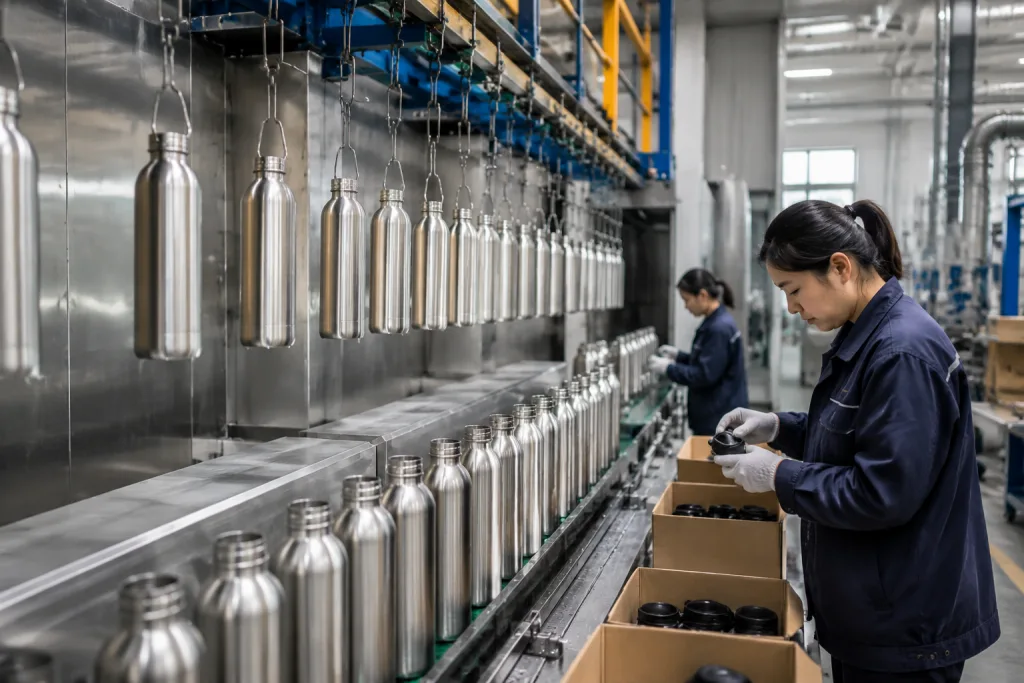
You need a buying filter, not a sales deck. Start with the basics: which material fits the channel, what MOQ you can move, whether the factory knows Europe and North America compliance, and how far you can push customization before the unit price breaks. At BottleForge in Hangzhou, Zhejiang, we run 300,000 units per month across common bottle lines, and standard custom lead times sit at 25-35 days depending on decoration and packaging. QC pulled the sample on a 28 mm cap last week and caught a torque miss; that is the kind of detail that keeps a PO from turning into a claim. Scale matters here. The math does not work any other way.
Start with the sales channel
Start with where the bottle sells. A canteen for a German retail chain is a different job from a US gym distributor program or a trade-show giveaway. The channel drives material, closure, finish, carton count, and whether the print stays quiet or goes loud.
If the sale runs through distributors, the bottle has to survive mixed orders and fast replenishment. We run that setup every week on the line. One shape. One or two lids. Decoration that repeats cleanly without retooling pain. MOQ 3,000 pcs is a normal start here, not a shock. A national promo can push for a lower piece price, while a premium shelf bottle can carry better finishing. The buyer once flagged “matte” on a PO where the art file said “metallic”; QC pulled the sample back to the laser table and the whole batch waited 2 days. The math matters.
Do not make the first step harder than it is. Pick the channel, set the target retail price or wholesale price, then work backward. A $2.20 FOB bottle can pass in one market and fail in another. We have seen a $0.08 cap upgrade save a shipment because the retailer wanted a cleaner shelf read. That is the real test. If the buyer wants distributor packaging, retail hangtags, or FNSKU labeling, say it at the start, not after sample approval.
Choose the right material first
The first mistake new buyers make is treating every reusable bottle as the same part. It is not. Stainless steel, Tritan, aluminum-lined canteens, borosilicate glass, and rPET each solve a different job. For a commuter bottle, stainless steel is the line we run. For a clear bottle with lower weight, Tritan or another BPA-free copolyester sells easier. For an outdoor canteen or a military-style spec, aluminum or steel usually beats plastic. If the buyer keeps pushing only on capacity, that is the wrong question to ask.
Ask the factory for wall thickness, not just volume. A 500 ml stainless bottle at 0.4 mm is a different product from a 0.6 mm body, and we have seen buyers miss that on the PO twice. That 0.2 mm changes dent resistance, thermal hold, and cost. For a custom growler, we usually quote heavier-gauge stainless with a leakproof threaded cap and silicone seal. For retail beverage programs, a cleaner finish and lighter weight often matter more than brute strength. QC pulled the sample and found the cap torque was off by 1.5 N·m, so the buyer flagged it before shipment.
- Stainless steel: best for durability, insulation, and premium custom drinkware.
- Tritan: best for clarity, lighter freight, and lower condensation risk.
- Glass: best for clean taste, but brittle and packaging-heavy.
- Aluminum: useful for classic canteen custom projects, but lining and coating quality must be checked.
For Europe, ask for REACH compliance where applicable and material declarations. For North America, ask for FDA food contact statements and test reports tied to the exact resin or steel grade. A canteen factory in China that cannot name the grade or coating spec is not ready for a serious order. We ship fewer surprises when the paperwork matches the line, and that starts with the material file, not the sales sample.
Decide how you will decorate
Decoration is where budgets slip. A blank bottle is simple. Add exact PMS color, a wrap print, laser logo, and a gift box, and the cost stack changes fast once we run the line. Pick the method from the artwork, the run size, and the abuse the bottle will take after it ships.
Silkscreen is cheap for one- or two-color logos and works on a flat panel. Laser engraving holds up on 304 stainless, but you get no color. Heat transfer and full-wrap printing make a customized drinkware item look retail-ready, yet they add labor and scrap risk. We had one buyer push back on a $0.18 print upgrade, then the sample failed the rub test at 200 cycles. For canteen promotional programs, a single-color print is enough because the buyer cares about price and turnaround, not a fancy finish. For retail or corporate gifting, the look can justify an extra $0.35 to $1.20 per piece. We've seen this go sideways when someone tries to save $0.12 on decoration and then asks for a showroom result.
Rule of thumb: if the artwork needs photographic detail, do not put it on a process built for simple logos. If the order is under 1,000 units, stay away from decoration setups that punish every changeover.
Ask your canteen vendor to confirm the decoration area in millimeters, not vague “logo position” language. A 30 x 50 mm print zone can be tight for distributor canteen programs where the brand has to read from 2 meters away. Ask for adhesion tests, abrasion tests, and dishwasher cycles if the bottle is going into retail. QC pulled the sample once and the edge lift showed up after 50 cycles; the buyer flagged it on the PO because “logo fade” was typed as “loog fade.” If the supplier cannot tell you how the finish behaves after 50 dishwasher cycles, you are buying hope, not product.
Check compliance before samples
Compliance is not paperwork you leave for later. It decides what clears customs, how you label the bottle, and whether a marketplace audit kills the listing. For reusable water bottle suppliers, the first check is material compliance, food-contact testing, and batch records that trace back to one coil or one resin lot. If the bottle is insulated, ask for the vacuum retention claim and the exact test method, ISO or ASTM. QC pulled a sample at 23:00 on the line last month and found cap torque drift of 0.2 mm. Small gap. Big problem.
For Europe, REACH and food-contact proof matter. For North America, buyers ask for FDA-related declarations, California Proposition 65 where it applies, and the lab report your channel needs. If the bottle goes through Amazon, FNSKU labeling, carton marks, and pack-out strength matter too. We saw a PO typo turn “24 pcs/carton” into “240 pcs/carton”; the buyer flagged it before shipment, and that saved a mess. A canteen manufacturers list is easy to print. Real documents are harder, and that is the whole point of asking early.
Good factories in China do not get defensive when you ask for AQL inspection criteria, usually AQL 2.5 for major defects and 4.0 for minor defects on standard consumer goods, unless your brand contract sets tighter limits. They should show raw material lot numbers, the coating line used, and the QC checks for cap torque, seal integrity, and leak testing. We run a 12-day sample loop when the buyer wants a new lid, and it usually beats an 18-day fire drill after the PO is signed. A bottle can look fine in photos and still fail if the closure tolerance is off by 0.2 mm. This is the wrong question to ask after samples arrive.
Price the real landed cost
FOB is only the first line in the spreadsheet. Landed cost is what finance signs off on, and it changes the answer fast. We once saw a stainless bottle quoted at $2.10 FOB Ningbo land at $3.40 after freight, duty, inner box, testing, and retailer packaging. That gap is real. If you compare two canteen suppliers on unit price alone, you will pick the wrong line.
Ask for a full quote split into bottle body, lid, printing, packaging, carton, and any special inserts. On a recent 50,000-piece order, a $0.08 cap change moved the total by $4,000 before freight. For custom growler programs, a heavier pack can add 15-30% to ocean freight versus a lighter customizable growler spec. The buyer flagged it, and the math did not work. We run that check before the sample even hits the tape measure.
Watch sample and tooling charges. A new mold can run $3,000-$15,000 depending on complexity, but a lot of projects do not need new tooling if you pick from existing bottle profiles in a canteen factory catalog. QC pulled the sample last week and found a 1.2 mm wall variation, which would have turned into complaints after shipment. If you need a PMS match or a special coating, ask for the Delta E 2.0 number in writing. Cheap quotes often hide loose tolerance language, and that turns into rejected stock.
China is competitive because the supply chain is dense, especially in Zhejiang, but density only helps when every quote uses the same units and the same Incoterms. We have seen buyers compare one supplier on FOB Ningbo and another on EXW with a 12 kg carton spec, then act surprised when the totals do not line up. This is the wrong question to ask. Compare apples to freight cartons, or the spreadsheet will lie to you.
Use samples to test failure modes
Samples are not souvenirs. They are failure-mode probes. We run them on the bench before the line sees a full order. For a reusable bottle sample, check lid torque with a torque wrench, leak resistance at the cap seam, finish wear, and whether the logo rubs off after 200 cycles of abrasion. On a double-wall insulated model, measure temperature retention with the same fill level and the same room temp every time. If the supplier says 12-hour hot hold or 24-hour cold hold, ask for the actual ambient temp and water fill spec. The math does not work otherwise.
Ergonomics gets people after the photo stage. A bottle can look clean in a render and still miss a car cup holder by 3 mm or sit too tall for a school bag. We ship enough cartons to know this turns into claims. For a customizable canteen line, check whether the cap opens with one hand and whether the carry loop holds repeated loads on a 5 kg pull test. The buyer flagged a handle mold once, and it broke the design fast. This is the wrong question to ask later.
Do not approve samples after one quick look. QC pulled the sample, then we ran a simple checklist: thread alignment, lid seal, print clarity, coating uniformity, carton drop test, and odor test after a hot-water rinse. After that, request a pre-production sample and a golden sample with both stamps on it. On one PO, the buyer typed the carton count as 1200 when they meant 12,000, and that typo would have burned a week. Good supplier talks here are dull. That is the point.
Pick a supplier you can scale with
The right supplier is not the one with the prettiest catalogue. It is the one that can ship the same spec 90 days from now without drama. A serious reusable water bottle supplier should show monthly capacity, mold changeover time, QC checkpoints, and which parts we make in-house. If they dodge that, you are buying from a trader, not a factory. We see it on the line.
Look for signs the line is under control: BSCI audits if your customer asks for them, in-house leak testing, a sample approval flow, and a production plan that still holds when you add one more color. QC pulled a lid sample with a 0.3 mm gap last week, and that kind of miss turns into a claim later. A Zhejiang factory should tell you where the lids come from, how it holds coating thickness, and whether the line can run canteen customized jobs beside standard SKUs. The math does not work if you plan to move from 5,000 pieces to 50,000 pieces and the supplier starts learning on your order.
For distributors, the better partner is usually the one that can handle reorders, packing changes, and mixed-warehouse shipping. For brands, it is the one that keeps finish stable and lead time steady. For private label, it is the one that treats your custom drinkware as repeat work, not a one-off. We had a PO last month with one typo on the carton mark, and the buyer flagged it before loading. Small stuff matters. In China, there are plenty of sellers. Fewer run like a real canteen factory with export discipline, and you see that the moment the PO gets large.
Ask one question before you place the order: if I need 20 percent more volume next quarter, what breaks first? If the answer is vague, walk away. A sample box logo does not ship containers.
Request a practical quote, not a brochure
Send your target price, capacity, and market. We’ll return a spec-driven quote with MOQ, lead time, and compliance details.
Frequently asked questions
What MOQ should I expect from reusable water bottle suppliers?
For standard reusable bottles, a realistic MOQ is usually 500-1,000 units per color or per SKU. For custom canteen projects with special lids or coated finishes, the MOQ can move to 1,000-3,000 units. If a factory offers 100 pieces with full customization, the unit cost usually climbs fast because setup, print, and packing labor get spread over too few units. In Zhejiang and across China, the factories with better pricing discipline usually prefer repeatable orders over tiny experimental runs. Ask whether the MOQ is per design, per color, or per carton configuration, because that detail changes the real commitment.
How long does production usually take for custom drinkware?
Standard lead time is commonly 25-35 days after sample approval and deposit for common custom drinkware. If you need a new mold, a special coating, or complex packaging, allow 40-55 days. For a simple custom drinkware reorder from an existing bottle shape, 20-25 days is possible if the factory line is open and the decoration is straightforward. A larger canteen distributor program can also be split into partial shipments, but only if that is agreed before production starts. In China, good factories will give you a schedule by process step, not just one vague completion date.
What documents should I ask for before confirming an order?
At minimum, ask for material declarations, food contact compliance documents, test reports tied to the exact SKU, and a factory profile with audit status if needed. For Europe, REACH-related documents are often requested, and for North America you may need FDA-related declarations plus packaging and labeling support. If you are selling through Amazon or another marketplace, confirm carton specs, case pack, and FNSKU labeling. I also recommend requesting the QC plan, AQL levels, and a pre-production sample sign-off sheet. A proper reusable water bottle supplier in China should be able to provide these without delay.
Is laser engraving better than screen printing?
Not always. Laser engraving is durable and sharp on stainless steel, so it works well for premium custom drinkware, corporate gifts, and products that will see heavy handling. Screen printing is usually cheaper and better if you need color, especially one or two solid PMS tones. For a 1,000-unit order, the price gap can be meaningful: laser may add $0.10-$0.35 per piece depending on complexity, while silkscreen may stay lower unless you add multiple colors or wrap positions. If the product is a canteen promotional item, screen printing often makes more commercial sense. If it is a long-life retail item, laser is often the safer finish.
How do I compare two canteen manufacturers fairly?
Use the same quote sheet for both sides. Compare material grade, wall thickness, lid type, decoration method, packaging, lead time, MOQ, and compliance docs. A canteen manufacturer quoting $1.95 FOB with a basic box may not be cheaper than one quoting $2.20 FOB with better packing and test reports. Also compare defect policy: ask what AQL level they use and whether they replace leaking units or credit them. For distributor drinkware programs, consistency matters more than the lowest price. A supplier in Zhejiang or elsewhere in China that can repeat the same spec on reorder is usually worth more than a lower first quote.