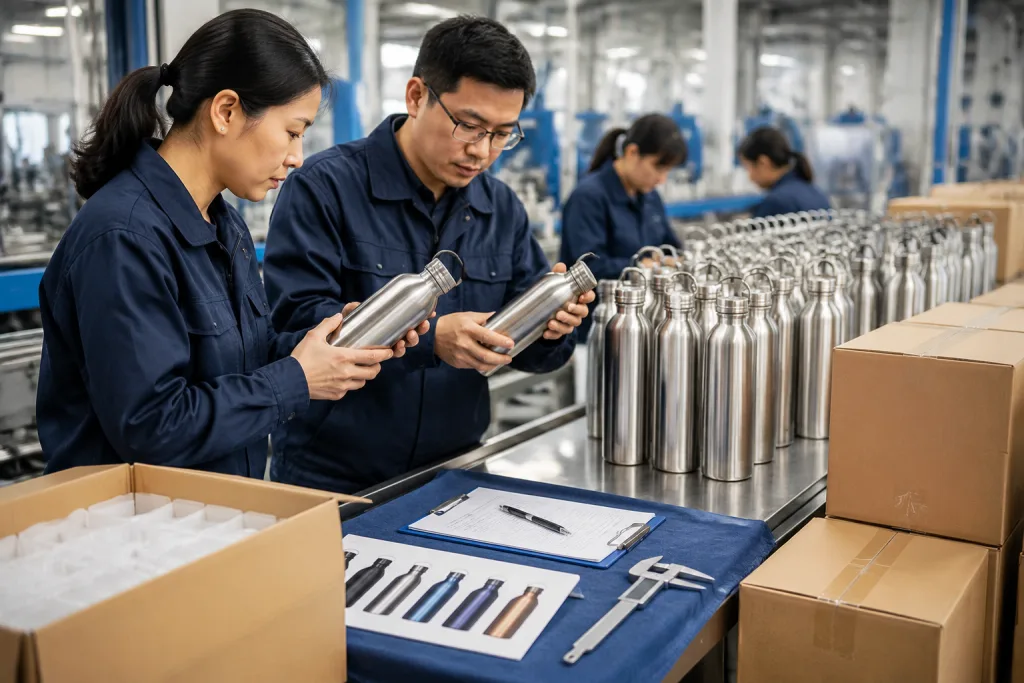
Key Takeaways
- For reusable water bottle promotional orders, set MOQ at 300-1,000 pcs per SKU and confirm lead time at 20-35 days before art approval.
- A 0.6 mm 304 stainless wall is usually the lower limit for stable canteen promotional quality; below that, dent risk rises fast.
- Ask for AQL 2.5 major and 4.0 minor, plus 100% leak testing on lids for any custom canteen shipped by air or retail.
- FOB China pricing for a basic powder-coated 500 ml bottle often lands around USD 2.80-4.20, depending on lid, finish, and print method.
Most reusable water bottle promotional orders go sideways for plain reasons: the wrong cap leaks in transit, a logo prints clean on the sample but turns muddy on 5,000 units, or the carton spec skips retail handling and margin disappears before the goods leave China. We had one PO with “5000PCS” typed as “500OPCS”; the buyer flagged it, and that typo saved a bad run. If you buy custom drinkware for a brand, distributor, or campaign, the job is not picking a nice-looking bottle. It is holding the production risks that show up after PO approval.
We make this custom drinkware in Hangzhou, Zhejiang, and the pattern stays the same on the line. A 2 mm lid gap will fail a drop test fast. Buyers who spec by use case instead of catalog photos get fewer rejects and faster reorders. Buyers who treat canteen custom, custom canteen, or customized drinkware as a price-only buy usually run into leakage tests, decoration breakage, and carton damage. This is the wrong question to ask. Give us a tighter brief, check the lid fit in mm, and QC pulled the sample before mass production; that is how you keep the order on track.
Where the order usually breaks
The first break usually looks simple. The buyer asks for a reusable water bottle promotional program, and the supplier hears “cheap bottle with logo.” That gap turns into bad assumptions fast. We had one PO from a gym chain where the cap had to open with one hand, but nobody wrote that down. Another distributor drinkware run needed mixed cartons, and scuff marks mattered more than a glossy body. A retail canteen customized job goes the same way if hang tags, barcode placement, and master carton strength never get fixed on paper.
In Zhejiang, product definition matters more than the artwork. Lock the bottle body material, lid format, decoration area, and packaging level before sample approval. If not, the factory fills the blanks with whatever is easiest to run on the line. We run 50,000 units a month and still miss the target when the brief is loose. QC pulled a sample at 24 hours and the lid failed the shake test. This is the wrong question to ask: “what color?” Ask what can break.
- Leakage risk: define the lid type and the test method, then confirm it on the sample before mass production.
- Logo risk: define the decoration process and artwork tolerance, because a 1.5 mm shift is enough for the buyer to flag it.
- Transit risk: define carton strength and drop criteria, or the master carton will collapse on the first rough unload.
Material choices that dent fast
Material is where a supplier saves 0.20 USD and leaves you the problem. We have seen that on the line. For reusable water bottle promotional work in 304 stainless, that grade is still the baseline we ship. On a vacuum bottle, the inner wall usually sits at 0.35-0.45 mm and the outer wall at 0.35-0.45 mm; that setup keeps the shell from oil-canning when the buyer drops a carton from 80 cm. For non-vacuum single-wall canteen promotional items, 0.6 mm is the floor if you want the body to stay stiff. Anything thinner dents fast. The math does not work, and buyers learn that after the first dented carton.
Plastic custom drinkware has its own trap. Tritan and copolyester can look clean, but only when the resin grade is stable and the mold polish is right. We had a buyer flag a cloudy batch after QC pulled the sample at 3,000 cycles on the dishwasher rack tester. Cheap plastic usually shows flow lines, stress whitening, or flavor retention after a few uses. For Europe or North America, ask for REACH and FDA-related material declarations where they apply, and add an odor test if the bottle touches beverage directly. "Food grade" by itself is weak. In Zhejiang, a solid factory will show resin traceability and batch IDs; a weak one just waves a showroom sample and hopes you do not ask for the lot card.
For a custom canteen or customizable canteen with powder coating, check film thickness too. 40-60 micron is normal. Below that, edge wear shows up early. Above that, you can get brittle cracking if the base prep is poor. We run a mil gauge on incoming parts for a reason, and we've seen a 15 micron miss turn into rust at the rim after a short export trial. That is the wrong question to ask: not whether the coating looks nice on day one, but whether it survives the first 12 days in a carton and the first scratch on the cap ring.
Lids fail before bodies do
Most complaints start at the cap. We had one run where the bottle body passed drop testing, but the lid popped in transit because the seal land was 0.3 mm off and the thread finish never got locked down. For a reusable water bottle promotional order, do not sign off on a lid by looks alone. Ask for torque checks, open-close cycle counts, and a 100% leak test on the filling line. A flip lid or straw lid needs thermal cycling too. Room temp is not enough.
If you are buying custom growler formats, the closure gets touchier. QC pulled one sample with a weak gasket, and it seeped after a 10 kPa pressure swing; the first sign was a wet carton, not a buyer email. For canteen distributors, we run 2 lid families max. More lid types mean more spare parts, more packing slips with the wrong code, and more QC confusion. The math does not work when someone asks, "can we add one more cap style?" Keep the lid spec tight: thread size, gasket material, BPA-free declaration if relevant, and whether replacement lids fit across SKUs. That is how we keep distributor canteen inventory under control.
“A bottle body with a bad lid is not a bottle problem. It is a specification problem.”
Decoration that looks good and ships badly
Decoration failures get expensive fast. The first carton opens, and the crooked logo is staring back at you. On reusable water bottle promotional runs, screen printing still works for flat logos and solid color blocks, but the jig has to hold the bottle within 1 mm and the ink cure has to land at the right temperature. Laser engraving holds up better on stainless, so we run it on bottles that go in bags and get washed hard. UV print and full-color wrap graphics look sharp when the brand wants dense color, but the adhesion test and carton pack-out need tight control. We saw one run go sideways on a 24-hour shift.
Do not let the vendor pick the decoration method after sampling. Put it on the PO. We had a buyer flag “laser or silk print” on one order, and the line stopped while we cleared the artwork. That typo cost 2 days. A canteen vendor that can do silkscreen, laser, and heat transfer helps, but only if the method matches the design. For a 500 ml stainless bottle, laser engraving usually adds about USD 0.30-0.80 per unit depending on area and setup. Multi-color print can add USD 0.20-0.60. If your margin is tight, one color may be the only number that works. The math does not work any other way. This is the wrong question to ask: not “what looks nice,” but “what ships the same way on run 1 and run 20.”
For customizable drinkware or customized canteen runs, ask for an approved decoration proof on the actual substrate, not on paper. QC pulled the sample once and the print shifted on matte lacquer by 2 mm after cure; the paper proof had looked perfect. Metal, powder coat, and matte lacquer do not behave like a flat print sheet. We ship this every week, and paper proofing still lies.
Packaging is part of the product
Buyers call packaging an afterthought, then the damage claim shows up. On reusable water bottle promotional shipments, the bottle still has to pass a 1.2 m drop test, survive carton stacking, and make the handoff from our line to the warehouse without scuffing. We run a 24-bottle trial, QC pulled one sample, and we check the cap ring for rub marks after the first pallet wrap. If the goods go to FBA, we build in individual polybags, suffocation warnings, and FNSKU labels. For a distributor, carton spec is the real call: 5-ply or 7-ply, stack strength, and whether the divider keeps the cap from scuffing. One buyer flagged a dent. He was right.
A factory that knows the job asks where the goods land before it talks packaging. That is the correct order. A gift box can look premium, then add 18-30% to freight when carton volume jumps, and we have seen that go sideways on a small PO with 600 units. A plain kraft box cuts cost, then misses the shelf if the program needs retail presence. We quote it as one package system in Hangzhou: inner box, master carton, 600 mm drop target, and label format. Ask for ISTA-style handling assumptions if the shipment is sensitive, especially for glass or custom growler formats. The math does not work any other way.
- Retail: hang tag, barcode, display-ready carton.
- FBA: FNSKU, polybag, carton label, carton count.
- Bulk distributor: divider, stacking, pallet spec.
QC numbers you should demand
If a supplier cannot speak in numbers, they are not ready for B2B work. For reusable water bottle promotional orders, we ask for incoming inspection, in-process checks, and final inspection by AQL. A normal setup is AQL 2.5 for major defects and 4.0 for minor defects. QC pulled the sample on the line, and that is where the leak showed up. Leak testing should be 100% at assembly, especially for vacuum bottles, canteen promotional SKUs, and any lid with a straw or flip mechanism.
The numbers that matter are not brochure claims. A standard custom drinkware order usually runs 20-35 days after sample approval and deposit. On one Zhejiang line, we ship 200,000 to 400,000 units per month across multiple machines, but that means little if one artwork round burns 12 days before release. This is the wrong question to ask: how nice the render looks. Give us the dimensional tolerance, logo position, and color Delta E before mass production starts. If you need corporate colors, send a Pantone reference and a signed pre-production sample. We have seen this go sideways when the buyer flagged a 1.5 mm logo shift only after packing started.
Final inspection should check carton count, label accuracy, accessory count, and cap fit. We once found a PO typo that turned 1,200 lids into 12,000 on the packing list, and the math did not work. The cheapest loss is not a dented bottle; it is a mispacked carton that becomes a claims file later.
Choosing the right factory partner
For B2B buyers, “supplier” is too loose. You need a canteen partner that runs like a factory, with molding, forming, coating, printing, assembly, and packing under one roof or one export desk. If a canteen vendor outsources half the job, one spec change can eat a day on the line. We run that math every week, and it breaks fast.
When you compare canteen distributors and canteen manufacturers, check response speed, sample discipline, and how they handle corrective action. Can they revise the spec sheet in 1 day? Do they keep a signed sample as the golden reference? Do they write down root cause when a lid leaks, or do they just say “next batch will be better”? We’ve seen that go sideways. A buyer once flagged a 0.5 mm cap gap, and QC pulled the sample before the line kept running. For distributor drinkware, this matters even more because the same SKU may ship under 3 brand names, 2 pack formats, and different regions. A good partner holds the bottle spec steady and changes only the branding and pack-out.
Ask for factory photos, machine list, test equipment, and compliance docs such as BSCI, REACH, and any relevant ISO records. A real canteen factory in Zhejiang should show those without drama. If they dodge the caliper, the oven test, or the torque meter, the math does not work.
Spec your bottle order before production starts
Send the target capacity, lid style, logo file, and destination market. We will turn it into a factory-ready spec for China production and QC.
Frequently asked questions
What is a realistic MOQ for reusable water bottle promotional orders?
For most reusable water bottle promotional projects, a realistic MOQ is 300-1,000 pcs per color or SKU. For custom canteen orders with a new mold or special lid, the MOQ often moves to 3,000 pcs or more. If you want mixed printing or multiple Pantone colors, expect separate MOQ per decoration setup. In practice, a factory in Zhejiang can sometimes support lower trial quantities, but the unit cost will rise by 15-30%. If you are testing a distributor drinkware program, start with one body style and two logo variants rather than spreading volume across too many SKUs.
How much should a customized drinkware bottle cost FOB China?
A basic stainless reusable water bottle promotional item with powder coating and one-color logo often lands around USD 2.80-4.20 FOB China, depending on capacity, lid type, and print method. A vacuum insulated custom canteen with better packaging and a premium lid can move to USD 4.50-7.50. Laser engraving usually adds less than full-color print, while gift boxing adds freight cost. The number that matters is landed cost, not just factory quote. If you are buying from China for North America or Europe, ask for separate pricing on product, packaging, and carton labels so you can see where the cost is coming from.
Which decoration method lasts longest on stainless bottles?
Laser engraving is usually the most durable on stainless custom drinkware because it removes the coating instead of sitting on top of it. On powder-coated bottles, laser can expose the metal cleanly and survive repeated handling better than standard screen print. If you need color, screen printing or UV print can work, but the cure and adhesion need proper checks. For a canteen customized order meant for daily use, insist on abrasion testing and a sample rub test before mass production. On a normal program, a good factory should show you at least one decorated sample that has already passed basic wear checks.
What QC documents should I ask for before shipment?
Ask for a pre-production sample approval sheet, inline inspection records, final inspection report, and photos of carton packing. For reusable water bottle promotional shipments, request AQL 2.5 major and 4.0 minor if that is your acceptance level. Also ask for leak test records, especially if the lid is a flip cap or straw cap. If the goods are going to retail or FBA, get the carton labels, FNSKU placement, and any polybag warning proof before dispatch. A serious canteen manufacturer in China should also be willing to share compliance declarations for REACH or food-contact material requirements where relevant.
How long does production usually take in Zhejiang or elsewhere in China?
For a standard reusable water bottle promotional order, production usually takes 20-35 days after sample approval and deposit. If the order includes a new mold, unusual lid, or heavy packaging customization, plan for 35-50 days. In Zhejiang, good factories may keep stock materials and decoration capacity ready, which helps with urgent orders, but you still need time for proofing and final QC. Shipping time is separate. Sea freight to Europe or North America adds roughly 20-40 days depending on the port and route. If your campaign date is fixed, build the schedule backward and lock artwork early.