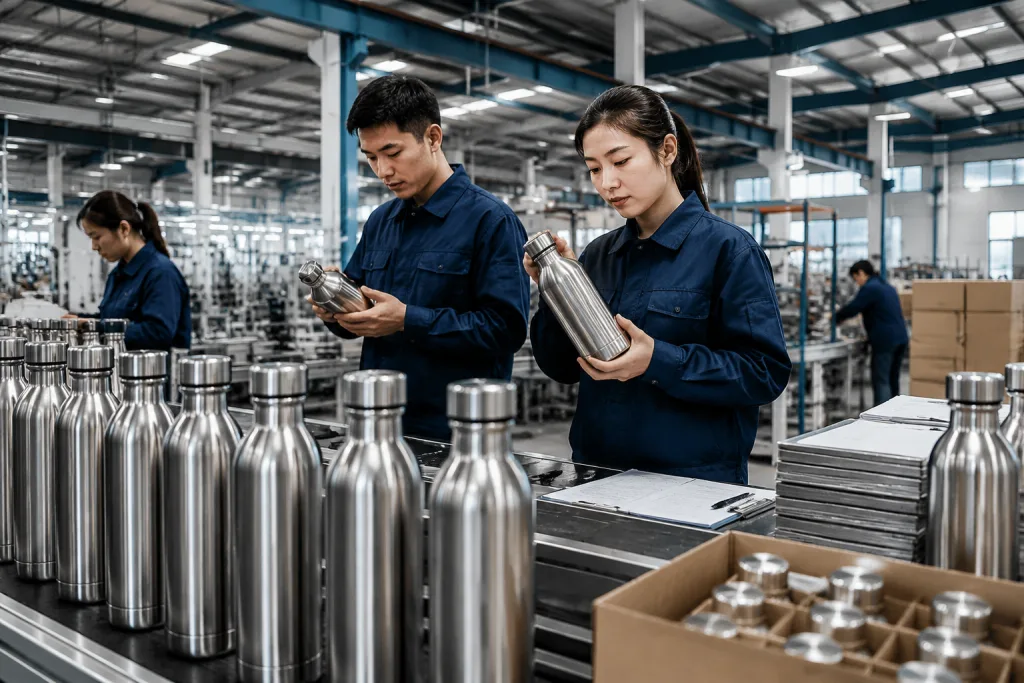
Key Takeaways
- Wall thickness directly impacts durability and price; a 0.4mm difference can alter unit cost by 15-20%.
- MOQ for custom canteens typically starts at 1,000-3,000 units for standard colors, but 5,000+ for custom Pantone matching.
- Lead times in Zhejiang average 35-45 days, but complex customized drinkware with powder coating requires 55+ days.
- AQL 2.5 is the standard inspection threshold for structural defects in B2B drinkware orders.
- Tooling costs for a custom canteen shape range from $3,000 to $12,000 depending on complexity.
You have probably already opened 20 spreadsheets, with wall thickness, lid fit, and print limits lined up side by side. Finding a reusable water bottle manufacturer gets messy fast. The buyer flags one sample at 0.8 mm, the next factory sends a polished PDF, and the problem only shows up when we run 5,000 pcs and the cap leaks. Simple as that.
This guide stays spec-first. We compare factory capability against the job, from promo canteens to custom growlers, and we use production numbers from our Hangzhou shop floor where QC pulled the sample and checked the neck finish with a caliper. This is the right question to ask. Not whether a supplier sounds confident on Alibaba.
Spec Head-to-Head: Stainless Steel vs. Tritan vs. Aluminum
Picking the material is the first gate for a canteen manufacturer. Use case sets the spec, and the spec decides line speed, tooling, and what the quote can honestly carry. On the shop floor, that starts with the first sample and the first caliper read. We run this check before anyone talks glossy finish.
18/8 Stainless Steel (304 Grade): This is the usual call for a reusable water bottle manufacturer selling to outdoor and premium buyers. It holds temperature, takes a beating, and runs clean on a vacuum line. In our Hangzhou plant, we run double-wall bottles at 0.5mm to 0.8mm wall thickness. One buyer pushed for a rock-bottom price, and QC pulled the sample at 0.4mm after a dent test with a rubber mallet. The math doesn't work at that thickness; the bottle saves cents and comes back looking tired after one drop. We've seen that go sideways fast.
Tritan (Plastic): For a canteen promotional product where unit cost runs the show, Tritan is the common pick. It is BPA-free and clear. The buyer flagged one PO because it said "Tritan-like" instead of Eastman Tritan, and that typo would have turned into a claim later. A canteen supplier should confirm the resin source, because generic copolyester and Eastman grade do not behave the same in drop tests or on the polish line. MOQ usually starts at 500-1,000 units. We had one batch come back with a haze issue after the dishwasher cycle at 65°C. The line did not like that.
Aluminum: We used to see more of it. Not much now for hot-liquid drinkware, because the inner lining has to do a lot of work and the line gets fussy fast. If you source aluminum, check the food-grade coating and ask for a crack test after thermal cycling at 70°C. Aluminum is light, but it moves heat fast, so this is the wrong question to ask if the buyer wants insulation. A 0.25mm liner defect can turn into a leak claim. We have shipped that lesson before.
Material Comparison Matrix
- Impact Resistance: Tritan > Stainless Steel > Aluminum
- Insulation (Hot/Cold Retention): Stainless Steel (Vacuum) > Aluminum > Tritan
- Cost per Unit (1000 pcs): Tritan ($1.50-$3.00) < Aluminum ($2.00-$4.00) < Stainless Steel ($3.50-$8.00)
Defining Your Canteen Custom Decoration Limits
Custom canteen work starts with three buckets: decoration, finish, or tooling. Buyers mix them up all the time. Last month a PO said “custom color,” but the sample was a stock body with a logo, and the math did not work. We run into this on the line at least once a week.
Level 1: Decoration Only. You pick an existing bottle shape and add a logo. Fast. That is the right fit for a canteen vendor running a 500-unit test order. Silk screen or laser engraving adds 2-3 days on our line. Print space is the hard stop. On a standard 500ml cylinder, the wrap area is about 200mm x 100mm. If the buyer wants edge-to-edge coverage, we move to UV printing, and that adds about $0.30-$0.50 per unit. QC pulled one sample last week because the PO typo said 200 x 10 mm; the buyer flagged it before we ran the batch.
Level 2: Custom Finish. This means powder coating or hydro-dipping. A matte powder coat looks clean, but it needs an extra curing oven pass. That adds 7-10 days to lead time. The wrong question is whether the color is “close enough”; adhesion is the issue. If pre-treatment misses the acid wash, the coat chips on the first drop test. We reject about 2% of powder-coated units during QC for pinholes, dust marks, or thin edges. One 18kg rack load came back with scuffs near the base ring, so we stopped the line and reset the spray gun.
Level 3: Custom Tooling. This is for a brand that wants a new silhouette, not just a new surface. A new mold for a customized growler or bottle takes 30-45 days, and the tooling fee is a one-time charge. We usually ask for 50% on the mold before sampling starts. Put mold ownership in the contract. If you paid for it, you own it. Then you can move it to another reusable water bottle manufacturer if the deal goes sideways. We have seen buyers lose leverage because the PO left that line blank, and nobody wants to argue over a mold after 2 rounds of samples.
MOQ Realities: What a Canteen Factory Actually Needs
MOQ is not a sales trick. It comes from the line. Stainless steel tubes are bought by tonnage, and our buyer does not get a clean price on 300 kg of raw tube. We run the numbers on every coil.
For a standard 500ml vacuum flask, our MOQ is 1,000 units per color. If a distributor is testing a new SKU, we sometimes cut it to 500 units, but the price usually climbs 10-15%. Last month QC pulled the first sample on a 500-unit run and the scrap rate was already up because the press line had to stop, clear, and restart. That is the real cost.
For customized canteen orders with a specific Pantone color, MOQ moves to 3,000-5,000 units. Powder coating guns and spray booths need a full cleanout before the next shade goes on, and that changeover takes the same setup time whether we paint 500 bottles or 5,000. A buyer once flagged a PO asking for two colors in one 800-unit lot; the math does not work, and if the factory forces it, you get color bleed or mixed cartons. We have seen that go sideways.
Pro Tip: If your volume is low, ask the canteen vendor for their 'stock color' chart. Using an existing inventory color removes the MOQ penalty entirely.
Top 5 Use-Case Fits for B2B Drinkware Buyers
Not every bottle fits every buyer. We say that on day one. A reusable water bottle manufacturer should be judged by what it runs well on the line, not by a shiny catalog page. In Zhejiang, we sort orders by use case, carton count, and how fast QC catches a bad finish before it leaves the packing table.
1. Corporate Gifting (Best Fit: Vacuum Flask with Laser Logo): This one has to ride in an office bag and still look clean at handoff. A dented flask sends the wrong message. We run 18/8 stainless steel with a 0.6mm wall thickness, and laser engraving stays sharp after repeated handling. MOQ is usually 100-500 units; one buyer pushed for 80 pieces, and the setup fee plus packing loss made that a bad run.
2. Outdoor Retail (Best Fit: Wide-Mouth Canteen): Outdoor shops buy for abuse, not display. A wide mouth takes ice cubes and makes washing easier after a muddy trip, which is the point. We specify BPA-free lids with loop caps and test a 1 meter drop in-house on a concrete block. QC pulled the sample after the cap hinge showed a hairline crack on the 3rd drop.
3. Gym & Fitness (Best Fit: Tritan Sports Bottle): Gym buyers want light weight, a clear body, and a price that still leaves room for retail margin. Single-wall Tritan is the clean fit. We can pack 4 colors per carton, and that mix-color request solves the shelf problem without forcing a big SKU count. One buyer asked for a “premium” look on a sub-$2 target; the math doesn't work.
4. Craft Beer & Beverages (Best Fit: Custom Growler): A growler lives or dies on the lid. Standard screw caps leak carbonation, so we use pressure-sealing lids and check the neck finish against the threading gauge. A 64oz growler should hold carbonation for at least 24 hours, and we test that with seal checks before shipment. The buyer flagged a PO typo on the finish code once; one wrong digit can stall the whole run.
5. Eco-Conscious Retail (Best Fit: Recycled Stainless Steel): This niche keeps growing, especially for Europe. Recycled stainless steel, often called 'RVS' or 'Eco-Steel', cuts carbon footprint claims and gives the sales team a cleaner story. It costs about 20% more than virgin material, and we have seen that premium hold up when the buyer has to pass claim checks. A 304 stainless comparison at the sample stage usually settles the argument fast.
Quality Control Standards You Should Enforce
A canteen factory is only as good as its reject rate. Put the standard in writing, or the line ships whatever passes one inspector’s eye. We set the bar on paper. No guessing.
The baseline we run is AQL 2.5 (Acceptable Quality Limit). From a random lot, zero critical defects are allowed, 2.5% major defects cover leak risk and function failures, and 4.0% minor defects cover scratches or print marks. On a 5,000-piece run, QC pulled the sample before carton sealing, and the buyer flagged one dented cup base. That is the moment to catch it.
For a canteen manufacturer in China, ask for a Third-Party Inspection (TPI) report. Factory QC photos are not enough; we have seen that go sideways on a 12-day shipment window. Common failures from weaker canteen manufacturers include:
- Vacuum Loss: The insulation layer loses vacuum and the bottle sweats. Test with boiling water, then check the outer wall by hand after 10 minutes.
- Odor Retention: Low-grade plastic lids hold a chemical smell. Ask for food-grade PP material proof, such as FDA or LFGB.
- Coating Adhesion: Run the Cross-Hatch Test on powder coating. If squares lift cleanly, the pre-treatment missed the mark.
In our Hangzhou facility, we run 100% vacuum testing on insulated bottles before they leave the line. Every bottle gets checked. A buyer once sent a PO with "vacume" typed in the spec column; we fixed it before production, because the math does not work if you skip the basics. A reliable reusable water bottle manufacturer should show the test method, the pass limit, and the inspection record.
Logistics: FOB, CIF, and DDP Explained
The quote from a canteen supplier is not your landed cost. Buyers miss that line item all the time, and the math falls apart once a 40HQ hits the freight bill. We had one PO with “Shanghi” typed instead of Shanghai, and that small typo pushed the booking window by 3 days.
FOB (Free on Board): This is the usual move. The reusable water bottle manufacturer pays to the port of origin, such as Shanghai or Ningbo, then you take over ocean freight, insurance, and import duty. You control the carrier and the sailing, which matters when the buyer flagged a bad vessel and we had to rebook before the line loaded.
CIF (Cost, Insurance, and Freight): The canteen factory ships to your destination port and rolls freight into the price. It looks simple. We have seen this go sideways when the factory padded the freight line by $600 or booked the slowest vessel because the margin sat there on the quote.
DDP (Delivered Duty Paid): The factory sends goods to your door with duty covered. That works for small canteen vendors without a freight forwarder. The price is higher for a reason: customs work, tax filing, and last-mile handoff all land on the factory, and the broker has to clear the cargo cleanly.
For a 5,000-piece customized canteen order, FOB Ningbo to Los Angeles usually runs 20-30 days on the water, then 5-7 days for customs. We still tell buyers to keep a 2-week buffer. August to October gets tight fast, and QC pulled a sample with a late carton mark on one rush job because the PO typo pushed the booking by 3 days.
Verifying a Reusable Water Bottle Manufacturer
Before you wire a deposit, check the factory. A glossy site is easy to print. The line is not.
Ask for a live video walk-through. We want the TIG welding station on vacuum flasks, the lid injection machine, and the QC table with the caliper on it. If the reusable water bottle manufacturer says BSCI or ISO 9001, get the certificate number and verify it on the auditor’s site. We had a PO last quarter with a fake cert typo in the footer, and the numbers did not line up.
Ask for references from buyers in your market, not a vague “global client” line on a brochure. If they dodge that, we have seen it go sideways before. Then order a random unit from current production, not the polished golden sample. QC pulled a shelf sample last month, and the lid torque was 0.8 N·m off.
Get Your Custom Drinkware Project Started
Submit your specs for a detailed quote. We provide transparent pricing and real production timelines from our Zhejiang facility.
Frequently asked questions
What is the typical lead time for a custom canteen order?
For a standard customized canteen with a logo, lead time is typically 25-35 days from deposit receipt. If the order requires custom tooling (a new shape), add 30-45 days for mold creation. Complex customized drinkware with powder coating or hydro-graphics may extend production to 45-55 days. Always confirm the ex-factory date, not just the shipping date.
Can I order different colors within the same MOQ?
Yes, but it depends on the canteen manufacturer. Most factories allow mixed colors within a Master Carton, but they often require a minimum per color (e.g., 500 units per color) to justify the line change. For a reusable water bottle manufacturer, cleaning the powder coating booth between colors is time-consuming, so some may refuse mixed colors for small runs or charge a 'color change fee' of $50-$100 per switch.
How do I ensure my custom growler keeps carbonation?
A customized growler requires a specific lid mechanism, typically a swing-top or a screw-top with a pressure relief valve. Standard screw lids will leak gas. Request a 'pressure test' report from the canteen supplier. The seal must withstand at least 1.5 bar of pressure. Also, ensure the threading on the bottle neck is precision-machined to match the lid gasket perfectly.
What certification should I look for in a canteen supplier?
For the US market, FDA compliance for food contact materials is mandatory. For Europe, LFGB (Germany) or REACH compliance is standard. If you are a canteen distributor selling to big-box retailers, they often require BSCI (social compliance) or Sedex audits for the factory. ISO 9001 indicates a quality management system is in place.
Is it cheaper to source a reusable water bottle manufacturer in China or locally?
For volume orders (1,000+ units), China remains significantly cheaper—often 30-50% lower than domestic production even with tariffs included. Labor and raw material supply chains in Zhejiang are optimized for efficiency. For small runs under 500 units, domestic sourcing might be cheaper due to zero shipping costs, but customization options will be very limited.