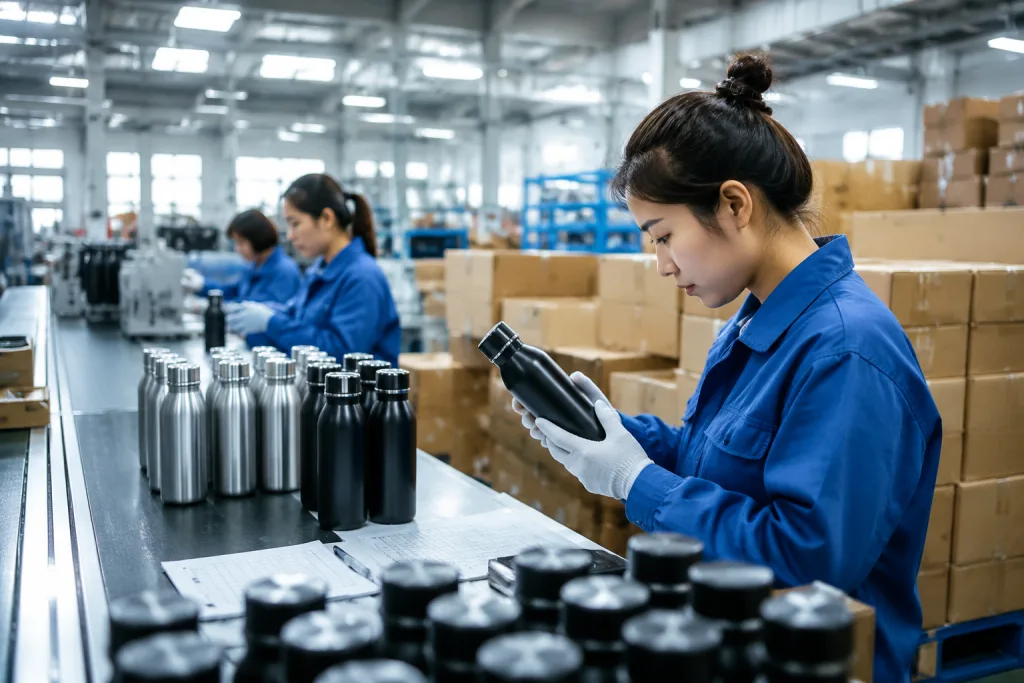
Key Takeaways
- Typical MOQ for a customized canteen is 500-1,000 pcs, with 30-45 day lead times after sample approval
- A workable FOB price for a 500 ml stainless bottle usually starts around USD 2.20-4.80 depending on steel grade and finish
- For export buyers, ask for REACH, food-contact declarations, and AQL 2.5/4.0 inspection terms before you place deposit
- A factory in Zhejiang with 300,000+ units/month and in-house printing is better for repeat distributor orders than a trading-only setup
If you buy drinkware for resale, you already know the real problem: most supplier brochures look fine until you ask about MOQ, leak tests, print durability, and whether the same bottle can clear REACH in Europe and the paperwork your U.S. buyer wants. For reusable water bottle distributors, margin does not disappear on the product page. It goes when the pallet lands with weak coating adhesion, fuzzy carton specs, or a lead time that slips by 18 days. We have seen that one before. QC pulled the sample, and the tape test failed on the second peel.
That is why chasing the cheapest canteen supplier is the wrong question. You need a canteen manufacturer that holds tolerance, a canteen factory that understands export paperwork, and a product line you can reorder without turning every shipment into a new project. We run the same check on the line: wall thickness, caliper reading, PO notes. If a factory cannot answer that in plain language, keep moving. The math does not work.
What buyers need to ask first
The first question is not “what is your best seller?” It is “what job does this bottle do in my channel?” A reusable water bottle for a school program is a different build from distributor drinkware for a gym chain, and both sit apart from a custom growler for a craft beverage promo. We had a buyer compare a 500 ml school bottle with a 750 ml retail piece on unit price only. The math does not work. Simple as that.
Start with four facts: volume, use case, decoration method, and destination market. A canteen customizable for European retail may need a powder coat, laser logo, and REACH paperwork. A canteen promotional order for North America may need a lower FOB price and a single-color print. On the line, we check cap torque at 0.6 N·m with a torque wrench, because a bottle that lands at USD 2.85 FOB but fails after 2,000 cycles becomes dead stock. This is the wrong question to ask if you are buying for canteen distributors or distributor drinkware channels.
Ask the supplier to confirm in writing: material grade, capacity tolerance, lid compatibility, packaging, and which parts are actually customizable. A serious canteen vendor will tell you whether the lid is PP, Tritan, or stainless-steel capped, and whether the seal is silicone or TPE. QC pulled the sample on a 1.5 mm gap at the lid thread, and the buyer flagged it before we shipped. That is the difference between a catalog item and a customized drinkware program you can reorder for 12 months without redesigning it.
Materials that actually matter
Material choice sets the rest. We run the line that way. For reusable water bottle distributors, stainless steel stays the safest default because it holds branding, passes retail checks, and survives repeat orders without drama. On a 1,000-piece run, QC pulled the sample at 0.38 mm inner liner thickness, and the buyer signed off after asking for the spec sheet twice. For double-wall bottles, a 304 stainless body with a 201 outer shell is common in China when price is tight. Full 304 inside and out gives a cleaner export file and fewer back-and-forth emails.
For plastic canteen custom projects, Tritan, PP, and rPET each have a job. Tritan is the cleaner pick for premium customizable drinkware because it stays clear, takes abuse, and supports a higher shelf price. PP costs less, but if the bottle comes off the mold thin or carries odor, the buyer flags it fast. Glass can work, but only if you accept breakage risk and upgrade carton protection. We saw a 12-day vs 18-day carton test swing on a custom growler job after the thread pitch was off by 0.3 mm. The body was fine. The cap was not. This is the wrong question to ask if you only look at shape.
- 304 stainless steel: best balance for retail and corporate orders
- 316 stainless steel: useful when the spec demands corrosion resistance
- Tritan: premium clear bottle option for reusable water bottle distributors
- PP/rPET: lower-cost choices when price is the main lever
A canteen manufacturer in Zhejiang should be able to show material certs and explain where each yuan of cost goes. Ask for the actual mill test report and the MOQ split. If they dodge that, the math does not work and the margin gap shows up later in QC. We have seen a PO typo turn 5,000 pcs into 500 pcs on paper, and the line still had to stop while the buyer cleaned it up.
MOQ, price, and timing
Buyers ask for price first. That is the wrong question. MOQ sets the math. We watched a 500 pcs logo run slip when the buyer added carton print and a second artwork position, and the packing room had to redo 2,000 inner boxes. A standard customized canteen starts at 500 pcs for one logo color, 1,000 pcs for box print, and 3,000 pcs if you want mixed body colors with special packaging. For distributor canteen programs, a supplier worth using shows tiered pricing at 1,000, 3,000, and 5,000 units, with the quote tied to the line plan and the packing spec, not a guess over email.
From China, a single-wall stainless bottle usually sits around USD 1.20-2.20 FOB, while a double-wall vacuum bottle often lands near USD 2.20-4.80 FOB depending on steel grade, finish, and accessory count. Printing moves the sheet fast. Silkscreen may be USD 0.08-0.25 per color, while laser engraving looks cleaner and holds up better, but a messy art file can add setup cost on the engraving jig. Lead time is usually 25-35 days for standard items and 30-45 days for customized canteen orders after sample approval. If a Zhejiang factory quotes 12 days for a full custom order, QC pulled the sample and found the neck finish off by 0.6 mm; the buyer flagged it for a reason. We’ve seen that one go sideways.
Practical rule: if your launch date is fixed, pad the schedule by 7-10 days for carton revisions, freight booking, and pre-shipment inspection.
Ask for monthly output in writing. A real canteen factory in China should show a capacity number, such as 300,000 to 500,000 units/month across multiple lines, not just say “big capacity.” We run into this on the line all the time: the PO says 20,000 pcs, then the buyer wants split shipments after week 2, and the math stops working. This is the number reusable water bottle distributors should plan against. One PO typo can burn a day fast.
Branding choices with fewer surprises
Decoration is where custom drinkware jobs go sideways fast. We have seen a logo pass approval on day one and start failing after 50 dishwasher cycles. For reusable water bottle distributors, the first question is plain: fast, durable, premium, or low-cost? Pick one. On the line, we check the artwork against a 12 mm print band before we run a sample, because a 2 mm shift is enough to throw the whole look off.
Silkscreen works for bold logos on flat panels, and we use it on canteen promotional orders all the time. Laser engraving is the better call for stainless steel when the mark has to stay put and not chip. Heat transfer and UV printing carry more detail, but if the bottle is headed for retail or ecommerce, ask for abrasion testing. One buyer pushed back on QR codes, then QC pulled the sample after the second rub test showed edge lift at the corners.
For a custom growler or customizable growler, the logo has to survive condensation, hand washing, and rough transit. The art file matters, but the decoration method matters more. Ask for a proof on the exact material and finish, not a stock photo. That is the question you cannot skip. A canteen supplier that knows export work should tell you the safe print area, the wrap-around seam risk, and whether the coating needs 24 or 48 hours to cure before packing. We once caught a PO typo on a 48-hour cure note, and the buyer flagged it before the line started.
There is nothing wrong with a one-color logo if it protects margin and keeps reorders clean. Some canteen distributors overwork the design when the channel only needs a durable customized canteen that ships the same way every time. We run this math a lot: a simple logo with a 500-piece MOQ usually sells better than a busy print that adds inspection risk and slows packing.
Quality checks you should not skip
If you are buying at scale, QC is not paperwork. It is the line between a clean shipment and a claim file. Ask the bottle maker which inspection plan they run: AQL 2.5 for major defects and 4.0 for minor defects is common on consumer drinkware. That is a number, not a promise. We had one buyer flag a cap typo on the PO, and the whole carton label set went back to the packing table for a second check.
For a reusable bottle order, test the cap seal, drop resistance, surface adhesion, odor, and carton compression. We run leak tests at 45 degrees, hot-water holding checks, and cycle tests on threads and lids with a torque wrench on the bench. If the bottle is insulated, ask for thermal retention in hours, not sales copy. A basic vacuum bottle might stay above 60 C after 6 hours and above 45 C after 12 hours, depending on fill level and room temperature, and the factory should show the test method. The math does not work any other way.
For Europe, ask for REACH declarations and food-contact statements. For the U.S., get ASTM or FDA-related material support if your buyer asks for it. For Amazon, carton labeling and FNSKU placement need to be locked before production starts. QC pulled the sample once and found the outer carton was 5 mm short of the agreed mark, which would have turned into an inbound headache. A vendor that ignores labels creates work at the warehouse, not just on the line.
- Confirm AQL level before mass production
- Ask for pre-production sample approval in writing
- Verify leak and thermal test methods
- Check carton drop and compression standards
Packaging for distributors
Packaging looks small until it blows up landed cost. We saw a 3-cent packout miss turn into a six-figure hit across 20,000 units. The math does not care how nice the bottle looks. Distributor programs need cartons that stack on a 1.1 m pallet, survive freight, and still move cleanly through retail handling. Before you sign off artwork, ask for master carton dimensions, gross weight, and units per case.
For reusable water bottle distributors, the better canteen manufacturers in China usually give three pack options: bulk pack, white box, printed retail box. Bulk pack fits B2B resale into uniforms and schools. Printed retail boxes work when the buyer sees the pack first. If you need customized drinkware for Amazon or DTC, check suffocation warnings, barcode placement, and whether the carton passes a 70 cm drop test. Basic stuff. QC pulled the sample, and one loose insert can still fail the line.
Ask for recycled master cartons or FSC paper when the buyer wants a sustainability spec. A Zhejiang supplier that ships export orders every week should not treat that as a special project. We run into an 8 kg master carton limit all the time, because once the case is too heavy, your warehouse team pays for it twice. The goal is simple: fit the channel, then ship without repacking.
Choosing the right supplier type
Not every source in China runs the same, and the name on the card matters less than the line. A canteen supplier, canteen vendor, or trading company can work for 300-piece mixed orders, but once repeat buys start, you want the factory close to the job. For reusable water bottle distributors, the better setup is a canteen factory or canteen manufacturer with in-house molding, polishing, coating, and printing. That trims 7 to 10 days off lead time and cuts the blame loop when something slips. We run this every week.
Ask if they are a real exporter from Zhejiang or just a middle layer. Zhejiang has a dense drinkware supply chain, so caps, cartons, coatings, and accessories can all move in one run. Paper looks tidy. We saw a buyer flag a PO typo on a 500 ml carton spec, and the plant caught it before print because the proofing table still had the old file open. The real split is response speed, docs, and whether they can support reorders without changing the mold or the carton spec. A serious canteen distributor partner should handle custom canteen, custom drinkware, and even a small custom growler run without acting like each SKU is a new headache. We’ve seen that go sideways.
Two numbers tell the story: monthly output and last shipment defect rate. This is the wrong question to dodge. If they stall, move on. If they give you a real number with paperwork, you have a supplier worth a second look. QC pulled the sample, checked cap torque at 12 kg, and that tells you more than a smooth sales pitch ever will. The math doesn't work any other way.
Send your spec, get a real quote
We can review MOQ, branding, compliance, and packaging in one pass so you see the true landed cost before you place the order.
Frequently asked questions
What MOQ should I expect for a customized canteen order?
For a normal customized canteen, expect 500-1,000 pcs per design and color. Simple logo printing can start at 500 pcs, while mixed finishes or special packaging often push MOQ to 3,000 pcs. If you need a canteen customized for retail with multiple colors, ask whether the factory can split the MOQ across sizes or only across one SKU. A good canteen manufacturer in China will state the MOQ by decoration method, because silkscreen, laser engraving, and full-color print have different setup costs. Anything below 300 pcs usually means a stock item with a logo, not true custom production.
How do I compare FOB prices without getting misled?
Compare the same spec line by line: steel grade, wall thickness, lid type, logo method, inner box, and carton quantity. A 500 ml stainless bottle might be USD 2.20-4.80 FOB depending on whether it is single-wall or vacuum insulated, whether the body is 304 or mixed-grade, and whether the lid uses PP, bamboo, or stainless trim. Ask for the price at 1,000, 3,000, and 5,000 pcs so you can see the curve. If a canteen supplier gives you only one number, it is not enough to make a buying decision.
What certificates should I ask for from a China factory?
For Europe, ask for REACH and food-contact declarations. For the U.S., ask what material statements they can provide and whether they have experience with ASTM-related testing or buyer-required compliance files. If you are selling through Amazon, also check carton labeling and FNSKU readiness. A Zhejiang factory that exports regularly should know how to prepare packing lists, commercial invoices, and product specs without needing repeated explanations. If the product is insulated or coated, ask for the actual test report, not just a certificate cover page.
Is laser engraving better than silkscreen for distributor drinkware?
Not always. Laser engraving is more durable on stainless steel and is often the best choice for premium distributor drinkware, especially when the logo needs to survive heavy handling. Silkscreen is cheaper and works well for simple one- to two-color branding on flat surfaces. For canteen promotional orders, silkscreen can protect your margin. For a custom growler or high-end customized drinkware program, laser usually looks cleaner over time. The right answer depends on your price target, artwork, and whether the bottle will be washed by hand or in a dishwasher.
How much lead time should I build into my launch plan?
For stock-like orders with logo work, 25-35 days is common after sample approval. For a true custom canteen or customized growler, plan 30-45 days, and add another 7-10 days if you need new cartons, sample sign-off, or third-party inspection. A canteen factory in China may claim faster timing, but you should still protect your launch with freight and customs buffers. If your order is going to a fulfillment center, the extra days matter because labeling or carton errors can delay inbound booking more than production itself.