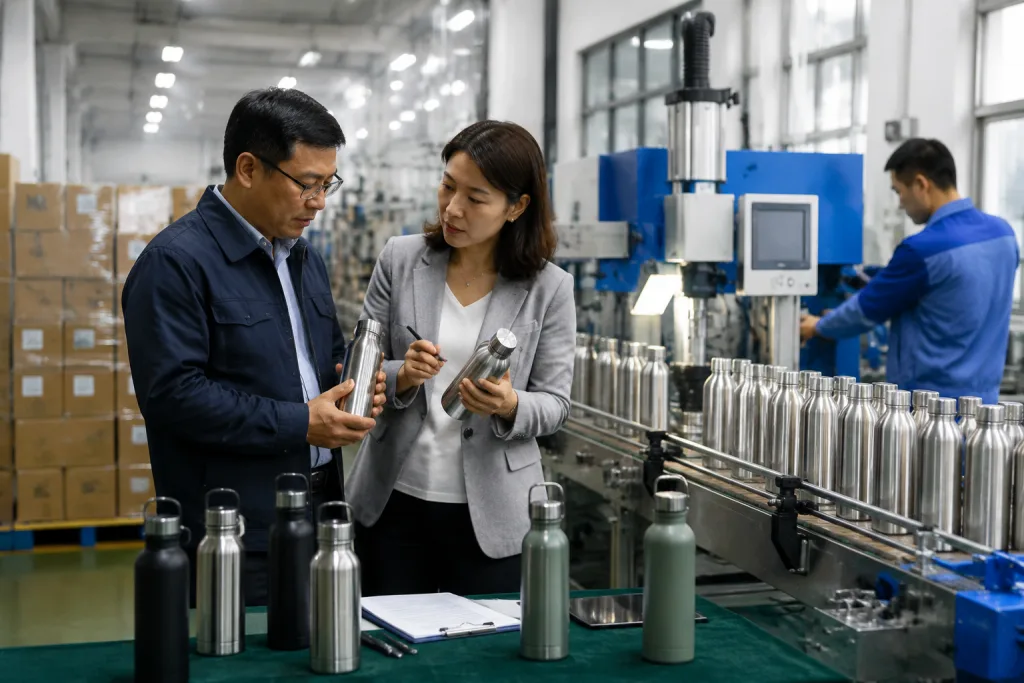
Key Takeaways
- A typical MOQ for reusable water bottle custom orders is 500-1,000 units per SKU, with 25-35 day lead time after sample approval
- 304 stainless steel bottles usually land around USD 2.10-4.80 FOB depending on capacity, lid, and finish
- Laser engraving holds up best for long-cycle retail; silkscreen is cheaper at USD 0.08-0.25 per color but less abrasion-resistant
- AQL 2.5 for major defects and 4.0 for minor defects is a practical inspection target for export drinkware
If you are sourcing reusable water bottle custom for retail, promotions, or private label, do not treat every sample as the same bottle with different art. That is the wrong question to ask. A 500 ml stainless bottle with a 0.4 mm inner wall, a 1.0 mm powder coat, and a laser logo runs on a different line from a 750 ml Tritan bottle with a flip lid and silkscreen print. We ship both. The math does not work any other way. Freight, dent rate, shelf price, and first-day handling all change with the build.
From our Zhejiang factory, we see the same pattern every week: the buyer opens with a logo brief, then QC pulled the sample and the spec sheet became the real issue. A good canteen factory sells structure, compliance, and repeatability first. On one PO, the buyer typed the lid code one digit off, and the line caught it before molding; that mistake turns into a 12-day delay if nobody checks. Read the spec line by line. Ask what each line does to cost, lead time, and return risk.
Start with the use case
Before you ask for a quote, define the job. A bottle for gym retail is not the same as a canteen promo piece for an event, and neither matches a custom line for Amazon FBA. Capacity, lid type, surface finish, and carton pack all change with the use case. For a custom canteen aimed at outdoor retail, we usually run 750 ml or 1,000 ml bodies with a carry loop and powder coat. For a custom growler for beverage brands, the buyer wants a wider mouth, a thicker wall, and a cap that survives repeated filling; QC pulled a 1.2 mm wall sample last week and the number held. Simple.
Do not let anyone rush you into artwork before the function is settled. A canteen distributor selling through three channels may need one body and three lid options. A distributor drinkware program often needs carton efficiency more than loud graphics. We had a buyer flag a PO typo on lid color once, and the line stopped for half a day. In Zhejiang, the factories that know export ask for the target market, washing method, and retail price band before they confirm the structure. That is the right order; otherwise you pay for the wrong mold, the wrong pack, or a print that chips in 6 weeks. The math does not work.
- Gym and fitness retail: 500-750 ml, narrow body, one-handed lid
- Outdoor and camping: 750 ml-1 L, loop cap, thicker coating
- Promotions: lower unit cost, simpler lid, fewer color changes
- Retail private label: stronger finish, better carton pack, barcode-ready packaging
Read the body spec
Body spec is where buyers get trimmed down fast. We see it on the line every week. For stainless steel, ask for grade, wall thickness, and how the shell is built. A real 304 stainless bottle usually runs 0.4-0.5 mm on both inner and outer walls. On retail orders, double-wall vacuum bottles with 0.5 mm shells take dents better and hold temperature steadier. If the quote skips thickness, you are not comparing the same bottle.
For plastic, name the resin, not just “BPA free.” Tritan, PP, and PET do different jobs. A Tritan canteen customizable order gives clearer body transparency and better impact resistance, while PP stays cheaper and shows up on a lot of canteen promotional runs. For a canteen customized order, wall thickness matters more than some buyers expect. We had one PO typo that listed 1.0 mm, and QC pulled the sample because the sidewall flexed under hot water. A 1.5-2.0 mm body costs more. The math works.
Ask the canteen manufacturer to state:
- Material grade: 304, 316, Tritan, PP, AS, or aluminum
- Wall thickness: 0.4 mm, 0.5 mm, 1.2 mm, 1.8 mm, etc.
- Capacity tolerance: usually +/- 5%
- Finish: matte powder coat, glossy paint, brushed steel, clear body
A serious canteen factory in Zhejiang should have a micrometer and a caliper on the table, not guesses from the sales desk. The buyer flagged it on our side once when the brushed finish measured 0.03 mm off spec, and that order got held. If they cannot document these specs, keep looking.
Choose the right lid system
Lid choice drives leakage, user habits, and carton damage. It also hits landed cost. A simple screw cap is cheap and steady, but it does not fit sports retail. A flip lid gives fast drink access, yet the hinge and seal add failure points. A straw lid sells in North America, but it brings more cleaning complaints and extra parts in packout. We saw this go sideways on a 24,000-unit run when the cap came back scuffed from carton rub, and the buyer flagged the freight claim.
For custom drinkware, the lid has to fit the channel. A canteen supplier serving schools or corporate gifts usually runs a leak-resistant screw cap with a carry handle. A canteen vendor selling to outdoor distributors often needs a wide-mouth cap with a silicone seal and dust cover. If you are making a customizable growler, the lid must hold up under repeated carbonation pressure and wash cycles. We check gasket material, thread depth, and closure cycle count; QC pulled the sample after 800 opens and the seal was already soft. That is the wrong question to ignore.
Practical rule: if the lid has more than three moving parts, ask the factory for a 1,000-cycle functional test and a spare gasket quote.
One more point: lid colors. For distributor canteen programs, we run 1 body with 2 or 4 lid colors. That gives range without opening a second mold. Keep the colorant stable and make sure the supplier can hold shade across repeat batches; we saw a buyer flag a PO typo on Pantone code 295C versus 296C, and the line had to stop for recheck. The plug gauge was still on the bench when it happened.
Decoration should fit the surface
Decoration is not just branding. It changes wash durability, defect rate, and shelf appeal. On a reusable water bottle custom order, we run silkscreen, laser engraving, heat transfer, and UV print on the line. The right call depends on the bottle surface and the sell price. One buyer sent us a sample with a perfect logo photo, then the ink rubbed off after two dishwasher cycles. That's the wrong question to ask.
Laser engraving is the clean answer on stainless steel because it does not flake. On a 304 bottle, engraving usually adds USD 0.10-0.35 per position, and the number shifts with logo size and fixture setup. Silkscreen costs less for one or two colors, often USD 0.08-0.25 per color, but it wears once the bottle goes into dishwashers or cargo bins. UV print gives bright graphics, yet it needs a prepared coating and it hates tight curves. For a customized canteen handled every day, pick the decoration that survives abuse, not the one that only looks good on a sample table. QC pulled the sample with a tape test last week, and the glossy print failed on the first pull.
If you are buying from a canteen manufacturer in China, ask for print adhesion testing. Cross-hatch plus tape pull tells us more than a long email thread. We use it on 18 mm test grids before we release the job. For export orders, we usually ask buyers to send:
- Artwork vector file in AI, PDF, or EPS
- Logo size tolerance within 1-2 mm
- One white sample before mass production
- Print position drawing with exact reference points
That keeps the line moving and cuts batch disputes later. We saw one PO typo on the logo width turn into a 12-day delay, and the math does not work when a buyer wants a rush fix after packing starts.
Compliance is not optional
For Europe and North America, compliance is where weak sourcing gets expensive fast. We run this check before sampling because one missing REACH file or LFGB report can turn a 15-day sample cycle into 18 days, and that delay hits the launch date. Ask for REACH, LFGB where food contact is needed in the EU, FDA food-contact declaration for the US, and full material traceability. If the bottle uses stainless steel, ask for the steel mill source, heat number, and the SGS or equivalent test report. For coatings, get the exact powder or paint system and the migration result. QC pulled a sample once, and the buyer flagged a coating smell at 60°C; that is not where you save money.
A procurement team often asks whether a canteen factory can “provide certificates.” That is too vague. Ask for the exact standard and the exact batch reference. A canteen manufacturer should state whether the bottle meets ASTM, ISO, or local export requirements, and whether the packaging inks and cartons are compliant too. We had a PO with a typo on the carton code last quarter; the line stopped for 2 hours while we reprinted labels. If you are selling a custom drinkware line into retail, barcode labeling and carton drop strength matter as much as the bottle itself. For Amazon FBA, you may need FNSKU labels, carton markings, and polybag suffocation warnings.
In Zhejiang, the better factories handle this question set because they ship every week. The gap is not the bottle line; it is the paperwork stack and whether sales will show it before deposit. We ship into the EU every month, and a factory that stalls on test files usually has a gap somewhere. We once checked a lot with an AQL 2.5 sheet and a buyer flagged the missing batch link in 10 seconds. The math does not work otherwise.
Price is a spec outcome
You cannot quote reusable water bottle custom well unless you know what drives the unit price. On stainless bottles, steel grade, vacuum draw, coating, lid structure, and print method move the number fast. A 500 ml 304 single-wall bottle can leave the line around USD 1.20-2.00 FOB. A double-wall vacuum bottle with powder coat and laser logo usually lands in the USD 2.10-4.80 range. Add a flip lid or gift box, and the quote climbs. We had a buyer flag a PO once because “laser logo” was typed as “lader logo” - QC pulled the sample, and the math still pointed to the same answer.
For plastic canteen customized jobs, the unit price starts lower, but mold logic does the real work. A plain PP canteen promo item can run cheap at 5,000 units and above. A Tritan clear bottle with custom lid color and retail packaging costs more than buyers expect because packaging, assembly, and scrap rate all sit in the bill. This is the wrong question to ask if you only compare body price; we ship by total landed cost, not the sticker on the bottle. On one run, the molding tool needed a 0.15 mm gate tweak before the line could hold the finish.
Use this cost checklist:
- FOB price per unit
- Print or engraving cost
- Gift box or mailer cost
- Carton pack quantity
- Ocean freight by CBM
- Duty, brokerage, and domestic delivery
A quote that looks cheap at the factory gate can still be the expensive option once you add damage allowance and channel packaging. We have seen this go sideways on a 3,000-unit order with a 12 kg drop test fail and a carton spec that was too loose. The buyer thought the bottle price won. It did not.
MOQ and lead time realities
For reusable water bottle custom programs, 500-1,000 units per design is the number that holds. We do run 300 units on stock models with plain screen print or laser marking. Once the buyer asks for a custom lid or a new mold, MOQ jumps fast. On the line, a Zhejiang canteen factory shipping mixed drinkware usually has 300,000-500,000 units a month on paper, but resin color, surface finish, and the Q3-Q4 rush decide whether your slot stays open. The math does not lie.
Lead time usually runs 7-12 days for samples, then 25-35 days for mass production after sample approval and deposit. On one order, QC pulled the sample at 24 hours because the cap torque was off by 1.5 kgf-cm, and that kind of miss eats days. If carton customization, label printing, or polybagging is on the list, add 3-5 days. For a custom canteen or customized growler with mold development, the tooling takes 25-45 days before production starts.
Reorder timing is where buyers get caught. First order teaches the line; second order is where margin shows up. We keep artwork, carton spec, and QC standard on file, so the next 10,000 units do not need a full reset. I have seen a PO typo on carton count turn into a 12-day delay because the buyer flagged it too late. Chasing USD 0.03 off the bottle price is the wrong question to ask.
Inspect like a buyer, not a dreamer
Inspection is where the promise turns into a shipment. For export drinkware, AQL 2.5 for major defects and 4.0 for minor defects is the baseline we run. Leak tests. Coating adhesion. Logo position. Carton checks from the top pallet. One bad lid seal can snowball into 300 returns and wipe out the margin fast.
Ask the supplier for a pre-shipment report with photos from the exact lot. Then spot-check random units against the list below. QC pulled the sample at 10:20 a.m. on the line, and that is the level of detail buyers should ask for. We have seen a buyer accept “sample OK” and then miss a crooked print by 2 mm on the bulk run.
- Leak test after 30 seconds upside down
- Thermal performance if sold as insulated
- Odor check on plastic parts
- Thread smoothness and cap torque
- Drop test on packaged samples
For distributor drinkware programs, packaging consistency matters almost as much as the bottle itself. A crushed carton or a missing insert can break retail compliance even when the bottle passes. We saw a PO with one typo on the insert count, 1,000 pcs vs 10,000 pcs, and the buyer flagged it before loading. That is the wrong question to ask: does the inspection look clean, or does it protect the channel? We ship cartons at 540 mm, and that size check catches sloppy pack-out fast.
Send your spec sheet for a quote
We can price your reusable water bottle custom project with exact material, lid, print, and carton details, then return a clean FOB breakdown.
Frequently asked questions
What MOQ should I expect for reusable water bottle custom orders?
For stock bodies with custom logo, expect 500-1,000 units per SKU. If you need a custom lid color, special carton, or a new mold, 3,000 units is more realistic. In Zhejiang and other export-focused parts of China, we often see 500 units for simple laser engraving and 1,000 units for multi-color print. The lower the MOQ, the less room there is for complex packaging. For a first order, keep the spec tight and avoid too many variants.
What is the best material for a retail water bottle line?
For stainless retail, 304 is the practical default. It balances cost, corrosion resistance, and buyer confidence. A 316 upgrade makes sense for harsher use or premium positioning, but it usually adds 10-20% to the bottle cost. For clear plastic, Tritan is stronger than basic PET and holds up better for a canteen customizable line. If your channel is promotions, PP can still work, especially where price matters more than perceived premium value.
How much does custom branding add to unit cost?
Laser engraving on stainless often adds USD 0.10-0.35 depending on logo size and setup. Silkscreen printing is usually USD 0.08-0.25 per color, while UV print can be higher if the artwork is full coverage. Packaging can add more than decoration: a printed box may add USD 0.20-0.60, and retail inserts can add another USD 0.05-0.15. Always ask for the price split so you know where the money is going.
How long does production usually take?
For standard reusable water bottle custom orders, sample time is usually 7-12 days and mass production is 25-35 days after sample approval and deposit. If you are developing a custom canteen mold, add 25-45 days for tooling first. During peak season, a canteen manufacturer in China may need an extra week if your order includes multiple lid colors or special packaging. Ask for a firm shipment date, not just a production window.
What should I check before approving a supplier?
Check factory type, not just trading activity. A real canteen factory should show you capacity, QC steps, and test records. Ask for REACH, food-contact declarations, and recent inspection data. For export orders, confirm AQL targets, carton drop testing, and whether they support FNSKU labels if you sell through Amazon. A good canteen supplier will answer in numbers: MOQ, lead time, monthly output, defect tolerance, and the exact finishing method used.