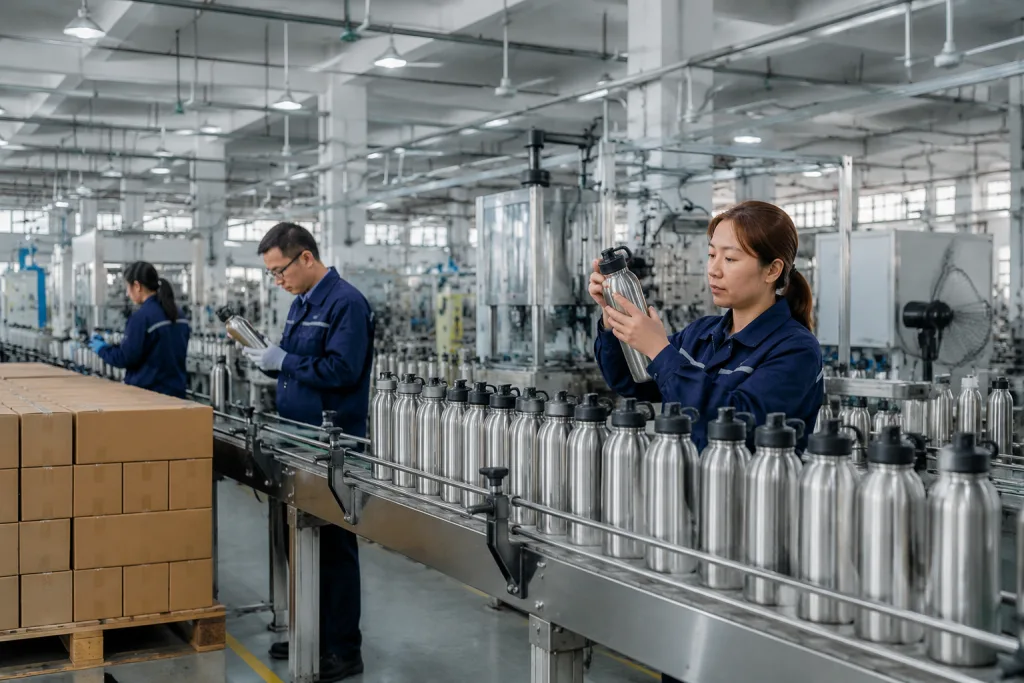
Key Takeaways
- A serious refillable water bottle vendor should state MOQ, lead time, and monthly capacity up front; a practical benchmark is 5,000 pcs MOQ and 25-35 days production.
- For export orders, ask for REACH, LFGB, FDA, or ASTM-related test files before deposit; do not wait until after production.
- Decoration changes cost more than most buyers expect: silk screen can add $0.08-$0.25 per color, laser engraving often adds $0.15-$0.40 per unit.
- A clean QC plan uses AQL 2.5 for major defects and 4.0 for minor defects, plus drop, leak, and dishwasher checks on the first article sample.
You are not buying a bottle. You are buying a repeatable supply chain: resin or 304 stainless, decoration that stays put, an inspection plan QC can run, and a vendor that ships on time without your team chasing every carton. That is the gap between a clean launch and a warehouse mess. We had one buyer flag a 1.5 mm wall-thickness slip on a 600 ml bottle, and the PO went straight back to the line. The math does not work any other way. For refillable water bottle vendors, price is the wrong first question; the first check is whether the factory can hold spec across 5,000 or 50,000 units and still clear Europe or North America rules.
If you source in China, especially from Zhejiang, you will see sharp gaps in factory maturity. A real canteen factory will quote MOQ, lead time, and test standards without blinking, then show the drop-test rack and the torque gauge. A weak canteen supplier hides behind soft promises. We saw this go sideways when a PO said “matte black” but the buyer meant “soft-touch black,” and the samples got rejected after 12 days of waiting. The line keeps moving, but only if the spec is nailed down first. The order walkthrough below is the one I use for custom drinkware, custom canteen, or a custom growler program: lock the bottle spec, test the sample, inspect production, then release the shipment.
Start with the actual use case
Before you talk to refillable water bottle vendors, lock the use case first. A 500 ml commuter bottle, a 750 ml sports bottle, and a 1 L promo canteen do three jobs, even if the lid looks the same on paper. We had one buyer send a single RFQ for all three, then ask why the quotes came back scattered. The math does not work. Put capacity, target retail price, lid type, packaging, decoration, and sales market on the brief. We run the line differently for each one.
Europe usually asks for cleaner material traceability and food-contact paperwork; North America pushes harder on drop tests, leak tests, and carton cube. That changes the spec fast. A double-wall 18/8 stainless bottle with a 0.5 mm inner wall is a different run from a single-wall aluminum canteen for a charity event. If you need canteen customizable options, say it straight: matte powder coat, screw cap, carabiner loop, or loop-top lid. We had a PO once with “loopp top” typed in it. The buyer flagged it before the plates were made.
Write the brief like a production sheet, not a mood board. Put the Pantone number, artwork format, and carton count in black and white. QC pulled a sample last month because the PO said “navy” and the line matched the wrong shade. If you are working with a canteen manufacturer in Zhejiang, this is where they can tell you what will run at scale and what will stall the line.
Read the vendor like an operator
Refillable water bottle vendors are not equal just because they all call themselves a canteen supplier or canteen vendor. Read the line. Ask three numbers on the first call: monthly output, MOQ by SKU, and how many decoration lines they run. A Zhejiang factory shipping 300,000 units a month with two screen-print lines and one laser line is a different animal from a trading desk forwarding PDFs. If they cannot answer in numbers, we stop there.
For a proper canteen distributor program, you want a canteen factory that can handle repeat orders without swapping cap suppliers every quarter. We saw this go sideways on a 12-day re-order once: the buyer flagged a cap shade drift, and the line had to hold cartons. Ask for:
- Monthly capacity in units
- MOQ by model and by color
- Sample lead time, usually 5-10 days
- Mass production lead time, usually 25-35 days
- Accepted audit or social compliance files, such as BSCI
Do not get distracted by vague words like customizable drinkware or distributor drinkware. That is the wrong question to ask. Ask what is actually customizable: body finish, lid color, logo method, carton print, or insert card. The stronger canteen manufacturers will show you a production flow, not a sales brochure. QC pulled the sample with a 0.3 mm print offset, and that told us more than any pitch deck.
Quote the bottle the right way
Most quote problems start with thin input. Ask for a custom bottle quote with no material, no decoration, and no pack spec, and the number looks neat until it shifts. We saw that on a 5,000 pcs PO last month: the buyer left out carton count, then flagged the revision two days later. Quote one full SKU instead. Example: 750 ml 304 stainless steel bottle, single color powder coat, one-color silk screen logo, PE bag plus 24-piece master carton, FOB Ningbo or Shanghai, 5,000 pcs. Then every vendor is pricing the same job.
For export drinkware, the spread is not small. A plain stainless bottle can land around $2.10-$4.80 FOB depending on wall thickness, finish, and lid build. A 1.0 mm body with a locking lid costs more than a thin-wall run with a basic cap, and the math does not work any other way. Cheap lids are where leaks start. QC pulled the sample, shook it for 30 seconds, and the cap seeped at the thread.
Quote on the same terms every time: same capacity, same logo size, same carton pack, same Incoterm. Otherwise you are comparing noise.
For a serious buyer, ask for a price ladder at 3,000, 5,000, and 10,000 units. That is where you see whether the bottle supplier knows scale or just guessed once on a spreadsheet. We run that ladder on the line every week, and the step-down is not always clean. The buyer asked for 2,000, then 8,000, then changed to 6,000 after sample approval. That typo on the PO changes the quote fast.
Samples must prove the spec
The sample is not a souvenir. It is the first gate we run. For a customized canteen or customizable growler, ask for a pre-production sample made with the final material, finish, and logo method. Then check the parts that kill orders: leaks, dent resistance, thread fit, coating adhesion, odor, and temperature retention on insulated pieces. We had a buyer flag a 0.3 mm cap mismatch after the PO typo said “neck 28mm” instead of “neck 30mm.” That was a bad save. If the customer is in Europe, tie the compliance papers to that exact sample, not a similar SKU. QC pulled the sample from the rack and the caliper told the story.
Here is the order I recommend:
- Visual check under neutral light
- Thread alignment on cap and neck
- Leak test upside down for 24 hours
- Drop test from 1.0 m on carton and bottle
- Logo rub test after 50-100 cycles
If the bottle is a canteen customized for outdoor use, test the handle and cap torque on the torque meter. If it is a custom growler for beverage service, test seal retention after repeated opening, not just one clean close on the line. We once shipped a sample that looked fine on day 1 and failed after 2 days in transit because the liner shifted 4 mm. The buyer said it was “close enough.” The math does not work. Sample from the canteen factory, not from a sales photo.
Build QC into the purchase order
A purchase order without QC terms is just paper. For refillable water bottle vendors, we lock the inspection points before the line starts. We run pre-production confirmation, in-line checks, and final inspection at AQL 2.5 for major defects and AQL 4.0 for minor defects. A leaking cap, wrong logo, cracked body, bad thread, or a heavy color mismatch is a major defect. Minor defects are small print drift or light cosmetic marks inside your tolerance.
Put these items into the PO: accepted material grade, finish tolerance, logo position tolerance, packaging method, and carton mark format. On one 12,000-piece run, the buyer flagged a 3 mm logo shift and the PO had the carton mark line typed as “custon”; QC pulled the sample, and the batch sat on hold. If you are ordering from a canteen manufacturer in China, add photo approval at first article stage and a hold point before mass packing. That is your last brake before a bad run gets shipped.
Buyers skip the carton test. Wrong call. For export to North America, the pack has to survive distribution, not just sit clean in the warehouse, so ask for a 5-layer export carton if the order is heavy, especially for stainless steel or glass bottles. We checked an 18 kg master carton with a drop test last month; one corner split on the second drop. For canteen distributors, carton performance is part of the product.
Know your decoration choices
Decoration sets cost and wear. Silk screen is still the go-to for a simple logo on custom drinkware because we run it fast and keep the unit price down. Laser engraving leaves a permanent mark on 304 stainless steel, and it fits premium distributor canteen programs. UV print carries more color detail, but the line needs tight adhesion control; QC pulled a sample at 24 hours, and the ink lifted after a weak pre-treatment run. For a canteen promo order, this is the wrong question to ask: “what looks best?” Ask what survives a 2-meter drop test and daily wash cycles.
A practical rule: one-color silk screen usually adds $0.08-$0.25 per unit; laser engraving may add $0.15-$0.40; multi-color print costs more and the reject rate climbs if the art is crowded. We had a buyer flag a PO typo on the bottle size, 750 ml written as 700 ml, and the pricing changed once we rechecked the decoration area on the caliper. If the bottle is powder coated, ask how the factory handles pre-treatment. If the body is bare metal, ask about polish marks and laser contrast. The math does not work if you pick a method that fights the finish.
If your artwork has fine type, request a print proof at actual size. Small text on a curved canteen disappears fast, especially below 3 mm letter height. We see this go sideways on first samples all the time. One logo looked crisp on screen, then vanished on the 25 oz bottle once the wrap radius kicked in.
Shipping terms change your margin
By the time cargo is on the booking sheet, the deal should already be tight. Ship late, and margin leaks through freight, duties, and carton density. FOB is the clean starting point for China sourcing because we quote ex-factory, then you compare vendors on the same basis. We run a packing check on the line before handoff, with a tape measure and a scale on the table. If the supplier sits in Zhejiang and the truck reaches Ningbo in 1 day, inland risk drops, but geography is not the buying rule. Total landed cost is.
For a distributor drinkware program, ask for carton dimensions, gross weight, and pallet count before you confirm. A 5,000-piece order that looks cheap at FOB can turn ugly if the carton is 58 x 38 x 42 cm and the pallet stack hits the warehouse limit. QC pulled the sample once and found a 120 g variance between cartons, which changed the load plan. That is where a good canteen factory earns its keep. We pack tighter, palletize cleaner, and ship fewer broken units. If you need FNSKU labels for Amazon or retail barcodes for a North American warehouse, say it early so the factory prints the right inner pack. The buyer flagged a PO typo on label type once, and that burned a week.
Europe buyers often miss how much paper the shipment needs. Keep the invoice, packing list, test reports, and photo records in one file. We had one container held because the carton mark on the packing list did not match the outer case; the math does not work when that happens. This is not bureaucracy. It is how you keep customs from slowing the truck at destination.
Use a buyer checklist on every run
The best repeat orders are boring. Same vendor, same spec, same QC logic, same lead time. Once a canteen supplier proves it can ship on time, we turn the order into a checklist and run it every time. That is how canteen distributors cut launch risk, and how a canteen vendor stops being a quote machine and starts acting like a partner.
Your checklist should lock down the model name, capacity, material grade, finish, logo file, carton spec, compliance file, sample approval date, production start date, and final inspection date. If anything shifts, write it down before the PO goes out. We saw a 1 mm lid-height change throw off an inner carton on the line, and the buyer flagged it only after QC pulled the sample. For a custom canteen or custom growler line, that tiny miss turns into a packing problem fast.
China has good factories and lazy ones. Zhejiang has both. Sort them with evidence, not hope. Ask for output records, QC photos, and a signed spec sheet with dates and counts; if the vendor starts hand-waving, the math does not work. We trust the shop that can put 12 days next to the sample lead time and 18 days next to mass production, because that tells you they know their own line.
Send your spec and get a real quote
We can quote your refillable bottle program with MOQ, lead time, and packaging spelled out, then sample it from our Zhejiang line.
Frequently asked questions
What MOQ should I expect from refillable water bottle vendors?
For a standard stainless or aluminum bottle, a realistic MOQ is 3,000-5,000 pcs per SKU. If you want multiple colors, expect 1,000 pcs per color or a higher total order. For a more complex custom growler or insulated bottle, MOQ often rises to 5,000-10,000 pcs because the lid and body parts are harder to balance in production. A real canteen factory in Zhejiang will tell you the MOQ by model, decoration method, and packaging, not give you one blanket number for everything.
What lead time is normal for a custom order?
Sample lead time is usually 5-10 days if the artwork is ready. Mass production is commonly 25-35 days after sample approval and deposit, assuming the factory has materials in stock. If you need a canteen customized with special color powder coating, unusual packaging, or imported parts, plan for 35-45 days. Add another 7-20 days for ocean freight depending on the destination. Refillable water bottle vendors that promise everything in 10 days usually have not explained the full process.
Which compliance documents should I ask for?
For Europe, ask for REACH and, when relevant, LFGB or food-contact documentation tied to the exact material. For North America, request food-contact declarations and any applicable ASTM or CPSIA-related files if the product is aimed at children. You should also ask for factory audit documents such as BSCI if social compliance matters to your channel. The key is that the document must match the exact bottle, lid, coating, and decoration method you are buying, not a similar canteen promotional sample.
How do I compare two quotes fairly?
Line them up on the same spec sheet. Compare capacity, material grade, wall thickness, lid type, decoration method, packaging, Incoterm, and inspection standard. A quote of $2.20 FOB for a single-wall bottle is not comparable to $3.80 FOB for a double-wall insulated model. Ask each canteen supplier for carton size and gross weight too. If one vendor includes individual boxes and the other uses bulk packing, the lower price may disappear after freight and repacking.
What is a sensible QC standard for a first order?
Use a pre-production sample, in-line checks, and final inspection at AQL 2.5 major and 4.0 minor. Define major defects clearly: leaks, wrong logo, wrong color, broken lid, cracked body, or missing parts. For a refillable bottle program, test at least 3-5 samples from each production lot for leak and drop resistance. If the product is a custom canteen or custom drinkware item for retail, add carton drop tests and barcode verification before shipment. That is standard discipline, not overkill.