Key Takeaways
- A serious refillable water bottle supplier should quote by material, lid type, decoration, and carton spec, not just a loose USD price.
- For most custom drinkware programs, MOQ starts around 3,000 pieces and lead time is 25-35 days after sample approval.
- For EU and US importers, ask for REACH, FDA, LFGB, or ASTM-relevant test files before you approve artwork.
- The best fit depends on use case: stainless steel for premium retail, Tritan for light weight, and aluminum or growler formats for promotional or distributor drinkware.
You are not buying a bottle. You are buying fill rate, margin, and fewer headaches at dock receiving. A solid refillable water bottle supplier should show the material, coating, cap tolerance, carton count, and test standard before you ask twice. If they dodge that, you are talking to a sales desk, not the line.
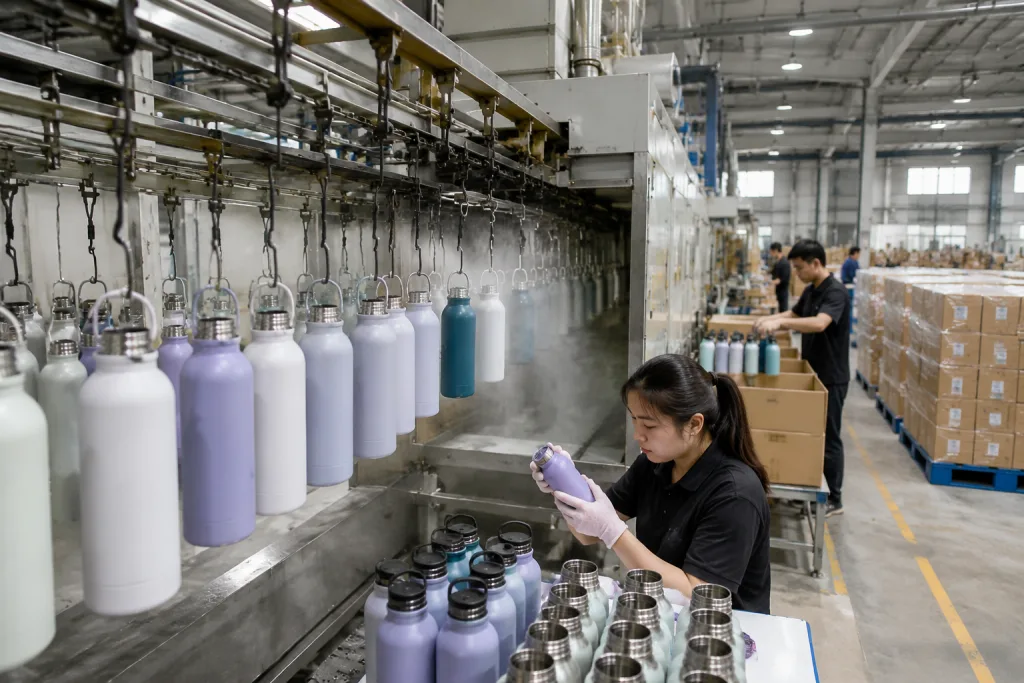
For B2B drinkware buyers in Europe and North America, the job decides the spec: retail shelf, Amazon FNSKU, distributor pack, employee gifting, or a canteen promo run. We see this every week. In Zhejiang, the factories that ship well think in specs, not slogans. At BottleForge Industrial in Hangzhou, we run 280,000 units per month, standard MOQ starts at 3,000 pieces, and custom lead time is 25-35 days after sample approval. QC pulled a cap sample last Friday and found a 0.3 mm mismatch on the thread. That sort of miss turns into a buyer complaint fast. The buyer flagged it, and they were right. This is the baseline to use when you compare canteen suppliers, canteen manufacturers, and customizable drinkware vendors.
Start with the use case
If you start with price, you usually compare the wrong bottles. Start with the use case first, and the spec table clears up fast. A refillable water bottle supplier should split retail-grade, promotional, and distributor-grade work before decoration comes up. That matters because a 500 ml stainless bottle for premium retail is a different job from a 750 ml canteen custom program for field teams or a 64 oz custom growler for brewery merch. On our line, QC pulled a 500 ml sample with a loose cap ring at 1.2 mm, and the buyer flagged it before we ran the second carton.
Use-case fit is the cleanest way to compare canteen customizable options:
- Retail shelf: clean finish, tight cap feel, carton-ready presentation, and low defect tolerance.
- Promotional programs: lower unit cost, fast branding, and simple packing.
- Distributor canteen orders: stable replenishment, consistent shade control, and repeatable packaging.
- Travel and outdoor: leak resistance, impact tolerance, and easy cleaning.
We see the BOM change with the channel. A powder-coated 18/8 stainless bottle with a laser logo may cost USD 2.80-4.60 FOB China at 3,000 pieces, while a Tritan custom canteen might land around USD 1.95-3.10 depending on the lid. A good canteen supplier in Zhejiang will show you that math straight. The wrong question is, "What is the cheapest bottle?" The right one is, "What bottle survives the way you ship it?" We had one PO with "750ml" typed as "750 ml" in the artwork file and the buyer still got the sample wrong on first review.
Compare the core materials
Material drives weight, unit cost, hand feel, and the compliance file. Too many suppliers stay vague here because resin names are easy to sell and test data is not. We check what happens after 90 days on shelf or in a backpack: dents, odor, print rub, and cap wear. That is where the real cost shows up. On the line, a 0.2 mm wall shift can change the whole quote.
Stainless steel is still the safest premium pick. For a double-wall bottle, we run 18/8 stainless on the body, 0.4-0.5 mm on the inner wall, and 0.35-0.45 mm on the outer wall. QC pulled the sample with a caliper last week; the buyer flagged a 0.32 mm outer wall as too thin, and they were right. We ship fewer surprises when the gauge stays in range. This is not a place to guess.
Tritan or another copolyester works better when the bottle needs to stay light, especially for kids or gym use. The catch is scratch control and resin traceability. We shipped one batch where the PO typo said "Tritan" but the spec sheet listed generic copolyester, and customs asked for a cleaner declaration. 5000 units later, nobody wanted to explain that on the phone. A lot of buyers push for lower cost here, and the math does not work if the paperwork is sloppy.
Aluminum fits promo work when weight beats thermal retention. Coating quality becomes the whole job. If the liner fails, the line fails. We saw this go sideways on a 5000-piece order when the buyer wanted a matte finish but skipped the extra abrasion test, and the first rub check showed scuffing at 20 cycles. Use the 100-cycle rub test, or expect a complaint.
Glass suits office and wellness channels, where the bottle stays on a desk and not in a truck. It is a poor fit for rough distribution. A carton drop at 80 cm tells the story fast. For a China canteen supplier, this is the wrong question to ask: not “what materials do you offer?” but “which material fits my channel, my price target, and my compliance file?” Start with the use case. A factory that runs this way will hand over the food-contact declaration, REACH papers, and FDA or LFGB support without drama. On glass, we pack 6 pcs per inner carton and still check the corner crush test.
Read the spec table correctly
Spec tables expose bad sourcing fast. If you want to compare refillable water bottle supplier options line by line, get the table in writing before samples leave the line. We ask for material, capacity, lid type, finish, logo method, MOQ, unit price at volume, packaging, and test standard. Without those fields, landed cost is a guess.
Buyers miss the math here. Two bottles at USD 3.20 FOB can land in different margins if one comes with a silicone straw, matte powder coat, and gift box, while the other is a plain gloss shell with a basic cap. QC pulled the sample on a 28 mm lid once, and the print area shifted 4 mm off-center; the buyer flagged it, and the retail sheet broke. At 3000 pieces, a $0.18 material gap matters less than decoration cost, carton fit, and insert cards.
Ask the supplier to quote three lines: EXW, FOB Ningbo or Shanghai, and DDP if you need it. A real canteen supplier in Zhejiang should do that cleanly. We ship this every week.
For distributor drinkware, repeatability beats novelty. A distributor canteen or distributor growler order that comes back each quarter needs the same lid torque, the same carton count, and the same print location. We had one PO with “4000pcs” typed as “400pcs”; the line caught it before packing, and that saved a costly reprint. This is the wrong question to ask if the spec table is loose.
Choose branding that survives use
Decoration is not a side note. It is the first thing the buyer sees on the shelf, and it still has to survive handling, washing, and transit. A refillable water bottle supplier with real experience will match the logo process to the substrate instead of selling one method for every bottle. We run that check on the line with a tape measure and a rub card. A weak setup fails fast.
Use these rough rules:
- Silkscreen: good for simple logos and larger runs, often USD 0.08-0.25 per color per piece at scale.
- Laser engraving: holds up on stainless steel, looks cleaner on corporate and retail orders.
- Heat transfer or UV print: works for full-color custom drinkware, but ask for abrasion resistance data.
- Embossed or debossed marking: solid on some canteen customized molds, but the tooling has to be set early.
If you are buying canteen promotional products, keep the artwork simple. A one-color logo on a matte bottle outlasts a crowded full-wrap graphic, and we have seen that choice save a run. If you are buying customized growler units for breweries or bottle shops, label placement and condensation behavior matter more than most buyers expect. The buyer flagged a 2 mm shift on a sample cap print, and that stalled the PO for 3 days. Wet surface, cheap print, complaint in 2 weeks.
China has plenty of capacity for premium decoration, but not every factory in Zhejiang runs the same QC discipline. Ask for rub-test data, adhesion notes, and a sample approval photo with the exact Pantone. QC pulled the sample after a 200-cycle rub test once, and the logo still ghosted at the edge. If a canteen manufacturer cannot show that workflow, the math does not work. You are buying hope, not production control.
Check compliance and test files
Compliance looks dull until customs or a retailer stops the shipment. Then it is the whole job. For a refillable water bottle supplier shipping into Europe or North America, ask for the test pack before you sign off final tooling. We want the file set on the first sample round, not after the mold is cut. REACH, LFGB, FDA food-contact declarations, California Proposition 65 where relevant, and ASTM or ISO references where they apply all need to be on the table early. One missing PDF can stall a 20,000-piece order.
For stainless steel and plastic canteen custom work, ask for migration testing, odor testing, dishwasher durability, and drop-test procedures. QC pulled the sample on a 1,000 ml bottle and found a cap smell issue after 24 hours in a hot box. That came from one 0.8 mm gasket change. A lab certificate is not the same as a batch control plan. You need both. If the resin lot or coating formula changed, a certificate from two years ago is dead weight.
Factory discipline matters. In Zhejiang, the better canteen lines keep incoming resin, cap parts, and print inks tied to lot records. If a supplier says they can handle compliance but cannot show batch traceability, the math does not work. We saw that go sideways on a private label run because the PO said “matte blak,” and the buyer flagged it only after approval. For distributor canteen programs, ask for QC at three points: incoming material, in-process assembly, and pre-shipment AQL. Most buyers should hold the line at AQL 2.5 for critical defects and 4.0 for minor defects, unless the channel calls for tighter limits. We run that on the line for a reason.
That level of detail is not overkill. It cuts returns and keeps repeat orders moving. A bad file now costs 12 days; a customs hold costs 18.
Use MOQ and lead time as filters
MOQ and lead time tell you whether the supplier lives on the line or just lives in email. A real refillable water bottle supplier gives straight numbers: standard MOQ, sample time, mass-production time, plus what pushes each one up or down. In our Hangzhou plant, a standard custom run starts at 3,000 pieces, samples take 5-7 days, and mass production runs 25-35 days depending on decoration and packaging. QC pulled the sample last Tuesday with a caliper on the neck finish. That is normal when we ship on schedule.
Do not treat low MOQ as flexibility if the supplier cannot hold the same spec on reorder. A canteen distributor buying for 4 accounts needs repeatability, not a one-off small batch. We've seen this go sideways: the first carton looks fine, the second PO changes a print code by one digit, and the buyer flags it after 2,000 units are already packed. You may pay USD 0.20-0.40 more per unit for a smaller run, but the math does not work if you lose 12 days and have to re-approve the color.
Lead time also moves with lid complexity. A simple screw cap runs faster than a push-button lid with a lock, straw, and extra silicone seal. Each added part raises assembly time and leak-test time on the line. That is why a plain customized drinkware bottle can ship faster than a fancy customizable growler, even if the base body is similar. If your launch date is fixed, ask for the conservative schedule, not the best-case one. We had one PO where the buyer wrote “PUSH LID, STAW”; that typo cost a day because we had to confirm whether they meant straw or just a typo.
Match packaging to channel
Packing is where a lot of B2B drinkware programs lose margin. If the bottle looks clean at approval but lands scuffed or dented, the quote falls apart fast. We saw that on a 1,200-carton run last quarter, and the pallet jack marks showed up before the cartons even reached receiving. A proper canteen supplier prices the bottle with the inner box, master carton, and packing route. Not as an afterthought.
For retail, we run printed color boxes, barcode labels, and hang tags. For Amazon or marketplace orders, the buyer flagged FNSKU labels, suffocation warnings where required, and carton sizes that keep inbound fees under control. For distributor drinkware, plain export cartons with a clear drop-test target usually make more sense. A canteen promotional order may ship in bulk packing with dividers if the bottles go out with other campaign items. The wrong question is "what looks nicer?" The real question is which pack spec survives the channel. We’ve seen this go sideways on a 24 mm cap neck because the insert was too loose.
Ask for carton data in numbers: 12 pieces per carton, 58 x 38 x 32 cm, gross weight 9.8 kg, and stackability. That tells you freight, shelf loading, and whether the supplier has packed this job before. QC pulled the sample on a 280,000-unit monthly line and found a corner crush issue at 1.8 m drop height; after that, the carton spec changed. A casual canteen vendor will quote the bottle and ignore the carton math. The math doesn't work. We had one buyer push back on a 3 mm divider, and the pallet damage rate doubled.
If you are selling into distributors, packaging consistency is not optional. It is the product. A missing barcode or a sloppy inner box typo on the PO can stall a shipment for 12 days vs 18 days in our experience. We ship around that all the time, and the paperwork has to match the line.
Pick the best fit by channel
Compare the program fit, not the sales pitch. A custom canteen run for a university bookstore, a custom growler for a brewery, and a canteen for corporate gifting are three different buys. We had a PO that said “gift box” while the spec sheet called for bulk pack, and QC caught it before the line started. Same factory. Different answer every time.
Best for premium retail: stainless steel, laser engraving, matte coating, and individual box packing. The shelf test is simple. A 12 mm logo on a brushed body reads cleaner than a busy print, and buyers in this channel push back fast on anything that looks cheap.
Best for promotional volume: aluminum or Tritan, one-color print, bulk packing, and a simple lid. This is where canteen promotional budgets stretch. A 5,000 pcs MOQ with a plain cap usually beats a decorated spec, and the math does not work if you add foil box upgrades.
Best for distributor programs: durable lid, repeatable color, and conservative packaging. Your canteen distributors care about carton count, color drift, and breakage in transit. We ship a lot of these in 24 pcs master cartons, and the buyer flagged it once when a lid color shifted by two Pantone steps.
Best for beverage brands: custom growler or customized growler formats with strong sealing, easy labeling, and enough panel space for brand story. A 304 stainless body with a 58 mm mouth gives the label room and keeps the cap sealed under real use. We’ve seen this go sideways when someone asks for a tiny panel and a long back-label story.
Best for multi-market private label: a canteen manufacturer that can document compliance, control color, and hit reorder timing without rework. That means paperwork that passes, color that stays within 2.0 Delta E, and repeat lead time that holds at 18 days instead of slipping to 30. The wrong question is “who is cheapest?”
There is no universal winner. The best refillable water bottle supplier is the one whose spec table matches your channel and whose quality system can repeat the order six months later without a redesign. That matters in Zhejiang and any other big China production base, where the gap between a real production partner and a paper supplier shows up fast once volumes climb past the first trial order.
What to ask before ordering
Before you send artwork or pay a deposit, ask five questions that force straight answers. What is the exact MOQ by finish and lid style? What do sample charges run, and are they refunded at 5,000 pieces? Which test reports do you have for this material and coating? What defect limit do you hold under AQL 2.5? How do you handle replacement parts for lids and seals? QC pulled a matte-black 750 ml sample last month and found a 0.8 mm lid gap, so this is not theory.
This sounds basic, but it sorts the field fast. A canteen factory that runs a real line will give numbers. A weak canteen supplier waves at “no problem” and rewrites the quote after the order is warm. We saw that go sideways on a 3,000-piece PO when the buyer flagged a lid typo and the factory tried to call it a new mold. This is the wrong question to ask if you are only chasing a low unit price; ask whether the factory can support custom drinkware, customized drinkware, and distributor canteen programs without changing the rules mid-project.
For buyers handling multiple SKUs, ask for a reorder file with SKU code, decoration method, packaging spec, and approved sample photos. That saves time on every repeat PO. It also helps when the next procurement manager takes over and asks why carton 24 had the wrong barcode. Good suppliers in China keep that record clean. The better ones in Zhejiang build it into day one, with a scanner on the packing table and a 1,200-piece carton count that matches the file.
Buy the supplier that can prove process, not the one that only talks about potential. The math does not work otherwise.
Send your spec sheet and get a real quote
We will map your channel, target margin, and compliance needs into a production-ready quote with MOQ, lead time, and decoration options.
Frequently asked questions
What MOQ should I expect from a refillable water bottle supplier?
For a standard custom order, expect 3,000 pieces as a realistic MOQ from a serious refillable water bottle supplier. Some canteen suppliers may offer 1,000 pieces, but price usually rises by 15-30% and decoration choices narrow. If you need custom molds, the MOQ can move to 5,000-10,000 pieces depending on the lid, finish, and packaging. For repeat distributor drinkware, a stable MOQ matters more than a one-time low entry because it affects reorder consistency and freight planning. Always confirm whether the MOQ is per color, per logo, or per SKU.
How much does custom drinkware cost FOB China?
For common custom drinkware, FOB China pricing usually starts around USD 1.80-3.10 for Tritan or simple promotional bottles and USD 2.80-4.60 for stainless steel bottles with basic decoration at 3,000 pieces. Custom growler or more complex insulated designs can run higher, often USD 4.80-8.50 depending on size, lid complexity, and finish. A canteen promotional order with one-color silkscreen is cheaper than laser engraving or full-color wrap. Freight, carton spec, and compliance testing are separate costs, so do not treat the unit price as landed cost.
What compliance documents should I ask for in Europe and North America?
At minimum, ask for REACH-related documentation for Europe, LFGB if you need stricter food-contact support in Germany, and FDA food-contact declarations for the US market. Depending on the product, you may also want migration testing, dishwasher resistance data, and a coating or ink safety declaration. For plastics, ask what resin is used and whether the supplier can show batch traceability. A professional canteen factory in China should be able to provide those files before mass production, not after shipment.
Which is better for retail: laser engraving or silkscreen?
For retail-grade stainless steel bottles, laser engraving is usually the safer choice because it does not peel and keeps a premium look after repeated handling. Silkscreen is cheaper and better for bold color logos, especially on canteen promotional programs or large-volume distributor canteen orders. As a rough guide, silkscreen can add only USD 0.08-0.25 per color at volume, while laser is often used when durability and brand perception matter more than absolute decoration cost. If your artwork is simple, laser is hard to beat.
How do I judge a canteen manufacturer beyond price?
Look at three things: proof of compliance, production control, and repeatability. Ask for AQL standards, batch traceability, and recent test reports. Then ask how many units per month the factory runs; a facility doing 280,000 units monthly is usually set up for repeat orders and shipping discipline. Also check whether they can quote EXW, FOB, and DDP, plus whether they can hold the same color and lid spec on reorder. A good canteen manufacturer in Zhejiang or elsewhere in China will answer with specific numbers, not vague assurances.