Key Takeaways
- A serious refillable water bottle manufacturer should state MOQ, lead time, and monthly output up front; 3,000 pcs MOQ and 30-45 days is common for custom drinkware.
- For stainless steel, 18/8 or 304 body material and 0.35-0.5 mm wall thickness are practical baselines for retail canteen customized orders.
- Ask for REACH, LFGB, FDA, or ASTM test reports where relevant, plus AQL 2.5 or tighter for critical defects.
- A clear art file, lid spec, and packaging spec can cut sample revisions from 3 rounds to 1 round.
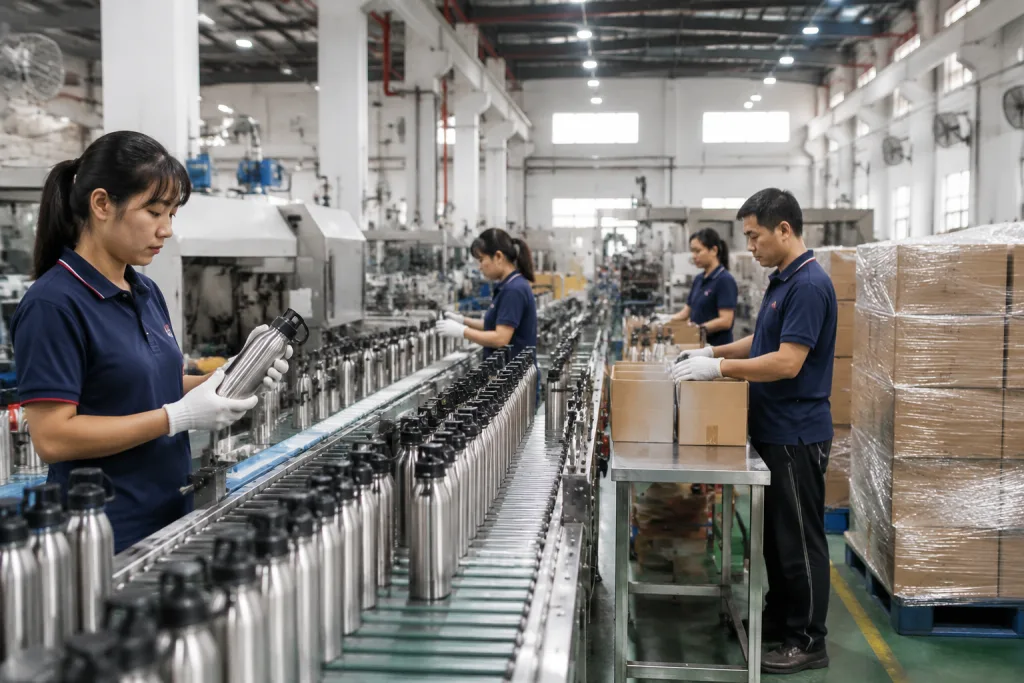
Buying from a refillable water bottle manufacturer gets simple once you stop treating every quote as the same bottle. We run 500 ml units on the line all day, and the split shows fast: one bottle measures 0.35 mm, uses a loose cap, and starts leaking after 200 cycles; the other uses 304 or 316 steel, a tighter neck finish, and cartons that still hold shape after a drop test. That gap is your margin. For Europe or North America, it decides the order.
Most procurement trouble starts with vague specs. A canteen factory in Zhejiang can throw out a low FOB number, but if you leave out coating, lid type, AQL level, and print method, the quote is noise. QC pulled a sample with the wrong lid once because the PO said “matte black” and skipped the finish code. We ship faster when the brief is tight. Ask for lead time, MOQ, monthly output, and compliance papers up front. The first sample looking nice is the wrong question.
What are you actually buying?
The first question is plain: are you buying a bottle, a canteen, a tumbler, or a promo giveaway that only holds liquid? Buyers mix those up, then the quote jumps. A refillable water bottle manufacturer prices by structure first, not by fill volume. A 500 ml single-wall aluminum canteen custom order sits in one cost bucket. A double-wall vacuum insulated custom growler sits in another. A 750 ml customized drinkware item with powder coating, laser logo, and a screw cap with carry loop is a third. We run this split every day on the line, and a caliper at 74 mm settles the argument fast.
Get specific on use. If your customer is a distributor canteen buyer selling to sports retailers, weight and leak resistance matter more than gift-box polish. For a campaign run, a simpler cap and one-color silkscreen logo keep the landed cost down. If you are sourcing for North America, spell out whether the bottle must fit car cupholders, pass dishwasher cycling, or hit insulated performance claims. That is the real question. We had one PO where the buyer wrote “fits cup holder” and the sample measured 74 mm at the base; the math did not work, and QC pulled the sample right back.
Practical rule: if the buyer cannot describe the lid, coating, and end use in one sentence, the quote will be unstable.
Which material fits your channel?
For most B2B drinkware, material drives the deal more than shape. Stainless steel is still the safest default for a canteen manufacturer serving Europe and North America because it holds premium pricing, and the durability claim survives QC. 304 stainless is the workhorse we run on the line. 316 costs more, but it makes sense when the buyer wants better corrosion resistance for salty water, coastal markets, or a higher-end line. Aluminum still fits a lightweight canteen distributor program, yet it dents faster and the lining needs tighter control. Tritan and PET work when you want clear bodies or lower weight, but they do not sell like metal. Best material? That is the wrong question to ask.
Ask the factory for actual material thickness, not a vague “premium grade” line. On stainless bottles, 0.4 mm is a practical start for mid-market SKUs; 0.35 mm can work for cost-sensitive orders if the neck and seam stay tight. We had a buyer flag a PO that said “0.4 thick” with no unit, and that typo cost us 2 days before we could open the line. For a custom canteen or customizable growler, check whether the vacuum chamber welds hold and whether the powder coat passes adhesion checks after thermal cycling. QC pulled the sample after a 24-hour salt spray test when the coating started lifting at the edge. In Zhejiang, we talk in mm, kg, and test results, not marketing copy.
- 304 stainless: our default for retail custom drinkware; stable on the line and easy to quote
- 316 stainless: better corrosion resistance for coastal or salty-use programs; higher material cost
- Aluminum: lighter for carry programs, but dent resistance is weaker
- Tritan/PET: clear or lower-weight builds, usually for price-driven programs
How low should your MOQ be?
MOQ is where first-time buyers get stuck. We see it on the line all the time. A canteen vendor may say "flexible," but the real number moves with print method, color count, cap tooling, and carton layout. For a simple logo on an existing bottle shape, 3,000 pcs is a workable MOQ at many China factories. For a canteen with new mold parts, special lid colors, or gift packaging, 5,000 to 10,000 pcs is more normal. If someone offers 500 pcs on a full custom build, the math does not work. You pay for it in unit cost, or the lead time slips.
The cleaner question is standard, semi-custom, or fully custom. A canteen customizable project using existing tooling can run fast and stay economical. A fully customized canteen with new embossing, special finish, or unique lid geometry starts as a tooling job, not a sales quote. We had one buyer flag a PO that asked for 1,200 pcs, six Pantone lid colors, and a new cap mold in the same order. That was never going to land cleanly. For distributor drinkware programs, split the order into a standard core SKU plus one or two promo variants. You get a cleaner forecast and less dead stock. A good refillable water bottle manufacturer in China should give you a ladder of MOQ and price breaks, not one rigid number.
Factory reality matters. A Zhejiang plant with 120,000 units monthly capacity can handle repeat orders and short replenishment cycles better than a small workshop with no line balance. QC pulled the sample, and the caliper showed a 1.2 mm wall variance on one batch; that is the kind of thing that tells you whether the MOQ is real or just talk. Ask whether the MOQ applies per color, per logo, or per order. Those are not the same thing. The buyer who treats them as the same usually gets a surprise on the first quote.
What compliance should you ask for?
Compliance is not decoration. It keeps customs from holding the load, keeps a retail buyer from killing the PO, and keeps you from paying for the same lab work twice. For Europe, ask for REACH and, where needed, LFGB for food contact. For North America, FDA food-contact declarations and supplier traceability are standard asks. If the bottle has coating, print ink, or silicone parts, test those too. Last month QC pulled a 12 oz sample with a coating mismatch, and the buyer flagged it before shipment. A solid refillable water bottle manufacturer should send material declarations and third-party reports without making you chase them.
Do not stop at a certificate. Check that the report matches the exact SKU, capacity, lid material, and finish you are buying. A report on one canteen sample does not cover every line on the floor. Ask how the factory controls incoming stainless, whether they keep heat number traceability, and whether finished goods are inspected under AQL 2.5 for major defects and 4.0 for minor defects. For custom drinkware sold through retail or Amazon, carton drop resistance, leak testing, and odor checks need to be in writing. We run a torque test on lid threads at 0.8 N m, and that catches the loose-cap issue fast. This is the wrong question to ask after the first shipment fails.
Do not buy on a test report alone. Buy on traceability, batch control, and the factory’s ability to repeat the same result across 10,000 units. We have seen this go sideways on a typo in the PO: one buyer wrote 500 ml, the carton spec said 550 ml, and the math did not work.
How should you compare quotes?
Most quote sheets leave something out. On purpose, or by habit. Compare the landed cost, not the headline number. We had a buyer in Germany flag a PO because one supplier wrote “carton” and skipped 5-ply, so the freight claim came back ugly. A custom canteen at USD 1.85 FOB can still lose to a USD 2.10 offer if the low quote leaves out print, inner box, desiccant, and export carton. Ask each canteen supplier to break out bottle body, lid, logo, packaging, and testing. Keep the Incoterm the same. FOB China against FOB China, or EXW if you are consolidating yourself.
Watch the hidden lines: color surcharge, laser engraving setup, extra cavity charge, carton master size. A distributor canteen order with 1-color silkscreen is cheaper than a promo run with 3 PMS colors and gift packaging. If you need a custom growler or customized growler for beverage channels, check whether the lid is standard or needs a special gasket. The gasket tooling and leak test can cost more than the print. We’ve seen that go sideways. QC pulled the sample on a 12 mm cap and found a 0.3 mm mismatch, so the line stopped there, not at packing. A clean quote usually comes from a supplier that asks clean questions.
- Compare FOB with FOB, not FOB with EXW
- Separate unit price from packaging price
- Confirm print method and logo setup fee
- Ask for carton spec and gross weight
Which logo method makes sense?
Logo method should follow channel economics, not ego. On our sample line, we see the same math every week: screen print is still the lowest-cost pick for a simple canteen custom order when you need 1 or 2 colors and a 3,000-piece run. Laser engraving fits stainless steel better if you want a permanent mark and a cleaner premium look. Heat transfer and UV print handle more complex graphics, but the press room needs tighter control. If the bottle gets washed often or goes through a premium corporate gift channel, laser is the safer call.
Think in product families, not slogans. A canteen customizable program for outdoor retail may use a matte powder coat with a laser logo on a metal body, usually on 304 stainless with a 0.2 mm logo depth target. A customized drinkware program for a distributor canteen account may use screen print on a lower-cost painted surface. A custom drinkware order for an e-commerce launch may need individual barcode labels and FNSKU stickers, and that means the factory has to know Amazon prep, not just decoration. QC pulled the sample and found tape lift after 50 rubs, so we asked for a retest. The buyer flagged a PO typo in the logo file, and that cost us a day. Ask for tape test, abrasion rub, and dishwasher resistance when the claim matters. A canteen vendors list is easy to build; a decoration partner that keeps print and hit rate steady is harder to keep.
What should your checklist cover?
Keep the pre-production checklist tight, and make every field exact. The line does not guess your business model. We lock the drawing before steel is cut or the print screen is made. For a refillable water bottle manufacturer, the checklist should cover capacity tolerance, wall thickness, lid type, seal material, finish, logo placement, and packaging. Leave one field blank, and you pay for rework or a late ship. QC pulled a sample on the bench at 500 ml, and the first shot landed 18 ml off; that kind of miss turns into a dispute fast.
Use this as the working list. We run it on every new PO, even when the buyer says they already sent a spec sheet. The math does not work if the sheet is loose. A buyer once sent a PO with “5000 pcs” in the remark line and “500 pcs” in the item line, and we had to stop the job before the filler ran. That is the wrong question to ask: ask whether the document can survive the line.
- Capacity: 500 ml, 750 ml, or 1,000 ml, with +/- 5% tolerance
- Body material: 304 stainless, 316 stainless, aluminum, Tritan, or PET
- Thickness: 0.35 mm, 0.4 mm, or 0.5 mm depending on price point
- Lid: screw cap, flip top, sport cap, or custom gasketed cap
- Logo: silkscreen, laser, emboss, or UV print
- Packaging: color box, white box, gift box, or bulk pack
- Testing: leak, drop, odor, coating adhesion, and carton compression
If the factory can fill this out without hedging, you are dealing with a competent canteen manufacturer. If they keep saying “no problem” and give you no numbers, stop there. We have seen that go sideways after the buyer flagged a typo on the PO, and the whole carton count had to be corrected. A good canteen distributor relationship is built on defined inputs. Not optimism. On a 48-hour pilot run, that extra correction can burn the whole schedule.
When does a factory deserve repeat orders?
Repeat orders go to the factory that cuts headaches, not the one that sent the loudest first email. A good canteen line quotes the same structure on the second order, ships production photos without a chase, and flags any drift before the cargo closes. We ran this with one buyer who reordered 8,000 units, then 20,000 units; the plant held artwork placement within 1.5 mm and the numbers stayed clean. That is the test.
For Europe and North America, reliability also means paper that matches the goods. Ask for inspection photos, carton counts, and a packing list that follows the PO line by line. We saw a PO typo turn “12,000 pcs” into “120,000 pcs” on the first draft, and QC caught it before print. For canteen programs, mixed-SKU cartons, barcode application, and pallet labels need to run without drama. For custom growler work, gasket hardness and lid torque need to stay within spec after reorders. The boring factories usually win here. Plain answers. Fewer surprises. China has plenty of capacity; the question is which plant treats a reorder like a repeat run, not a fresh experiment.
Send your spec, get a real factory quote
Share capacity, material, lid, logo, and carton requirements. We will price the SKU cleanly and tell you where the cost really sits.
Frequently asked questions
What is a normal MOQ for a refillable water bottle manufacturer?
For a standard custom drinkware order using existing tooling, 3,000 pcs is a common MOQ. If you want new molds, special lid colors, or premium packaging, 5,000 to 10,000 pcs is more realistic. Some small canteen suppliers will quote 500 to 1,000 pcs, but the unit price usually jumps by 20% to 40%. Ask whether the MOQ is per color, per logo, or per SKU, because those are different commercial questions.
How do I check if a canteen manufacturer is credible?
Start with numbers. A real canteen manufacturer should tell you monthly output, lead time, and QC process. For example, a Zhejiang factory might produce 120,000 units per month with a 30-45 day lead time for repeat orders. Then ask for REACH, LFGB, FDA-related declarations, and an inspection standard such as AQL 2.5 for major defects. If they cannot answer material grade, thickness, and packaging spec in the first round, treat the quote as incomplete.
What price should I expect for custom canteen orders?
For a basic canteen custom stainless steel order in 3,000 to 5,000 pcs, FOB China prices often start around USD 1.85 to USD 3.20 depending on capacity, coating, and lid complexity. Laser engraving, powder coating, and gift packaging can move the number up by 10% to 25%. A custom growler or insulated bottle will usually sit higher because vacuum processing and leak testing add cost. Always compare like-for-like FOB terms.
Which logo method is best for canteen promotional projects?
For canteen promotional runs, screen printing is usually the lowest-cost option if you have 1 or 2 colors and a large quantity. Laser engraving is better when you want a durable premium finish on stainless steel. UV print works for more detailed graphics, but it needs tighter process control. Ask the factory for abrasion and tape-test results. If the product will be washed often, laser is usually the safer long-term choice.
Can a China factory handle Amazon prep and retail labeling?
Yes, many canteen factories in China can handle retail prep if you specify it early. Ask for FNSKU labels, barcode placement, inner carton counts, master carton marks, and pallet labels. If you sell in North America, confirm carton dimensions and gross weight before production. A capable refillable water bottle manufacturer should also supply a packing list that matches the PO and can support mixed-SKU shipments if your distributor drinkware program needs it.