Key Takeaways
- A refillable water bottle customizable order usually starts at 1,000 units MOQ and 18-25 days lead time after sample approval.
- For logo work, laser engraving is cleaner on stainless steel; silkscreen is cheaper at about USD 0.12-0.35 per color per bottle.
- Plan on 304 stainless at 0.4-0.5 mm wall thickness for most canteen custom programs; 201 stainless is usually a cost-down move.
- For EU and US buyers, ask for REACH, food-contact declarations, carton drop test results, and AQL 2.5 inspection on critical defects.
You are not buying a bottle. You are signing up for repeat orders, print control, compliance, and freight, all tied to the same ship date. A refillable water bottle customizable looks simple until lid type, coating, logo method, carton strength, and the target size, 500 ml or 750 ml, land on the same PO. We have seen a 0.3 mm print shift turn into a claim. Small miss. Big mess. That is why the wrong spec chews up margin on distributor drinkware programs and retail packs for Europe and North America.
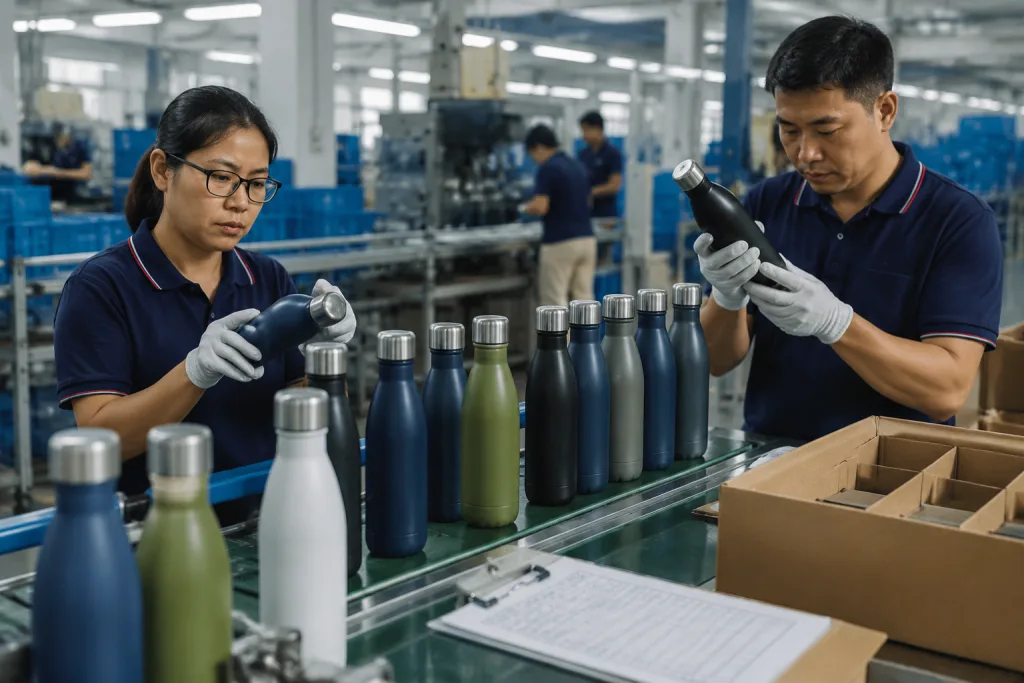
At our factory in Zhejiang, we run it as one chain: spec sheet, sample, pre-production check, mass production, packing. QC pulled the sample with a caliper at 72.4 mm last week because the buyer flagged a cap fit issue, and that number saves a week of back-and-forth on the line. A typical canteen custom run starts at 1,000 units MOQ, with 18-25 days lead time after sample approval, and we ship 300,000 units per month across stainless and Tritan lines. The useful question is not “can you make it?” That is the wrong question to ask. Ask whether the same finish, the same lid torque, and the REACH and food-contact papers will still pass on the second order.
Start With The Order Scenario
A distributor usually walks in with a first PO for 3,000 units of a refillable water bottle customizable model tied to a spring promo. We had one last month. The brief was 500 ml, matte powder coat, one-color logo, and a leakproof lid that still had to survive retail shelves and the odd airline toss-in. That is not a “nice bottle” job. On the line, we check lid torque with a torque meter, and the buyer needs a canteen factory that holds spec, ships on time, and gets the customs file right.
This is where orders slip. Buyers start with artwork and skip use case. A gym-chain canteen promo bottle is a different job from a pharmacy chain drinkware run, and both sit far from a custom growler for a beer brand. If the bottle rides in a bag every day, we check cap torque and seal pull force. If it stays in a retail carton, scuff resistance and barcode placement matter more. The buyer flagged a barcode 3 mm too close to the edge on one run, and QC pulled the sample back. This is the wrong question to ask: boring questions win here. Target price, market, color standard, shipping term, compliance docs.
For a clean RFQ, keep the first brief tight: capacity, material, lid style, logo method, Pantone, packaging, target FOB price, and whether this is for a canteen distributor or a direct brand program. That cuts one sample round and usually 7-10 days of back-and-forth. The math works. Skip the fuzzy notes and send the real spec.
Choose The Right Bottle Body
The bottle body drives cost, weight, and how the buyer reads the SKU on shelf. For stainless steel custom drinkware, 304 is still the default on the line because food-contact checks and corrosion claims are easier to defend. We run 0.4 mm to 0.5 mm wall thickness for 500 ml to 750 ml bottles. QC pulled a 0.38 mm sample once, and the dent rate showed up after a 1 m drop test. Go thinner and returns climb. Go thicker and freight adds dead weight with no shelf value. The math does not work for a refillable water bottle customizable program.
If you are building canteen custom SKUs for retail, coating and hand feel close the first order before the logo gets noticed. Powder coat holds up better than simple spray paint in abrasion checks. A polished stainless body looks clean, but it prints fingerprints fast. Tritan or other copolyesters fit jobs that need a clear fill line or lower weight, yet mold cost is higher and the heat limit has to be stated cleanly. We had a buyer flag a PO typo on the cap spec once, and the cap, gasket, and bottle body no longer matched the same use case. A canteen supplier should call that out before production starts. We see this go sideways at approval.
- 304 stainless: best balance for most custom canteen programs.
- 201 stainless: lower cost, but you need to accept a weaker corrosion margin.
- Tritan body: good for visible fill level and lighter distributor drinkware kits.
Do not let the catalog photo choose the material. Let the channel do it. Retail can absorb a heavier body. Promo orders usually cannot. A 12-day ship plan turns into 18 days fast when a 2 mm wall or a wrong lid thread slips into the drawing.
Pick The Decoration Method
Logo choice drives cost, rub resistance, and shelf read. For a canteen customizable program in stainless steel, we ship laser engraving when the buyer wants the mark to stay put. No peel. On matte and brushed bodies, it comes out clean, and QC pulled the sample back only when depth drifted past 0.15 mm on the laser head. Silkscreen costs less and works for one- or two-color art, but the ink will scuff if the bottle lives in a bag every day. Heat transfer and UV print give room for multi-color branding, though the line adds extra steps and registration can drift.
The numbers are plain. Laser engraving often adds USD 0.20-0.60 per unit, depending on size and path count; silkscreen can start around USD 0.12-0.35 per color per bottle; UV print usually lands higher. For a canteen promotional order, that gap matters because decoration can eat more of the landed price than the base bottle. We had one buyer flag a PO where the logo cost was 18% of the bottle value, then ask why the math did not work. It was the wrong question to ask after the art was already approved. On one run, the logo file came in with a typo in the PO, and that small miss added a full day at the laser station.
Ask for a decorated pre-production sample, not just a blank bottle with artwork shown on a PDF. Ink on a screen is not ink on powder coat.
For a custom growler or customizable growler, logo placement has to clear the hand grip and the condensation line. A mark covered by the palm is dead space. We run a 30 mm keep-clear zone on the sample wrap for that reason, and buyers still ask to move the logo lower until the bottle looks crowded. We've seen that go sideways on retail sets. The tape measure does not lie.
Lock Down Lid And Seal
The lid is where leaks start and where returns begin. For a refillable water bottle customizable order, we lock the lid type with the same care as capacity. Flip lids, screw caps, sports caps, and bamboo-accent lids behave differently on the line and in the hand. For travel retail, a one-hand flip lid can move faster, but it brings more pins, springs, and assembly checks. For hiking or outdoor retail, a screw cap with a carry loop usually stays tighter in use. We run a 12-minute sample check on every new lid spec, and that catches weak hinge feel before the buyer does.
Ask the canteen factory for torque data, leak test method, and gasket material. Silicone shows up often, but 1.5 mm vs 2.0 mm gasket thickness changes the seal more than a brochure line ever will. We run inverted leak tests for 24 hours at room temperature, and for stricter programs we repeat them after hot-fill or cold-fill conditioning. On one EU order, QC pulled the sample and found the gasket hardness had drifted from the approved 65 Shore A; the buyer flagged it before shipment. That is the right place to push back. If the market is the US, ask for ASTM-related material references where applicable. If the market is EU, keep REACH and food-contact declarations ready. The wrong question is “does it look fine?”
One rule we use: once the cap has more than three small parts, the QC plan needs to be stronger. The math does not work otherwise. On a distributor program, a lid with five parts added 18 minutes per carton at inspection, and that slowed the line fast. We have seen that go sideways before, so we keep an eye on torque wrench readings, not just the pretty sample. A PO typo on one job said “sillicone” instead of “silicone”; that kind of slip turns into a material dispute if nobody catches it early.
Set MOQ, Price, And Timing
Buyers still ask for the cheapest FOB price before the spec is locked. That is the wrong question. A refillable water bottle customizable order gets priced from the full sheet: color, decoration, lid type, and packaging all move the number. Last week QC pulled a 500 ml sample on the bench with a one-color logo and a matte powder coat, then the quote shifted again after the buyer flagged a bamboo lid. For that build, FOB China sat around USD 2.20-4.80, and a premium lid pushed it past that fast. Freight from Zhejiang to the US or Europe sits on a separate line. We ship what the carton can survive, not wishful math.
On MOQ, a steady canteen supplier will often quote 1,000 units for a standard bottle and 3,000 to 5,000 units for custom shapes or color work. Custom mold work is a different bucket. Lead time usually runs 18-25 days after sample confirmation for standard customization, and packaging adds 12 days versus 18 days when the insert changes. That gap is real. We add 7 extra days for approvals and 1 more day for carton recheck with the tape gun on the packing table. The line does not care about a PO typo, but the buyer does, and we have seen a wrong lid code hold release for 4 days. The math runs this way.
For distributors, split the buy into two steps: 500 to 1,000 units for the market test, then a larger follow-on. That beats locking 10,000 bottles before you know sell-through. MOQ 1,000 keeps the first run clean, and if the label copy or carton spec needs a fix, you catch it before cash is tied up. We have seen this go sideways when a buyer pushed for a full container on day one. Better to ship the test lot, read the shelf, then place the next order with real data. The barcode scanner only tells you so much.
QC The Order Before Shipping
QC sits inside the order. It is not the last box to tick. We run incoming stainless sheet checks at 0.6 mm with a micrometer, then watch decoration alignment on the line, then do leak tests, function tests, and carton checks before we book the truck. AQL 2.5 is the usual start for consumer goods, but the buyer has to spell out major and critical defects. One buyer rejected a 2 mm scratch on a matte bottle. Another took it. Same bottle. Different channel.
Ask for a pre-production sample, an in-line sample after the first run, and a final random inspection report. That sequence works. For export orders, a third-party inspector can verify quantity, appearance, dimensions, carton marking, and barcode quality. If you sell on Amazon, get FNSKU label placement confirmed before shipment. We had a PO with the sticker line typed as "back panl"; the buyer flagged it, and the label went on the shoulder by mistake. That cost us one day. No mystery there.
- Leak test: inverted, 24 hours.
- Drop test: packed carton from 76 cm or per buyer spec.
- Print check: rub resistance after 50-100 cycles.
- Dimension check: capacity, mouth opening, cap fit, and height.
A good canteen vendor documents the result, not a promise. QC pulled the sample, logged the batch number, and signed the report before we ship. If the carton code is off by 1 digit, the math does not work and the pallet stays here. We’ve seen that go sideways on a Friday loadout. No drama. Just no truck.
Packaging And Shipping Details
Packaging moves margin fast. A refillable water bottle customizable order can ship in a plain polybag with an egg-crate insert, or in a rigid color box with a window and barcode. We ran both on the line last month: the polybag version saved 0.18 USD per set, while the retail box added 42 g and gave the buyer a cleaner shelf look. This is the wrong question to ask if you only care about unit cost. A Shanghai chain buyer pushed back on the box because their shelf team wanted a 260 mm height cap, and that killed the first quote.
For export, master carton strength is the part that gets blamed when goods arrive dented. Double-wall cartons usually earn their keep; the extra few cents beat crush damage in sea freight and forklift handling. QC pulled the sample after a carton failed a 1.2 m drop test, and the buyer flagged a PO typo on the carton mark before we shipped. Carton marks need to match the purchase order, and palletization should be fixed in writing if you want clean receiving. We run 24 pcs per carton on this spec, not “about 20.” A canteen supplier in Zhejiang can run either spec, but loose carton counts get messy at the receiving dock.
FOB is still the cleanest starting point for most B2B buyers because the factory scope stays visible. If you ask for DDP or door delivery, you are asking the supplier to carry freight swings, customs paperwork, and destination risk. The math works only when the lane is stable; we’ve seen it go sideways on a 40HQ to Hamburg when the surcharge moved by 310 USD mid-booking. A forwarder once changed the HS code note on the draft bill and the buyer caught it at noon. That can still work, but you should know exactly what you are paying for.
When To Use Each Bottle Type
Not every PO should go to a straight water bottle. A canteen custom buyer gets a better result by matching the bottle to the channel. We run the same split on the line every week: stainless at 18/8 for corporate gifting, school programs, and outdoor retail; a custom growler or customized growler for beverage brands, taproom merch, and local promos where the package story does the selling; glass for wellness shelves and premium display, with the freight math checked twice because breakage goes up fast.
If you buy for a canteen distributor or build a wider customized drinkware range, set one core SKU and one seasonal SKU. Core means repeatable, low-risk, easy to reorder. Seasonal means color-led, promo-led, limited. A canteen promotional product should not be asked to carry every feature the brand team wants. We had a buyer flag a PO typo on sleeve size once, and QC pulled the sample before carton print started. Keep the bottle fixed, then change decoration, sleeve, or packaging. That is how you avoid dead stock. The math does not work any other way.
At BottleForge in Zhejiang, production scheduling follows the same rule. Stable core items move cleaner through the line, and a 0.3 mm spec drift on the cap seal can stop a batch fast. We ship what holds spec. The best canteen vendors are plain about specs for a reason. Plain wins when you are loading containers out of China on a deadline.
Send your spec and get a real quote
We will price your bottle against material, decoration, packing, and lead time, then tell you where the hidden cost sits before you commit.
Frequently asked questions
What MOQ should I expect for a refillable water bottle customizable order?
For a standard stainless or Tritan bottle, a realistic MOQ is usually 1,000 units. If you want a custom shape, special lid, or Pantone-matched coating, expect 3,000 units or more. For a first test order, some canteen manufacturers will split color and logo options, but that usually raises unit cost by 8-15%. A serious canteen factory should tell you the MOQ per SKU, not just the total order. Ask early whether packaging changes the minimum, because retail boxes and insert trays often do.
Is laser engraving better than silkscreen for custom drinkware?
For stainless steel, laser engraving is usually the more durable option. It does not peel and handles daily washing well. Silkscreen is cheaper and works fine for simple logos, often around USD 0.12-0.35 per color per unit, while laser engraving may add USD 0.20-0.60 depending on size. If your bottle is a canteen promotional item or a distributor canteen program, the right choice depends on whether you want low decoration cost or a premium feel. For powder-coated bottles, both can work, but you should approve a decorated sample first.
What documents should a canteen supplier provide for EU and US imports?
At minimum, ask for food-contact declarations, REACH-related compliance where applicable, material specs, and carton marks. For stainless products, buyers often also request ISO-based quality processes or third-party inspection reports. If you are shipping to the US, you may need packaging and labeling aligned with retail or fulfillment rules, including FNSKU if the stock goes to Amazon. A good canteen vendor in China should provide the paperwork before shipment, not after the container is on the water. If they cannot, that is a warning sign.
How do I reduce leakage risk on a custom canteen order?
Start with the lid. Specify gasket material, lid type, and inverted leak testing for 24 hours. Ask for torque checks and one decorated pre-production sample, not just a blank sample. For a refillable water bottle customizable program, leakage problems usually come from inconsistent gasket fit or a cap that changes during mass production. During QC, inspect the first 30-50 units carefully, then apply AQL 2.5 for appearance and stricter rules for critical defects like leaks. A bottle that leaks once is a rejected bottle, full stop.
Can I order different logos for the same customized drinkware base?
Yes, and that is common for canteen distributors and distributor drinkware buyers. The practical way is to keep the same bottle body, lid, and packaging structure, then change only the logo artwork or color. That protects your MOQ and keeps production simpler. If you split too many logo versions, you risk extending lead time by 3-7 days and increasing setup cost. For a Zhejiang factory running multiple orders, consistency is what keeps your price stable. It is usually better to create one master SKU and let the artwork vary by market.