Key Takeaways
- Refillable water bottle bulk pricing usually changes by 15% to 30% between 3,000 and 10,000 units, so your MOQ matters.
- A usable RFQ needs material, capacity, lid type, decoration, packaging, and target test standards before you ask for FOB.
- Sample approval should cover logo placement, leak test, drop test, and color tolerance, not just appearance.
- A clean bulk PO separates bottle, lid, decoration, insert, carton, and test requirements so you avoid surprise adders.
If you buy refillable water bottle bulk for retail, corporate gifting, food service, or promotion, the expensive mistakes are usually not the bottle itself. It is the small stuff you miss: cap torque, coating adhesion, carton drop test, logo method, and whether the supplier can repeat the same build at 8,000 or 20,000 units. We run into this on the line all the time. A clean sample is easy. Bulk is the hard part.
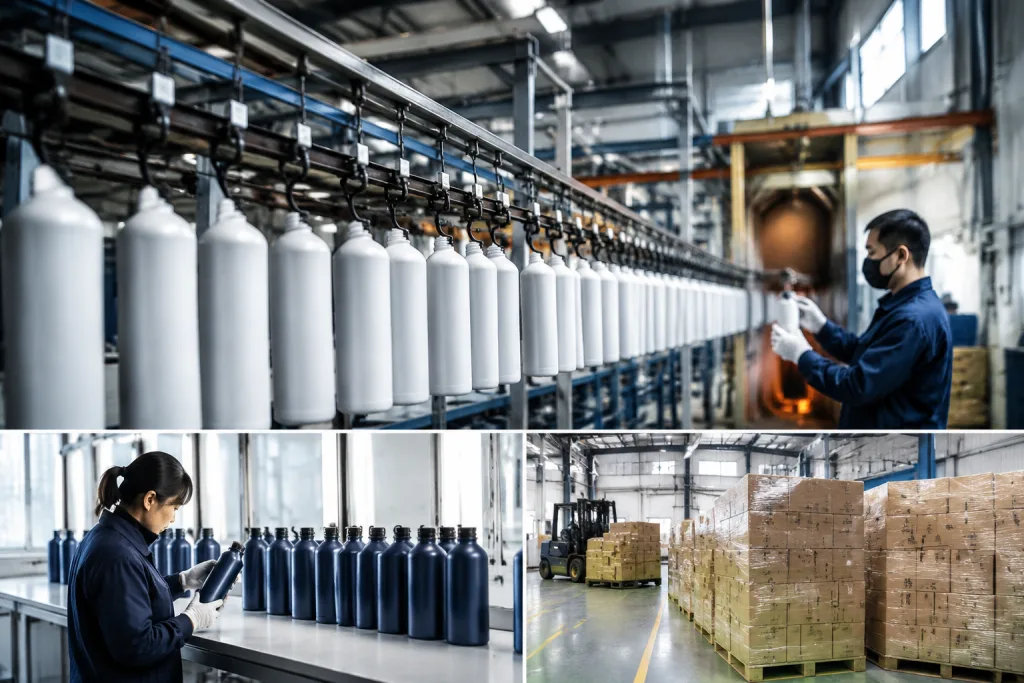
You need a sourcing process that reads like a purchase order, not a mood board. This is the wrong question to ask: “Can you make it?” Ask for RFQ data, check materials against REACH or FDA needs, approve samples with measurable criteria, and place bulk with line items the factory can price cleanly. QC pulled the sample with a 0.3 mm print shift last week, and the buyer flagged it before it became a 10,000-piece problem. A good drinkware factory in Hangzhou, Zhejiang should be able to support 300,000 units per month, quote in 2 to 3 days, and ship a normal bulk run in 25 to 35 days after deposit.
Start with the use case
Before you ask for refillable water bottle bulk pricing, pin down where the bottle sits all day. A 500 ml aluminum gym bottle, a 750 ml stainless bottle for outdoor retail, and a 1 L tritan bottle for wellness kits do three different jobs. We quoted one buyer all three on the same sheet once; QC pulled the sample, and the 0.8 mm wall on the tritan body was fine for kits but wrong for resale. If you blur the use case, the supplier sends the cheapest build and you eat the rejects or the margin hit. This is the wrong question to ask.
For bulk drinkware, the split is simple. Cold-use retail usually runs on PET, tritan, or stainless. Hot-and-cold needs stainless. For a brand launch, a powder-coated steel bottle holds up better than a thin plastic body, and the line shows it in the first hand-feel check. For canteen wholesale or wholesale canteen programs, buyers keep asking for 600 ml to 1 L with a screw cap and carry loop; we ship that spec a lot because the MOQ and carton count stay clean. For beer growler wholesale or growler bulk programs, the closure and seal matter more than the shape. The math doesn't work any other way.
Put the use case in the RFQ. Say retail, promotional, staff issue, stadium, outdoor, or hospitality. We had a PO last month with "stadium" typed as "staduim"; the buyer flagged it, and the fix changed the lid spec before production started. One line. That is enough to steer the factory better than a glossy spec sheet.
Build a proper RFQ pack
A proper RFQ for refillable water bottle bulk fits on one page. Clean, not thin. Leave out capacity or material grade and the factory will quote a generic model, then you lose two days chasing the same question. We see that go sideways on the line. Buyers who send 8 to 12 exact fields usually get a usable quote back in 48 to 72 hours, and we can price it without guessing.
Include these PO-ready details:
- Capacity, for example 500 ml, 750 ml, or 32 oz
- Material, such as 304 stainless, 201 stainless, tritan, or aluminum
- Lid style, like screw cap, flip lid, or straw lid
- Surface finish, powder coat, spray paint, UV print, or bare metal
- Logo method, silk screen, laser engraving, heat transfer, or emboss
- Packaging, including single box, egg crate, or master carton count
- Test standard, such as leak test, drop test, and dishwasher cycles if required
- Target market compliance, such as REACH, LFGB, FDA, or California Proposition 65 screening if relevant
For aluminum bottle bulk or stainless bottle bulk, ask for wall thickness too. We run 0.4 mm to 0.5 mm on insulated bodies for the inner and outer shells; non-insulated bottles usually sit at 0.5 mm to 0.7 mm. If you are sourcing beer tumbler bulk or beer tumbler wholesale bulk, say whether it needs a can-coozie fit or a straight tumbler profile. If you want alcohol flask wholesale bulk, state the fill line and cap retention requirement. QC pulled the sample last week at 0.45 mm, and the buyer flagged a missing fill line on the PO. Precision costs less than rework.
Ask for a real price structure
Do not take one all-in number and call it sourcing. For refillable water bottle bulk, ask for the split, because decoration, packaging, and freight can move landed cost more than the bottle body. A clean quote should show EXW or FOB, any mold or setup fee, unit price by tier, sample charge, and carton spec. If the supplier cannot break those out, you get stuck the moment the MOQ shifts. We saw that on a 500 ml run last month; the buyer flagged the carton line, and the math changed fast. This is the wrong question to ask if you only want a headline number. Ask for the pieces.
For a standard 500 ml stainless bottle from Zhejiang, FOB often lands around USD 2.10 to 3.40 at 3,000 units, then USD 1.85 to 2.95 at 10,000 units, depending on lid and finish. A single-color silk screen logo usually adds USD 0.08 to 0.18 per piece. Laser engraving can cut labor, but if the artwork is complex, the jig setup eats the saving. A gift box can add USD 0.20 to 0.60, and a color printed carton can add another USD 0.10 to 0.25. We run these numbers on the line with a caliper in hand, not a guess. One PO typo on a 304 stainless order added the wrong lid code, and that small line item changed the whole margin.
For growler bulk and wholesale growler programs, the spread is wider because capacity, neck finish, and insulation change the structure. A 64 oz insulated growler can move by 20% to 35% between basic and premium lid builds. That is normal. Compare like with like, or the quote is noise. A bulk growler price with a cheap lid does not help if your retail spec needs a tighter seal and a different handle. QC pulled the sample at 18 mm neck OD, and the buyer still wanted the upgraded cap. We have seen this go sideways when the lid spec gets skipped.
Approve samples like a buyer
Samples show problems fast. We do not approve a bottle because it looks clean on the desk. On our bench, the sample has to pass filling, capping, carton shake, and a 24-hour hold. For refillable water bottle bulk, ask for two pre-production samples: one stays on the shelf, one goes to test. On a chain order, we keep one color master with a 1.5 mm tag card. The buyer flagged a shade shift from a PO typo before, and that argument ate two days. Wrong fight.
Use a simple acceptance list:
- Leak test at ambient temperature and after hot-fill if applicable
- Drop test from 90 cm to 100 cm onto carton corners and flat faces
- Logo alignment within +/- 1.5 mm
- Color tolerance within Delta E 1.5 to 2.0 if color matters
- Lid torque consistency and no thread cross-binding
- No sharp edges, pinholes, or coating fisheyes
For alcohol flask in bulk orders, especially if you call it alcohol flask bulk or alcohol flask wholesale, we check cap seal and odor hold with a 48-hour sniff test. For beer growler in bulk programs, ask about pressure if the bottle ships sealed; a 2.0 bar cap that looks fine can still fail at the seam. QC pulled one sample after 24 hours and found a weak seal line near the shoulder, so the buyer killed the lot before we ran cartons. The math doesn't work if you skip that check.
Insist on a signed sample with date, finish code, logo artwork reference, and carton spec. Without that, you do not have a control sample. You have a sample bottle.
Line up the bulk PO
Your bulk purchase order should read like a shop-floor instruction sheet, not a sales note. We had a buyer flag a PO with “same as sample” and no finish callout; QC pulled the sample, the line sat idle, and the shipment slipped 6 days. Clean PO, fewer arguments. That is the math.
A practical PO structure looks like this:
- Product description with capacity, material, finish, and lid
- Quantity by SKU and color
- Logo method and artwork reference
- Packaging specification and carton quantity
- Inspection level, such as AQL 2.5 major and 4.0 minor
- Compliance documents required, such as REACH, LFGB, or test reports
- Incoterms, usually FOB Ningbo, FOB Shanghai, or FOB Shenzhen depending on your lane
- Target ship date and delay terms, if you have them on paper
For refillable water bottle bulk, keep each cost driver on its own line. A 500 ml bottle, a 750 ml sports bottle, and a 1 L canteen are three different BOMs on our side, even if the shape looks close on screen. If you mix SKUs, split them. If you need bulk drinkware for a promo set, add the carton insert and master carton mark in the PO, or the packing team will guess and the buyer pays later. We have seen this go sideways on 12 days vs 18 days lead time, and a typo on the carton count is enough to trigger it.
Control quality before shipment
Quality control costs less on our line than fixing claims in your warehouse. For refillable water bottle bulk, lock the inspection point before the first 500 pcs run. A supplier worth the deposit will accept inline checks, pre-pack inspection, and a final random inspection to AQL 2.5 for major defects and 4.0 for minor defects. QC pulled the sample at 9:20 a.m., and one lot showed 18 N-m cap torque while another sat at 12 N-m. That gap ships defects.
For a 10,000-unit run in China, we run one pre-production review, one midline check if the logo has two colors, and one final inspection before balance payment. Ask for photos of raw material arrival, body forming, logo application, leak testing, and carton drop simulation. If the supplier is in Zhejiang, ask for batch tracking by date and shift; we use that to catch issues before the truck leaves. The buyer flagged a PO typo once, “10000” turned into “1000,” and that mistake burned two days. The math does not work if you wait.
Test what fails in real use. Caps crack. Threads miss by 0.3 mm. Powder coat scratches at the carton edge. Vacuum insulation drops when seam welding is off. For beer tumbler wholesale bulk, the coating and bottom ring take abuse in transit; for wholesale growler and growler wholesale orders, check handle strength and cap seal after vibration on the shaker table. “Does it look fine?” is the wrong question to ask. We ship drinkware that gets opened, washed, dropped, stacked, and resold, so QC needs to chase those failures first.
Plan freight and compliance early
Freight and compliance are not side notes. They kill margin fast. For refillable water bottle bulk headed to Europe or North America, we check chemical limits before the line starts. REACH shows up on a lot of EU orders. FDA comes up for contact use in the United States. If the bottle is sold as food-contact drinkware, ask for test reports tied to the exact material and print, not a similar sample from last season. We had one buyer push back on a quote because the ink change had not been tested; that pushback saved the order. This is the wrong question to ask after production starts.
Packaging drives the freight math. A 12-bottle inner carton and a 24-bottle master carton change pallet count, CBM, and breakage risk. We run that calculation before samples move. One buyer flagged a PO because the carton length was typed as 510 mm instead of 515 mm. Small typo, big headache. If you are buying wholesale drinkware for Amazon FBA, you also need FNSKU labels, polybag rules, and carton sizes that fit inbound checks. Retail-ready is one setup. Bulk packed is another. The wrong spec turns a good landed cost into a weak one.
For buyers running bulk canteen or best wholesale drink bottle programs, ask the factory for carton count per 20-foot container and 40-foot container. A Hangzhou or Ningbo supplier should put that load plan in the quote. QC pulled the sample on one order and the 40HQ plan was off by 14 cartons because the insert thickness changed from 2 mm to 3 mm. That is the kind of miss that burns time. If a supplier cannot give freight numbers, they do not ship export volume every week. The math does not work.
Use a sourcing calendar that works
Most refillable water bottle bulk orders miss the ship date because the buyer crushes the calendar too hard. A straight stainless bottle usually needs 3 to 5 days for RFQ alignment, 5 to 10 days for sample production, 2 to 5 days for sample transit, 2 to 4 days for approval, and 25 to 35 days for bulk production after deposit. Add 7 to 30 days for freight, sea or air. That is the schedule we run. On the line, a pallet jack waits for the same slot as cartons.
Use the calendar to force decisions. If the target is a holiday delivery, count backward from arrival, not from PO issue. Custom printing, color matching, and gift packaging each need another 5 to 7 days, and the math does not work if you pretend those steps are free. We saw this go sideways on a 500 ml bottle run when the buyer approved artwork late and then asked why the cartons slipped. Zhejiang factories move fast, but the line still has loading, mold checks, and peak-season congestion. This is the wrong question to ask: “Can you hurry it?”
One hard rule: no mass production before signed sample approval. Simple. A lot of projects break here because the buyer wants 12 days and the factory quotes 18 days, then both sides start guessing instead of locking the sample. QC pulled the sample, measured the lid at 68 mm, and the PO still had a typo on the print color. The buyer who writes the timeline into the PO usually gets the shipment that matches the sample. The rest get excuses.
Send your RFQ and lock the spec early
Get a clean quote, sign the sample, and turn your refillable water bottle bulk order into a repeatable production plan from China.
Frequently asked questions
What MOQ should I expect for refillable water bottle bulk?
For a standard refillable water bottle bulk order, a realistic MOQ is 1,000 to 3,000 units per SKU for stock tooling, and 5,000 units or more for heavy customization. A simple one-color logo on a common stainless model can stay at 1,000 units in many China factories, while custom lids, special colors, or molded shapes often push MOQ to 3,000 to 5,000. If you need mixed colors, ask whether the factory can split by 500 or 1,000 units per color. A clear MOQ saves time and avoids pricing games.
What is a fair FOB price for bulk drinkware?
For bulk drinkware like a 500 ml stainless bottle, fair FOB pricing often falls between USD 1.85 and 3.40 depending on wall thickness, insulation, lid quality, and decoration. A plain non-insulated bottle with a basic cap can be lower, while a double-wall vacuum bottle with powder coat and laser logo moves higher. For canteen wholesale or growler wholesale items, the range can widen by 20% to 35% because capacity and hardware drive cost. Always compare the same material, same finish, same carton spec, and same test requirements.
How do I check quality before placing a bulk PO?
Ask for signed pre-production samples, then test leak performance, logo placement, drop resistance, and carton strength. For refillable water bottle bulk, use AQL 2.5 for major defects and 4.0 for minor defects as a working standard unless your program requires stricter control. Confirm material certificates, REACH or LFGB where needed, and photo evidence of the production line. A factory in Zhejiang should be able to give you batch traceability, especially on larger runs. If they cannot track the batch, do not assume the rest of the control plan is stronger.
Can I order mixed styles in one shipment?
Yes, but keep the SKUs separate on the PO. You can combine canteen bulk, bulk growler, and drinkware wholesale items in one shipment if the factory can pack and label them cleanly. Each style should have its own line item with quantity, logo method, carton spec, and compliance requirement. Mixing styles without separate paperwork usually creates packing mistakes, sticker errors, and invoice confusion. For Amazon or distributor programs, separate FNSKU or barcode rules should also be written into the order. One shipment is fine; one vague spec sheet is not.
How long does production take in China?
For a normal drinkware bulk order from China, bulk production usually takes 25 to 35 days after deposit and sample approval. Complex custom lids, special coating, or printed gift packaging can stretch that to 40 to 45 days. Add 7 to 30 days for freight depending on whether you ship air, rail, or ocean. A good Zhejiang factory should confirm a realistic lead time early and stick to it. If someone promises 10 days for a custom bottle run, that is not efficient. It is usually unrealistic.