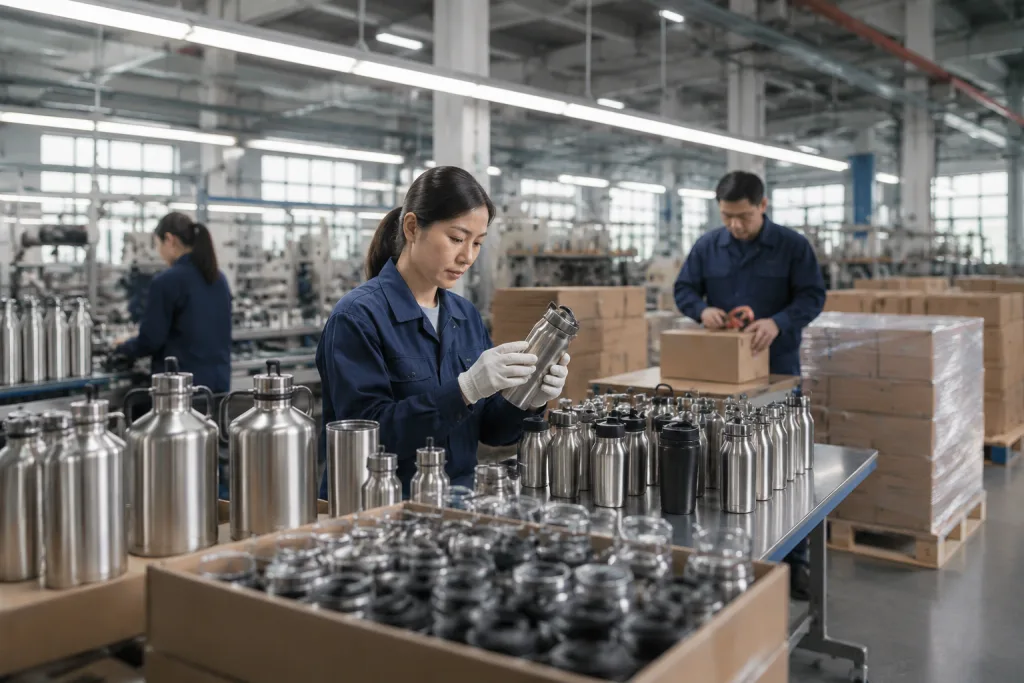
Key Takeaways
- Purchase water bottles wholesale by use case first: hydration retail, sports, corporate gifting, or travel; MOQ often starts at 500 to 3,000 pcs
- A reliable Zhejiang factory should quote lead times in 25 to 35 days for standard orders and show monthly output of 300,000+ units
- For export markets, ask for REACH, food-contact declarations, and production QC by AQL 2.5 for critical defects
- FOB China pricing can vary from USD 1.20 to 6.80 per unit depending on material, lid, and decoration, not just size
Buying water bottles wholesale goes wrong fast when the buyer only checks color or cap style. The bottle passes a catalog photo and then fails on freight, leaks in transit, or gets held up at import. Start with the use case. Retail, promo, ecommerce, foodservice. We run a torque wrench on the line for that reason.
At BottleForge Industrial in Hangzhou, Zhejiang, we see the same pattern every season: buyers chase unit price first and ask about testing after the PO is already moving. That is the wrong order. A 12 oz bottle with a low FOB quote can turn expensive if the lid fails ASTM-style torque checks, the finish scuffs in bulk handling, or the factory cannot repeat the same run in 30 days. QC pulled the sample on a 2.5 mm thread last week, and the buyer flagged the lid for wobble. The useful questions are plain: what material, what closure, what decoration, what monthly capacity, and what MOQ can your supplier hold without guessing.
What the top five really mean
A working top 5 for purchase water bottles wholesale is not five random SKUs with decent photos. It is five buying cases where the bottle changes the math. We rank by margin, freight density, compliance risk, and repeat-order stability. Last week QC pulled the sample at 1,200 cycles, and the buyer still pushed for the cheaper quote. That is the wrong question to ask.
1. Everyday PET or Tritan hydration bottles fit retail and promo jobs when you need low weight, tight carton size, and a price that sits in the USD 1.20 to 2.40 FOB band. 2. Stainless steel insulated bottles make more sense for retail when the buyer wants higher margin and better shelf value, usually USD 4.80 to 9.50 FOB depending on the vacuum structure. 3. Sports squeeze bottles are the line choice for events and clubs when speed matters. 4. Wide-mouth canteen bulk formats work better for campus, outdoor, and industrial use. 5. Specialty growlers or flasks stay niche, but they pay when the channel sells beverage-service accessories or seasonal gift sets. We once had a PO typo on “4000 pcs” that should have been “400 pcs”; the carton plan broke in 10 minutes.
That order flips when the order is not retail. A corporate buyer may care more about print area and carton density than insulation. A distributor may care more about re-order speed than a polished finish. We ship both ways from Hangzhou, and the buyer flagged it on one job where the MOQ was 3,000 but the artwork file needed a 45 mm logo zone. A good Zhejiang supplier should say why one model fits canteen wholesale and another fits drinkware wholesale, plain and straight.
Best option for retail margins
If margin is the target, a straight-wall stainless or Tritan bottle usually wins. Clean sidewalls take pad print and laser marking well, and the shelf price shows it fast. We had a buyer push back on anything above USD 3.20 FOB unless the box and insert looked like a retail set. For private label, 500 to 1,000 pieces on a stock mold is the normal start; once you ask for custom color or a new lid, 3,000 pieces keeps the line busy.
Stainless steel gives the cleanest shot at a premium shelf tag, but it comes with more checks. QC pulled the sample on the weld seam, powder coat adhesion, and cap fit, and that is the right order. A 304 body with 0.4 to 0.5 mm wall thickness is standard on our floor. For a vacuum bottle, we ask for vacuum retention confirmation and finish testing after 24-hour thermal cycling. A polished sample photo does not ship a bad liner.
If you are comparing wholesale drinkware for a chain rollout or an online launch, stable output matters more than a clever spec sheet. BottleForge runs 350,000 units per month, so repeat colors and printed runs stay on the same schedule. We had one buyer flag a PO typo on the lid color code, and that small error would have held the shipment for 12 days. That is the wrong question to ask if you only look at unit price; the math does not work when the next delivery misses the sales window.
Best option for events and clubs
For sports meets, school runs, and club kits, squeeze bottles and lightweight copolyester bottles move first. They cut freight and pack tight. We run this every season. Buyers usually ask for 2,000 to 20,000 pieces, one-color logos, and cartons that stack straight on the line. For tight promo budgets, USD 0.65 to 1.80 FOB is the number that works; trying to push an insulated body into this order is the wrong question.
The mistake is treating all bulk canteen bottles the same. They are not. A 0.2 mm shift in cap seal, nozzle stiffness, or wall clarity changes how the bottle feels in hand and how fast the buyer flags it. For school and fitness programs, 650 ml or 750 ml usually wins. QC pulled the sample on a leak check last month and found a loose cap after 120 drops, so we ask for sample-drop testing and cap-cycle counts before we quote, not after a PO typo shows up.
- Ask for cap open-close cycle targets: 3,000 to 5,000 cycles is a workable baseline
- Ask for carton pack-out: 24 or 48 pcs per master carton changes freight math fast
- Ask for decoration method: silkscreen is often cheaper than laser for a simple logo
For event buyers, canteen bulk and canteen wholesale sourcing only works when the supplier can repeat packing and replenish fast. One clean sample is not enough. We ship reorders off the same packing spec, and that is where the real job starts. The buyer flagged it before on a 6 mm carton mark, and we fixed the print file the same day.
Where growlers actually make sense
Growlers are not broad-market drinkware. They fit beverage retail, hospitality, and gifting. Full stop. We ran a 2,000-piece stainless batch last quarter, and QC pulled the sample twice because the 1.5 mm neck bead was off by 0.3 mm. If the buyer has no craft beer channel or refill service, this is the wrong question to ask. Beer growler bulk and beer growler wholesale bulk orders need thicker walls, tight lid tolerance, and odor control on the cap and liner. A bad closure kills the program fast.
A sensible growler wholesale order usually starts at 1,000 to 3,000 pieces, depending on finish, shape, and packaging. Stainless growlers usually land between USD 5.50 and 11.00 FOB. Glass growler bulk can look cheaper on paper, but the freight math does not hold once cartons start breaking; we saw one 18-day line plan slip to 12 days on the glass option, then the buyer flagged the pallet test. For alcohol flask bulk or alcohol flask wholesale bulk requests, the same rule applies: the customer wants a compact, premium feel, but the pack still has to survive export handling and shelf abuse. We run that check on the drop test rig before we quote.
Do not buy growlers because the unit price looks attractive. Buy them because your channel can sell the same shape 2 or 3 times per year without changing the artwork or cap spec.
If your distributor asks for beer tumbler bulk or beer tumbler wholesale bulk instead, check whether they actually want a vacuum tumbler format with beverage positioning. We get that mix-up a lot. The PO typo is usually one word off, and then the line builds the wrong neck or lid thread. The requirement stays the same: stable QC, clean engraving or print, and a clear food-contact declaration. This is where a 0.2 mm thread gauge saves a week.
Material choice beats size choice
Most first-time buyers start with volume: 500 ml, 750 ml, or 1 liter. Fine, but that is the wrong question to start with. On the line, material decides the sourcing result. PET is light and cheap, Tritan stays clear and drops better, stainless steel carries stronger shelf value and insulation, and glass looks premium until export cartons start taking hits. We shipped a 750 ml glass run once, and the buyer flagged 3 cracked units after the carton drop test. Material won that round.
For Europe and North America, compliance is not a box-check exercise. Ask for REACH declarations, FDA food-contact statements where needed, and nickel or lead limits if the bottle has plated or decorative metal parts. For thermal bottles, ask for ISO-style thermal retention data or a written in-house method with the test time, fill temperature, and ambient room temp. QC pulled one sample at 24 hours because the curve flattened early. On a second PO, that kind of straight answer saves time.
In China, 20 factories can quote a clean sample. Fewer can tell you the resin grade, the lid gasket material, and the defect rate at 5,000 pcs. That is the real test. We run into this on wholesale canteen and wholesale drinkware orders all the time: the buyer sends one approved sample, then the next lot shifts in color, smell, or cap fit. A PO typo like “TPE” instead of “TPR” can cost a week. The math does not work any other way.
Decoration and packing decide profit
Your margin usually leaks in decoration and packing, not in the bottle body. A one-color silkscreen adds about USD 0.08 to 0.20 per unit; laser engraving or a 3-position print pushes the number up fast. We had a buyer flag a 1.5 mm logo shift on the first carton run, and that one mistake killed the premium look. The math does not work if you ignore that step. If you are ordering alcohol flask wholesale or wholesale growler units for premium channels, the box and insert carry almost the same weight as the container itself. Retail buyers spot dents, scuffs, and off-center print in seconds.
For export programs, I ask buyers to lock three things early: artwork format, print position, and carton spec. That keeps the sample from drifting away from the production lot. QC pulled the sample with a 0.3 mm plate tolerance once, and the approval still failed because the buyer sent a PDF with the wrong bleed. Ask for an AQL plan that separates critical, major, and minor defects. AQL 2.5 for major defects and 4.0 for minor defects is common, but the acceptance number needs to sit on the purchase order, not in a side email. This is the question to negotiate, not a 2-cent unit price cut.
Packaging also changes freight density. A bottle in a single-color kraft box costs more, but it can lift retail conversion. A plain polybag saves money in bulk drinkware and drinkware wholesale orders, yet it hurts shelf presence and gives the buyer less room to charge up the line. We run this with carton pack tests all the time: one export case at 24 pcs versus 36 pcs can change the cubic meter count enough to move freight by a full pallet. Tie the pack spec to the channel. Do not let the factory default decide it for you.
How to vet a China supplier
Check the supplier fast, but check it on facts. Ask for factory photos, BSCI or an equivalent audit file, and the last 3 months of output on the same SKU. On our line, QC pulled a random 500 ml sample before lunch, and that tells you more than a polished sales deck. For standard items, a Zhejiang factory should send a sample in 3 to 7 days. For custom work, ask straight whether mold lead time is 18 to 30 days and mass production is 25 to 35 days after sample approval. If they dodge those numbers, the math does not work.
Then test the export paper trail. You need the commercial invoice, packing list, HS code support, and the right label format for your market. One buyer sent a PO with “carton lable” spelled wrong, and we caught it before the ship date. If you ship through Amazon, ask about FNSKU placement, carton marks, and case-pack uniformity. The buyer flagged it? Good. If the supplier treats that as a surprise, move on. A real Zhejiang partner knows the shipment is not done until paperwork, carton count, and test reports match.
For buyers sourcing bulk canteen, growler bulk, or alcohol flask in bulk, tolerance control across mixed runs matters more than a cheap sample quote. We run 2 mm checks on cap fit and neck finish for a reason, because one loose run can blow up the whole order. China has plenty of factories. The wrong question is how low they can quote; the right one is whether they can hold spec on export volume without slipping at 5,000 units.
Use cases that justify each option
If you want to purchase water bottles wholesale without burning time on dead-end quotes, match the bottle to the channel first. Retail resale needs a steady carton spec and decoration that lands the same on run two. Promo jobs need low MOQ and a lead time we can hold on the line. Foodservice and hospitality need a body that survives wash cycles. Outdoor and campus programs need low weight, tight lids, and cartons that cube out cleanly. We had a buyer flag a 1.2 mm wall on a campus bottle because it looked fine on the sample bench and failed the drop test after 18 cycles. That was a real miss. We see it a lot.
- Retail launch: stainless or Tritan, MOQ 500 to 1,000, FOB USD 2.40 to 6.80
- Promo campaign: squeeze bottle or basic canteen bulk, MOQ 1,000 to 3,000, FOB USD 0.65 to 1.80
- Premium gift set: vacuum bottle or growler wholesale, MOQ 1,000+, FOB USD 4.80 to 11.00
- Marketplace replenishment: light, standardized drinkware bulk with repeatable cartons and labels
We see buyers search for alcohol flask wholesale bulk, beer growler in bulk, or beer tumbler in bulk when what they need is a compact gift item with a drink theme. That is the wrong question to ask. We check the cap, print area, and compliance file against the channel, then QC pulled a sample with a 2 mm print offset and the buyer still approved it after we fixed the carton insert. A product that moves once and breaks on reorder is a bad buy.
Request a supplier quote with real specs
Send your target volume, lid type, decoration method, and market. We will quote the right bottle, not the cheapest guess.
Frequently asked questions
What MOQ should I expect when I purchase water bottles wholesale?
For standard stock-style bottles, a realistic MOQ is 500 to 1,000 pieces per color or SKU. For custom color, logo, or packaging, 1,000 to 3,000 pieces is more normal. If you need custom tooling, expect 3,000 to 5,000 pieces before the pricing becomes workable. In Zhejiang, many factories can sample in 3 to 7 days and move to mass production in 25 to 35 days after approval. Always ask whether the MOQ is tied to one color, one logo method, or one carton spec, because those are not the same.
What is a fair FOB price for wholesale drinkware?
It depends on material and decoration. Basic PET or squeeze bottles can start around USD 0.65 to 1.20 FOB. Tritan bottles usually sit around USD 1.40 to 2.80. Stainless vacuum bottles often run USD 4.80 to 9.50, and premium growlers can go above USD 11.00 with packaging. If a quote is far below that range, check whether it includes printing, leak testing, and export cartons. Low upfront price often means hidden costs later.
How do I check quality before placing a large order?
Ask for pre-production samples, then define acceptance by defect category. A common approach is AQL 2.5 for major defects and 4.0 for minor defects, with critical defects set to zero. You should also ask for closure torque checks, drop testing, and leak tests after thermal cycling for insulated products. For imported bulk drinkware, request food-contact declarations, material specs, and photos of the actual production line, not just catalog images. A disciplined supplier in China will provide all of that without drama.
Can I source canteen wholesale and growler wholesale in the same factory?
Yes, if the factory handles both molding and decoration well. Many buyers combine canteen wholesale, wholesale growler, and even alcohol flask wholesale bulk programs with one supplier to simplify freight and QC. The catch is consistency: the factory needs enough monthly capacity, usually 200,000 to 300,000 units or more, and clear process control across different body shapes. If the factory cannot show separate test records for each category, split the order. One weak product line can contaminate the whole shipment schedule.
What documents do I need for Europe or North America?
At minimum, ask for commercial invoice, packing list, product photos, and a food-contact or REACH declaration depending on the market. For retail programs, you may also need carton markings, barcode placement, and FNSKU labels if you are selling through Amazon. If the item has vacuum insulation, coated parts, or plated hardware, request the relevant material declarations and test reports. A good supplier in Zhejiang will know which documents are standard and which are market-specific, and they should be able to send them before shipment.