Key Takeaways
- 304 stainless steel is the practical base choice for 90% of bulk thermos programs; 316 is usually reserved for harsher use cases.
- A realistic MOQ for custom thermos in Zhejiang is often 1,000-3,000 pcs per SKU, with 25-35 day lead time after sample approval.
- FOB China pricing for a standard 500 ml stainless thermos typically starts around USD 2.80-4.90 depending on lid, finish, and decoration.
- Ask for AQL 2.5/4.0 inspection, REACH documentation, and heat-retention data at 95 C and 23 C ambient before you place an order.
Buy vacuum flask wholesale on the wrong spec, and you pay after the invoice clears. A 304 steel body can pass the first look and still fail when the lid leaks, the powder coat chips in transit, or the print drops at 5,000 cycles. We had a buyer flag a 2 mm lid gap on the first carton check. That one line item cost more than the unit price.
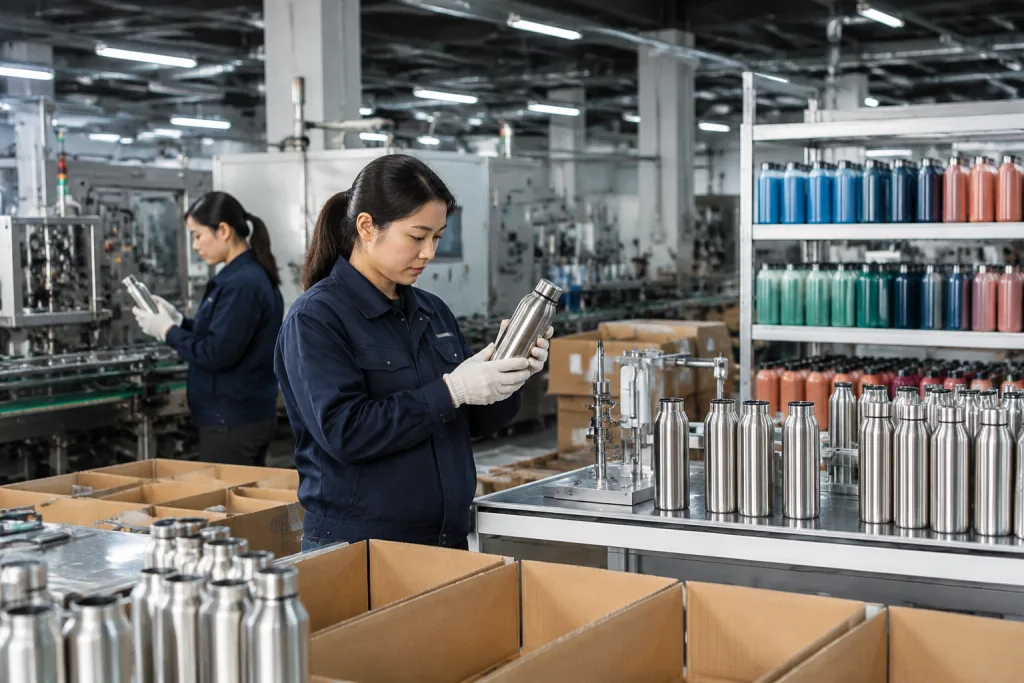
We build and export stainless thermos from Zhejiang, China, and the pattern is stable: the buyers who do well treat the flask as a packed product, not a bare bottle. If you need bulk thermos for retail shelves, distributor thermos for regional channels, or promotional thermos for campaigns, check the shell thickness, lead time, and test standard first. The math does not work any other way. A serious thermos factory gives you the wall gauge, lead time, and test standard before sign-off, and QC pulled the sample before we ship.
What buyers should rank first
If you are comparing options for purchase vacuum flask wholesale, rank the use case first, then price. Outdoor retail needs insulation, a grip that does not slip with gloves on, and a shell that survives a 1.2 m drop. Promo jobs need a clean print panel, stable color, and cartons that ship the same from lot to lot. Distributor thermos programs need fewer headaches: repeat orders that match, tight carton counts, and low damage rates. We shipped one 20,000-piece run last month where the low quote lost money after claims, and that is the wrong question to ask.
For a basic stainless thermos, we rank the buying points in this order: insulation performance, lid sealing, body material, surface finish, decoration method. A 500 ml bottle that keeps water at 70 C for 12 hours and 55 C for 24 hours is not the same build as a 350 ml day-hike flask. QC pulled the sample on the bench at 1.2 kg drop force, and the buyer still pushed for a cheaper lid. The math does not work. Better suppliers in Zhejiang will put those numbers in writing, not just in a sales deck.
Use these checkpoints before asking for samples:
- Material: 304 inner and outer walls for general use; 316 if you want stronger corrosion resistance. We check the 304 stamp at the line before polishing.
- Wall thickness: commonly 0.4-0.5 mm on quality bulk thermos builds. Thin walls bend fast, and we have seen 0.35 mm fail on the vacuum seam.
- Seal test: 100% leak test on assembly, then carton drop test for export packs. We run the inverted water test on every shift.
- Compliance: REACH for Europe, FDA-grade material declarations for the US, and if needed, LFGB on request. One PO typo on the buyer name once held customs for 3 days.
Best option for retail sell-through
Rank 1: straight-wall 500 ml stainless thermos with screw cup lid. This is the safe pick. Simple to explain. Easy to stack, easy to reorder, and a shopper gets it in 5 seconds on the shelf. The outdoor retail buyer wants a custom thermos with broad appeal and low return risk. We run this shape a lot because it packs tight, the print panel is wide, and the unit cost stays in line. For most channels, I start here.
Typical FOB China pricing sits around USD 3.10-4.20 at 1,000 pcs, depending on spray paint, powder coating, or brushed steel. A proper 500 ml model usually measures 26-28 cm tall, weighs 280-350 g, and keeps hot water above 60 C for 12-18 hours in standard lab conditions. QC pulled the sample with a tape measure on the line before we ship, and one PO landed with a 50ml typo that would have broken the carton plan. This is the number to make the factory back up with a test report, not a brochure claim.
It ranks first for one plain reason: fewer moving parts, fewer lid complaints, less crush damage in transit. That is the whole math. For distributor thermos programs, that beats a fancy silhouette. We have seen glossy shapes go sideways when the buyer flagged lid leaks after 200 drops in carton tests, and a 2 mm lid gap was enough to sink the sample. If your customer wants a promotional thermos with a logo and one Pantone color, this format gives the best shelf presence for the money. You can decorate it by silk screen, laser engraving, or UV print, and the MOQ stays predictable.
Best option for premium gifting
Rank 2: 316 stainless vacuum flask with double-wall lid and matte finish. Use this when the buyer wants a premium custom thermos and can accept a higher FOB. We ship this build for corporate gifting, executive packs, and outdoor labels that need a stronger material story. The 316 inner wall is not for every order, but it earns its place with acidic drinks, flavored beverages, or humid storage that runs 3 months plus. Sample room said the same thing after a tea test at 72 hours.
At 1,000 pcs, the price usually sits around USD 4.80-7.20, and MOQ is often 1,000-2,000 pcs depending on print and gift box setup. A standard build uses a 0.5 mm inner wall and 0.5 mm outer wall. That gives better dent resistance than the cheap bulk thermos line. The trade-off is weight and cost. We had a buyer push back on this before, then QC pulled the sample after a 1.2 m drop test and the dent was obvious. The math does not work if you skip that part.
For logo work, laser engraving on matte steel gives the cleanest result and does not flake. If the artwork needs strong color, we run a two-layer powder coat and check scratch resistance with a 3H pencil standard. Ask for salt spray data too. A thermos manufacturer in China should show sample panels and call out whether the finish passes 48-hour salt spray, because one PO typo on the coating code can turn into a rework order fast.
Best option for promotions
Rank 3: 350 ml compact promotional thermos with color sleeve. This is the pick for reach, not 12-hour heat hold. We run these for giveaways, mailers, and bundle packs because the body is small, the freight cube stays sane, and the unit price stays inside the campaign budget. The bottle still needs a clean finish. It does not need retail extras, and this is where a lot of buyers ask the wrong question.
At 3,000-5,000 pcs, FOB China pricing usually lands around USD 2.30-3.60, depending on lid type and print coverage. MOQ on a simple straight-wall body can be lower, but the real issue is decoration repeatability. QC pulled the sample on a 1.2 mm logo line once, and the buyer flagged it; that line would have filled in on the curved shoulder. For thermos customizable jobs, silk screen or laser engraving holds up better than a full wrap with four colors.
Because the bottle is small, set the heat claim with some discipline. A 350 ml unit usually holds temperature for 8-12 hours, which fits commute bags and desk use, not a hike with a 24-hour target. We ship with 24-bottle cartons and fit tests before palletizing, since one bad carton pattern can add freight waste fast. On a promo run last month, the PO had a typo on the sleeve color code, and that cost us a day on the line. For a thermos distributor, the math has to work after ocean freight, duties, and the sleeve cost.
Best option for travel and commuting
Rank 4: slim travel thermos with one-hand open lid. This is the pick for commuters, site crews, and buyers who need cup-holder fit. We ship this shape fast because it looks useful, not decorative. The lid does the selling. If one hand opens it and the lock holds, the buyer stops arguing about the body finish and starts asking for carton counts.
For a 450-500 ml body, we run a diameter of 6.5-7.2 cm and a height of 23-26 cm. That gives shelf presence without fighting a backpack pocket or car holder. FOB usually lands at USD 3.40-5.50 for 1,000 pcs, depending on the lid structure and whether you want soft-touch coating. On the line, we check hinge fatigue with a 3,000-cycle test; 2,000 looks fine on paper, then QC pulls the sample and finds play in the latch.
This is where thermos sales teams get sloppy and talk only about shape. Wrong question. The lid gets touched every day, and a weak seal turns a good bottle into complaint emails. We’ve seen it go sideways on a PO with a typo in the lid color code, so ask for a hot-water fill, a shake test, and an upside-down leak check before mass production.
Best option for brand campaigns
Rank 5: wide-mouth thermos with gift box pack-out. This is the pick for brand campaigns that need shelf punch, a clean unboxing, and a bundle story buyers can explain in one line. We run this style for holiday sets, retailer exclusives, and branded kits. The 58 mm mouth gives room for coffee, tea, or plain water, and it leaves more print space for a logo or wraparound message.
At 1,000 pcs, the usual price sits around USD 3.80-6.30, and the box adds another USD 0.30-0.80 depending on the insert. One buyer cut the box spec from 2.5 mm to 1.8 mm board, then the corner crush showed up after a 1.2 m drop test. That save-back was noise. We checked the ECT sample on the carton line, and the box still failed at the corner fold. If you source from a thermos factory in China, ask for carton compression testing and drop testing on the full retail pack, not just the bottle.
This also fits thermos bulk programs where one distributor needs the same bottle in 3-5 stock colors. On our line, we keep the core tooling and still run one or two imprint options, so the MOQ stays sane and the artwork stays clean. QC pulled the sample on a 304 stainless run last month and caught a PO typo on the lid color code before we shipped. That repeatability is the point; the math does not work if every campaign turns into a new mold discussion.
How to judge the factory
Judge a thermos factory on process control, not sample shine. A hand-polished demo can hide a weak line; a 10,000-piece order will show it fast. On real visits in Zhejiang, the good plants put numbers on the whiteboard: 300,000 units per month capacity, 25-35 day lead time, sample in 5-7 days. We run checks on those figures because they tell you if this is a real thermos manufacturer or a trading desk in a factory coat. I have seen a 12-day sample promise turn into 18 days after the line hit a stainless brush shortage. That delay costs bookings.
Ask for these before you sign off mass production:
- Material declarations: 304 or 316 stainless, silicone grades, PP or Tritan lid components.
- Inspection plan: AQL 2.5 for critical defects, AQL 4.0 for minor cosmetic issues.
- Test data: heat retention at 95 C fill temperature, leak test, and finish adhesion.
- Compliance docs: REACH, LFGB if needed, and carton master data for shipping.
If the seller cannot tell you which defects are critical and which are major, the math does not work. We saw this go sideways on a 12,000-piece PO where the buyer flagged a lid print typo after the cartons were packed. That is not a minor issue. Once you buy bulk thermos for North America or Europe, vague answers stop at the dock, and QC pulled the sample is not the same thing as a clean shipment. Ask for the gauge names too, like a 0.02 mm film thickness check and the torque wrench log. If they dodge that, we stop the talk.
Ordering without expensive surprises
The cleanest way to buy vacuum flask wholesale is to lock the spec sheet before discount talks start. We run this on the line every week: 500 ml or 750 ml capacity, 304 stainless or 201, 0.35 mm wall thickness, lid type, insulation target, finish, logo method, carton count. Put the boring bits on paper too, like spare gasket, outer box, and a bilingual care label. Leave those open and landed cost jumps after approval.
For most buyers, the practical path is simple. One sample round first. QC pulled the sample, checked print and leakage with the vacuum tester, then we moved to a trial order of 500-1,000 pcs. After the carton and decoration pass, scale to 3,000 pcs or more. That is where unit cost usually drops 8-15%, especially on repeat colors. We saw a buyer push back on this once, calling it slow; the math does not work for their margin, and the first PO typo on “inner box” instead of “outer box” would have cost them a reprint.
Customizable thermos projects do not fail because the bottle shape is wrong. They fail because the buyer skips spec control. A solid thermos supplier will tell you where the money sits: a branded retail SKU, a promotional thermos, or a higher-end customized thermos line. Pick the one that fits the channel. That is the real question. We had one 8,000 pcs run stall because the buyer changed the lid drawing after tooling, and the caliper reading on the neck finish was off by 0.4 mm.
Get a factory quote for your thermos line
Send your capacity, lid type, logo file, and target market. We will quote FOB China pricing, MOQ, and lead time for your bulk thermos order.
Frequently asked questions
What MOQ should I expect when I purchase vacuum flask wholesale?
For a standard stainless thermos, a realistic MOQ is 1,000 pcs per color or per logo setup. Some thermos manufacturers in Zhejiang can start at 500 pcs on stock bodies, but custom colors, special lids, or gift boxes usually push it to 2,000-3,000 pcs. If you need multiple SKUs, treat each decoration method as a separate MOQ because screen setup, laser jigs, and carton inserts all add real cost.
How much does a custom thermos cost FOB China?
A basic 500 ml stainless thermos usually sits around USD 2.80-4.90 FOB China at 1,000 pcs. A premium 316 build or special lid can move it to USD 5.00-7.20. Logo printing is often USD 0.08-0.35 per color, while laser engraving is commonly USD 0.15-0.45 depending on size. Ask the thermos supplier to quote with packaging included so you do not get surprised later.
What insulation performance is acceptable for bulk thermos orders?
For retail-grade bulk thermos, a reasonable target is 60 C or higher after 12 hours and 45-55 C after 24 hours, tested with 95 C fill water at room temperature around 20-23 C. The exact result depends on capacity and lid design. Smaller 350 ml units usually retain heat differently from 500 ml or 750 ml bottles, so compare like with like. Always ask for the lab sheet, not a verbal claim.
Which decoration method is best for promotional thermos programs?
For one-color logos, silk screen is usually the lowest-cost option. For a clean premium look, laser engraving is better, especially on matte or brushed steel. UV print works when you need more color but it can cost more and may need extra care on curved bodies. If you are buying thermos promotional stock for a campaign, choose the method that survives handling and transit, not just the method that looks good in a photo.
How do I check if a thermos factory is reliable?
Ask for factory capacity, QC records, and compliance documents. A real thermos factory should tell you monthly output, such as 300,000 units, production lead time of 25-35 days, and sample lead time of 5-7 days. They should also explain AQL levels, provide REACH documentation for Europe, and show leak and insulation test data. If the answers are vague, you are probably talking to a trading layer rather than a manufacturer.