Key Takeaways
- Raw stainless steel accounts for 40-60% of the total FOB cost; a $0.10/kg price swing impacts your unit price by $0.05-$0.08.
- Standard MOQ for custom colors is 1,000-3,000 units per color; dropping to 500 units often adds a 15-20% surcharge.
- True lead time from deposit to FOB port averages 45-55 days for custom orders, not the standard 30-day quote.
- Laser engraving tooling costs are negligible ($0-$50), but rotational printing setups run $200-$500 per design.
You have likely seen the quotes: a distributor offers a stainless thermos at $3.50, while factory direct sits at $2.80. The spread looks tidy on paper. We ship enough of these to know the math does not stop there. Once QC pulls the sample and checks the 0.35 mm liner, landed cost starts moving with tooling amortization, vacuum spec, and freight terms. Miss one line item, and the SKU stops behaving.
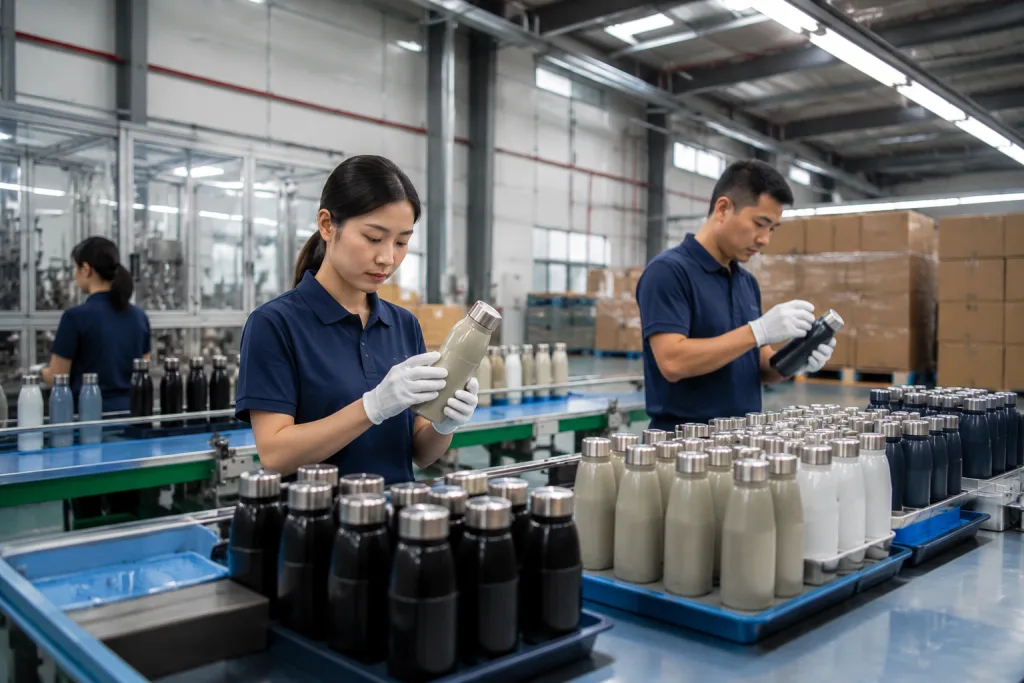
This section breaks the price down without the fluff. We run this every week on the line in Zhejiang: raw steel surcharge, cap molding, carton size, even the tape width on the outer box. A buyer once flagged a PO typo on carton count, and the shipment cost jumped for no good reason. We will also lay out a production timeline that is closer to 12 days vs 18 days on straightforward runs, since the neat "30 days" claim falls apart once decoration, sampling, and inspection get into the schedule. If you are buying 1,000 units or pushing 50,000, this is the part that keeps the supply chain honest.
The Anatomy of a Stainless Thermos Unit Price
When a thermos manufacturer sends a quote, stainless coil is the first line we check. At 9:00, we run 304 (18/8) stock through the gauge and watch the price move by lunch. Most Zhejiang factories keep 10 to 14 days of coil on hand, not 30. Nickel spikes do not wait for your PO. For a standard 500ml double-wall vacuum flask, the blank starts around 220 grams before trimming, and deep-draw scrap usually sits at 8% to 12%. That waste lands in the unit price whether the sheet shows it or not.
The vacuum step is where buyers get caught. We run an 8-hour retention test as the base check, while outdoor buyers ask for 12 hours or 24 hours because 8 hours does not match their shelf claim. To hit that spec, the bake-out runs slower and the conveyor drops 15%, which burns more gas and ties up the line. QC pulled a sample on a 24-hour order last month and found a weak spot at the shoulder weld. Ask for the hour target, wall structure, and test method. “Can you just keep warm?” is the wrong question. We have seen that go sideways when the factory saves a few cents by thinning the copper plating inside the outer wall, then the buyer flags it on first inspection.
Cost Tiers by Volume
Volume decides how hard the dies work and how much hand labor the assembly line needs. A 100-piece trial is a different animal from a 3,000-piece run. The math does not work the same. On one trial, the caliper showed a 0.3 mm lip variance, and that alone changed the rework count. That is why MOQ and setup time matter before anyone talks margin.
- Sample Run (50-100 units): $8.00 - $12.00/unit. Manual assembly, die setup, and a lot of hand checks.
- Small Batch (500-1,000 units): $4.50 - $6.00/unit. Often run on older lines with higher defect rates (AQL 2.5 vs 1.5).
- Production Run (3,000+ units): $2.80 - $3.80/unit. Better line efficiency, automated welding, and lower carton cost per piece.
Those numbers assume standard 304 steel and a powder coat finish. Add hammertone or hydro-dipping, and you are usually looking at another $0.40-$0.80 per unit. Buyers push back on that every time, then sign after the first sample gets scratched in transit. A PO typo on one job listed “hammertone” as “hammer tone 2,” and the line had to stop for a material check. That kind of slip costs half a day.
Minimum Order Quantities: The Real Flexibility
The standard MOQ for a thermos factory is usually 1,000 units. That number comes from the powder coating line, not from a sales brochure. We run a 2.5 mm spray gun setup, and a color change means washing the booth, clearing the filters, and burning 2-3 hours before the first good piece lands on the rack. The math does not work for tiny lots. Most factories want 3,000-5,000 units in one color so setup cost gets spread out. For a thermos distributor, the real question is whether the buyer will accept a split run. We have shipped 500 units per color before, but only when the total order quantity (TOQ) still held at 3,000 units. A 1,200-unit order with four colors sounds flexible on paper. On the line, it is a headache.
For promotional thermos buyers, MOQ works a different way. The logo job is the easy part. If a thermos supplier keeps blank stock on the shelf, QC can pull the sample and get you down to 100 units with one-color printing. The catch is finish choice. You get stock white, black, or silver cans, not a custom Pantone match. We saw one buyer flag a PO typo on the Pantone code, and that saved them from a 1,000+ unit color run they did not want. That mistake would have cost weeks. Ask the stock finish first. Then check print position and carton mark.
Do not read a low MOQ as a good deal. We've seen that go sideways. A factory quoting 100 units on custom color is often sending coating out to a smaller shop, and then lead time stretches from 12 days to 18 days while the finish drifts from sample to bulk. A direct thermos manufacturer will usually hold the 1,000-unit color minimum because the line needs it. Clean process. Stable output. The buyer wants flexibility; the factory wants a run that keeps the oven full.
Tooling Costs for Customization
Customization is not just the logo. Shape and finish move the price too. For a standard cylindrical bulk thermos, tooling cost is zero because we already have thousands of molds on the line. Once you ask for a new body curve or a custom lid, the bill starts moving fast. A body mold usually runs $5,000 to $12,000, depending on draft angle and wall draw. We had a buyer push back on a 0.8 mm shoulder radius once, and the sample cracked on the first press. That mold stays here in Zhejiang. The buyer owns the tool record, not the workshop floor.
Logo tooling is cheaper, but the method changes the bill fast:
- Laser Engraving: No physical mold. We run it from a digital file, and setup is usually $0-$50.
- Silk Screening: Needs a stencil. $50-$100 per color. Good for 1-2 color logos.
- Heat Transfer: A copper plate is made. $200-$400. Works for full-color prints.
- 3D Relief Printing: A metal mold is made. $300-$600. Gives the logo a raised feel.
When you purchase thermos wholesale, ask who owns the logo mold. We saw a PO typo on the stencil line turn into a billed “maintenance fee” for an $80 screen, and the math does not work. This is the wrong question to skip. A straight-shooting thermos supplier rolls the mold cost into unit price on orders above 2,000 units, and QC pulled the sample before packing, so there was no back-and-forth at ship time.
Lead Time Phases: From Deposit to Port
The biggest complaint we hear from distributors thermos buyers is the gap between the quote and the dock date. A factory says 25 days, then the cartons leave in 45. That is the wrong question to ask. The quote usually covers production only. Pre-production and port handoff sit outside that number. On our line, one missing artwork bleed or a PO typo can burn 2 days before we run the first sample. Here is the real split for a custom order:
- Pre-Production (7-10 days): Mold work, sample approval, and raw material buying. If you want a golden sample, add 5 days for courier time. QC pulled the sample and the buyer flagged the color chip before we released the order. That saved a rework on the 420 ml spec, which is the kind of detail that gets missed when people only stare at the quote.
- Production Queue (5-10 days): Your order waits its turn. In August to October, we see 15-20 days here, and the math does not work if you are promising a tight promo launch. We run by slot, not by wishful thinking, and a 3,000 pcs MOQ still sits behind the jobs already on the machine list.
- Manufacturing (20-25 days): Stamping, welding, vacuuming, coating, and assembly. A 304 stainless shell does not move itself; we run each batch through fixed stations, and one missed weld check can stop the next cart. A caliper on the bench will tell you fast. If the seam is 0.2 mm off, QC catches it before the lid line gets packed.
- QC and Packaging (3-5 days): Final inspection, drop test, then carton packing. AQL 2.5 is the benchmark we ship against, and a wrong carton mark can add another day. We had one PO with “CTN” typed as “CNT” and the buyer flagged it before labels were printed. Small typo, big delay.
Total Lead Time: 35-50 days.
If you are sourcing a thermos bulk order for a seasonal promo, place the deposit at least 70 days before the ship date. We build in 2-3 extra days for artwork fixes and packing list corrections, because a buyer once sent “5000 pcs” on the PO and wrote “4500” in the email. That sort of mismatch costs time. It also pushes the carton count off by 55 cases on a 12,000-unit run. The math is simple. A Thursday deposit and a Monday shipment plan do not live in the same factory.
Factories in Zhejiang close for Chinese New Year for 2-3 weeks. Orders put in during January often do not ship until early March. We’ve seen this go sideways when buyers booked cargo first and factory space second. Plan inventory around the holiday, not around hope. The line stops, the warehouse fills, and the vessel booking does not wait. One missed booking can turn 18 days into 32 before the first box leaves the gate.
Quality Standards and Testing Protocols
“Food grade” by itself means nothing. A real thermos vendor sends REACH (Europe) and FDA (USA) reports, plus vacuum test data from the line. The number we watch is vacuum retention. On normal runs, we see 3-5% failure over product life; on a high-vacuum build, good factories keep it under 1%. QC pulled the sample? Fill it with boiling water, wait 5 minutes, then touch the shell. Warm shell, bad news. The vacuum is gone, or the steel wall is too thin. We have seen buyers skip that check and pay for it later. One batch came back with a typo on the PO, “food grad” instead of “food grade,” and the supplier still tried to ship it.
Wall thickness changes the whole feel. Standard bottles run 0.4mm to 0.5mm steel. Cheap manufacturers thermos quotes sometimes come in at 0.35mm, and the buyer flags it as “same spec” on the PO. It is not the same spec. A 0.35mm body dents fast, especially in outdoor retail cartons that take a 1.2m drop test. We specify at least 0.5mm for that channel. The math works. About $0.15 more per unit, far fewer crushed-stock claims. This is the wrong question to ask if someone only looks at unit price. We run the dent check with a caliper at 6 points, and the thin shells show up fast.
Third-party inspection is not optional. For most export runs, AQL 2.5 for major defects and 4.0 for minor defects is the base line, and Amazon or big-box programs usually push us to AQL 1.5 for leaks and other critical defects. That means more inline checks, and the line can slow by 5%. We run that risk on purpose. A leaky thermos fails in the field, not in your warehouse. On one inspection, QC found two caps with a 0.3mm gap at the gasket seat; the buyer changed the order before shipment, which saved a return headache. We've seen this go sideways when the gasket groove is cut 0.2mm shallow.
Packaging: The Volume and Cost Multiplier
Packaging gets treated like an afterthought until it lands on the freight bill. A standard customized thermos ships in a white or brown mailer box, flat-packed and folded on the line at our Hangzhou plant. That saves carton volume, but it adds hand work. A printed color box with a window usually adds $0.20-$0.40 per set, and the buyer flagged that the moment they saw the quote.
The bigger number sits in the master carton. A 500ml thermos usually loads 24 units per carton. Switch to polybag-only packing, which we run often for promotional thermos orders, and the same carton takes 36 units. That 50% jump cuts freight by about $0.10-$0.15 a unit. On 10,000 units, the gap is $1,000-$1,500. The math does not work if you only stare at unit price. Check the carton count first.
Talk master carton size with your thermos suppliers before you lock the PO. Ask for the stacking test report, not just a pretty packing photo. QC pulled the sample and checked a 1.2 m stack here; that is where weak cartons start to fold. Once a carton caves in, you get scratched powder coat and dented bodies, and a distributor thermos order goes sideways fast.
Selecting the Right Manufacturing Partner
Not every thermos manufacturers shop runs the same line. One plant turns 12 oz promo mugs; another ships 500 ml outdoor flasks with tighter neck tolerances and cleaner welds. We check the client list first, then the paperwork. If a factory holds BSCI (Business Social Compliance Initiative) or SEDEX, it is usually built for European and North American buyers, and that matters when the buyer flags a labor clause on the PO. Last month the buyer circled a missing stamp on page 2. Real issue, not a sales pitch.
Ask for capacity in black and white. A mid-sized factory in Zhejiang usually runs 200,000-300,000 units per month, and we have seen that number slip fast when the line is already booked with 18,000-piece orders. If your order is 50,000 units, the math works. If you send 500 pieces, you are at the back of the queue. Match your volume to the plant, or you burn time for no gain. A 500 pcs MOQ looks small on paper; on the floor, it is noise.
Then look at R&D. Can they turn a sketch into a 3D rendering in 24 hours? Do they have an in-house lab for insulation testing, with a vacuum gauge and a 72-hour heat-retention check? A thermos factory that spends on R&D catches drift before it shows up in repeat runs. QC pulled the sample, found a 1.2 mm lid gap, and that saved the order. A thermos custom project is brand work, not a one-off deal. We have seen this go sideways when a plant treats it like stock.
Request a Detailed Quote for Your Custom Thermos
Send us your specs. We will provide a line-by-line cost breakdown including tooling, packaging, and FOB freight estimates within 24 hours.
Frequently asked questions
What is the typical warranty period for a custom stainless thermos?
Most manufacturers offer a 1-year warranty against manufacturing defects. This covers vacuum failure and lid seal issues. It does not cover dents, scratches, or normal wear and tear. For premium outdoor lines, some suppliers extend this to 2 years, but this requires a higher unit price to cover potential claims.
Can I mix different lid styles in one order?
Yes, but it complicates the production line. Lids are assembled at the end of the line. Mixing lids (e.g., 50% straw lids, 50% handle lids) requires sorting and increases the risk of error. Expect a 5-10% surcharge for mixed lid configurations unless the total order quantity exceeds 5,000 units.
How are thermos bottles shipped to avoid damage?
Standard packaging is an individual polybag, then a white box, then a 5-ply master carton. For extra protection, factories can add EPE foam inserts or egg-crate dividers. This adds $0.10-$0.15 per unit but is highly recommended for glass-lined or thin-walled bottles to prevent denting during ocean freight.
What is the difference between 304 and 316 stainless steel?
304 (18/8) is the industry standard for drinkware, offering excellent corrosion resistance. 316 steel contains molybdenum, making it more resistant to chlorides and acids. It is often marketed as 'medical grade' or 'marine grade'. Upgrading to 316 adds roughly $0.50-$0.80 per unit and is usually only necessary for bottles intended to hold acidic liquids for extended periods.
Do I need to pay for samples before ordering?
Yes, reputable factories charge for custom samples. The fee is typically $50-$100 per sample plus shipping. This covers the labor of setting up a mini-production run. The fee is often refundable against your first bulk order if it exceeds 1,000 units. Free 'stock samples' are usually available to test insulation and finish quality.