Key Takeaways
- Most purchase thermos flask wholesale orders land at MOQ 1,000 to 3,000 pcs, with 20-35 day lead time after sample approval.
- A 304 stainless liner is the usual floor; 316 makes sense only when corrosion risk justifies a 15-25% cost jump.
- Double-wall vacuum performance should hold 60C+ after 12 hours or 40C+ after 24 hours, depending on fill temp and ambient conditions.
- For custom thermos decoration, laser engraving is durable, while silk screen is cheaper at USD 0.12-0.35 per color but less abrasion resistant.
Buy thermos flask wholesale and the bad call usually does not show up on day one. The sample clears, the FOB looks tidy, then the claims start: condensation complaints, loose lid seals, logo rub-off, and a carton spec that misses Amazon FBA or distributor storage. We had a buyer flag a 0.5 mm gap at the cap ring after launch. Four words. The gap mattered. For outdoor retail or promo runs, this is the wrong question to ask: “What is the cheapest unit?” You need a thermos that still holds after repeat use.
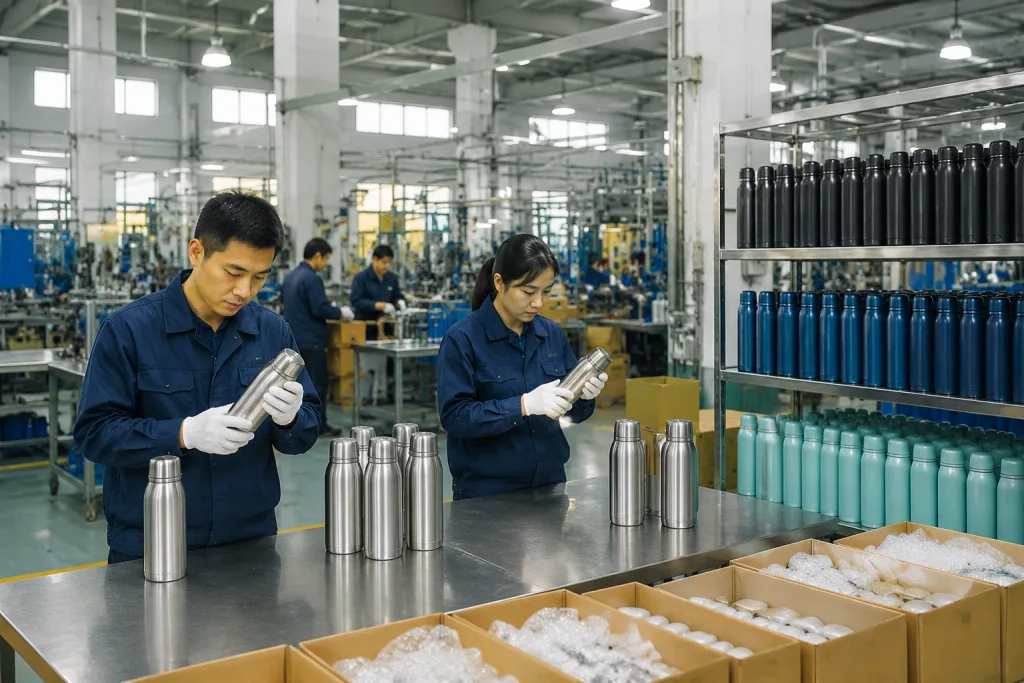
We make stainless drinkware in Hangzhou, Zhejiang, and the pattern is steady across China. The buyers who save money do not chase the lowest unit price; they match build to use case. For bulk thermos orders, we run capacity, insulation target, coating, print method, and compliance first, then lock QC before production starts. QC pulled the sample on a 12-hour hold test, and that one step saved a carton rework. A decent thermos factory can run 80,000 to 150,000 units per month, but the math does not work unless the spec sheet is tight.
Which thermos is worth buying first
If you are buying thermos flask wholesale for the first time, do not start with shape. Start with the buyer problem. A supermarket chain in Malaysia once sent us a PO with a 3 mm logo tolerance and then complained the bottle still looked “too plain”; the issue was shelf appeal, not the bottle body. Outdoor retailers want a rugged bottle that takes drops, glove use, and cold mornings. Promotional brands want a clean imprint area, a decoration cost that does not jump, and a price that still works at 1,000 to 5,000 pieces.
The first pick for most buyers is the standard 500 ml straight-wall stainless thermos. It is the least risky format for factory thermos production because the tooling is common, the lid set is standard, and packing runs clean on the line. QC pulled the sample on a 0.5 mm cap-gap check, and it passed on the first round. The second pick is the 750 ml handled model if your customer drinks hot tea or coffee all day. Third is the slim commuter thermos for gift sets and retail shelves. Fourth is a wide-mouth food-grade style if the channel cares more about use than looks. Fifth is the powder-coated version when the margin can pay for the extra coating step.
This ranking is based on manufacturability, failure rate, and resale flexibility, not sales talk. A thermos manufacturer in Zhejiang will usually quote a lower base price on the 500 ml line because the shell, lid, and carton are already locked in. We have seen this go sideways when buyers chase a fancy shape first; the math does not work once you add rework and slower packing. That is why the 500 ml spec usually wins for a stable supplier thermos program across several seasons.
1. Standard 500 ml seller
This is the safest pick for bulk thermos stock that has to move through different channels. A 500 ml double-wall vacuum body with 304 inner and outer steel gives a clean balance between cost and performance. On our line, wall thickness usually runs 0.35 to 0.45 mm. That is enough for day-to-day retail use, and it does not make the bottle heavy. QC pulled the sample, and the gauge showed 0.42 mm on the sleeve.
FOB Ningbo or Shanghai usually sits around USD 2.10 to 3.60 at 1,000 to 3,000 pcs, with the lid, coating, and print doing most of the price movement. We had a buyer push back on a 6 g heavier cap last season, and the math did not work for his margin. For distributor thermos buyers, this size stays easy to stock because it fits office runs, commuter bags, and light outdoor use without forcing a separate SKU. The unit carton also loads cleanly on pallets, which matters when you ship mixed cartons through a 3PL.
- Best for: broad retail assortments and promotional thermos programs
- Typical MOQ: 1,000 pcs for stock color, 3,000 pcs for custom color
- Common tests: vacuum leak test, lid torque test, 24-hour insulation test
If your channel needs a safe default, this is usually the first model to price. We once saw a PO typo turn 500 ml into 550 ml, and the buyer flagged it before the line started.
2. 750 ml for heavy use
The 750 ml size fits buyers who need more drink capacity without jumping to a bulky flask. Outdoor crews, commuters on 10-hour shifts, and ski-shop accounts ask for it all the time. We run this spec with a 42 mm mouth on the line, and that extra room makes the lid easier to twist with gloves on.
On sourcing, 750 ml is less efficient than the 500 ml line because the shell takes more stainless and the master carton count drops. FOB usually lands around USD 2.60 to 4.20, and the spread comes from lid structure and coating. A matte powder coat with laser logo pushes the price up. A plain painted body with one-color silk screen stays in range. The math does not move. A buyer once flagged a PO typo on the lid color code, and that cost a day.
For outdoor retailers, this reads as an upgrade, not just a bigger bottle with the same pitch. For distributors, it sits between entry-level and premium SKUs without much drama. QC pulled the sample last week and flagged cap torque after 80 cycles, so we keep this size in regular rotation and watch it closely. We’ve seen that issue go sideways. In Zhejiang, this is the size we ship with confidence. The 750 ml shell also gives us a cleaner 0.6 mm wall check on the gauge.
3. Slim commuter bottle
The slim commuter thermos is the clean pick for gift programs, corporate giveaways, and retail shelves where the box face does the selling. We run 350 ml to 450 ml on this shape, and the body slips into side pockets, car cup holders, and small work bags without a fight. Buyers keep asking for it. QC pulled a 380 ml sample off the line last month, and it cleared a standard cup holder with 2 mm to spare.
This category is not the cheapest by volume. The math does not work. A straight cylindrical body gives us wraparound silk screen, spot UV, or laser on stainless steel, and the slim shape keeps the logo readable from 1 meter away. If you want a custom thermos look with a gift box, this format handles it without turning the carton into a freight headache. On one PO, the buyer flagged a carton artwork typo, and we caught it before print; pricing still sat around USD 2.40 to 4.80 FOB at moderate quantities because the cap finish and outer surface do the selling.
For corporate buyers, treating the slim bottle as a budget item is the wrong question to ask. It is a presentation item with insulation attached.
Use this when the channel cares about gifting, office desks, and logo visibility more than raw capacity. We ship these for office sets, and the MOQ usually starts where the print setup pays back. Push it too low and the unit cost jumps fast.
4. Wide-mouth practical choice
The wide-mouth thermos is the straight answer for buyers who sell function first. Campers, field staff, and tea drinkers want fast filling, ice cubes that drop in clean, and a mouth wide enough for a brush. We ran a 45 mm opening on the line last month, and QC pulled the sample twice because the buyer flagged a lid scrape after washing. This is the wrong question to ask if you chase only price.
On purchase terms, this model earns space through fewer returns. Depending on lid style, it lands around USD 2.80 to 5.20 FOB. A food-contact-safe PP lid, silicone gasket, and brushed body keep the cost in range. Ask for a pouring cap or cup-lid hybrid, and the tool change needs more coordination; lead time usually stretches by 7 to 10 days. We have seen this go sideways when the PO had a typo on the cap code.
For thermos bulk orders in outdoor retail, it ships well because the end user can pour coffee, tea, or soup into the same bottle without feeling boxed into one drink. Leakage testing is simple on this type: fill to 90%, invert for 2 hours, then check the seal ring and shoulder weld. A plain wide mouth is easier to qualify than a fancy top, and the math works.
5. Premium powder-coated line
This is the line we push when buyers want a higher shelf price. Powder coating beats glossy paint on feel and on wear. The rub rig makes that clear in one pass. It looks like a retail bottle, not a promo giveaway. That is the point. In custom thermos programs, this spec pulls the buyer away from unit cost and back to margin.
FOB pricing sits at USD 3.50 to 6.50. Steel grade, lid build, and print method drive the spread. A 316 inner liner adds 15% to 25% over 304. We only push 316 for acidic drinks or salty outdoor use; for a normal office flask, 304 is the right call. The math does not work otherwise. On one job, the buyer wanted 316 for black coffee only, and we pushed back after the salt-spray report came in clean at 24 hours.
Brand owners get deeper customization here: debossed logos, laser marking, mixed-finish bodies, premium cartons. We shipped one run with a 58 mm lid, and the buyer flagged the carton height on the PO by 3 mm. For distributors, this SKU carries a cleaner margin, and we run it on the same line as the mid-tier range, so sourcing stays in Zhejiang instead of splitting volume across two vendors. QC pulled the sample, and the finish matched the approved chip card. We’ve seen that go sideways when the carton spec is loose.
What matters in the spec sheet
If you want a thermos factory to quote cleanly, speak in numbers. Steel grade, wall thickness, vacuum gap, lid material, and test standard do the work; marketing copy does not. We run this every week, and the quote goes sideways fast when a buyer writes “good insulation” instead of 60C after 12 hours or 40C after 24 hours, measured from a 95C fill in a 20C room. One buyer sent a PO with “316 look” in the spec. The math does not work.
Ask for the test method, not just the result. A vacuum leak test, a 1 meter drop test, and a salt-spray or abrasion check on decorated surfaces tell us more than a glossy sample on the line. QC pulled the sample last month and found a lid torque issue at 1.8 N·m, but the buyer had only approved the photo. If the bottle is going to the EU or North America, ask for food-contact documents and compliance to REACH, LFGB where needed, and BPA-free declarations for lid plastics. For promotions, carton marks need to match retail and FNSKU handling; we have seen a typo on a barcode line hold up a shipment by 4 days.
- Steel: 304 standard, 316 for harsher environments
- Insulation: define hours and starting temperature
- Decoration: laser for wear, silk screen for cost
- Packing: master carton count, drop-test spec, barcode placement
That level of detail is normal in China exports. It cuts back-and-forth and keeps us from shipping samples that only look right. We ship faster when the spec sheet says 0.40 mm wall thickness, 24 pcs per carton, and the buyer flags the lid color before the line starts.
How to qualify the factory
Check production discipline first. That is the point. Ask for BSCI or the social compliance audit they actually passed, monthly output in units, and the incoming steel check on 304 coils. We run into factories that print 80,000 units a month on the brochure, then QC pulled the sample and found the weld seam drifting 0.6 mm on the line. The math does not work when the process is loose.
Request the first article sample, then lock down the production plan: ink curing time, vacuum welding method, lid assembly line, and final AQL inspection level. A common export standard is AQL 2.5 for major defects and 4.0 for minor defects, but the channel should set that call. A buyer once flagged a PO typo on lid color, and that small miss turned into a three-day delay. Ask what gets checked at 100% and what goes to lot sampling. That is the real test.
Ask where the molds sit, which parts are in-house, and how fast the vendor can replace a bad lid gasket. A real thermos manufacturer can answer with numbers, not adjectives. In Zhejiang, we see plenty of factories, but the stronger ones point to the tool cabinet, the gasket shelf, and the spare mold rack. If they cannot tell you whether a 1.8 mm gasket is on hand, we ship with caution.
Decoration and branding choices
Decoration should fit the use case, not the sales desk. If the bottle lives in backpacks and car cup holders, we run laser engraving. It holds up. On a 500 pcs order, the buyer flagged a rubbed label after drop tests, while the laser marks stayed clean after 12 days of handling. For price-driven runs, silk screen is the low-cost play, often USD 0.12 to 0.35 per color at scale. UV print, wrap labels, and embossed details suit premium retail, but each one adds a handoff on the line and another scrap point. The math does not work if the bottle only needs a clean logo and a fair landed cost.
A customizable thermos only pays off if the logo stays readable after normal use. That is the test. We usually push laser on coated metal or brushed steel for long-term programs, because QC pulled the sample and the logo stayed sharp after abrasion. For promotional thermos campaigns, one-color print is usually enough. For retail, two print positions can work, but do not overdo it. A 304 stainless body with a busy print stack looks forced, and it shows every dent, dust speck, and coating nick.
Before you approve artwork, check the logo size in millimeters, the exact Pantone reference, and whether the print lands on a flat zone or a curved wall. A 28 mm mark and a 32 mm mark are not the same thing on a 72 mm body. The buyer once sent a PO with the logo name typed wrong by one letter, and we had to stop the film plate before production. Small changes like that move yield more than buyers expect. This is the wrong question to ask if you only think in decoration cost.
Get a wholesale thermos quote that matches your channel
Send your capacity, decoration, and carton requirements. We will price the right bottle, not a vague sample, from our Zhejiang factory line.
Frequently asked questions
What is a realistic MOQ for purchase thermos flask wholesale?
For standard stock shapes, most thermos suppliers in China will quote MOQ at 1,000 pcs per color. If you want a custom lid, special coating, or a new carton, 3,000 pcs is more realistic. For a fully customized thermos with unique tooling, the floor may rise to 5,000 to 10,000 pcs. The practical way to buy is to separate base bottle, decoration, and packaging so you do not overpay for tooling that you do not need on the first run.
How long does production usually take?
For a normal order from a thermos factory in Zhejiang, sample approval to shipment usually takes 20 to 35 days. If you need new molds, custom packaging, or a busy-season slot, plan 40 to 50 days. The first proof sample is usually ready in 5 to 7 days. Do not promise your sales team a 15-day turnaround unless the supplier already has stock bodies and the print is simple.
Which steel grade should I choose, 304 or 316?
For most bulk thermos programs, 304 stainless is the right choice. It gives solid corrosion resistance and keeps FOB price controlled. Choose 316 only when your customer uses acidic drinks, the bottle sees harsh coastal exposure, or the brand wants a premium story that can absorb a 15% to 25% material premium. For lids and contact parts, ask for food-grade PP or Tritan and get the compliance paperwork in writing.
What quality checks should I ask for?
At minimum, ask for vacuum retention, leak testing, lid torque testing, and carton drop tests. For export, an AQL inspection at 2.5 for major defects is common, with logo and finish checked separately. If you are selling in Europe or North America, request REACH-related declarations, food-contact documentation, and BPA-free statements for plastics. A good supplier thermos team will give you a written QC plan before mass production.
What is the cheapest way to brand a custom thermos?
Single-color silk screen is usually the lowest-cost branding method, often USD 0.12 to 0.35 per piece depending on quantity. It works well on simple promotional thermos orders. Laser engraving costs more up front but holds up better in field use and has a stronger retail feel. If your bottle has a coated body, laser on the coating can be the best balance of durability and presentation.