Key Takeaways
- Protein shaker suppliers usually start at MOQ 3,000-5,000 units; sample runs below 200 pieces are often not cost-efficient.
- For export, a 25-35 day lead time is realistic on standard shakers; custom molds add 30-45 days before mass production.
- Tritan or food-grade PP at 1.0-1.5 mm wall thickness is the practical baseline for durable custom drinkware.
- A good Zhejiang canteen factory should quote FOB terms clearly, pass REACH and food-contact checks, and support AQL 2.5 inspection.
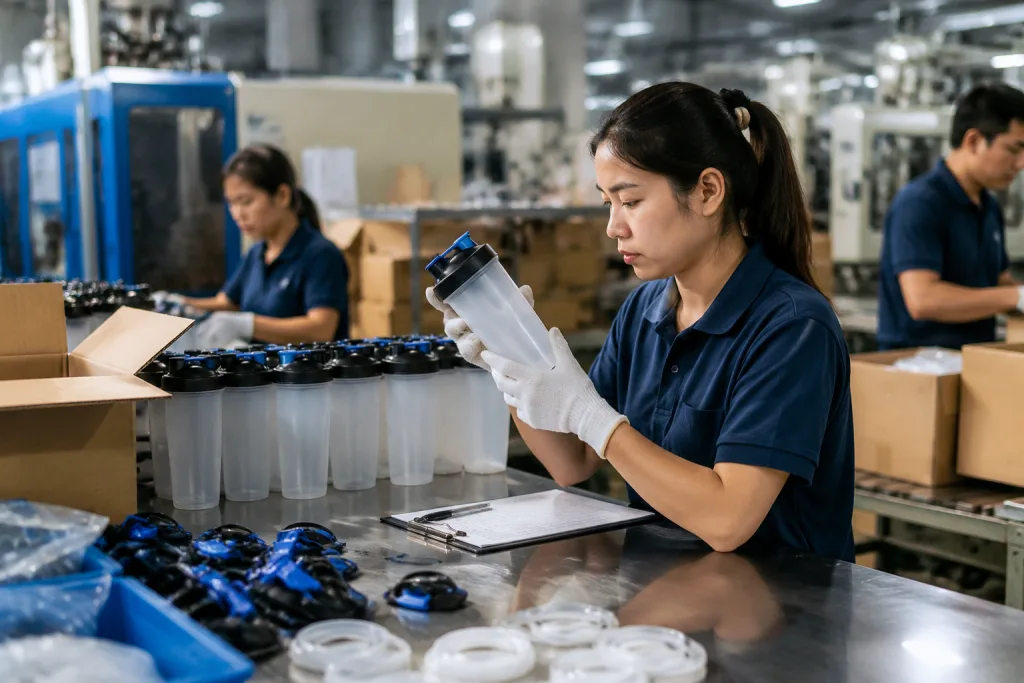
Buy from protein shaker suppliers, and do not treat the shaker like a plain plastic bottle. That is the wrong question to ask. You are buying a closure system, a lid seal, a mixing ball or mixer insert, print that survives rubbing, and a pack-out that can take export knocks. On the line, QC pulled the sample with a 0.5 mm feeler gauge, and the first 5,000 units usually show where the weak spot sits.
The better way is to compare suppliers like we do in Zhejiang: by spec, not by brochure. Ask about PP, Tritan, and stainless options, check whether the mold can hold 0.5 mm on the cap fit, and pin down numbers such as MOQ 3,000 units, 25-35 day lead time, and AQL 2.5 / 4.0 inspection flow. A buyer once flagged a PO typo on the carton count, and we caught it before production; the math does not work if the factory cannot repeat the same carton, same lid torque, same print position on every run.
Compare suppliers by spec first
If you want a clean comparison, stop asking which protein shaker is “best” and start with what the shaker has to do. On one gym chain order, we run a 700 ml Tritan shaker with a screw-on lid and wire whisk; for a retail promo, the buyer flagged a 500 ml PP shaker with one-color logo print and carton-ready packing. The spec table sorts suppliers fast.
Use four columns: material, closure, decoration, logistics. Material tells you whether the bottle will haze, crack, or smell after hot washing at 80°C. Closure tells you whether the cap leaks at 20-30 psi in a truck run or warehouse shift. Decoration tells you whether your logo survives 50 dishwasher cycles. Logistics tells you whether the factory can ship 20,000 units from Zhejiang without the line getting jammed. A serious canteen manufacturer puts this in writing; a quick call is not enough, and the math does not work any other way.
| Spec | Typical range | What it means |
|---|---|---|
| Capacity | 500-800 ml | Retail sweet spot for shaker use |
| Wall thickness | 1.0-1.5 mm | Better rigidity, less stress cracking |
| MOQ | 3,000-5,000 pcs | Normal for custom drinkware export |
| Lead time | 25-35 days | Standard production window |
That is the gap between a canteen custom order that moves and a container of rejects that sits on your cash. QC pulled the sample last Friday, and the 1.2 mm wall held up; this is the number we trust, not a sales pitch from someone who never stood by the line.
Pick the right body material
Material is where buyers miss the number. For protein shaker suppliers, the body usually comes down to PP, Tritan, or 304 stainless steel. PP is light and cheap. Fine for canteen promo runs. On our drop bench, the cup wall picked up scuffs after 18 hits, and the buyer flagged that fast. Tritan adds about USD 0.40-0.90 per unit over basic PP, depending on order size and print method. Clear sells. That is the whole point.
For a distributor canteen program, Tritan is usually the safer middle ground. Stainless makes sense when the customer wants a growler feel or an insulated bottle look, but that is the wrong question to ask if the target price is still entry level. We ran a batch with a 304 stainless shell at 0.4-0.5 mm outer wall and a PP or silicone lid insert. QC pulled the sample because the lid ring sat 1.2 mm off center. It held up, but the landed cost math did not work for a low-ticket program.
- PP: best for price-driven promotions and high-volume custom drinkware
- Tritan: best for retail, clarity, and premium shelf appeal
- 304 stainless: best for durability and higher ticket programs
Ask the canteen supplier for food-contact declarations, REACH alignment for Europe, and migration test records. We ship this file set every week, and the factory that has it ready usually knows export paperwork better than the one sending only product photos. On one PO, the buyer typoed “shaker” as “shker,” and the line still caught the mismatch before print. That is the level you want. We have seen this go sideways when paperwork gets treated as an afterthought.
Lids and seal design matter
A shaker usually fails at the lid first. The body can print clean and still lose the order because the cap drips in a gym bag. We ask protein shaker suppliers to show the seal geometry, not just the Pantone chart. Screw caps, flip lids, dual-thread lids, and one-piece sport caps all work, but each one changes mixing, one-hand use, and line setup time.
For export, I push a screw-top lid with a deep thread and a silicone gasket. We run those on a torque gauge, and a loose snap-fit design gives us more headaches in mass production. QC pulled the sample last month at 1.2 meters on six faces, then checked for seepage after thermal cycling. The buyer flagged it, and the math does not work any other way. Ask for that test set, not a promise.
Good lid design is not a marketing feature. It is cheap insurance before the shipment leaves Zhejiang.
Check whether the supplier can swap lids across formats. A platform that keeps the same neck finish across shaker, bottle, and custom growler lines cuts tooling risk and makes warehouse spares easier. We had one PO with a neck callout typo, 38 mm written as 36 mm, and the buyer caught it before tooling cut steel. That is the wrong question to skip.
Decoration choices change failure rate
Printing is where a lot of custom drinkware programs go sideways. A logo can look clean on day one and still scratch off if the ink stack is wrong or surface prep is thin. For protein shaker suppliers, we run silkscreen, pad print, laser engraving on stainless, and heat transfer. Silkscreen holds cost down on 1 or 2 colors. Laser engraving on stainless does not wash off. Heat transfer gives more color, but the extra oven pass adds risk and cost.
If you are buying canteen promotional stock for a distributor network, keep the decoration simple. One or two colors usually gives the best yield. We had a buyer flag a full-wrap file with 0.8 mm text on a curved bottle, and the line lost half a shift fixing registration drift. The math does not work if the print looks nice on a mockup but starts rejecting at 10,000 units and 3% scrap. That is the wrong question to ask.
Ask for decoration tolerance samples. Check edge sharpness, ink adhesion, and whether the logo warps near the shoulder or bottom radius. QC pulled the sample after a 48-hour tape test left lift on the corner, and that is the sort of miss that turns into a claim later. If your program must support Amazon or retail barcodes, confirm the supplier can place FNSKU labels without covering the main mark. We ship these with a label map on the packing sheet, because packing and fulfillment is the real issue here. A typo on the PO can throw that off fast.
Use case beats catalog breadth
A fat catalog proves nothing. We run this check on the line with one question: what does the buyer need this shaker to do, and who is paying the margin? A 500 ml PP shaker fits promo drops. A 700 ml Tritan shaker moves better in gym retail. A stainless custom growler with a carry loop fits outdoor accounts or beverage-brand campaigns. Shelf space does not. Product use decides the slot.
If you also source canteen custom items, ask whether the supplier can build one platform across shaker, travel bottle, and custom canteen jobs. We had a buyer flag a PO once because the cap code changed from one item to the next, and QC pulled the sample to compare closure heights at 2 mm. A canteen manufacturer already running multiple closure systems can usually support a broader canteen customized program without forcing three mold bills. The math does not work if every SKU gets its own tool set.
- Best for promotion: PP shaker, simple print, MOQ 3,000 pcs
- Best for retail: Tritan shaker, clearer body, higher perceived value
- Best for premium gifting: stainless shaker or custom growler format
When a canteen vendor can explain why one SKU goes to distributors and another goes to direct retail, you are talking to a factory that thinks in channels, not just cartons. We ship that way. The buyer who only counts SKUs is asking the wrong question.
What a serious factory can prove
Factories in Zhejiang are not all the same. Some only assemble parts; others run tooling, molding, printing, and packing under one roof. A buyer spots the gap fast. Last month we had a 48,000 pcs PO with a typo on the carton mark, and the real plant caught it before the plate hit the press. A serious factory should state monthly capacity, the QC sequence, and how many lines stay on drinkware instead of general plastic work. On a mid-size plant, 300,000-500,000 units per month and 2-4 export lines is a solid baseline.
Ask for proof, not promises. This is the wrong question to ask if the supplier only waves a brochure. If your customer needs it, ask for BSCI or a similar social compliance audit. For Europe, we ship REACH declarations and food-contact papers; for stainless parts, ask for traceability to 304 or 316. We run a pull test on carton handles at 8 kg, and that beats a sales pitch. A factory that ships custom drinkware well keeps pack-out simple: barcode placement, inner box strength, master carton drop resistance, and carton count accuracy all have to line up.
If a canteen supplier cannot explain rework, spare gaskets, or color hold across repeat orders, you will pay for it later. We’ve seen this go sideways on a 10,000-piece shaker job where QC pulled the sample and the cap tint drifted after the third batch. The buyer flagged it, and the fix cost a week. The math doesn’t work. On the line, the difference between a vendor and a manufacturer is simple: one passes the order along, the other controls the process.
Price breaks and MOQ reality
Buyers usually start with target price. That is backwards, but we see it every week. For protein shaker suppliers, a basic PP shaker with one-color silkscreen usually lands around USD 0.85-1.20 FOB at 5,000 units. Tritan sits closer to USD 1.35-2.20 FOB, and lid stack-up can swing it by 15-20 cents. Stainless shakers move up fast, often USD 2.80-5.50 FOB, especially when the buyer wants a brushed finish or a custom growler-style body. We ran one lid trial on a 48-cavity mold, and the hinge pin tolerance alone added 0.08 USD when the buyer asked for a tighter snap feel.
MOQ does the real work. A Zhejiang factory will often quote 3,000 pcs for an existing mold and 5,000-10,000 pcs if you need a new lid or bottle shape. If the buyer only wants 500 units, the math does not work; you are paying for setup, not flexibility. We had one PO with “5000pcs” typed as “500 pcs” and the buyer flagged it before the line started. Match the MOQ to the channel: canteen distributors can take a generic SKU in volume, while a niche brand usually needs fewer units and a cleaner spec. This is the wrong question to ask if you start from a tiny order and expect factory pricing.
Use price bands to check structure, not just chase the low number. If one canteen factory is 18% below the market and another is 5% higher, ask about resin grade, gasket material, carton spec, and whether the quote covers one logo position or three. QC pulled the sample, and the cheap one had a loose cap after 20 drops from 1.2 m. Cheap is often unquoted labor and weaker inspection. We’ve seen that go sideways on a 72-hour rush, and the buyer paid for the save twice.
Sample the way you will sell
Samples are process checks, not trophies. If you are comparing protein shaker suppliers, ask for two pieces: one production-style sample and one pre-production sample with final artwork, carton, and barcode. We run this on the bench before PO sign-off. For retail or distributor drinkware channels, check label placement now, not after the carton code is printed wrong. A 1.5 mm drift is enough to trigger a rework call.
Inspect the sample like a buyer who will return it. Fill it, shake it, leave it on its side for 30 minutes, then do a basic drop test. Check the lid thread, the gasket, and whether the logo survives a standard detergent wipe. On one 750 ml shaker job, QC pulled the sample after a 60-70°C warm-water soak because the resin carried a faint odor. Good catch. The math doesn't work if you ship a smell complaint.
The better suppliers tell you what changed after approval. The weak ones hide it. That matters more than a polished PDF. If you are comparing canteen suppliers, ask for revision notes, color swatches, and the control sample the line follows. The buyer flagged a 2 mm label shift on one order because the PO typo said left side instead of center. This is the sample you want, not a loose piece in a drawer.
Get a shaker quote built on real specs
Send your target capacity, material, logo method, and carton needs. We can quote from Zhejiang with clear MOQ, FOB, and lead time.
Frequently asked questions
What MOQ should I expect from protein shaker suppliers?
For a standard custom shaker using an existing mold, expect MOQ 3,000 to 5,000 units. If you need a new lid or body shape, 5,000 to 10,000 units is more realistic. In Zhejiang, a capable factory may accept 1,000-2,000 pcs for a repeat order, but the unit price will usually rise 15%-30%. If you are a distributor canteen buyer, it is smarter to match the MOQ to your channel instead of forcing a tiny run. The best suppliers will quote price steps at 3,000, 5,000, and 10,000 pcs so you can see the breakpoints clearly.
Which material is better for a custom shaker: PP or Tritan?
PP is the lower-cost choice and works well for canteen promotional programs or bulk giveaway orders. Tritan is better when you want clearer appearance, better retail perception, and a higher perceived value. In practice, PP shakers often sit around USD 0.85-1.20 FOB, while Tritan can run USD 1.35-2.20 FOB depending on the lid and decoration. For Europe and North America, Tritan is usually easier to sell as customizable drinkware because buyers associate it with a cleaner, more durable look. If your order is price-led, PP is fine. If your customer cares about shelf appeal, Tritan is the safer choice.
How long does production usually take in China?
For a standard shaker order with existing tooling, lead time is usually 25-35 days after sample approval and deposit. If you need a new mold, add 30-45 days before mass production starts. Shipping time depends on destination, but from Zhejiang to a US or EU port, sea freight is often 18-35 days. A solid canteen manufacturer will give you a split schedule: tooling time, sample time, mass production time, and packing time. That is the level of detail you need if you are planning retail launches or distributor allocations.
What compliance documents should I ask for?
At minimum, ask for food-contact declarations, REACH-related documentation for Europe, and an audit report if your customer requires social compliance such as BSCI. For stainless products, request material traceability for 304 or 316. If the shaker uses printed graphics, ask about ink safety and migration testing. A serious canteen supplier in China should be able to provide these documents without long delays. If they cannot, that is a signal to slow down. For North America, many buyers also want packaging data and carton strength details for warehouse handling.
Can one factory handle shakers, canteens, and growlers?
Yes, but only if the factory actually controls molding, assembly, and decoration rather than outsourcing everything. A good Zhejiang plant can run custom canteen, custom growler, and protein shaker programs on related neck finishes and shared components. That lowers tooling risk and simplifies spare parts. The question is not whether they can make multiple products; it is whether they can make them consistently at scale. Ask for monthly output, line count, and how they separate plastic and stainless production. A factory that produces 300,000+ units per month and tracks each batch properly is a better bet than a vendor with a long product list but no process control.