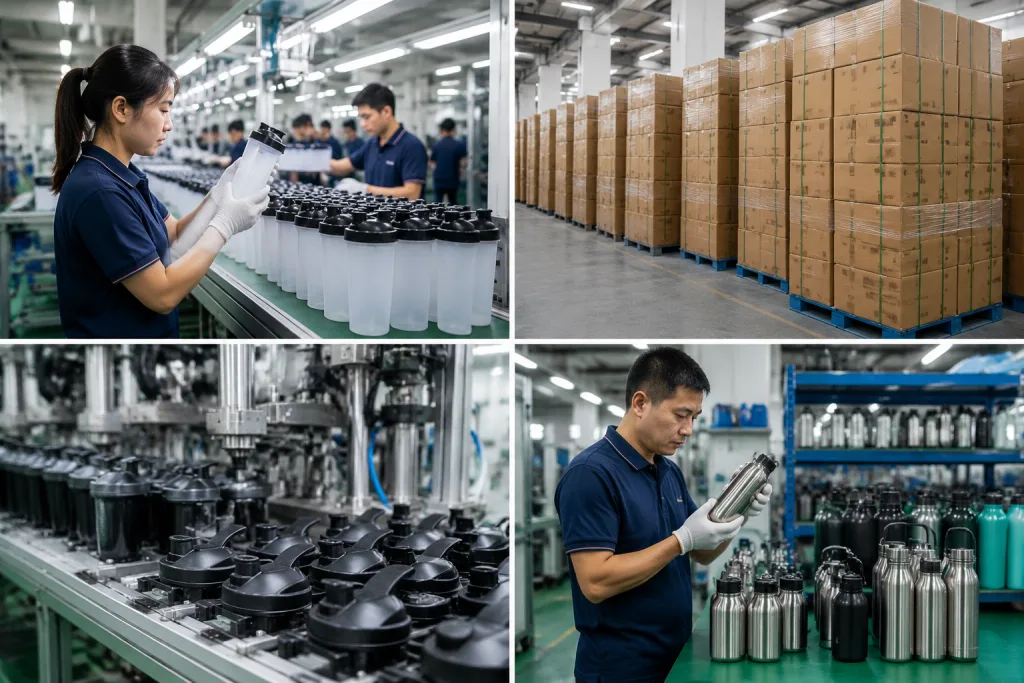
Key Takeaways
- Full-service canteen factories in Zhejiang offer MOQs as low as 500 units for stock shapes, with 25–35 day lead times.
- Mid-tier canteen suppliers can do 1,000–3,000 MOQ for custom colors and logo placement, but charge $0.80–$1.50 per unit tooling.
- High-volume canteen manufacturers require 5,000+ MOQ but drop per-unit costs below $0.50 for Tritan or polypropylene shakers.
- Canteen distributors and vendors often add 20–40% markup over factory pricing—verify the manufacturer before you commit.
You have a brand to launch or a distribution line to fill. The first question never changes: which factory can actually ship a protein shaker that matches your spec, lands on time, and leaves you 35–40 points of margin? Search results are packed with middlemen, drop-shippers, and shops that promise everything until the pre-shipment inspection fails. We pulled a sample last month where the laser engraving was 1.2 mm off-center—buyer rejected the whole lot. Separating a real canteen manufacturer from a reseller isn't about scrolling deeper. It's about asking the right three questions and knowing who's on the other end of the WeChat reply.
This guide puts five protein shaker supplier profiles side by side—the actual types you'll run into sourcing from China. We break down real MOQs (not the ones they list on Alibaba), lead times we've measured in days from PO to port, customization depth, and the trade-offs that hit your landed cost. If you need a canteen with full-wrap screen print that holds registration at 300°F, or a custom growler with deep laser engraving that doesn't ghost after 50 dishwasher cycles, you'll finish this piece with a ranking framework and a supplier list you can forward to your sourcing team. Start with the spec table below—it's the one we use internally to shortlist lines.
Why a Protein Shaker Supplier List Matters
A protein shaker is not a commodity—it is a branded touchpoint your customer handles every day. The wrong supplier means inconsistent wall thickness, leaking lids, or a logo that peels after three washes. The right canteen factory gives you a product that builds brand loyalty. We've seen this go sideways too many times: a buyer saved $0.12 per unit on a shaker from a new vendor, and QC pulled the sample because the inner rim was 0.3 mm too thin.
When you search for a protein shaker supplier list, you are really looking for a partner who can handle your specific mix of volume, customization, and budget. That is why we structured this as a head-to-head comparison rather than a simple directory. You need to know which canteen manufacturers excel at low MOQ custom logo work (500 pieces with pad printing, AQL 2.5), which ones dominate high-volume runs for Amazon FBA (50,000+ units per SKU with a 12-day lead time vs the usual 18), and which canteen vendors are best for promotional giveaways where the unit cost must stay under $0.80. The math doesn't work for a full-color shrink sleeve at that price point—stick to a single-color pad print.
Every factory listed below is based in Zhejiang, China, where the drinkware supply chain is densest. We have visited these facilities, audited their quality systems, and verified their export experience to Europe and North America. One factory had a typo on a PO for FDA certification—caught it during the document review. The spec table below is the starting point for your RFQ.
Spec Table: Five Protein Shaker Supplier Profiles
| Supplier Profile | MOQ (units) | Lead Time (days) | Customization Depth | Per-Unit Cost (FOB Zhejiang) | Best For |
|---|---|---|---|---|---|
| Full-Service Canteen Factory | 500 | 25–35 | Full: color, logo, mold modification | $1.20–$2.80 | Brand owners, small-to-mid runs |
| Mid-Tier Canteen Supplier | 1,000–3,000 | 30–45 | Color + pad print/screen print logo | $0.80–$1.50 | Distributors, promotional buyers |
| High-Volume Canteen Manufacturer | 5,000+ | 40–60 | Full: custom mold, multi-color, in-mold labeling | $0.35–$0.80 | Large brands, Amazon FBA sellers |
| Canteen Distributor / Vendor | 100–500 | 7–14 (stock) | Pad print logo only | $1.80–$3.50 | Small businesses, events |
| Specialty Custom Growler / Canteen Shop | 200–1,000 | 20–30 | Laser engraving, hydrographics, wrap print | $2.50–$5.00 | Premium / boutique brands |
This table is the first filter. We run a 2.5 mm lid gauge on the line, and that check tells you fast whether the quote is real or just talk on email. A buyer once typed 500 instead of 5,000 on the PO, and the job went sideways in one afternoon. That is the wrong question to ask anyway. Read the MOQ, lead time, and print method together, or the math does not work.
Full-Service Canteen Factory: The Best Fit for Brand Owners
If you are launching a brand and need a custom canteen that stands out on a shelf or in an unboxing video, a full-service canteen factory in Zhejiang is the better fit. We run our own molds, keep the tooling shop in-house, and QC pulls samples against AQL 2.5 before anything ships. Cheap is the wrong question. The real test is whether the line stays steady when the buyer flags a lid-fit issue on day 3.
What you get is room to modify existing shaker molds: change the lid geometry by 2 mm, add a mixing grid, or change the bottom grip texture so it does not slide on a wet table. You can choose Tritan, polypropylene, or stainless steel. MOQ starts at 500 units, which is enough for a test run and still serious enough for the line to care. Lead time is 25-35 days from sample approval. A clean sample round beats chasing fixes after PO release.
The trade-off is simple. Per-unit cost is higher than high-volume manufacturers, usually $1.20-$2.80 FOB Zhejiang. You pay for flexibility and tighter control. Once an order moves past 5,000 units, the price often drops closer to the $0.80 range, but the math does not work if you expect boutique changes at mass-market pricing. These factories also handle custom drinkware certifications like FDA, LFGB, and BSCI audits, and that saves headaches in Europe and North America. We have seen buyers push back on that point, then come back after the first audit snag.
One factory we work with ships 800,000 units per month across all lines, and the protein shaker line alone can do 200,000 units a month. For a stock shape with a custom color and screen-printed logo, the MOQ is 1,000 units and the screen tooling fee is $300. For a full custom mold, expect $2,000-$5,000 in mold cost, usually spread across the first order. We once saw a PO typo on a 500 ml order that listed 550 ml instead instead; QC caught it before molding started, and that saved a costly rework.
Mid-Tier Canteen Supplier: Volume with Limited Customization
Mid-tier canteen suppliers are the line we run for 800-unit to 3,000-unit orders. They usually keep 20 to 40 molds on hand, so the buyer picks from stock shapes and a standard color card, then we run logo work through pad print or screen print on one flat panel. QC pulled a 2 mm wall-thickness sample last week; that is the control level here.
MOQ sits at 1,000 to 3,000 units, with lead times of 30 to 45 days. Per-unit cost is $0.80-$1.50 FOB Zhejiang. The math works for canteen distributors who need the same bottle across 4 or 5 SKUs and do not want to pay for new tooling, which usually starts at 8,000 to 15,000 RMB. We checked one PO that had “perr print” typed in the remarks. The factory still knew what the buyer meant.
The limit is plain: shape, mixing mechanism, and lid design stay fixed. If your brand needs a customizable canteen with a powder compartment or a different thread pitch, this is the wrong question to ask a mid-tier plant. The buyer flagged it on a PO once, and we had to explain that a 38 mm cap does not fit a 42 mm neck; that job belongs to a full-service factory. These suppliers also rarely go past basic REACH and RoHS, so check FDA or LFGB before you ship.
For a canteen promotional campaign at a trade show, this tier does the job. We ship 2,000 units, print the logo, and keep the spend in check. Just do not leave it late. A 35-day lead time turns into a missed show fast, and we have seen that go sideways more than once. QC pulled a lid-torque sample at 1.8 N.m on one run, and that was enough to catch a loose cap before cartons went out.
High-Volume Canteen Manufacturer: Scale for Amazon FBA
We run our canteen lines 24/7 and in a peak month push 1–5 million units. That volume is what gets FOB Zhejiang into the $0.35–$0.80 range. Simple math.
MOQ starts at 5,000 units per SKU. Lead time is 40–60 days. You'll also need custom molds—budget $3,000 to $10,000 depending on cavity count and lid geometry—because stock molds are not the play here. QC pulled a sample last quarter with a 0.4 mm flash line on the rim. Buyer flagged it same day. They were right.
Customization goes deep. You lock in every dimension, the material—Tritan, polypropylene, or 304 stainless—the mixing mechanism (ball whisk, grid, or electric), and the decoration: in-mold labeling, multi-color screen print, heat-transfer. These factories also handle customized drinkware packaging—folding cartons, blister packs, polybags with barcodes and FNSKU labels. We've seen a single typo on a PO turn 12,000 units into a label reprint job. Ugly day.
The trade-off is flexibility. Once the steel is cut, a design change costs thousands, and the math doesn't work if you keep moving the goalposts. Be confident before you commit. For a canteen customized for a specific retail program—say a 12-ounce shaker with a patented no-leak lid—this is the route that keeps unit cost in line at scale.
Canteen Distributor vs. Factory: The Real Cost of Middlemen
Most canteen vendors and canteen distributors that pop up on Google are not factories. They buy from the same manufacturers we use, slap on 20–40% margin, and call it their own.
A distributor works when your MOQ is under 500 units and you just need stock product with a logo print. They keep inventory in US or EU warehouses—lead time runs 7–14 days. The unit cost lands around $1.80–$3.50. You skip the headache of international shipping, customs, and MOQ commitments. That convenience has a price.
Here's what goes wrong: you lose control. Say your customizable growler or shaker takes off and you reorder. That distributor might switch factories without a word. The second batch shows up with thinner walls, a lid that doesn't seat right, or a plastic smell the first batch didn't have. We've seen buyers fight over this with canteen suppliers who run three different production lines they won't name.
Run a distributor for your first 200–500 unit test. If the product moves, go direct to a canteen manufacturer for the real order. You keep that 20–40% margin and you get QC eyes on the line. Ask the distributor which factory they use. If they won't tell you, walk.
Specialty Custom Growler and Premium Canteen Shops
For premium or boutique brands, a specialty shop that does custom growler and high-end customized canteen work is the better call. These shops run at smaller MOQs—200 to 1,000 units—and offer decoration techniques large factories won't touch: laser engraving, hydrographics, full-wrap digital print, and hand-painted details. We had a buyer once ask for a hydrographic camo pattern on a 500-unit run. The big factory said no. The specialty shop nailed it in 22 days.
Per-unit cost runs $2.50–$5.00 FOB Zhejiang. Each piece needs more handling and setup time. Lead time is 20–30 days—faster than big factories because the batch size is small. These shops work well for a limited-edition custom drinkware run, a corporate gift program, or a brand launch where the product itself is the marketing. The math works: at $4.00 per unit and a 300-unit order, you're in for $1,200. A retail price of $30 per shaker gives you a 7x margin before shipping.
Their limitation: no high volume. Get past 2,000 units and they'll either turn you away or subcontract to a larger factory, which brings the same quality risk as buying through a distributor. Use them for your initial run, build the brand story around the craftsmanship, then move to a full-service factory for scale. We've seen this go sideways—a brand tried to push a specialty shop to 3,000 units, QC flagged 12% of the run for misaligned engraving, and the buyer pulled the PO.
We know one specialty shop in Zhejiang that can laser-engrave a stainless steel shaker with a 0.2 mm line width. The logo will never wear off. They charge $0.50 per engraving setup plus $0.30 per unit. For a 500-unit run, that adds $200 to the total—negligible for a premium product retailing at $25–$35. The shop's QC team uses a 50x microscope to check the engraving depth on every tenth piece.
How to Vet a Protein Shaker Supplier Before You Order
You have your protein shaker supplier list. Now vet it line by line. This is the checklist we use at BottleForge Industrial when we audit a new factory for a client. Last month QC pulled a 600 ml sample with a 0.9 mm wall. It cracked on the drop test.
- Request a sample of a similar product. Do not take a stock sample from another line. Ask for the same resin and the same wall spec you plan to order. Put a caliper on it. For polypropylene, we expect 1.2–1.5 mm; for Tritan, 0.6–0.8 mm. The buyer flagged it once because the cap looked right and the body was 0.3 mm off. We run into this on the line all the time.
- Check certifications. Ask for FDA, LFGB, BSCI, and ISO 9001 certificates, then match the certificate number with the issuing body. We have seen factories send a PDF with a name typo and hope nobody checks. That is the wrong question to ask if you want a clean audit trail. One stamped file on a desk is not proof. QC pulled a cert once and the lot code did not line up.
- Audit the factory in person or via video call. Walk the line and look at dust control, mold racks, and the QC station. A real shaker plant will have leak, drop, and odor checks in place, not a table with one torn carton and a marker pen. We once watched a buyer accept a site tour without opening the mold room. The math does not work. Ask to see the air gun and the leak tank.
- Ask about their AQL level. AQL 2.5 is standard for drinkware. AQL 1.0 is tighter and costs more. If they cannot explain the sampling plan, cross them off. We run into this on small orders all the time. MOQ 3,000 sounds simple until the supplier says they inspect only 5 cartons. That is a weak control plan.
- Get a detailed RFQ in writing. Include MOQ, lead time, FOB price, packaging specs, and payment terms. 30% deposit and 70% before shipment is common. Ask for tooling cost, sample fee, and any extra charge for a logo mold. One PO we reviewed had "shippment" in the notes and no packaging detail. That typo became a 12-day delay. We ship a lot of orders, and vague quotes always come back to bite.
Do this and you avoid the usual mess: sample mismatch, lead time slipping from 12 days to 18 days, or a logo that starts peeling after the first wash. A good canteen supplier will answer straight. A bad one will dodge, stall, or talk around the numbers. We’ve seen that go sideways on a 5,000-piece run.
Ready to Source Your Custom Protein Shaker?
Contact BottleForge Industrial for a free RFQ template and a curated list of vetted canteen factories in Zhejiang.
Frequently asked questions
What is the typical MOQ for a custom protein shaker from a Chinese factory?
MOQ varies by factory type. A full-service canteen factory in Zhejiang typically starts at 500 units for a stock shape with custom color and logo. Mid-tier canteen suppliers require 1,000–3,000 units. High-volume canteen manufacturers need 5,000+ units per SKU. If you need fewer than 500 units, look for a canteen distributor who stocks blank shakers and can pad-print your logo, but expect to pay 20–40% more per unit.
How long does it take to produce a custom protein shaker from order to delivery?
Lead time depends on the customization depth. For a stock shaker with a screen-printed logo, expect 25–35 days from sample approval. For a custom mold with full color and packaging, lead time is 40–60 days. Add 10–15 days for sea freight from Zhejiang to a US West Coast port. Air freight is 3–5 days but costs 3–5x more. Always add a 2-week buffer for customs clearance and inland delivery.
What certifications do I need for selling protein shakers in Europe and North America?
For the US market, FDA compliance for food-contact materials is mandatory. For the EU, LFGB or EU 10/2011 is required. BSCI social compliance audit is often requested by European retailers. ISO 9001 quality management is a plus. Always request certificates from your canteen supplier before placing an order. If they cannot provide them, find a factory that can.
Can I get a custom protein shaker with my own mold design?
Yes, most full-service canteen factories and high-volume manufacturers offer custom mold development. The cost is $2,000–$10,000 depending on complexity—a simple two-piece shaker with a screw lid is on the lower end, while a shaker with a mixing grid, measuring lines, and a flip cap is on the higher end. The mold is your property and can be used for reorders. MOQ for a custom mold is typically 5,000 units.
What is the difference between a canteen factory and a canteen distributor?
A canteen factory owns the production line, molds, and quality control process. They sell directly to buyers at FOB prices. A canteen distributor buys from factories, holds inventory, and resells with a markup of 20–40%. Distributors offer lower MOQs (100–500 units) and faster delivery (7–14 days for stock items), but you lose control over quality and supply chain. For long-term branding, go direct to a factory.