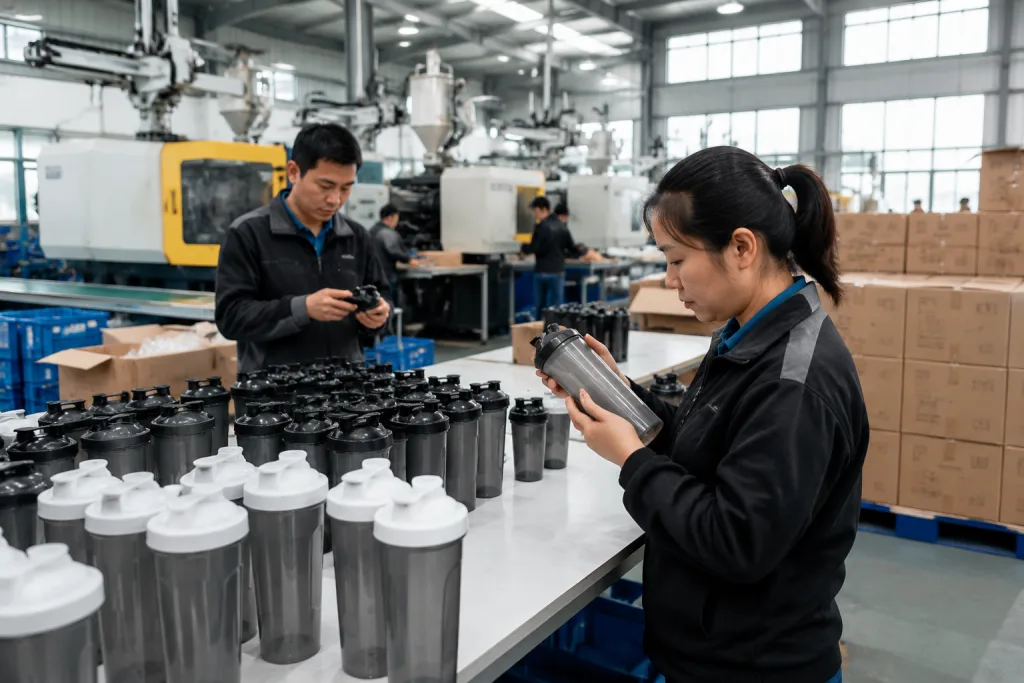
Key Takeaways
- Specify a minimum wall thickness of 1.8 mm for Tritan or PP shakers to avoid stress cracking at the thread root.
- Require a 48-hour leak test at 0.5 bar air pressure on 100% of units before shipment.
- Mandate an AQL of 1.0 for critical defects (leaks, cracks, missing parts) and 2.5 for minor defects (ink rub, flash).
- Budget for a 15-20% cost premium for double-shot injection vs. pad printing on the mixing ring—it will not delaminate.
I’ve pulled protein shaker samples from our QC bench where the ball whisk jammed on day four. Not a slow degradation—just locked solid after three hand washes. We also had a buyer send photos of a 5,000-unit run where the logo ghosted after one dishwasher cycle. The shaker itself was fine. The decoration wasn't. That order cost them a booth at a supplement expo they’d pre-paid for. The root cause in both cases: nobody wrote a spec for the failure mode they actually cared about.
Most RFQs we get treat a protein shaker like a 500 ml water bottle with a different lid. That's the wrong starting point. A shaker has at least three failure modes a standard bottle doesn't: the mixing insert (ball, grid, or built-in agitator) can corrode or detach, the seal can blow under back-pressure from shaking warm liquid, and the threads on a screw-top lid can cross under torque from a user who just finished a set of deadlifts. We run these units on the same injection lines as our vacuum bottles, but the QC checklist is longer—and if you skip a line item, it shows up in your warehouse.
This guide walks through each failure point from the factory floor. You'll see what we measure, what we reject, and where we've seen buyers get burned. The goal is simple: before you issue a PO for 3,000 or 30,000 promotional shakers, you know which specs to lock down and which AQL inspection points catch the problems that matter.
Thread-Stripping: The #1 Field Failure
Thread-stripping kills more protein shakers than any other field failure. The lid gets cranked down, the neck gives way, and after 15 to 20 open-close cycles the cap starts free-spinning. We run a thread gauge on first shots for every new mold. On a standard 28-410 neck finish for a 700 ml shaker, we want 1.8 mm minimum at the thread root. Drop below 1.5 mm and the math stops working. We saw it go sideways on one PO where the buyer flagged a typo in the neck spec, then QC pulled the sample and the cap was done by cycle 18.
For quotes, ask for the thread-root wall thickness from the mold review. If they cannot give a number, they did not design it. Simple. Lock the resin too: Tritan copolyester or PP homopolymer with a melt flow index between 8 and 12. We had one run at MFI 14.6, and the threads came out soft under torque. A clean factory hands over the MFI certificate without drama; if they stall, that is the wrong question to ask, because the answer is already there.
Mixing-Mesh Delamination and Mold Flash
The mixing mesh, or mixing ring, is the part that makes a shaker a shaker. We inspect it first. Two failures keep coming back: the mesh lifts when the overmold bond is weak, or mold flash hangs in the openings and turns washing into a pain. QC pulled a sample with a 0.3 mm burr last month, and the buyer flagged it on the first sweep.
To stop delamination, we run the mesh and ring in one shot with double-shot injection, or we inject the second material within 8 seconds of the first so the melt line still grabs. If a canteen vendor suggests pad-printing the mesh pattern onto a flat ring, that is the wrong question to ask. It peels. We have seen it fail in under 10 dishwasher cycles. For a canteen customizable with a logo, the ring is a good branding spot only when the logo is recess-engraved into the mold steel, not printed after the fact. One PO from a US buyer came through with "mesh logo" typed as "mesch logo"; the line caught it before steel was cut.
Set a maximum flash opening of 0.15 mm at the mesh edges. That is the number we hold on PP at 60°C mold temperature or Tritan at 85°C. If the factory runs the mold colder to shave cycle time, flash shows up. The math does not work. Ask for a first-article inspection report with a flash measurement, not just a photo, and check the gauge callout before you approve the run.
Seal-Groove Geometry and Leak Paths
A protein shaker that leaks in a gym bag comes back fast. Then the buyer stops replying. The leak path is usually the lid-to-bottle seal, not the mesh insert. We run the lid groove at 0.3–0.5 mm interference against the bottle rim, and the silicone gasket, if the spec calls for one, sits best at Shore A 50–60. Softer seals close easier. They wear faster too.
On our line, QC pulled the sample and we ran a 0.5 bar air test for 10 seconds on every unit before packing. That adds about 0.02 USD per unit in labor, and it catches most seal failures before cartons leave Hangzhou. If the buyer flags the cost, AQL sampling at S-4 with a 0.65 critical defect limit is the fallback, but that is the wrong question to ask for a daily-use promo shaker. We have seen this go sideways. A missed leak costs more than the test.
For a customized canteen or growler with a wide mouth, the same rule still holds, and the seal groove matters even more because large lids warp easier. We ask for a 3D seal-groove profile on the first article, and we have seen a 1.2 mm flat spot at the rim turn into a slow drip after two cap cycles. The math does not work if the groove is guessed.
Ink Adhesion and Decoration Durability
Your logo on a protein shaker has to survive the run. If it rubs off after 2 washes, the promo is dead. On PP or Tritan, we run pad printing with two-part epoxy ink and cure it at 80°C for 30 minutes. QC pulled the sample, and the cross-hatch landed at 4B or 5B per ASTM D3359. Silkscreen is cheaper, but curved bodies fight it. Laser engraving stays permanent, yet it only works on dark parts or molded-in-color parts.
For a canteen promotional run, we still push pad printing with a clear overcoat. The overcoat adds about 0.03 USD per color per unit, cheap insurance when the buyer flags dishwasher wear. We had one PO with a typo on the color line, and the line caught it before ink mixing. If you source from a canteen supplier in Zhejiang, ask for a 24-hour dishwasher test at 60°C, 50 cycles, on the pre-production sample. If the logo scuffs there, it will scuff in the field. The math does not work.
Spell out the ink color target too. Use Pantone numbers and hold ΔE to ≤ 2.0. We run that check with a spectrophotometer, and without one the factory will miss the same shade from batch to batch. That is the wrong question to ask after shipment.
Material Selection: Tritan vs. PP vs. Stainless
Three materials drive this category: Tritan copolyester, polypropylene (PP), and stainless steel. Each fails in a different way. Buyers usually miss that. We have seen the line stop after QC pulled a shaker from an IPA wipe test at 24 hours, and the spec sheet was already on the floor.
- Tritan: Clear, tough, and easy to sell on shelf. The weak point is stress cracking if the buyer uses isopropyl alcohol or certain essential oils in cleaning. MOQ from our factory: 3,000 units. Lead time: 35 days. Cost: 1.8–2.4 USD FOB for a 700 ml shaker. One customer sent a PO with “alcohol wash approved” in the notes; that typo changed the spec the same day.
- PP: Lower cost and solid chemical resistance. The tradeoff is a cloudy look and weaker impact strength below 0°C. MOQ: 5,000 units. Lead time: 25 days. Cost: 1.0–1.5 USD FOB. We ship a lot of these for giveaways, and the math does not work if the buyer wants a premium print feel on a 1.2 USD target. We ran a matte sample on the pad printer, and it still read like budget stock.
- Stainless steel: Best durability and insulation. Thin-wall 0.4 mm double-wall vacuum bottles dent fast; we spec 0.5 mm inner and outer walls on a canteen custom build. MOQ: 1,000 units. Lead time: 45 days. Cost: 4.5–6.0 USD FOB. A buyer flagged a 0.4 mm sample after a 1 m drop test, and they were right to push back. That bottle came back with a flat spot by the seam.
For a promotional giveaway, PP is usually the right call on cost. For a retail product or a premium corporate gift, Tritan or stainless makes more sense. For canteen distributors selling into the supplement channel, Tritan is the sweet spot because it looks clean, takes print well, and avoids the BPA question without extra explanation. We run that comparison a lot on the line. This is the wrong question to ask if the only filter is unit price.
QC Checklist: What to Include in Your Factory Audit
Take this list into the audit. Good shakers fail fast on a bad line. We run it in Zhejiang, and the defects do not hide for long.
- Mold maintenance logs: Ask for the last 3 months. Check that the molds are cleaned and polished every 50,000 cycles. One skipped polish left a 0.3 mm flash line, and the buyer flagged it before packing.
- Wall thickness gauge: Check that the gauge is used on every shift, not just when QC is nearby. Readings should be taken at the thread root and the bottom corner; one PO typo said 1.8 mm, but the line was running 1.4 mm, and the math does not work.
- Leak test station: Confirm whether the station is automated or manual. Automated gives tighter repeatability. Ask for the test pressure and dwell time, then watch one full run; if they cannot hold the same 12-second dwell across 200 pieces, the test is weak.
- Ink adhesion test: Do they run a cross-hatch test per ASTM D3359 on every batch? If they skip it, stop there. That is the wrong question to ask. QC pulled the sample on one order and the logo peeled after 24 hours in a water bath.
- Dimensional report: For the first article, ask for a full 3D scan or CMM report of the lid, bottle, and mesh ring. Sealing faces should stay within ±0.2 mm. We saw a lid seat drift by 0.25 mm after tool wear at 80,000 cycles, and the cap started ticking on the line.
- Packaging: Check whether each unit is bagged before carton loading. Scratches happen at the packing table, not on the truck. A 5 kg drop test on the outer carton is a better filter than a nice-looking tray.
If a factory cannot show these records for a past order, treat it as a warning sign. A clean vendor has the files at the desk, with dates and shift stamps. Our shaker line holds a 98% first-pass yield, and we show buyers the full log when they ask.
MOQ, Lead Time, and Cost Drivers for Custom Shakers
Getting the cost split right is how you push back on a quote. We run this every week on the line, and the numbers stay close: mold cost at 2,500–8,000 USD per cavity depending on cavity detail, material at 0.30–0.60 USD per unit for PP and 0.70–1.20 USD for Tritan, decoration at 0.10–0.30 USD per color per unit, and packaging at 0.05–0.15 USD for a plain box or 0.20–0.40 USD for a printed retail box. QC pulled a sample with a 1.2 mm wall last month, then the buyer still asked why the print looked expensive. That is the wrong question.
MOQ is where a lot of buyers get stuck. For a custom color and logo shaker, we usually quote 3,000 units for Tritan and 5,000 for PP, because the color changeover means purging the injection machine and we burn about 200 USD in material and labor each time. If you are a canteen distributor stacking multiple SKUs, sharing a mold base can trim the per-SKU cost. Lead time from a Zhejiang factory is 25–45 days, and the spread comes from decoration count and whether the mold is new or already on hand. A PO typo on a 10,000-piece run once pushed the ship date by 4 days. We've seen that go sideways.
For a canteen promotional run of 10,000 units, expect 1.20–1.80 USD FOB for PP with two-color pad printing. A canteen customizable with a stainless steel body and a Tritan lid jumps to 4.00–5.50 USD FOB, and the math does not lie. We always tell buyers to compare mold cost, unit price, and lead time in the same quote sheet, then ask the supplier to break out each line. A caliper on the inspection table caught a 0.3 mm lid gap on one sample, and that small gap was enough for the buyer to flag it. Get three FOB quotes. Then compare the real numbers, not the headline price.
Why B2B Buyers Fail on Protein Shaker Promotions (and How to Succeed)
European and North American buyers keep making the same mistake: they treat a protein shaker like a commodity bottle. They send a logo file, ask for a price, and assume every factory runs the same line. It does not. We had one PO with the cap color code typed as P-021 instead of P-012, and QC pulled the sample before mold trial. The gap between a shaker that fails in 30 days and one that still works after 2 years sits in the mold design, the material spec, and the QC checks.
Skipping real-use testing is the next miss. A sample on a desk looks fine. A sample that goes through a dishwasher, a freezer, and a drop test tells the truth. We tell buyers to order 10 pre-production samples and run a 50-cycle dishwasher test, a 1-meter drop test on concrete, and a 24-hour leak test with water and protein powder mixed. Last month the buyer flagged a lid that warped by 1.2 mm after heat cycling. We saw that one coming. The math does not work if you skip this step.
Supply chain is where a lot of programs go sideways. A canteen supplier that buys resin from one petrochemical plant gets squeezed the first time prices move or allocation tightens. Ask for at least two approved material suppliers. We keep three resin sources on file for every grade we use, and we track incoming lot numbers on each 25 kg bag. That is how we keep lead times steady when demand spikes, and this is the wrong place to cut corners.
Follow the specs and checks in this guide, and your protein shaker promotional products will do their job. Your brand gets clean use, not leak complaints and peeling logos. Your procurement team spends less time on damage control and more time on the next campaign. We ship cleaner when the buyer stays strict.
Get a Custom Protein Shaker Quote in 48 Hours
Send us your logo and target quantity. We'll reply with a FOB price, MOQ, and lead time from our Zhejiang factory.
Frequently asked questions
What is the minimum order quantity for custom protein shakers with my logo?
For a standard 700 ml Tritan shaker with pad-printed logo, our MOQ is 3,000 units. For PP, it's 5,000 units. If you need a custom mold (unique shape or thread), the MOQ is 10,000 units to amortize the mold cost, which ranges from 2,500 to 8,000 USD per cavity. For smaller quantities, we can offer stock molds with custom decoration, but the color options are limited to the resin we have in inventory.
How do I ensure the logo doesn't peel off after a few washes?
Specify two-part epoxy ink with a clear overcoat, cured at 80°C for 30 minutes. Require a cross-hatch adhesion test per ASTM D3359 on the first article, targeting a 4B or 5B rating. Also run a 50-cycle dishwasher test on a pre-production sample at 60°C. If the ink shows any wear, reject the batch. Pad printing with epoxy ink costs about 0.10–0.30 USD per color per unit but is the most durable option for PP and Tritan.
What is the typical lead time for a custom protein shaker order?
Lead time from our factory in Zhejiang is 25–35 days for an existing mold with standard decoration (pad printing or silkscreen). If a new mold is required, add 20–30 days for mold design, fabrication, and first-article approval. For rush orders, we can expedite to 18–20 days for an existing mold, but that adds a 10–15% surcharge. Always confirm the lead time in writing and include a liquidated damages clause for delays if the order is time-sensitive for a trade show.
Can I get a protein shaker that is BPA-free and dishwasher-safe?
Yes. Tritan copolyester is BPA-free by default and rated for top-rack dishwashers up to 80°C. PP is also BPA-free and dishwasher-safe, but it may warp at sustained temperatures above 100°C. For stainless steel double-wall shakers, the inner liner is typically 304 or 316 stainless, which is BPA-free and dishwasher-safe, but the lid and mixing ring must be Tritan or PP to avoid chemical leaching. Always request a BPA-free certificate from the material supplier.
What QC checks should I request before shipment?
Request the following: (1) 100% leak test at 0.5 bar air pressure for 10 seconds. (2) AQL inspection per ISO 2859-1 with critical defect limit of 1.0, major defect limit of 2.5, and minor defect limit of 4.0. (3) Dimensional report on the first article (thread root wall thickness, seal groove interference, mesh opening). (4) Ink adhesion test (cross-hatch) and dishwasher test report. (5) Drop test on a filled shaker from 1 meter onto concrete. We provide these reports with every shipment at no extra cost.