Key Takeaways
- Most protein shaker private labeling orders start at 3,000 to 5,000 units with 25-35 day lead time after sample approval.
- A practical shaker spec is 650-750 ml capacity, 1.8-2.2 mm wall thickness for PP bodies, and leak testing at 1.2 meters drop.
- For FOB China, plain shakers often land around USD 1.10-1.90 per unit before printing, depending on cap style and packaging.
- Use AQL 2.5 for major defects and 4.0 for minor defects, plus REACH-compliant materials for Europe and documented testing for North America.
You do not lose money on protein shaker private labeling because of the mold or the logo. The slip usually comes from the small stuff: lid torque, leak rate, Tritan grade, carton count, and whether the supplier treats your shaker as a one-off sample or repeat production. We have seen a 2 mm cap gap turn into a return pile. Boring is good here. A custom drinkware program should ship the same way every run, survive transit, and pass the first retail test without a flood of complaints.
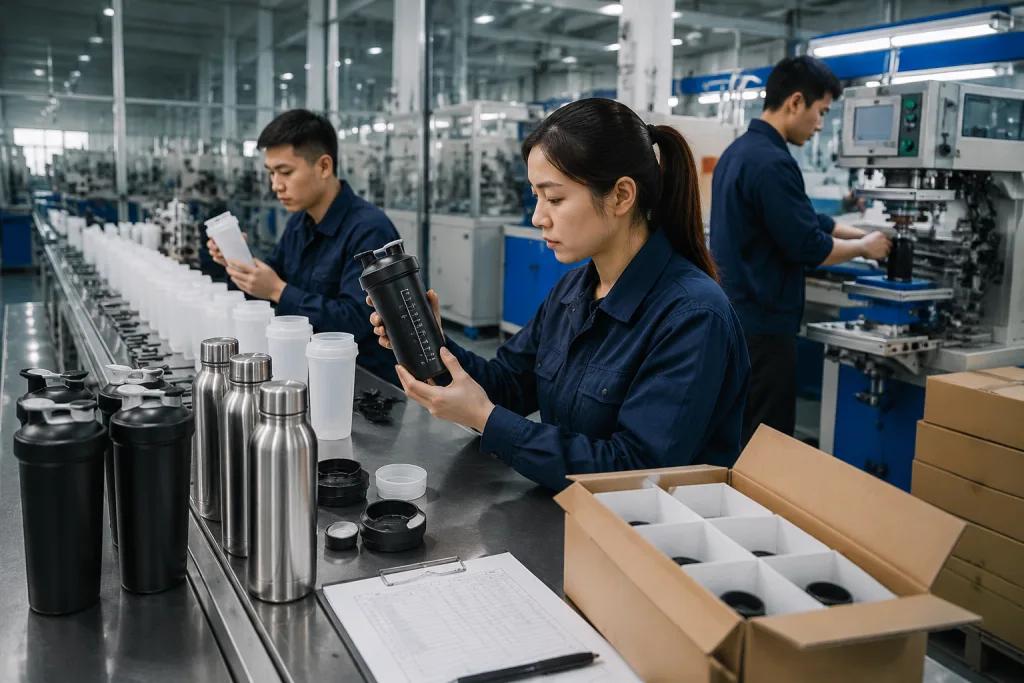
From Hangzhou, Zhejiang, we see this every week on the line. Buyers ask for a customized drinkware SKU, then find out the real work is wall thickness, cap style, and pack method for their channel. QC pulled the sample, checked the neck finish with a go/no-go ring gauge, and the buyer flagged a 6 g carton typo before we packed the first pallet. If you source from a canteen factory or a canteen manufacturer in China, run the order like a commercial project: spec, sample, pre-production, in-line check, final inspection. That is the only way to keep a protein shaker private labeling order profitable.
Start With the Channel, Not the Cup
Most RFQs start with “What shape looks good?” That is the wrong question. Ask where the shaker sells. Gym retail, Amazon FBA, corporate gifting, and a distributor catalog all run on different numbers. A distributor will take 48-piece cartons and plain polybags without blinking. Amazon wants FNSKU-ready barcodes, drop-tested mailer boxes that survive a 3-foot fall, and decoration that stays put when a warehouse scanner drags across it six times. A gym chain buyer wants a 3-day branding turnaround and a flip lid you can open with one thumb between sets. Switch to a canteen distributor or a promo program, and the $2.80 landed-cost ceiling decides how much print area you can afford. We run into this every week.
Put the usage story on one page before you ask for a quote. Capacity in ml, body color, logo method, lid type, leak-resistance threshold, and pack format all belong on that sheet. When a buyer sends a mood board, I send back a blank spec template. The factory needs numbers, not taste. Same rule for a custom canteen, a customizable canteen, or a customizable growler for a crossover campaign: lock the use case, then choose the decoration method. The Zhejiang plants that ship volume will push back if you skip this. I’ve seen a line manager at a Yongkang plant hand a quote back unopened because the buyer never said whether the seal had to survive a gym bag or a checked suitcase. If the factory does not ask, that is your red flag. This is the wrong question to ask if you care about a clean order.
For the first run, keep it tight: one body color, one lid color, one logo method, one carton spec. We shipped a 12,000-unit custom canteen order last quarter that started that way, and when QC pulled the AQL 2.5 sample there was one variable left to chase. That kept the line calm. One PO typo would have made a mess of it.
Choose the Right Shaker Construction
Protein shaker private labeling works best when the structure is plain and defensible. We run PP, Tritan, and stainless steel on the line for premium sets. PP stays the price leader, with a body wall around 1.8-2.2 mm. Tritan gives clearer walls and a cleaner shelf look, but the cost gap is not a guess. If you are pairing a custom growler or customized growler with the shaker line, do not assume the same cap or gasket will fit. We had a buyer flag that on a 700 ml sample after QC pulled the wrong ring spec. Growlers and shakers handle different pressure and carry loads.
For most buyers, the lid matters more than the body. A snap cap can look fine on a sample and still fail in production if the hinge is thin or the gasket groove is shallow by 0.3 mm. Ask for a lid torque target and a leak test. We spec no leakage after 10 minutes of inverted shaking with 300 ml of water, then a 1.2 meter drop test onto plywood or concrete-look board. That is basic risk control. We have seen this go sideways on a PO with one typo in the gasket code.
- Body capacity: 650 ml, 700 ml, or 750 ml are the safest commercial sizes.
- Common pack-out: 24 pcs/carton or 36 pcs/carton, depending on carton strength.
- Decoration: silkscreen, pad print, or laser on metal parts where applicable.
- Compliance: REACH for Europe, FDA-style material declarations for the US, and food-contact documentation from the canteen manufacturer.
If your assortment includes canteen custom, canteen customizable, canteen customized, or distributor growler items, keep the shaping logic consistent across SKUs so your line looks like one program, not a mixed bin of parts. That is the wrong question to ask if you only chase a lower unit price. A 36 pcs/carton load still needs the same neck finish and gasket depth across the program, or the cartons ship fine and the returns start later.
Price the Order Like a Buyer
Price isn't unit cost. It's mold amortization across your order quantity, plus print setup (screens, pad plates, laser fixture), carton spec, freight density, and the cost of a failed arrival inspection. For a basic PP protein shaker with one-color silkscreen at 3,000 units FOB Ningbo, we typically run USD 1.10–1.50. Tritan hits USD 1.70–2.80 depending on clarity spec, lid gasket tolerance, and whether you want a PP or ABS overcap. Bolt on a custom mixing ball, a 304 stainless spring insert, or a rigid gift box with foam cutout and your landed cost jumps 18–35% before freight touches it.
In Zhejiang, factories like ours quote by component stack. Body resin grade and gram weight. Lid assembly. Gasket material (silicone vs TPE, shore hardness matters). Print color count and coverage area. Insert spec. Outer carton ply and flute. This is healthier. Ask for a line-item breakdown. When a supplier markets themselves as a canteen supplier, canteen vendors, or canteen manufacturers all on the same Alibaba page, that's not a red flag—but if the quote comes back as one glossy round number with no BOM, walk. A decent canteen factory will tell you the body mold cavity count and cycle time that drives the piece price. A bad one won't even know their own insert gram weight.
FOB is usually the right starting point for North America and Europe. Then compare freight by carton cube, not just per-container rate. Shakers are light but bulky. A 700 ml shaker packed 24 pcs per carton in a standard export box ships at roughly 0.045 m³. Same item packed 12 pcs per carton because the lid foam insert eats space? You just doubled your freight cost per unit. We've seen buyers approve a beautiful box and then choke on the LCL charge. If you're building distributor drinkware pricing later, same discipline: quote the item, the print, and the shipper separately. The math works cleaner that way.
Lock Artwork Before Sampling
Sampling is not a design exploration phase. It is a verification gate. We had a buyer from Brisbane send three artwork revisions after they approved a sample. Each round cost them 7–10 days and $85–$120 in DHL courier fees—the factory absorbs none of that. Before you trigger sampling, lock three things: logo placement measured in mm from two reference edges, the exact Pantone code (not "navy blue" or "match my website"), and the print area. A 700 ml shaker body typically gives you 70 x 45 mm on the front panel. The lid gets a 12 mm debossed mark at best, or nothing at all. If the buyer runs a canteen promotional wrap or a custom canteen campaign alongside the shaker line, resist stretching artwork to fill dead space. We saw a 55 mm logo crammed into a 45 mm print zone last quarter—every unit from that first 500-piece run came out with edge clipping. Clean beats crowded every time.
For protein shaker private labeling, I set two physical samples: one master and one production reference. Both get signed, dated, photographed against a steel ruler with mm markings, and locked in a cabinet next to the QC desk. When the line runs 5,000 or 10,000 pieces, that pair is your only real control point. QC pulls against the reference—not memory, not the email from three weeks ago. On multi-SKU projects—say a customized canteen in 500 ml, 750 ml, and 1,000 ml plus a shaker—verify the logo file is vector. We received a 72 dpi PNG from a distributor in Frankfurt last month. Sampling took 14 days instead of the usual 5. The first 200 printed shakers showed pixelation at the logo edge. Weak artwork burns you twice: once in time, once in reprint cost.
One signed PDF, one physical golden sample, and one production checklist settle more disputes than a 27-email thread ever will.
If your catalog includes canteen distributor assortments, keep decoration rules uniform across lines. A canteen customized line and a shaker line should run the same tolerance: +/-1.0 mm on print position for standard screen printing. We had a buyer flag a 1.5 mm shift on shakers but accept the same drift on canteens because "different factory, different spec." That's the wrong way to manage it. The math doesn't work. One standard across all SKUs, or you'll spend a week arguing about what "acceptable" means while the container sits at the port.
Run QC Before You Ship
I've watched buyers try to save $300 on QC and lose $15,000 on chargebacks. The quality plan goes in writing before the first puck of PP resin hits the hopper. For standard drinkware we default to AQL 2.5 on major defects and 4.0 on minors—tighten to 1.5 if your channel runs strict return policies or you're landing on Amazon. Majors: leakage, hinge failure, torn silicone seal, wrong Pantone, print misregistration visible at arm's length. Minors: cosmetic marks under 1.5 mm that don't touch a sealing surface. Europe-bound? Ask for REACH compliance on the raw material lot and the ink batch, not just the finished piece. US-bound? Food-contact declarations with batch numbers tied to test records. If the test record and the batch sticker don't match, reject the lot.
On our floor in Hangzhou the QC flow runs four gates: incoming material check, first-article sign-off, in-line patrol at two-hour intervals, and final random inspection per ISO 2859-1. We push 300,000 units a month across drinkware lines. Process control isn't a checkbox at that volume—it's the only thing keeping a 40HQ from turning into a liability. Same logic whether you're running a custom growler or a mixed customized growler assortment. Lid spring force drifts by two Newtons and the flip-top won't seal. Silicone gasket runs 0.3 mm thin—we caught exactly that last month on the 10 a.m. in-line pull. Stopped the line. Swapped the gasket cavity insert. That's a 90-minute pause that saves a full-container return. I'll take that trade every time.
- Leak test: inverted shake, 10 minutes, zero seepage across the seal ring.
- Drop test: 1.0–1.2 meter free-fall onto concrete, three orientations, no lid pop or functional failure.
- Color tolerance: Pantone delta held against the signed master sample under D65 light.
- Carton test: edge crush and stacking compression checked before we book the container.
A canteen distributor who repeats orders runs the plan I just described. The one who skips it spends Q1 answering 1-star reviews. The math doesn't work the other way.
Packaging Can Make or Break Margin
Packaging eats margin faster than most line items. A plain polybag costs almost nothing—until 3% of units arrive crushed and the customer files a claim on 12,000 pieces. A window box looks sharp on-shelf but tacks on USD 0.35-0.60 per unit and increases carton cube by 18-22%, which means fewer units per pallet. We run both formats on the same line depending on the channel. DTC? A printed mailer carton with a single-color logo, no insert, works. Wholesale or distributor drinkware? Master carton with a die-cut inner divider. The packaging has to match where the product sells, not what the factory defaults to.
For protein shaker private labeling, figure USD 0.15-0.60 per unit. The spread comes from paper grade—200g coated vs 350g kraft—and insert complexity. A foam insert for a shaker plus pill compartment runs higher than a corrugated slip. If you need FNSKU labels, barcode verification, or batch stickers, tell us before the run starts. We add a QC station at the end of the line just for label scan and placement check. One buyer skipped this on 8,000 units headed to Rotterdam. Wrong FNSKU on the inner carton. That mistake wasn't caught until the 3PL started inbound scanning. The rework cost more than the packaging itself. We had to reprint and hand-apply 8,000 labels on a Saturday.
Carton efficiency is the wrong place to save two cents. We've seen a canteen vendor shave 8 mm off carton height and fit an extra layer per pallet—on a 40HQ that's 480 more units. That math works whether you're running a canteen customizable program, a custom canteen line, or a mixed container with customized drinkware and custom growler units. The box isn't an afterthought. It's freight cost, warehouse labor, and the first thing your customer sees.
Plan Lead Time Around Reality
I tell every new buyer the same thing: lead time separates factories that actually run production from trading companies that just forward emails. Standard protein shaker—same lid thread, same body shape—sample runs 7-10 days if we pull an existing mold and grab a blank bottle off the shelf. Mass production clocks 25-35 days after sample sign-off and the 30% deposit clears. We track this on a shared Google Sheet the buyer can see.
New mold? Add 18-25 days for tooling. A flip-cap lid with a carry loop and silicone gasket isn't the same as a simple screw-on. A buyer once pushed us to hit 15 days on a complex lid tool. The mold shop delivered—but the first shots showed flash on the parting line, and QC rejected T1 samples. The schedule slipped anyway. Faster isn't faster when rework eats the gain. We lost 6 days re-cutting the cavity.
Sea freight from Ningbo to LA runs 18-22 days port-to-port. East Coast via Panama adds another 8-10 days. Customs is the wildcard—we've seen 2 days and we've seen 12. A credible factory in Hangzhou builds the timeline around frozen artwork, a signed golden sample, and a locked packing list. No changes after the mold steel is cut. That's not being difficult—it's making sure your 20,000 units don't sit on the dock while we re-etch a silkscreen plate.
Reorder speed is where the real value sits. Once the mold, silkscreen plate, carton dieline, and AQL 2.5 limits are locked, a 20,000-unit repeat order ships in 18-25 days. The line crew knows the product. No learning curve. That repeatability is worth more than shaving 5 days off the first order and gambling on quality. One buyer tried to push us to 12 days on a repeat—we held at 18 and still delivered ahead of their warehouse appointment.
What a Good Order Looks Like
Here is the order we trust on the line: 700 ml PP shaker, 2.0 mm body wall, one-color silkscreen, black lid, food-contact gasket, 24 pcs/carton, AQL 2.5 major, REACH documents attached, golden sample signed, and an FOB quote split by body, lid, print, and carton. Clean. The buyer once sent a PO with “700ml” mashed into one word and the lid color left blank. We flagged it before mold tags came off the rack. That is a solid protein shaker private labeling program. It ships without drama, and the same spec map can carry into a broader custom drinkware line later.
Once that base order runs, you can carry the same buying logic into canteen custom, canteen customizable, canteen customized, and distributor canteen lines without changing the discipline. You change the body style and the channel, not the way you write the spec. We’ve seen buyers push for three lid options on the first order. The math does not work, and the line slows down. Best canteen manufacturers and canteen suppliers keep the spec lean, QC visible, and freight sane. That is what turns a first order into a repeat account, whether the next SKU is a shaker, a custom canteen, or a customized growler for a seasonal launch in Europe or North America.
Get a factory quote built around your channel
Send your target capacity, logo file, and carton needs. We will quote the shaker spec, QC plan, and freight-ready packing for China delivery.
Frequently asked questions
What MOQ should I expect for protein shaker private labeling?
For a standard shaker with existing tooling, MOQ is usually 3,000 to 5,000 units per color and logo setup. If you want a new lid mold or a special insert, the MOQ can move to 8,000 units or more because the factory needs to cover tooling and setup. In Zhejiang, many canteen manufacturers will still quote smaller trial runs, but the unit price usually jumps 15-30%. For a first order, 3,000 units is a sensible place to start if you need market feedback without overcommitting.
How much does a custom shaker cost FOB China?
A basic PP shaker with one-color print often lands around USD 1.10-1.50 FOB at 3,000 units. Tritan versions typically sit around USD 1.70-2.80 FOB, depending on clarity, lid design, and packaging. Add a mixing ball, premium box, or extra label work and you may add USD 0.15-0.60 per unit. China pricing is efficient, but the gap comes from tooling, print complexity, and freight density. Ask for a line-by-line quote so you can compare canteen supplier offers properly.
Which QC checks matter most for shakers?
Leak resistance, lid fit, and print durability matter most. I would require inverted leak testing for 10 minutes, a 1.0-1.2 meter drop test, and visible print alignment against the signed sample. For larger orders, use AQL 2.5 for major defects and 4.0 for minor defects. If you are shipping into Europe, also ask for REACH documentation; for the US, request food-contact declarations. A good canteen factory in China will be comfortable showing all of this before shipment.
Can I mix shaker and canteen products in one order?
Yes, but only if the factory has the right production lines and QC control. It is common to combine a protein shaker order with canteen custom, custom canteen, or custom drinkware SKUs to improve carton density and reduce buying admin. The risk is inconsistency across different product families. Keep the decoration method, carton spec, and QC format aligned. If your supplier is a real canteen manufacturer or canteen vendor with export experience, they should split the line items clearly and still keep the shipping plan tidy.
How long does production take after sample approval?
For standard shaker tooling, expect 25-35 days after sample approval and deposit. If you need new molds, add 15-25 days before production starts. After that, sea freight from China to Europe or North America usually adds 18-40 days depending on the port and season. A repeat order can be faster, often 18-25 days in production if the artwork, carton, and QC limits are already locked. Zhejiang factories with stable output can often run 300,000 units per month across drinkware lines, but your slot still depends on when you freeze the order.