Key Takeaways
- Material choice (Tritan vs. PP) affects cost by 20-30% and impacts dishwasher safety
- Mixing mechanism (ball vs. grid vs. no agitator) determines user satisfaction and price point
- Leak-proof sealing requires a silicone gasket with at least 1.5 mm thickness and a double-wall lid design
- Minimum order quantities for custom protein shakers typically start at 1,000 units per design
We have shipped protein shakers to 14 supplement brands in the US, UK, and Australia. Some POs sailed through. Others came back with rework notes. The bad ones usually started with an Amazon-style spec, not a spec that matches a 300-unit-per-hour line in Zhejiang. QC pulled one sample at the cap station and the buyer still wanted a retail finish on a bulk part. That math does not work.
Bulk shaker sourcing is not about finding a good bottle. It comes down to four checks that bite hard on a 5,000-unit order: resin grade, mixing insert shape, lid-seal tolerance, and print hold after 55°C dishwasher cycles. Miss one detail and the shipment turns into a warehouse headache. Get them right and the reorder lands before the container clears customs. We have seen that one go sideways when a PO had “shaker cap” typed as “shaker cup” and nobody caught it until sampling.
Decision 1: Material – Tritan vs. PP vs. Glass
The bottle body is the first thing the buyer picks up. It has to feel solid, survive a 1.2 m drop, and hold its shape after repeated dishwasher runs. We run three materials on the line:
- Polypropylene (PP): Low-cost, light, BPA-free, and recyclable. That is why it shows up in entry-level shakers and promo packs. The catch is plain: it scratches fast and keeps protein smell after a few washes. FOB price per unit: $0.80–$1.20 for a 600ml bottle. A buyer once flagged a cloudy cap after 48 hours in citrus tea, and that complaint was hard to walk back.
- Tritan (Eastman copolyester): This is the spec we see on mid-range and premium shaker orders. Tritan stays clear, takes impact well, and goes through the dishwasher without haze or odor pickup. FOB price: $1.50–$2.50 per unit for the same volume. The trade-off is cost and a bit more weight in the hand. QC pulled the sample after a 2 mm gate mark showed up near the shoulder, so the mold finish matters.
- Glass (borosilicate): Still niche, but we get more requests from buyers who want plastic off the spec sheet. Glass looks clean and brings zero chemical leaching, yet it is heavy and cracks if the carton insert is weak. FOB price: $2.00–$3.50 per unit. MOQ is often higher (3,000+ units) because the drop test spec and insert add cost. The math does not work for every channel, and we have seen this go sideways when the buyer underestimates freight by 18 kg per carton.
For most bulk orders, Tritan gives the best balance of shelf appeal and durability. If your target retail price is under $10, PP is the right call. If you sell to premium gyms or DTC, Tritan earns the markup. Glass only makes sense when the buyer can carry the shipping weight and the higher MOQ.
Decision 2: Mixing Mechanism – Ball, Grid, or No Agitator
A protein shaker has one job: move powder through liquid without leaving dry pockets. Miss that, and the buyer flags it on the first sample round. We run 250 ml water and 30 g powder on the line, and the result shows fast which design holds up.
- Stainless steel mixing ball: A 304-grade spring or ball drops into the bottle and does the work when the user shakes hard. It breaks clumps well, but the ball comes loose, gets lost, and then the customer blames the bottle. Cost: adds $0.10–$0.20 per unit.
- Mixing grid / screen: A plastic grid is molded into the lid or packed as a separate insert. Liquid gets forced through the openings, which creates turbulence and pulls powder apart. The grid stays with the shaker, though protein film can sit in the corners if the mold finish is rough. Cost: adds $0.15–$0.30 per unit.
- No agitator: This design depends on the user's shake, full stop. It is fine for pre-mixed drinks or shakers with built-in fins, but clumping complaints show up fast once the powder is dense or the water is cold.
For bulk orders, the mixing grid is the safer call. It stays in place, and the angled vane versions we ship mix better than the flat ones; QC pulled the sample after a 12-day test and the residue was cleaner than the ball version. Budget buyers still ask for the ball because the unit price looks lower, but that is the wrong question to ask - lost parts and complaint emails cost more than the $0.10 difference.
Decision 3: Sealing Performance – Leak-Proof Standards
A shaker that leaks in a gym bag kills trust fast. We watched a $30 repeat order vanish over one loose lid, and the first check is the seal stack on the line.
- Gasket material and thickness: Silicone gaskets are the default. For the lid seal, we hold 1.5 mm minimum; for the flip-cap seal, use 2.0 mm if the design has one. Softer silicone in the 50-60 Shore A range sits better against small lid irregularities. QC pulled the sample for a caliper check after the buyer flagged a 1.2 mm gasket on the PO.
- Lid design: A double-wall lid with a threaded closure and a secondary snap-lock gives a second barrier. A single-wall lid with thread seal only is where we see trouble after 20 or 30 open-close cycles. The math does not work when the customer is packing powder, water, and a bag full of keys. We have seen this go sideways on a 5,000-piece run.
- Testing: Good factories in Zhejiang run 24-hour water leak tests at 0.5 bar pressure. Ask for the report, not a promise. AQL 2.5 (normal inspection level II) is standard for leak testing, and we also check the paperwork for one typo that shows up all the time: “leak test” missing from the PO, which usually means someone skipped the spec review.
For a first order, we push a 100% air pressure test on every unit before shipment. It adds about $0.05 per unit, and on a 10,000-piece run that is cheap insurance. We have seen it save a batch when the buyer wanted 12 days on delivery and the line caught a weak cap before packing.
Decision 4: Decoration – Silkscreen, Pad Print, or In-Mold Label
Your logo turns a bulk shaker into your SKU. Decoration drives unit cost, scratch resistance, and how we run the line:
- Silkscreen printing: This is the workhorse for 1-2 color logos on a straight body. It sticks on a smooth wall, but a textured finish eats detail fast. Cost runs $0.10–$0.25 per color per unit, and screen setup is $50–$150 per color. We had a buyer flag a 0.8 mm logo on a matte cup; the first proof passed, then the ink filled in on the test run at the 24-hour check.
- Pad printing: Better when the mark sits on a curve, like a lid cap or a small side panel. It handles compact artwork. Wear resistance is weaker than silkscreen. Cost is $0.15–$0.30 per color per unit. QC pulled one sample after a rub test at 200 cycles because the edge started to soften. That is where buyers get surprised.
- In-mold labeling (IML): The film goes into the mold and becomes part of the cup during injection. No peeling. Sharp image, clean wash performance. This is the right call for premium buyers who want the print to stay clean after repeated washing. Cost is $0.30–$0.60 per unit, and the MOQ is 3,000+ units because the mold build is more involved. We’ve seen this go sideways when a buyer tried to push a 1,000-unit order through IML; the math does not work.
- Laser engraving: Best for metal parts such as a mixing ball or stainless steel trim. Permanent, one color only. Cost is $0.05–$0.10 per unit. On a 304 stainless insert, the mark stays crisp, and there is no ink to chip off. Simple job.
For a first order of 1,000–5,000 units, silkscreen usually gives the best balance of price and output. Once volume climbs, IML starts making sense on cost per unit and gives you a stronger shelf look without much touch-up at the packing table. We ship plenty of those, and the buyer often asks for a cheaper print first; that is the wrong question to ask if they want the logo still looking good after 12 days of washing instead of 18. The line tells the truth fast.
Supplier Evaluation: What to Ask Before You Order
Once the design is locked, we ask direct questions. No shortcuts. On a shaker line in Zhejiang, these are the numbers that decide whether we take the PO or park it:
- What is your monthly production capacity for this shaker? A mid-size line should show 50,000–200,000 units/month. We ask how many injection machines are actually on the floor, not how many sit in the brochure.
- What is your MOQ per SKU? Standard is 1,000 units for stock colors and 3,000 for custom colors. The math does not work if the buyer wants five lid colors plus one box print.
- Do you have BSCI, REACH, or FDA compliance? BSCI is common for European buyers, FDA for the US. We ask for the current report number, because an old certificate in a drawer does nothing at customs.
- Can you provide a sample pack of 5–10 units with different mixing mechanisms and materials? A solid factory will charge $50–$150 for samples, refundable with the first order. QC pulled the sample against a caliper at 0.2 mm after one buyer flagged a loose-fit lid, and that saved us a bad run.
- What is your lead time for a bulk order? We usually see 25–35 days after sample approval, plus 10–15 days sea freight to the US or Europe. A promise of 20 days with no line schedule behind it is not a serious answer.
For the first order, visit the factory or hire a third-party inspector. We run that check on the first lot. We've seen it go sideways on small stuff: a lid vent looked fine in email photos, then leaked at AQL 2.5. For leak risk, put AQL 1.0 in writing. The buyer flagged it for a reason.
Cost Breakdown: What You'll Actually Pay
This was the real cost sheet for a 600ml Tritan shaker with a mixing grid and silkscreen logo, run at 5,000 units from a Zhejiang factory. We quoted it last month on the line. QC pulled the sample after the buyer flagged a carton-mark typo, and we had not even cut steel yet:
- Unit price (FOB Shanghai): $1.80–$2.20
- Mold cost (if custom shape): $2,000–$5,000, spread across the order
- Artwork setup (silkscreen): $100–$200
- Sample cost: $50–$150, refundable after order
- Packaging (individual box): $0.15–$0.30 per unit
- Shipping (20-foot container to Los Angeles): $2,500–$4,000, or about $0.50–$0.80 per unit
- Duty (US, 3.5% for plastic drinkware): $0.06–$0.08 per unit
Total landed cost lands around $2.60–$3.50 per unit. The math works only if you retail at $9.99–$14.99. For a wholesale drink bottle tied to a promo push, we can switch to PP and drop the grid, which puts you near $1.50 landed. That is the wrong question to ask if you still want a premium hand feel. We have seen that go sideways fast. 600ml is the sweet spot.
Common Pitfalls and How to Avoid Them
Even seasoned buyers get burned. Three failure points keep coming up on the line:
- Underestimating lead time: A lot of buyers still think 2 weeks is enough. It is not. For a custom protein shaker in bulk, we run 4-6 weeks from PO to FOB, and the carton sample still needs one signed-off copy before the line starts. One buyer typed “ship asap” in the remarks field, then got a 12-day slip because their own stock plan had no buffer. The math does not work. Build inventory to the real schedule, or you pay air freight.
- Skipping the leak test: We saw 5% leakage on a 10,000-piece run because the gasket was 0.5 mm too thin. QC pulled the sample after 24 hours and caught it before shipment. Ask for a 24-hour water test on samples and a 100% air test on the production run. Skipping this is the wrong question to ask.
- Ignoring the mixing grid design: Cheap grids come with sharp edges. We had a buyer flag mouth cuts on a sample with an unrounded rib, and the fix was plain: specify R0.5 mm minimum on every internal edge. Put that in the PO, or you will end up with rework and a messy inspection. We have seen that go sideways fast.
Put these checks into your factory quality checklist before mass production starts. It cuts rework, and it cuts arguments at inspection.
Why Zhejiang Factories Lead in Drinkware Manufacturing
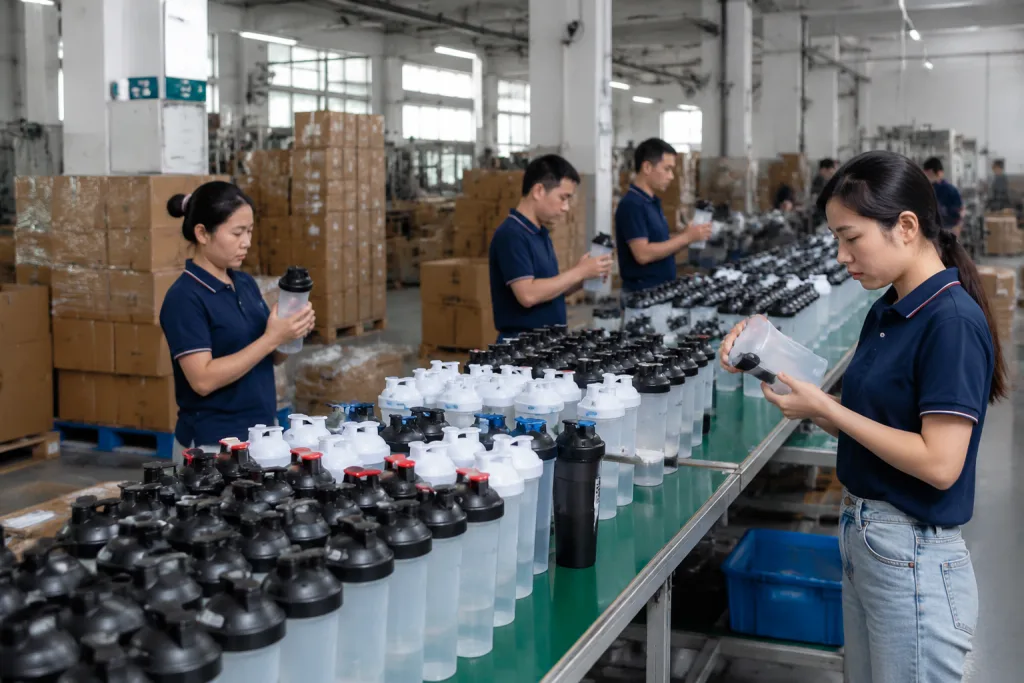
Zhejiang, especially Hangzhou and Yiwu, is where a lot of plastic and metal drinkware gets made. We run injection molding, mold repair, and carton packing in one belt, so the line moves faster and the mold fee stays lower than in inland provinces. A normal plant here ships 100,000 units of bulk drinkware per month across several SKUs. QC pulled the sample with a caliper at 0.1 mm, and the buyer flagged a loose cap before mass production. That is the real edge. For a protein shaker in bulk, Zhejiang gives you a supply base that has spent 20 years on this category, and the math works.
Ready to source your protein shaker in bulk?
Contact our team for a free sample pack and a tailored quote based on your volume and design needs.
Frequently asked questions
What is the minimum order quantity for a custom protein shaker?
For stock colors (e.g., black, white, clear), MOQ is typically 1,000 units per design. For custom colors (Pantone-matched), expect 3,000 units per color. If you need a completely new mold (custom shape), MOQ is usually 5,000–10,000 units to amortize the mold cost. Some factories in Zhejiang offer a lower MOQ of 500 units for existing molds but charge a higher per-unit price.
How long does it take to get samples before a bulk order?
Standard samples (existing design, stock color) take 3–5 days to produce and 5–7 days for shipping via express (DHL/FedEx). Custom samples (new color or logo) take 10–15 days. Most factories charge $50–$150 for samples, refundable with the first bulk order. Always request 5–10 samples to test for consistency.
Are Tritan shakers dishwasher safe?
Yes, Tritan is dishwasher safe up to 100°C (212°F) and does not warp or cloud. However, the silicone gasket and mixing grid may degrade faster if exposed to high heat cycles. We recommend top-rack washing or hand washing to extend the life of the sealing components. PP shakers are also dishwasher safe but may scratch over time.
What certifications do I need for selling shakers in the US and EU?
For the US, FDA compliance for food contact materials is essential. For the EU, REACH and EU 10/2011 (plastic materials) are required. Many Chinese factories hold BSCI (social compliance) certification, which is often requested by European retailers. Always request a material test report from an accredited third-party lab (e.g., SGS or Intertek) before shipping.
Can I get a custom shape for my protein shaker?
Yes, but it requires a new injection mold, which costs $2,000–$5,000 depending on complexity. The mold is owned by you (or the factory with a deposit). Lead time for mold making is 20–30 days. Custom shapes allow unique branding but increase MOQ to 5,000–10,000 units. For most first-time buyers, using an existing mold with custom color and logo is more cost-effective.