Key Takeaways
- A realistic MOQ for a custom shaker is often 1,000 to 3,000 pcs, with lead time around 20-35 days after sample approval.
- Budget USD 0.85-1.60 for a basic PP protein shaker, and USD 1.90-3.80 for Tritan or stainless variants depending on capacity and print.
- Leak tests should be written into the sample standard: 10 minutes inverted, then 30 seconds shake test, then 24-hour static hold.
- For export, ask for REACH, FDA contact-material declarations, carton drop testing, and AQL 2.5 for critical defects.
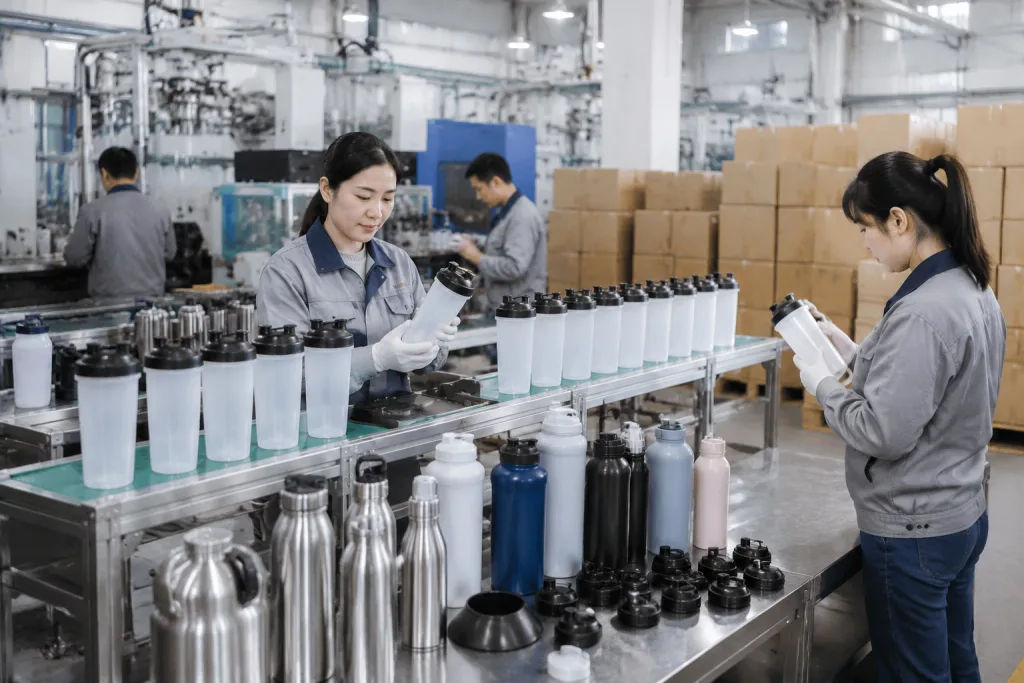
If you buy protein shaker factory direct, price is not the first line item. The real question is what is on the cart. A 600 ml shaker with a mixing ball, a 28 oz shaker cup with a flip lid, and a promo gym bottle can sit on the same quote sheet, but they behave differently on sealing, print registration, and export packing. We saw it on a Monday run: QC pulled one sample at 45 degrees, and the lid started weeping. Same family. Different headache.
The clean way to source is plain. Write the RFQ like a production sheet, approve one sample against measurable checks, then turn that sample into a PO with no loose wording. That is how you buy custom drinkware without paying for remake time. At BottleForge Industrial in Hangzhou, Zhejiang, we run about 220,000 units per month across shaker and bottle lines, and the buyers who get the best result ask for cap torque, logo position, and carton count before the line starts. The math does not work any other way.
Start With The Use Case
Before you ask a protein shaker factory direct supplier for a quote, lock the use case first. Gym retail, supplement bundles, distributor promos, and Amazon FBA hit the line differently. A 600 ml shaker for sports nutrition needs different lid torque and a different logo panel than a customizable drinkware piece sold as a corporate gift. Last month QC pulled a cap sample at 18 N-cm, and the buyer flagged it because the retail pack was meant for one-hand tightening, not repeated gym abuse. If you want a custom canteen or a custom growler later in the same program, split those jobs in the sourcing file. Do not mash them into one vague drinkware brief.
The buyer who knows the drill asks four things first: capacity, material, closure type, decoration method. This is the wrong question to ask after the quote. A 400 ml mini shaker looks cheaper on paper, but the math does not work; 500 ml and 700 ml move better at retail, and we have seen 400 ml sit in stock for 12 days while the 700 ml clears in 3. Write the spec down. On our side, a PO typo on one run swapped 1.6 mm PP body for 1.8 mm, and the carton weight jumped by 0.4 kg before anyone caught it. Put wall thickness in black and white, like 1.6 mm PP body, 2.0 mm Tritan body, or 0.5 mm 304 stainless if you are moving into metal. One clean line saves a lot of back-and-forth later.
- Best starter spec: 600 ml, PP body, screw lid, whisk insert, one-color print
- Retailer spec: 700 ml Tritan, silicone seal, embossed or laser logo
- Promo spec: 500 ml, single-color screen print, lower carton cost
Write The RFQ Properly
A clean RFQ is a build sheet, not a product name plus a logo file. If you want a canteen factory to take it seriously, send model, capacity, material, color, logo method, packing, and compliance on one page. We run 600 ml shaker quotes this way every week. The sloppy ones usually miss carton size or print position. If you are also sourcing canteen customizable or canteen customized SKUs, keep each line item separate. A canteen supplier that cannot quote from a clean RFQ usually cannot control the line either. QC pulled one sample last month and the 58 x 40 x 35 cm carton was still wrong because the buyer left out the insert count.
Use PO-style wording from the start. Item 1, 600 ml shaker, PP body, black lid, 1-color silkscreen, individual polybag, 50 pcs per carton, carton size 58 x 40 x 35 cm, FOB Ningbo. Item 2, spare mixing ball, packed separately. The buyer flagged one RFQ here because “ball” was left out of the second line, and the quote came back wrong. If you sell as a canteen distributor or distributor drinkware program, ask for separate SKUs for each pack format. This is the wrong question to ask if you expect one blended price. We had a PO typo last quarter where “blal” slipped in for “black”; the line caught it, but the buyer paid for the extra round trip.
Useful RFQ fields:
- Capacity in ml and oz
- Target price in USD
- Annual forecast, even a rough one
- Logo size in mm and print position
- Testing needs: REACH, LFGB, FDA, phthalate-free, dishwasher cycle count
Choose The Right Material
Material choice moves landed cost more than most buyers expect. PP is the low-cost route for a customized drinkware shaker, and it works when the order is about volume, not shelf appeal. We run PP cups with a 0.6 mm wall on line 3, and the mold stays simple. Tritan adds cost, but the cup comes out clearer, and the buyer stops asking why it looks like a promo item. Stainless steel changes the category. You are pricing against a premium custom canteen or insulated bottle program, not a basic shaker cup. That is the right comparison for a canteen vendor or canteen vendors handling more than one line. The math does not work any other way.
For protein shakers, the body is rarely the part that fails. The lid and seal cause the headache. QC pulled the sample last week, and the leak showed up at the gasket after 18 shakes on the bench tester. A good factory talks about gasket material, thread pitch, and top-load sealing force, not just the resin name. If you are building a customizable canteen or a customizable growler beside the shaker program, keep those tolerance calls separate; the closure systems are different, and we have seen that go sideways when the buyer tries to force one spec across both. Ask for material declarations, migration compliance, and REACH for Europe. For North America, ask for FDA contact material statements and, where relevant, ASTM test references. In Zhejiang, the stronger factories have those files in the drawer. The weaker ones start hunting after you ask, and that tells you enough.
Price logic: PP shaker body at USD 0.85-1.20, Tritan at USD 1.35-2.30, stainless hybrid at USD 1.90-3.80, depending on MOQ and print complexity.
Sample Before You Argue Price
Samples settle price talks fast. Email does not. Ask for a pre-production sample, not a shelf unit pulled from the corner. We check the exact Pantone, lid snap, logo hit, and pack-out before the line runs 5,000 pcs. I have seen a buyer skip that step and then ask why the rework bill landed on the second shipment. That is the wrong question. If you also source a customized canteen or distributor canteen line, keep the approval sheets separate. We had one PO with the carton mark typed one letter off, and the mistake rode all the way into production.
Use a simple sample test sheet. No drama. Check leak resistance upside down for 10 minutes, shake 30 times, then hold it upright for 24 hours with room-temperature water. After that, inspect print adhesion after a 50-cycle handwash trial or 20-cycle dishwasher trial if the decoration method allows it. For a custom growler or customized growler, add closure torque and carbonation pressure. For a shaker, the lid snap and gasket finish matter more than polished copy. QC pulled the sample last week and found a 1.5 mm gap at the hinge; price talk stopped there, and it should have.
Sample cost usually sits around USD 25-80 for courier and tooling adjustment, but do not let a factory hide a real defect behind a sample fee. We ship samples in a 2 kg test box for a reason. The math does not work if you skip a 300 mm drop check and then blame the factory when the cap cracks in transit. This is process confidence, not a souvenir.
Turn The Sample Into A PO
The PO has to read like a clean handoff from signed sample to bulk. Put the approved sample date, color code, logo file version, carton spec, and defect standard on the page. For export drinkware, we write the AQL levels straight out: critical 0, major 2.5, minor 4.0. If the buyer changed the cap color on revision 3, the line needs to say so. On one run, the buyer sent a PO with a 15 mm lid note on one line and 18 mm on the next; QC froze the line because nobody knew which tool setting to load. If you are dealing with a canteen manufacturer or canteen manufacturers on parallel programs, keep the wording identical across SKUs, or QC will treat one line as open and another as locked. That is how simple jobs turn ugly.
Good PO lines cover quantity, unit price, MOQ acknowledgment, lead time, Incoterms, packing details, and inspection method. A clean example is 3,000 pcs at FOB Ningbo, 25 days after sample approval, 1 pc in polybag, 50 pcs per master carton, no mixed colors unless written approval is attached. We had a buyer flag a PO because “carton” was typed as “corton” on page 2; the typo copied into the shipping mark, and the math stopped working. The buyer was not being picky. If the buyer is an Amazon seller, add FNSKU labeling, carton barcode placement, and pallet rules. If you are a canteen promotional buyer, spell out gift box, hangtag, or retail sleeve. We ship to spec, not guesswork. Guessing gets expensive fast.
Put rework authority in the PO too. Say who pays if print color is off by more than Delta E 2.0 or if leak failure exceeds 1 percent on final inspection. QC pulled the sample with the colorimeter, and we have seen this go sideways when nobody signs that line. That one sentence saves a week of back-and-forth later. On one order, the buyer tried to move blame after the burst test hit 1.3 percent; the PO had no owner on rework, so the claim sat for 12 days instead of 18 days to close. This is the wrong question to ask after the goods ship. Put it in writing before the line starts.
Inspect Like You Mean It
Inspection is where buyers find out whether they bought paper quality or production quality. On a 500-piece trial, a pre-shipment check is enough. On a 20,000-piece run, we run in-line checks and a final audit. QC pulled the sample before lunch, caliper on the table, and the 0.2 mm lip gap was already on the sheet. A Zhejiang factory should hold AQL-based checks without drama. If it cannot hold that line, the standard is not the problem. Their control is.
Watch the defects that actually sink a shaker program: leaking lids, warped threads, loose whisk inserts, off-center print, scratches on clear bodies, and wrong carton count. For a distributor growler or custom drinkware order with mixed SKUs, barcode readability and carton labels matter as much as the cup. We had a buyer flag one PO because “6 pcs/ctn” was typed as “8 pcs/ctn”; that typo would have broken the pallet math in the warehouse. Ask for random carton photos, not hero shots from one perfect unit. The math does not work any other way.
- Critical defects: leakage, missing parts, contamination
- Major defects: wrong logo, warped lid, color mismatch beyond tolerance
- Minor defects: cosmetic scratches, small print halo, light flash mark
Buyers who know inspection stop asking whether a factory is “good” in general. They ask whether this batch passed the agreed standard. That is the right question. We’ve seen it go sideways when someone skips the carton pull on a 30 mm cap, and the line only found it after 200 units were packed. Inspect like you mean it.
Plan Freight And Compliance
Once the PO is signed, freight and compliance set the pace. A shaker at USD 1.10 ex-factory can go sideways fast if the carton is 5 cm too tall or the inner tray leaves dead air; we saw that on a 36 g PP cup line last month. Ask for carton dimensions before you confirm. For exports out of Zhejiang, a tighter master carton cuts sea freight and warehouse handling, and the buyer who skips that math usually pays on landed cost.
For Europe, ask for REACH paperwork and a straight answer on whether the colorants and additives are cleared for contact use. For North America, ask for food-contact declarations and the FDA statement in plain language. If the shaker uses steel, confirm 304 or 18/8 where it applies, no fuzzy wording. On one PO, the buyer flagged a typo on the spec sheet and QC pulled the sample back to check the batch code on the line. For a custom drinkware range, keep the compliance file matched across the shaker, canteen, and bottle. One clean file beats three versions that drift apart.
Freight terms matter too. FOB is the cleaner default for a lot of buyers because it keeps factory cost and shipping cost apart. If you need DDP, put customs, VAT, and last-mile delivery in writing. The math does not work any other way. We have seen a 12-day booking slip turn into 18 days because the PO said “door delivery” and nothing else. No room for guesswork. We run the carton drop test at 1.2 m before booking cargo.
How To Compare Supplier Types
Not every seller works the same way, and buyers lose weeks when they act like they do. A direct protein shaker factory direct source gives you control over tooling, lead time, and QC records, but you own the spec sheet too. QC pulled the sample and found a 0.5 mm wall-thickness mismatch on the first run, so we check samples before mass order. A trading company can smooth emails and chase documents, yet the middle layer adds cost. A true canteen supplier or canteen suppliers network can cover mixed categories, but you still need to ask who molds the cup and who prints the logo. That is basic procurement hygiene. We run this check with a 0.02 mm caliper on the line.
If your business is a canteen distributor, distributor canteen, or distributor drinkware operation, judge suppliers by repeatability, not by one clean sample. Ask for monthly output, QC flow, and reorder stability. At BottleForge in Hangzhou, Zhejiang, we keep it blunt: a line that runs 220,000 units per month and holds a 20-35 day lead time matters only if the second order matches the first. We once saw a PO typo change carton count from 24 to 2,400, and the math did not work. A caliper on the line catches more than sales talk. Buyers in China-facing supply chains know this, and buyers in Europe and North America learn it fast. The buyer flagged it before booking.
When you compare quotes, compare the same build: same material, same print method, same carton spec, same compliance file. The buyer often sends three numbers that look close, then we find one quote is for 304 stainless and another is for a thinner body with a different lid. The lowest number is a decoy. Ask for the exact mold number, lid weight in grams, and carton size in mm. This is the wrong question to ask.
Send Your Shaker RFQ With Real Specs
We can quote from capacity, material, print, and carton data. Get a direct Zhejiang factory response with workable MOQ, sample timing, and bulk pricing.
Frequently asked questions
What is the usual MOQ for protein shaker factory direct orders?
For a standard PP shaker, MOQ is often 1,000 to 3,000 pcs per color and print setup. If you want Tritan, metal accents, or multi-color branding, 3,000 pcs is more realistic. Tooling changes and mixed cartons push the MOQ higher. For a small distributor test, some Zhejiang factories will accept 500 pcs if you pay a surcharge, but that usually hurts unit economics. A clean first order for export is often 2,000 pcs, because it balances packaging, freight, and QC.
How much should I expect to pay per shaker?
A basic PP shaker with one-color print is often USD 0.85-1.20 FOB China at normal MOQ. Tritan versions commonly sit at USD 1.35-2.30. If you add stainless parts, premium lids, or retail packaging, budget USD 1.90-3.80. Shipping is separate, and it can add more than the product price on a small order. If a quote is far below these ranges, check what is missing: seal quality, print durability, carton strength, or compliance paperwork.
What sample tests should I require before bulk production?
At minimum, require inverted leak testing for 10 minutes, a 30-shake agitation test, and a 24-hour static hold. Then confirm logo position, color match, and lid torque feel. For print durability, run either a 50-cycle handwash test or a 20-cycle dishwasher test if the decoration method supports it. If the shaker includes a whisk or spring insert, check rattle noise and fit. For export buyers, ask the factory to attach the approved sample reference to the PO so there is no dispute later.
What compliance documents should a buyer ask from China or Zhejiang?
For Europe, ask for REACH-related documentation and contact-material declarations. For North America, ask for food-contact statements and any applicable FDA support documents. If the product includes stainless steel, confirm the grade and ask whether the supplier can provide material traceability. If you are buying as a brand owner or canteen distributor, keep the test file with the artwork file and PO. Good factories in China already know this routine; if they hesitate, treat that as a risk signal.
How do I write a PO so the factory follows the approved sample exactly?
Reference the sample date, sample photos, color code, logo file name, carton spec, and AQL standard directly in the PO. Include quantity, unit price, lead time, Incoterms, packing count, and whether mixed colors are allowed. State critical tolerances such as no leakage, logo alignment within 2 mm, and Delta E color control if needed. Add who pays for rework if the bulk order deviates from the approved sample. The PO should remove judgment calls, not create them.