Key Takeaways
- MOQs range from 500 to 5,000 units per SKU across the six canteen suppliers reviewed.
- Tritan shakers cost 30-50% more than PP but meet FDA and REACH standards for EU/NA markets.
- Lead times vary from 25 to 60 days depending on whether you choose stock molds or custom tooling.
- Customization depth—from pad printing to full-wrap digital transfer—affects unit price by $0.30–$0.80.
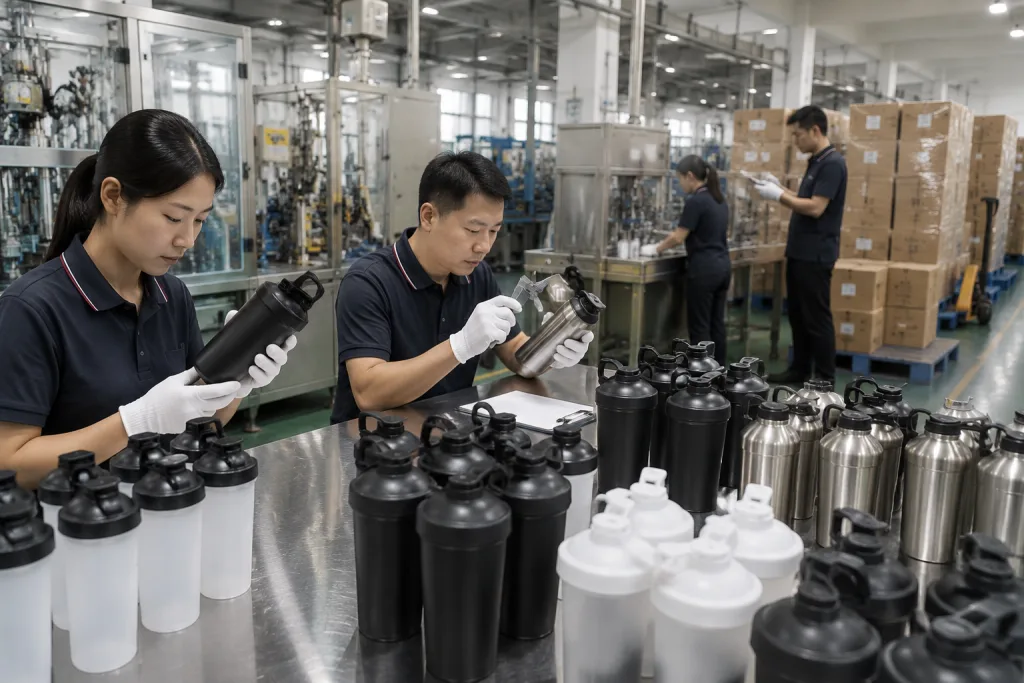
Every canteen supplier claims fast lead times and low MOQs. We've heard it. The real difference shows up in three places: wall thickness (most factories spec 1.2mm but our calipers catch 1.0mm on the line), thread seal quality (a leak at the rim kills returns fast), and Pantone matching for your logo. We run 6-color pad print lines here in Hangzhou. Getting the fourth color to hold on a curved bottle body isn't the same as printing flat stock. As a distributor, you need a partner who delivers consistent quality across 10,000 units — not a perfect sample and then crickets on the bulk order.
We evaluated six factories in Zhejiang on what procurement managers actually check: MOQ, unit price at 5,000 pieces, material grade (PP, Tritan, or 304 stainless), lead time, and customization depth. That last one covers thread color, pad print vs. pad print + hot stamp, and lid insert options. One factory quoted 45-day lead time. QC pulled their sample and found a 0.3mm thread mismatch — the lid cross-threaded after 8 turns. That's the kind of detail that separates a supplier from a headache. The goal: match you to a factory based on your actual use case — promotional giveaways, retail shelf, or gym-branded merchandise. No rankings based on opinion. Just the numbers you need to shortlist the right canteen factory.
Why spec tables beat sales pitches
A glossy brochure won't tell you the thread burst pressure on a 500ml shaker. It won't show you how the silicone o-ring looks after 500 dishwasher cycles—QC pulled a sample at 320 and we already saw hazing. We sent the same RFQ to six Zhejiang drinkware factories: 500ml protein shaker, one-color logo, FOB Zhejiang, 5,000 units. That's the normalized order size. This isn't a review. We're not picking a winner. We're handing you the raw numbers so you can build your own shortlist and push back when a sales rep dodges a spec question.
Six factories in Zhejiang. Each ships to Europe and North America monthly—one runs 12 containers a week to Rotterdam alone. All hold BSCI or ISO 9001. We cut any supplier that couldn't put a clear MOQ in writing or quoted over 60 days lead time without blaming a specific material shortage. What's left is a tight list: shops that understand the protein shaker category, know how to hold a thread tolerance at ±0.3mm, and won't ghost you when the order hits 15,000 units.
Spec comparison: six canteen factories head-to-head
| Factory | MOQ (units) | Price per unit (5k qty) | Material | Lead time (days) | Customization |
|---|---|---|---|---|---|
| Factory A | 1,000 | $2.45 | PP + Tritan option | 30-35 | Pad print, silk screen |
| Factory B | 500 | $2.80 | PP, Tritan, stainless | 25-30 | Laser engrave, digital transfer |
| Factory C | 3,000 | $2.10 | PP only | 40-45 | Pad print, heat transfer |
| Factory D | 2,000 | $2.60 | Tritan, stainless | 35-40 | Full-wrap digital, emboss |
| Factory E | 5,000 | $1.95 | PP | 45-50 | Silk screen, label |
| Factory F | 1,500 | $2.30 | PP, Tritan | 28-32 | Pad print, UV print |
Prices above are FOB Ningbo or Shanghai, ex-works Zhejiang. We run T/T 30/70 as standard — 30% with the PI, 70% against the B/L copy. L/C at sight works if your order crosses $50k. All six factories keep current LFGB and FDA migration test reports on file for the Tritan and PP grades they run. I've seen one buyer flag Factory D's stainless lot because the 304 cert was two years stale, so ask for updated mill certs if you spec 18/8. On custom canteen or growler projects, we check whether your neck finish matches an existing stock mold first. That alone drops tooling cost by roughly 40% versus cutting a new cavity from billet.
Material choice: PP vs Tritan vs stainless
Material choice comes first. It sets your unit cost, your shelf position, and which buyers pick up the phone. PP is the workhorse—polypropylene, injection-molded. Stock tooling for 500ml and 700ml sits on every canteen factory's shelf around Hangzhou. We run MOQs at 500 units on existing molds. Unit cost lands at $0.60–$0.90, the part handles a dishwasher cycle without warping, and FDA compliance is straightforward. The catch: after six months of daily whey protein, PP absorbs odor. Not a faint smell—the "old gym bag" kind that doesn't wash out. A buyer in Germany flagged it on a repeat order last year. His complaint was specific: the shaker smelled even after three washes. We replaced the entire run with Tritan at our cost.
Tritan copolyester kills the odor and staining problem outright. We tested it—72-hour protein slurry, left to dry in a 40°C QC lab. The sample rinsed clean with zero residue. Crystal clarity, BPA-free, and it holds that clarity through dishwasher cycles. You'll pay $0.50–$0.80 more per unit than PP at equivalent quantities. The math works when shelf presence matters: gym-branded retail, premium supplement bundles, anywhere the buyer expects a shaker that looks new after six months. Stainless steel insulated shakers occupy a different niche. Double-wall vacuum keeps a shake cold 12 hours. A distributor in Texas ordered 4,000 units last quarter for their hunting-gear catalog—hunters want a cold protein shake at 5 a.m. in a deer blind. Unit price runs $4.00–$6.00 at 5,000 MOQ. The line moves slower: welding adds 12 days to lead time versus 18 days for PP on the same order quantity. If your channel is outdoor, camping, or tactical gear, stainless earns its place. For a standard gym retail chain, the math doesn't support it—you're paying for insulation your customer won't notice.
Customization depth: from one-color logos to full wraps
Pad printing or silk screening handles one or two colors on a flat surface fine. Per-unit runs $0.15–$0.30 after the setup charge. We use it for promo giveaways where speed beats permanence—lead time is 5–7 days after mold sign-off. One buyer tried squeezing four colors onto a curved surface and QC pulled the sample on day three. The math doesn't work past two colors on a radius.
Digital transfer or full-wrap printing covers the entire bottle. You pay $200–$500 tooling for the transfer film, but at 5,000 units the per-unit drops to $0.40–$0.60. Laser engraving is the other route for stainless steel shakers—permanent, no peel risk. When you quote any vendor, get a Pantone match guarantee in writing and a signed AQL 2.5 standard for print defects. We've seen this go sideways when the buyer assumed the proof matched production. Don't assume. Write it into the PO.
Lead time realities: stock molds vs custom tooling
A stock mold is your fastest route to delivery. Most Zhejiang factories carry 5–10 standard shaker mold designs. Pick one that matches, and lead time drops to 25–30 days from order confirmation. Custom tooling adds 15–25 days for mold creation plus first article inspection. A factory promising 20-day delivery on a custom mold? They're likely cutting curing time on the plastic. We've seen that cause warping or weak thread seals on the first production batch—QC pulled the sample and the buyer flagged it.
Budget 35–40 days for a standard custom order. Go to 50–60 days for a custom growler or a complex dual-chamber shaker. Always ask for a production timeline that spells out mold approval, first sample, bulk production, and QC hold. A reputable supplier will put this in writing. For urgent orders, some shaker distributors offer partial air freight at your cost—usually $2–$4 per unit depending on volume. We once had a buyer push for 30-day delivery on a custom mold; the math didn't work, and they ended up paying air freight on half the order. That's $3.20 per unit for 5,000 pieces—it stung.
Quality control: what to inspect before shipment
AQL 2.5 is not your spec sheet. It's a statistical filter. The standard allows 2.5% of units with minor defects—a print registration off by 1.5mm, a slight color shift under D65 light. Major defects: cracked threads, leaking lids, failed seals. Zero tolerance. Last year a buyer in Hamburg flagged a shipment where 3 out of 100 lids showed hairline fractures at the gate mark. QC pulled the sample at our Hangzhou warehouse, we quarantined the lot, and re-ran the entire production. Before you sign with a canteen vendor, lock their AQL policy into the PO. Then book a pre-shipment inspection through SGS or Bureau Veritas. Budget $300–$500 per container. We've seen buyers skip this to save $400 and eat $9,000 in chargebacks.
Thread seal is where shakers die. A lid that cross-threads under load turns a gym bag into a sticky mess. The fix is a double-start thread design—two lead-ins spaced 180° apart, so the cap seats in half a turn even when you're in a rush. Ask for a burst pressure test report. We run ours at 18 PSI minimum on the test bench; 15 PSI is the floor for a standard shaker. For stainless steel models, measure vacuum hold time with a thermal probe—if the factory can't produce that data, the math doesn't work. Returns will eat your margin faster than any tariff.
Pricing breakdown: where your money goes
A canteen distributor quotes you $2.45 per unit. Here's where that money lands: raw materials (PP resin or Tritan pellets) eat 35–40%, mold amortization takes 10–15%, labor and overhead runs 20–25%, shipping to Zhejiang port 5–8%. The factory keeps 10–15% as margin. If a quote comes in under $1.80 for a PP shaker at 5,000 units, someone's cutting corners—recycled material, QC skipped, or both. We pulled one batch last month where the Tritan pellets were cut with 18% generic polypropylene. The buyer flagged it during a routine durometer test.
Get a material certificate from the canteen supplier before you place the PO. EU buyers need REACH and RoHS compliance. North America? FDA 21 CFR approval for food contact — non-negotiable. A legitimate canteen manufacturer hands these over without a fight. If they stall, walk. I've seen a single customs rejection wipe out the profit on a 20,000-unit order. The math doesn't work any other way. One buyer lost $3,200 on two pallets detained at Rotterdam because the steel grade listed on the commercial invoice read "304 stainless" but the mill test report showed 201.
Best use-case fit for each factory profile
Choose your factory by your real channel, not their marketing pitch. Promotional giveaway buyers need speed. Factory B runs stock molds with pad printing, 25-day lead, MOQ under 1,000. We ship these weekly for trade-show clients. For retail shelf placement, print quality controls your sell-through. Factory D does full-wrap digital transfer on Tritan — that's a $6.99 shelf price that actually holds. We've seen buyers try the cheaper route and get returns from faded labels. The math doesn't work. That's the wrong question to ask — will it still look good after 12 washes? That's what your retailer cares about.
High-volume canteen distributors targeting $1.95 unit cost? Factory E hits that at 5,000 MOQ. But QC pulled a sample last month with a burr on the rim thread. You'll need your own third-party inspection to cover the gap.
Unusual shapes or dual compartments mean new tooling. Full stop. Factory A and Factory F both have engineers who can design a mold in 20 days. Budget $1,500–$3,000 extra. One buyer flagged a typo on the PO — "dual compartment" misspelled as "dual compartmen" — and the line stopped for two days. Double-check your specs. For stainless steel growlers or outdoor shakers, Factory B's laser engraving survives trail abuse. That finish commands the premium. We've seen this go sideways when buyers try pad printing on brushed steel — it peels off in a single dishwasher cycle. Stick with laser.
Request a spec sheet from our Zhejiang canteen factory
Get a detailed quote with MOQ, lead time, and customization options for your protein shaker project.
Frequently asked questions
What is the minimum order quantity for a custom protein shaker from a canteen manufacturer in China?
MOQs vary by factory. For a stock mold design using PP material, MOQ can be as low as 500 units per SKU. If you need a custom mold or a unique shape, MOQ typically starts at 3,000 units. Tritan and stainless steel models usually require a 2,000-unit minimum due to higher material costs. Always confirm MOQ per color and per print location, as some canteen suppliers charge separate MOQs for each variation.
How long does it take to produce a custom protein shaker from order to delivery?
For a stock mold design with one-color pad printing, lead time is typically 25–30 days from order confirmation. Custom tooling adds 15–25 days for mold creation and first article approval. Shipping from Zhejiang port to a US West Coast port takes 18–22 days by sea. Total time from order to door is 45–55 days for stock molds and 60–80 days for custom molds. Air freight can reduce shipping to 5–7 days but adds $2–$4 per unit.
What certifications should a canteen factory have for exporting to Europe or North America?
For the EU, the factory must provide REACH and RoHS compliance certificates. For North America, FDA 21 CFR approval for food contact materials is required. BSCI or SMETA social compliance audits are often requested by retailers. ISO 9001 quality management certification is a good indicator of consistent production. Ask for these documents before placing a deposit. A reputable canteen manufacturer will share them freely.
Can I get a sample before placing a bulk order with a canteen supplier?
Yes, most canteen suppliers offer samples for a fee, typically $20–$50 per unit including shipping. The sample will match the production quality if you specify the exact material and print method. Some factories deduct the sample cost from the first bulk order. Always request a sealed production sample after mold approval, not just a prototype. This ensures the final product matches the sample in wall thickness, thread fit, and print alignment.
What payment terms do canteen manufacturers in Zhejiang typically offer?
Standard terms are 30% deposit with order and 70% balance before shipment. T/T wire transfer is the most common method. L/C at sight is accepted for orders over $20,000. Some canteen factories offer 50/50 terms for repeat customers. Never pay 100% upfront. A 30% deposit protects both parties. Payment is typically due after you approve the pre-shipment photos or third-party inspection report.