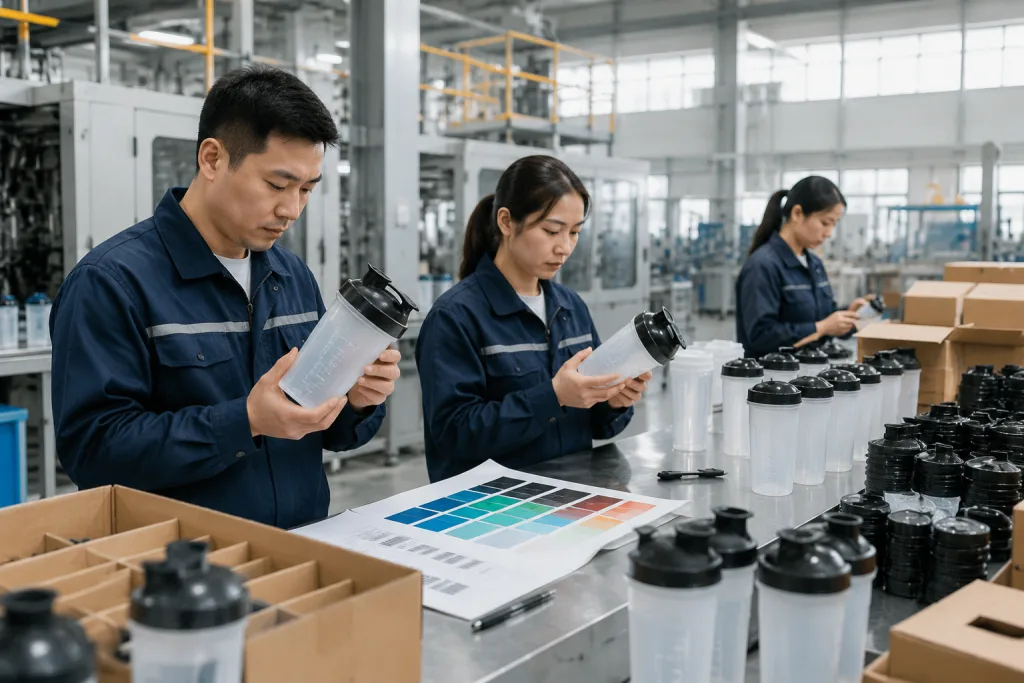
Key Takeaways
- Protein shaker customized orders usually start at 1,000 pcs MOQ and 25-35 days lead time at a Zhejiang factory.
- A 600 ml PP shaker with 2.5-3.0 mm wall thickness is usually the safest value spec for mass retail.
- Laser engraving works for stainless steel lids and sleeves, while silkscreen is better for 1-2 color graphics on plastic bodies.
- For EU and North America, ask for REACH, LFGB, FDA, and an AQL 2.5 pre-shipment inspection before you pay balance.
You are not buying a gym accessory. You are buying a repeat-order item with leak risk, print risk, and freight risk. A protein shaker customized job starts with a spec sheet, not a mood board. The call comes down to wall thickness, lid seal design, pigment stability, and whether the 500 ml, 600 ml, or 700 ml fill line still reads after 3,000 washes.
At BottleForge in Zhejiang, we see the same miss on the line: buyers send artwork first and ask about material later. That is the wrong question to ask. One PO last month had the lid code typed wrong by one digit, and QC pulled the sample before we ran it. A 0.3 mm wall shift can change feel in hand and carton count, and we have seen that go sideways fast. Lock the base spec first, then build decoration around it. If you handle custom drinkware for retail, gyms, or distributor programs, this is how you cut returns, complaint emails, and dead stock.
Start with the liquid spec
Start with capacity, material, and use. Logo comes later. For a protein shaker customized for supplements, we run 500 ml, 600 ml, and 700 ml. 600 ml is the safer pick for gym shelves. One scoop plus water fits cleanly, and the cup does not look bulky in hand or on a POS shelf. We saw a buyer push for 750 ml, then the carton height missed the shelf by 18 mm. That was the wrong spec.
Material is next. PP is common for the cup body because it is light, cheap, and holds up in daily use. Tritan adds about USD 0.80-1.50 per unit, depending on order size, but the wall clarity is better and buyers spot the upgrade fast. Stainless steel shakers are less common, but they fit a premium customized drinkware line. One buyer pushed back on PP, then QC pulled the sample and the Tritan body passed the 1.2 m drop check. Simple call. For a canteen customized program, we see the same thing on the line. Match the channel, not your ego.
Ask the factory for these lines in writing: capacity tolerance +/- 5%, wall thickness 2.5-3.0 mm for PP, and heat resistance rating if you expect dishwasher use. We also check the lid fit with a 0.2 mm feeler gauge on the line, because that is where leaks start. One PO typo once turned 600 ml into 6000 ml, and that sort of mistake burns a week. The math does not work. In Zhejiang, a good canteen factory will quote mold data, not vague adjectives.
The lid decides returns
If a shaker leaks, the lid is usually the problem, not the cup. We saw a buyer flag 2,000 units because the gasket sat 0.8 mm off in the mold. Enough to fail the carton test. For protein shaker customized work, put the closure type, gasket material, thread pitch, and vent path on paper before the line starts. I specify a screw lid with a silicone or TPE gasket and a flip cap that makes a hard click. Snap lids look cheap on the line, and one hinge warp after a 1.0 m drop sends returns back to us.
Check whether the bottle ships with a wire whisk ball, mesh insert, or mixing blade. A stainless ball is simple and holds up. Some buyers still ask for a fixed mixing grid because it cuts rattle in transit and sounds cleaner in the carton. QC pulled the sample on a 500 ml shaker last month and found the ball could jam the cap on a rough fall test. That is the wrong question to ask on price. A sports-retail distributor hears the noise complaint before the pallet leaves the warehouse.
- Leak test target: 30 minutes inverted at room temperature
- Drop test target: 1.0 m onto plywood, 3 corners
- Cap cycle target: 3,000 open-close cycles for wholesale programs
If you are comparing customizable canteen, customizable growler, or customized canteen programs, use the same discipline. The closure is where the buyer feels failure first. We run the lid check on every PO, and a typo on the gasket code can turn into a return claim faster than a bad cup ever will. Last month, one PO said "TPE gray" but the buyer meant black, and the shift had to pull 600 caps from the rack.
Decoration is not decoration
Decoration is not decoration. The print method changes margin and complaint rate. We run silkscreen for one or two solid colors on a big flat area. Clean. Cheap. Fast. That is why it fits canteen promo runs and custom drinkware bundles. Laser engraving belongs on stainless steel, aluminum, or coated parts when the buyer wants a mark that survives 30 dish cycles. On one line, a 1.2 mm logo stroke held; at 0.2 mm, QC pulled the sample and the edge broke up.
For a protein shaker customized in plastic, I usually skip full-wrap art unless the MOQ is big enough to justify tighter tooling control. Fine text needs a 0.25 mm minimum stroke and a 0.3 mm gap. Go below that, and the factory may sign off the file while the press still spits out a fuzzy edge. We saw that on a 750 ml shaker lid last month. The buyer flagged the PO typo on the artwork code, and the line caught it before we shipped.
Practical rule: if you sell through distributors, pick a decoration method that survives warehouse handling, not just one that looks good in a render.
For canteen customizable programs, the same logic holds. A canteen supplier should give you ink adhesion, cure temperature, and abrasion resistance, not a sales pitch. Ask for 100-cycle rub testing, and ask what failed on the last audit. This is the wrong question to ask if you only want the cheapest print. On our bench, a 65°C cure held; at 55°C, the ink lifted at the tape test.
MOQ changes the whole equation
Do not treat MOQ as a nuisance line. It tells you where the math stops working. On a PP protein shaker customized order, we usually see 1,000 pcs per color and per print position. Ask for a new mold, and the floor can jump to 3,000 pcs or more. For Tritan or stainless steel, some Zhejiang factories will take a smaller first run, but the unit price moves up fast.
At BottleForge, one line runs about 300,000 units a month across drinkware, and shaker jobs sit in the same injection and decoration schedule as canteen manufacturer orders. That is why lead time is not just molding time. It covers resin purchase, pad printing, assembly, QC, and carton packing. We ship repeat orders in 25-35 days. If you change lid tooling or ask for custom packaging, 35-50 days is the number that usually holds. QC pulled the sample on a 0.3 mm print shift last week; the buyer flagged it, and that is the sort of thing that burns a week if you ignore it.
If you are a canteen distributor or distributor growler buyer, ask the factory how they split production by color. We have seen one run with six colors look fine on paper and then blow the schedule because the line kept changing molds. That is the wrong question to ask if you only care about MOQ. The better check is whether they can hold one color cleanly without padding the queue.
Compliance is part of the spec
For North America and Europe, compliance goes in the spec sheet on day one. Not later. On a protein shaker customized order, we ask for FDA food-contact declaration for the U.S. side, REACH for EU chemical compliance, and LFGB test reports when the buyer wants a tougher retail gate. QC pulled one sample off the line because the ink on the cup wall sat 0.3 mm outside the print area, and the buyer flagged it before shipment.
Cartons and ship packs need the same treatment. Check whether the factory can do FNSKU labeling, barcode verification, and carton drop-test standards. If the order goes to Amazon or a similar channel, those three checks save a lot of receiving trouble. For distributor drinkware programs, we usually quote AQL 2.5 for major defects and AQL 4.0 for minor defects unless the chain sets a tighter incoming rule. The math does not work any other way; a 500-carton order with sloppy labels turns into a warehouse fight.
A serious canteen factory in Zhejiang or anywhere else in China will not hide behind a PDF certificate. They should show test scope, sample date, and the lab name, plus coil or sheet batch numbers for 304 or 316 stainless if that is in the build. We run it that way. A PO typo on the grade line has burned more hours than a bad sample ever did.
Packaging sells the second order
Your unit cost does not stop at the bottle. Packaging decides whether the carton lands retail-ready or turns into a warehouse mess. Plain polybags and egg-crate inserts keep cost down. Printed gift boxes, hang tags, and barcode labels push the quote up fast, but they also lift shelf conversion and help a canteen vendor or canteen supplier build a cleaner distributor program. We saw one buyer shave $0.08 off each unit with a plain mailer, then spend two days relabeling on arrival. Cheap turns expensive fast.
For a protein shaker customized line, we usually run carton quantities of 24 or 48 pcs when the order has mixed SKUs. Picking stays simple. Damage drops too. If the buyer wants ecommerce fulfillment, ask for individual mailer boxes with 3-layer or 5-layer outer cartons. We had one PO with a 2 mm lid gap, and QC pulled the sample before the line packed 6,000 pcs. A cracked lid wipes out the freight saving, so the math does not work any other way.
Experienced buyers in China and Europe spend time on packaging mockups for a reason. A custom canteen or customizable growler can look clean in photos and still fail a 5-layer stack test. Ask the factory for carton compression data, and check the numbers before you approve sea freight for 25-35 days. We have seen that go sideways when the buyer flagged a barcode typo after cartons were already sealed. One wrong label, and the whole pallet gets held.
Choose the right buyer path
Not every order belongs on the same sourcing path. Fast launch, lower risk? Use a stock body with custom print and carton art. That fits distributor canteen programs, seasonal promos, and retail tests. We ship those on 12-day sampling cycles when the print file is clean. If the buyer wants stronger branding, ask for a custom cap color, tinted cup, or an embossed logo on the lid. For a hero SKU, move to a full mold or a premium stainless format. That's the right fork.
Buyer types split fast. Brand owners want color consistency and traceability; distributors want a stable quote and a usable MOQ; retailers want packaging and barcode readiness. We had one buyer flag a carton barcode typo on a PO, and the line stopped for half a day while QC pulled the sample and rechecked the carton artwork. A sports-chain canteen distributor may also want coordinated SKUs across protein shaker customized, custom drinkware, and custom growler programs so one supplier can run the same QC standard across all three. We've seen that go sideways when the specs drift by 2 mm.
In Zhejiang, the better factories stay flexible, but they still need a clear brief. Send the target market, expected annual volume, target retail price, decoration area, and compliance need. That is enough for a correct quote. We run into trouble when buyers leave out the retail price; the first quote looks attractive, then the revision lands after tooling starts. The math doesn't work. One typo in a PO can cost a week, and nobody wants that after the mold is already on the bench.
Send your shaker spec, get a factory quote
Share capacity, material, logo file, and market. We will quote MOQ, lead time, and compliance lines that actually match your channel.
Frequently asked questions
What is a realistic MOQ for protein shaker customized orders?
For a standard PP protein shaker customized order, 1,000 pcs per color is a normal starting point in China. If you want special molding, custom lid geometry, or multiple print positions, expect 3,000 pcs or more. Tritan and stainless options may support lower trial quantities, but the unit price usually rises by USD 0.30-1.20. A factory in Zhejiang should also quote whether MOQ is per artwork, per color, or per carton pack. That detail matters more than the headline number.
Which material is best for a custom drinkware shaker?
For most buyers, PP is the practical baseline because it is light, durable, and inexpensive. Tritan is better when you need a clearer, more premium look and can absorb an extra USD 0.80-1.50 per unit. Stainless steel is less common for shakers but works for premium channels. If your customer base wants a canteen customizable or customized drinkware line that can share tooling across SKUs, ask the factory to quote the same lid across PP and Tritan bodies. That keeps tooling cost under control.
How do I reduce leakage risk before shipment?
Ask for a lid spec with gasket material, thread detail, and a simple pass-fail leak test. We normally recommend a 30-minute inverted test, a 1.0 m drop test, and a cap cycle test of at least 3,000 opens for wholesale programs. If the factory cannot explain where the seal line sits, that is a warning sign. Good canteen factory teams in China will also show you assembly checkpoints so you can catch warped caps before packaging.
What compliance documents should I request for Europe and North America?
For Europe, request REACH and, when needed, LFGB. For the U.S., ask for FDA food-contact declaration. If stainless steel is involved, confirm material grade and batch traceability. For ecommerce or retail distribution, ask whether the factory can do FNSKU labeling, barcode checks, and carton markings. For a protein shaker customized program, AQL 2.5 for major defects is a reasonable baseline. If your retailer requires tighter standards, specify them before sampling starts.
Can one factory handle canteen custom and protein shaker programs together?
Yes, if the factory has both injection molding and decoration capacity, plus separate QC for lids and bodies. A Zhejiang canteen manufacturer with around 300,000 units per month can usually support shaker lines, canteen promotional items, and custom growler orders under one export workflow. The key is whether they track resin, print, and assembly separately. If they only quote one price without process detail, they are acting as a trader, not a capable manufacturer.