Key Takeaways
- Standard protein shaker custom made orders usually start at 1,000 pcs, with FOB China pricing around USD 1.35 to 3.20 depending on material and lid complexity.
- Lead time is often 18 to 25 days after sample approval, but add 7 to 12 days if you need new mold work or special color matching.
- Printing method matters: one-color silkscreen is cheaper than laser engraving, and wrap print adds cost on curved bottles.
- Compliance and packing can add 8% to 18% to landed cost once you include REACH, food-contact declarations, carton specs, and retail labeling.
If you are buying a protein shaker custom made, do not treat it like a plain plastic bottle. That is the wrong question to ask. Unit price moves with mold status, lid build, mixing insert, print method, and pack spec. On the line, a shaker that looks cheap at sample stage turns into a different number once you add a leak-proof cap, Tritan body, stainless ball, retail carton, and Amazon FNSKU labeling. We have seen a 12% jump after the buyer changed the cap from a basic flip top to a lock lid.
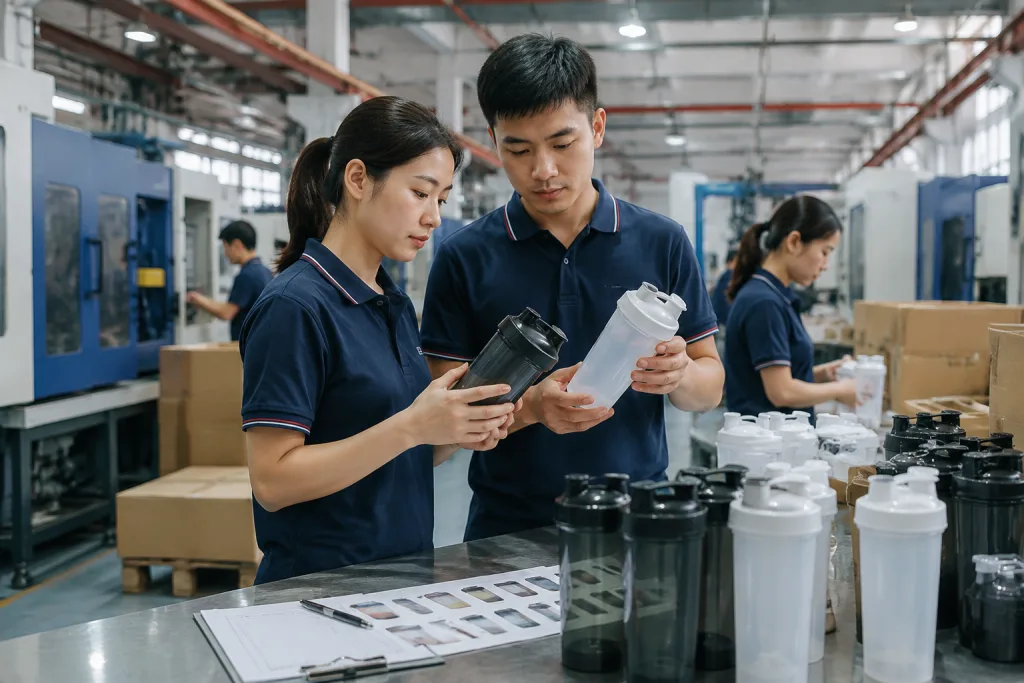
Serious buyers in Europe and North America ask for cost and lead time before artwork. Good call. In Zhejiang and across China, a standard shaker order can move fast, while custom colors, nested parts, and full compliance testing slow the job down. At BottleForge in Hangzhou, QC pulled the sample with a 0.3 mm lid gap on one run, and we fixed it before shipment. Our export line runs 150,000 units per month, MOQ starts at 1,000 pieces, and typical production lead time is 18 to 25 days after sample approval.
What actually sets your cost
For a protein shaker custom made, the cost drivers are plain, and buyers still miss them on the first quote. Material choice comes first. PP shakers usually sit around USD 0.75 to 1.40 ex-works for plain stock shapes. Tritan bodies move into the USD 1.35 to 2.40 range. If you want a stainless-steel outer wall or a custom growler-style body, the number climbs fast. The lid does the same job. A basic flip cap is cheap. A threaded leak-proof lid with a silicone gasket, handle loop, and mixing insert can add USD 0.18 to 0.65 per unit. We ran a 36 mm lid sample last month, and QC pulled it twice because the gasket sat 1.2 mm off center. That is the real bill.
Printing and packing sit next on the quote, and the buyer often pushes back on the wrong line item. One-color silkscreen on a flat panel is efficient. Full-wrap print, metallic ink, or laser engraving adds labor time and scrap risk. Retail-ready packing changes the math again: a plain bulk carton is one thing, while a printed box with barcode, FNSKU, insert card, and master carton labeling adds material and handwork. We had a PO last quarter with a typo on the carton mark, and the buyer flagged it after the sample box was already on the line. If you are buying custom drinkware such as a canteen custom line at the same time, keep the compliance pack and carton spec aligned where you can. That keeps freight waste down and stops the line from getting messy in Zhejiang.
- Material: PP, Tritan, AS, or stainless steel
- Lid: standard, leak-proof, or multi-part sports cap
- Decoration: one-color print, wrap print, laser, or emboss
- Packing: bulk, retail box, or e-commerce prep
For most buyers, the honest budget question is not “what is the cheapest shaker?” It is “which spec gives me a stable landed cost with acceptable margin after freight, duty, and rejected units?” We have seen this go sideways when a buyer chased a USD 0.06 saving on the lid and then paid for 18% more rejects. The math does not work.
MOQ tiers that make sense
MOQ is where a lot of protein shaker jobs get bent out of shape. We quote one number for a stock body and another for a new mold, and both can be right. For a standard body with custom print, 1,000 to 3,000 pcs is the range we run. For a new lid color or custom cap insert, 3,000 to 5,000 pcs is normal. If you want a fully custom body shape, especially a growler-style shaker with ribs, measurement marks, and a grip profile that is not standard, 5,000 to 10,000 pcs is the number that holds up.
This is tool cost, color mixing, and line speed. Nothing fancy. On the line, a 2.5 mm mold change or a 3-color print run adds setup time fast, and QC will pull samples twice if the spec is messy. We had a buyer push back on a 1,500 pcs launch and ask for custom tooling on the first shot; the math does not work, and we have seen that go sideways. A canteen factory or canteen manufacturer running customizable canteen and customized drinkware has to spread that cost across the order, or the unit price jumps and the buyer feels it immediately. If you are a canteen distributor or a distributor drinkware buyer, split the launch: 1,000 pcs to test, then 5,000 pcs after sell-through shows the SKU has legs.
Practical rule: if your launch budget cannot support at least 1,000 pcs, do not ask for a custom mold yet. Use a stock mold, then customize print, color, and carton.
This applies to canteen customizable programs too. A canteen promotional SKU with logo only is easy. A canteen customized body with odd wall geometry is not. We had one buyer flag a PO typo on the cap color code, and that single line held the order for 12 days while the revised sample was checked. Small mistake. Real delay. On a 5,000 pcs run, that kind of miss burns time and ties up the line.
Lead time from sample to ship
Lead time stays simple if the spec does not move. For a standard protein shaker custom made order, we ship the first sample in 5 to 9 days when the change is print, color, or packaging only. Mass production runs 18 to 25 days for 1,000 to 10,000 pcs. That covers resin prep, assembly, pad printing, curing, and carton pack-out on the line. If the mold is new, add 7 to 12 days for tooling validation, plus 3 to 5 days when QC pulled the sample and found a cap-thread fit issue on a 38 mm cap. We see that one a lot.
Shipping method changes the clock fast. FOB Ningbo or FOB Shanghai is standard for Zhejiang factories, and peak season booking can add 2 to 4 days before the container moves. Amazon prep adds 2 to 4 days for FNSKU labeling, polybagging, and carton drop tests. A buyer once mixed port time with factory time on a PO, then asked why the ship date missed; the math does not work. We had another order where the buyer flagged a typo on the carton mark after approval, and that pushed the schedule by 2 days. Ask for three dates only: sample approval, mass production, export packing. That is the real check. We run this every week.
- Sample only: 5 to 9 days
- Mass production: 18 to 25 days
- New mold adjustment: +7 to 12 days
- Amazon prep: +2 to 4 days
Materials that change performance
Pick material by use case, not by price alone. A protein shaker custom made for gym retail in Europe gets judged on feel, smell, and breakage rate. A canteen promo run gets judged on unit cost and fast ship. We ran one PP sample at 38 g and the buyer flagged the hollow feel on day one. PP works for entry price and short-cycle promotions, but it picks up odor sooner and looks tired after a few washes. Tritan gives clearer walls, better shelf appeal, and better crack resistance. Stainless steel feels premium, yet it adds cost, tooling time, and weight. For some buyers, a custom growler or customizable growler style makes sense—the bottle sells as merch, not just as a shaker.
Wall thickness belongs on the spec sheet, not in a sales pitch. For Tritan, 2.0 mm to 2.5 mm is the normal range. Thinner than that, the cup flexes in hand. Thicker, and you pay freight for no gain. On one line check, QC pulled the sample at 1.7 mm and the cap thread started to oval after a drop test. For stainless steel, 304 grade with 0.4 mm to 0.5 mm wall is common for outer shells in drinkware factories across Zhejiang. That matters if you also source custom drinkware, custom canteen, or distributor canteen programs. One material map across the range keeps replenishment cleaner. It avoids the mess we have seen when a buyer mixes three wall specs in one PO. It also helps when you compare canteen manufacturers, because a factory that controls one category well usually holds color and tolerance better on the others.
Check for: food-contact compliance, odor test results, dishwasher guidance, and whether the silicone parts are independently replaceable. Ask for the gasket drawing too. One typo on a PO turned 18 mm into 13 mm and the lid failed the leak test.
Decoration and branding costs
Branding is where buyers bleed margin. I've watched a $0.12 per-unit decoration decision trigger a full shipment rejection — not because the method was wrong, but because nobody asked the right question upfront. The right question isn't "which decoration is cheapest?" It's "which decoration survives this product's actual life?" For a protein shaker custom made for retail, one-color silkscreen still wins on cost and simplicity. Setup runs around $45–$80 per screen at our facility, and the per-unit print cost drops below $0.08 at quantities over 3,000. Clean vector logos only — gradients or fine halftones will disappoint you.
Laser engraving on 304 stainless or coated steel gives you a mark that won't scrub off in a dishwasher. It adds a labor step — our line runs engraving at roughly 40% the speed of silkscreen — so lead time stretches 3–5 days on large orders. On Tritan, we've had QC pull samples where the beam left a cloudy halo around the logo. The buyer flagged it, and we switched that SKU to silkscreen mid-run. UV print handles full-color artwork nicely, but the setup fee bites: expect $150–$250 for plate preparation, and batch-to-batch color matching on curved shaker bodies is where our QC team spends real time with the Pantone book. Wraparound print looks sharp on shelf, but the seam tolerance is unforgiving. We hold ±0.8 mm on our automated wrap stations. Drift past 1.5 mm, and the entire lot gets flagged at AQL 2.5 — I've signed off on that rejection report more than once.
Same logic applies to canteen customized and customized drinkware programs. A sporting goods canteen distributor might only need a logo and volume markings — silkscreen, done. A distributor growler or custom growler line wants a full wrap, but if that graphic scratches off after three dishwasher cycles, you're eating returns. In a solid Zhejiang factory, the decoration quote should break out three line items: setup charge, per-unit print cost, and reorder pricing. That third number tells you whether the project scales or stalls. Ask for that breakdown whether you're buying a canteen customizable item or a protein shaker custom made unit. Without it, the math doesn't work.
- Silkscreen: setup $45–$80, best for 1-color logos, fast line speed
- Laser: permanent mark, premium finish, roughly 40% slower throughput
- UV print: full-color capable, $150–$250 setup, tight color-matching required
- Wrap print: strong shelf impact, seam tolerance ±0.8 mm, higher rejection risk on curved bodies
Compliance you should ask for
Compliance is not paperwork theater. If you sell into Europe or North America, ask for documents that match the use case and the material stack. For drinkware, that usually means a food-contact declaration, REACH-related material statements, and BPA-free confirmation for resin parts where it applies. If the cup has stainless steel, we ask for the right test references and migration data when the market or retailer wants them. For a protein shaker custom made, the lid seal and mixing insert matter as much as the cup. That is where leakage starts. We saw a 2 mm gasket change turn a clean sample into a drip complaint after 300 shakes on the line.
Some buyers think a canteen supplier or canteen factory can reuse old documents from another job. That is the wrong question to ask. The file set has to match the exact mold, color masterbatch, gasket material, and print ink. If you are running a canteen promotional line next to a shaker launch, keep each SKU file separate. We had a buyer flag a PO typo on the color code, and QC pulled the sample because the pantone card did not match. A professional canteen manufacturer in China should still give you batch traceability, QC records, and AQL inspection results, usually AQL 2.5 for major defects and 4.0 for minor defects unless your program is tighter.
In Zhejiang, the better factories treat compliance as part of the order, not an add-on. We run it that way because the math does not work any other way. It saves days when your distributor canteen or distributor drinkware customer asks for documents during onboarding. The buyer wants the file pack before deposit, not after the first 5,000 units ship.
How to compare quotes fairly
Quote comparison is where buyers lose money without seeing it. One factory may quote USD 1.58 and another USD 1.92 for a protein shaker custom made order. That gap means nothing until you check the build sheet. We run this every week. The low number often leaves out lid assembly, gasket, mixing ball, inner carton, outer carton, and export marks. One buyer flagged a PO typo on the trade term, and the shipment landed on the wrong basis. The math does not work if you skip that step.
Use one comparison frame: same material, same volume, same decoration, same packing, same compliance docs, same inspection standard. If one canteen vendor includes AQL inspection and another does not, you are not comparing the same offer. If one canteen supplier says 18 days because they are pulling stock components and another needs 30 days for new tooling, that hits cash flow and ship date. QC pulled the sample on a 2 mm wall spec and a 12 g lid, and the quote moved after that check. You are buying line time in China, a packing workflow, and a freight-ready carton format, not just a bottle.
Ask for three lines in every quote: product spec, packing spec, and trade term. Without those, you are comparing noise. If the supplier cannot state the MOQ, the carton count, and whether the price is FOB China or EXW, send it back. We have seen this go sideways on a 24-piece carton count typo, and it turns into a messy re-quote.
A better way to launch
The fastest way to launch a protein shaker custom made line is not a perfect product. Start with one body material, one lid family, one decoration method. Keep the first run at a clean MOQ of 1,000 or 3,000 pcs, depending on whether you are testing one region or a wider distributor network. On the line, we saw a buyer push 5,000 pcs on day one, then get stuck with slow movers because cap torque was never checked. The math does not work. Keep the carton spec plain enough to approve fast, but strong enough for freight and shelf life. Then use the first sell-through cycle to tighten volume, cap feel, and logo placement.
This is the same logic we use on canteen custom and canteen customized jobs when the buyer is really a canteen distributor or distributor canteen wholesaler. You do not need five finishes on day one. You need a reliable factory in China, a lead time you can actually hit, and a product that sits inside your margin. QC pulled the sample at 10.8 mm cap height and the buyer flagged it for being too loose in hand; that kind of miss turns into a second round of sampling. We ship faster when the spec is tight. If the shaker sells, the next order can open into a customizable drinkware family: shaker, canteen customizable line, and a custom growler SKU for retail bundles. That is how you build repeat orders, not one-offs. Starting with too many SKUs is the wrong question to ask.
At BottleForge, we keep the launch process tight because loose specs create late shipments. A PO typo on carton count can move a ship date by 12 days, and we’ve seen that go sideways before the goods even hit the warehouse. If you want a quote that matches production, not guesswork, send volume, target market, lid type, print area, carton count, and whether you need Amazon prep or retail-ready packing.
Send your shaker spec for a real quote
Include volume, lid type, print method, and target market. We will price it against actual production, not a vague catalog number.
Frequently asked questions
What is a realistic MOQ for a protein shaker custom made order?
For most export programs, 1,000 pcs is the practical starting point for a stock body with custom print. If you want a new lid color or extra parts, plan on 3,000 to 5,000 pcs. Fully custom molds usually need 5,000 pcs or more to keep unit cost sane. In Zhejiang and broader China supply chains, smaller MOQs are possible, but the per-unit price usually rises fast once setup and color change time are counted.
How much does a custom shaker cost FOB China?
A plain PP shaker can start around USD 0.75 to 1.40 FOB China. Tritan versions usually land around USD 1.35 to 2.40, and more complex premium builds can reach USD 3.20 or higher. Add about USD 0.10 to 0.65 for decoration depending on print method, plus packing costs if you need retail cartons or FNSKU labels. The quote only becomes meaningful when the material, lid, and packing are fixed.
How long does production take after sample approval?
For a standard order, expect 18 to 25 days after sample approval. If you need a new mold, add 7 to 12 days for tooling and trial runs. Custom print, special cartons, or Amazon prep can add another 2 to 4 days. A factory in Hangzhou or elsewhere in Zhejiang should be able to show you a production calendar with sample, mass production, and export packing separated clearly.
What documents should I request for Europe or North America?
Ask for food-contact declarations, REACH-related material statements, and if needed, BPA-free confirmation for resin parts. For stainless steel, ask whether migration testing or ASTM-related references are available for your market. You should also request AQL inspection records, batch traceability, and carton spec sheets. If the supplier is also handling a canteen customizable program, make sure each SKU has its own compliance file.
Can I order a shaker with canteen-style branding for retail?
Yes, and that is common. Many buyers run the same brand across protein shaker custom made units, custom drinkware, and even custom canteen or custom growler lines. The important thing is to keep the SKU spec separate. A canteen promotional item, a distributor drinkware bottle, and a premium shaker can share design language, but they should not share the same approval file unless the materials and packing are identical.