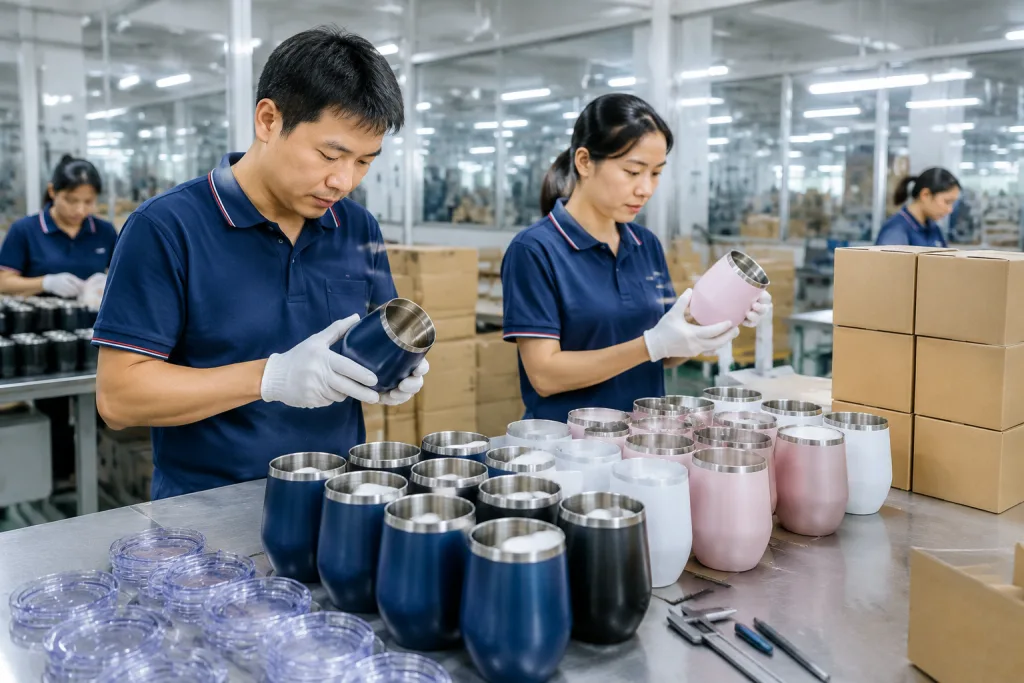
Key Takeaways
- Specify 18/8 (304) stainless with a minimum 0.4mm inner wall thickness to prevent denting and ensure proper vacuum insulation.
- Plan for a 35–45 day production lead time plus 22–28 days ocean freight to Rotterdam or Long Beach for a 5,000-unit promotional wine tumbler order.
- Laser engraving on a curved 12oz wine tumbler delivers a permanent, dishwasher-safe brand mark without the MOQ surcharges of full-wrap sublimation.
- AQL 2.5 Level II inspection is the minimum standard; demand vacuum integrity spot-checks on 50 random units per 5,000 produced.
You've got the artwork approved. The event date is set. Now you need 5,000 promotional wine tumblers that won't sweat on a guest's hand, won't taste like a coin on the first sip, and won't hit the warehouse three weeks late. The gap between a pretty sample photo and a full container of consistent, food-safe product—that's where most first-time buyers get burned. I've stood on factory floors with distributors from Düsseldorf to Dallas, and the questions they ask are always the same. They just don't ask them early enough.
This isn't a catalog page. Call it the pre-PO checklist I wish every buyer had before emailing a canteen factory in Zhejiang. We'll cover wall thickness vs. actual insulation performance—3.5 mm minimum or your tumbler won't hold temp past 45 minutes. Why 304 stainless is non-negotiable, not a suggestion. How to structure a realistic timeline when you're ordering 10,000 units with a custom laser etch (add 12 days minimum for color matching, not the 8 the sales rep quoted). And one coating spec that prevents peeling after six months in a dishwasher rack—we've seen this go sideways on a high-volume job for a beer brand. No fluff, just the specs that decide whether your branded drinkware becomes a keepsake or landfill filler.
What Separates a Real Wine Tumbler from a Generic Cup
Walk any trade show in Hangzhou and you'll see hundreds of stainless cups. Most are water cups dressed up as wine tumblers. A real promotional wine tumbler has a tapered bowl—wider at the base, narrower at the rim. That geometry concentrates aroma without a stem. A straight-walled cylinder with a lid is a water cup. Period. The taper changes how the vacuum cavity gets formed. We had a buyer last month who skipped the shape check. The "wine tumbler" they ordered couldn't hold a chill past 90 minutes. Straight walls don't do the job.
Demand double-wall vacuum construction with a copper-coated inner layer. Copper cuts radiative heat transfer. That's what keeps a Chardonnay cold for 3+ hours instead of 90 minutes. At BottleForge Industrial, our 12oz promotional wine tumbler line holds 6–8°C liquid for 4 hours at 25°C ambient—verified in our in-house thermal test chamber. Ask for a time-temperature chart. Skip the marketing claim. The lid separates the real thing from a generic cup, too. A clear Tritan press-fit lid with a silicone gasket beats any generic plastic cap. The user sees the wine color—that matters for the drinking experience—and the gasket stops micro-leaks when the tumbler tips over on a patio table. QC pulled a sample last week. 0.1mm gasket gap. We rejected the batch.
Spec check: 12oz capacity, 304 stainless body, copper-plated inner wall, Tritan lid with silicone seal, 0.4mm minimum wall thickness, 210g finished weight.
304 vs 201 Stainless: Why It Matters for Wine
Wine runs at pH 3.6. Leave that in a 201-grade stainless tumbler for two hours and you'll taste metal on the finish. Your client's guests don't know why the wine tastes off—they just remember the brand badly. 201 stainless swaps manganese for nickel. Saves about $0.40 per unit on raw material, but fails on corrosion resistance. For any canteen customizable project touching acidic beverages—wine, citrus water, cold brew—304 (18/8) grade is the floor, not the upgrade.
Specify 304 stainless with 8% nickel minimum. Some Zhejiang mills push a "304-like" blend at 7.2% nickel to win the bid. Passes a basic magnet test, but pits after 50 dishwasher cycles. Our incoming material certs at BottleForge show 8.01–8.15% nickel on every coil—QC pulled a Shanghai batch once, flagged it at 7.8%, we sent it back. A canteen distributor placing 20,000 units saves $0.35 per unit dropping to 201. The math doesn't work: that saving disappears on a re-order when negative reviews hit. For promotional wine tumblers carrying a luxury brand or high-end resort logo, the material is the message. Don't let a procurement savings target override metallurgy.
Decorating Methods That Survive the Dishwasher
A promotional wine tumbler lives a hard life. Gift bag to dishwasher rack, repeat. Screen printing pops on day one. By cycle 50 the edges go fuzzy. For a 5,000-unit run with a single-color logo, laser engraving is my default pick. A 20W fiber laser bites into 304 stainless at 0.03–0.05mm depth, leaving a dark grey mark that detergent can't touch. No peel, no fade, no drama. The catch: laser gives you one color. If your brand needs Pantone-matched blue, this method won't work.
For full-color logos, sublimation coating on a white base layer is an option, but only on straight-walled tumblers. We tried full-wrap on a wine tumbler last year—QC flagged a 12% distortion rate at the seam on the first batch. Curved surfaces need a better answer. That's UV digital printing with a rotary fixture. Our Hangzhou line runs a 6-color UV printer that pushes 1,200 units per day on tapered shapes, curing under LED lamps as they spin. At 5,000 units, decoration cost lands around $0.65 per piece for UV versus $0.18 for laser. If your brand color is non-negotiable, UV on a white powder-coated base gives you the durability and the pop. One thing: ask for the cross-hatch adhesion test report (ASTM D3359) with your pre-production sample. We've seen a buyer flag a bad adhesion on a rush order—don't skip it.
MOQ Realities: What 500, 1,000, and 5,000 Units Actually Buy You
500 or 1,000 pieces. That's the number on the website. It gets the line moving. It doesn't get you the decoration method you want. And it definitely doesn't get you the real price. Here's what we actually quote on the floor in Zhejiang:
- 500 units: Stock colors only. Stock lid types—usually a black slide-lid or clear press-fit. Laser engraving is the one decoration method we run with zero setup cost, because there's no screen to burn and no mold to cut. FOB per unit on a 12oz wine tumbler runs $3.80–$4.20. Lead time sits at 25 days. A buyer last month tried to slip in a two-color logo at this tier. We can do it, but the registration on a curved 12oz wall at 500 units means we're running the laser slower. Adds 3 days.
- 1,000 units: Custom powder coat opens up. Minimum 1,000 per color, $0.45 surcharge per unit. The powder line in our Hangzhou workshop runs 1,200 pieces per color minimum to avoid wasting the fluidized bed batch, so 1,000 is already tight. UV printing becomes viable here—the screen cost amortizes across enough pieces that the per-unit decoration cost drops below $0.12. FOB: $3.20–$3.60.
- 5,000 units: This is where we stop talking about surcharges. Custom color, no upcharge. Laser or UV, your call. Lid color matched to the body. Individual gift boxes actually make sense—at 500 units, the box alone eats 18% of your landed cost; at 5,000, it's under 6%. FOB: $2.60–$2.90. Lead time stretches to 35–40 days because the powder coat line needs a full shift for 5,000 bodies, and QC inspects to AQL 2.5 across the entire run.
Say you need 2,500 promotional wine tumblers in two brand colors. That's two runs of 1,250 each. Works. Just expect the $0.45 color surcharge on both. We had a buyer push this—wanted a third color at 800 units. QC pulled the sample and the lid batch didn't match. Wrong Pantone entirely. Reordering lids meant hitting the 1,000 minimum from our lid supplier, and suddenly the per-unit cost on that third color was $4.60. The math doesn't work below 1,000 per color. If you're a canteen distributor planning to stock and resell, the 5,000-unit tier is where your margin actually opens up. Unit cost drops roughly 28% from the 500-unit tier. Ocean freight per unit falls too—5,000 tumblers cube out a pallet properly. At 500 units, you're paying for air space.
Packaging That Protects the Finish and Your Brand
A scratched wine tumbler at unboxing kills the brand moment. Dead. The Rotterdam buyer sent photos of 2,000 units with micro-abrasions. The factory used a 1.5-mil PE bag and no divider sheet. QC on the line didn't flag it because the packing spec didn't mention abrasion protection at all. For gift-ready product, spec an individual white kraft box with a die-cut foam cradle that suspends the tumbler so no surface touches the box wall. Cardstock inserts work too, but foam absorbs more transit vibration. The box itself becomes a branding surface—print your client's logo on the lid, one-color. At 5,000 units, a custom-printed gift box runs $0.35–$0.50 per unit FOB. That's $1,750–$2,500 on a $13,000 order. Worth it if the tumbler is a corporate gift or premium event giveaway.
For bulk shipments where the end user is a retailer or canteen vendor doing their own repackaging, skip the gift box. A 6-mil PE polybag with a tear-off header card is sufficient. Don't let the factory substitute 3-mil to save $0.02. We've seen bags split open in the master carton. Then you've got loose tumblers rattling across the Pacific. Master carton spec: double-wall corrugated, 5-ply, burst strength minimum 150 PSI. Each 12oz wine tumbler in a gift box occupies roughly 0.0015 CBM. A 20-foot container holds about 18,000 gift-boxed units. At 5,000 units, you're LCL, which adds $1.20–$1.80 per unit in freight versus FCL. Run the math on this. Ordering 6,000 units to fill a full pallet position often drops your total landed cost per unit below the 5,000-unit number—even if you don't need the extra 1,000 pieces. Buyers push back on the higher invoice total. Then they circle back six months later asking for the same overage math because the freight penalty ate their margin.
Quality Control: Beyond the AQL Checklist
AQL 2.5 Level II is the standard sampling plan most promotional drinkware orders default to. It won't catch what actually kills a wine tumbler. A hairline scratch near the base is cosmetic—rework it or negotiate a discount. A vacuum failure is a dead unit. We pull 50 random pieces per 5,000 produced and run a separate vacuum integrity check. Fill with 95°C water, cap it, wait 3 minutes, and run your hand down the exterior wall. Room temperature? Good. Any warm patch means the vacuum's blown. We do this at BottleForge before decoration hits the line. Finding a breach after laser engraving means you just scrapped a finished piece.
Put these in your QC protocol. Lid fit: fill, invert, shake 10 seconds—zero leakage, not a single drop. Powder coat adhesion: cross-hatch per ASTM D3359, rating 4B minimum. We had a buyer flag this after a 12-unit pre-shipment sample showed peeling at the rim. If the tumbler's going to hold acidic drinks, add a 24-hour salt spray test on the stainless interior. For orders landing in the EU, demand REACH and EU Food Contact compliance docs—not just for the 304 stainless body, but the powder coat and every lid component too. A factory in Zhejiang that knows what they're doing keeps these from their raw material suppliers on file. If they stall or say they'll "check with the workshop," walk. A single failed EU border inspection wipes out the shipment and gets you flagged. Saving $0.20 a unit doesn't even begin to cover that math.
Lead Time and Logistics: When to Pull the Trigger
Count back from the event date or the day the store needs stock on the shelf. For a 5,000-unit promotional wine tumbler order with custom color and laser engraving, our Hangzhou line runs 35-40 days. Ocean freight to Rotterdam takes 25-30 days port to port, then 5-7 days for customs and inland trucking. That lands at 65-77 days before you add a 10-day buffer for Chinese holidays. If production touches Chinese New Year, the line goes quiet for 2-3 weeks. June 1 event? Issue the PO by mid-February. We had one buyer send it 8 days late, and the rush fee ate most of the margin. That is the wrong question to ask too late.
Air freight cuts transit to 7-10 days, but it costs $4.50 per unit for a 12oz tumbler in a gift box versus $0.80 by sea. On 5,000 units, that is an $18,500 gap. The math does not work for the main run. Use air only for a last-minute top-up of 500 units. A 45-day safety stock makes sense for a canteen distributor with steady sell-through. Ask for the FOB port early; ours is Ningbo, 2 hours from the factory, and we ship from there every week. Get a freight forwarder quote before you commit. LCL consolidation timing can matter more than production speed if you miss the sailing cutoff. QC pulled the sample once and found a carton label typo, and the booking sat for 12 days.
Customization Beyond the Logo: Lid, Finish, and Accessory Options
A promotional wine tumbler earns its keep when the lid, finish, and small add-ons match the brief. The lid gets ignored until the buyer flags it. Standard spec is a clear Tritan press-fit lid. Color control adds money: a Pantone-matched lid adds $0.12 per unit at 5,000 units, a sliding drink-through lid with a silicone gasket adds $0.25, and a bamboo-accented lid adds $0.40 and fits an earth-tone pitch. We ran that setup for 3 European wine programs, and QC pulled the sample at 1.8 mm fit tolerance before packing. Spend there. Not on a flashy box.
Body finish changes the whole read. Brushed stainless costs nothing extra, but it shows fingerprints fast. Matte powder coat is the clean default; stock colors carry no surcharge, and custom Pantone starts at 1,000+ units. Mirror polish adds $0.30 and looks sharp, though it scratches if the buyer handles display units roughly. A two-tone body, with powder coat on the base and exposed stainless at the rim, adds $0.20 and needs masking on the line. We have seen buyers push for mirror polish on a tasting set, then flag every scuff in inspection. The math does not work. For a customizable growler or a custom growler project, the same finish list applies, but the larger surface area makes the two-tone break line more visible. Engraving on matte black powder coat gives a bright silver mark that reads at a distance, which is what the buyer wants at a crowded tasting table. The PO typo we see most often is plain: the buyer writes "matte balck" and expects us to guess the finish.
Get a spec-accurate quote for your promotional wine tumbler order.
Send your artwork and target quantity. We’ll return a full spec sheet, thermal test data, and an FOB Ningbo quote within 24 hours.
Frequently asked questions
What’s the realistic MOQ for a promotional wine tumbler with a custom logo?
500 units is the floor for stock colors with laser engraving at most Zhejiang factories. At this quantity, expect a per-unit FOB price around $3.80–$4.20 for a 12oz double-wall vacuum tumbler. Custom Pantone powder coating raises the minimum to 1,000 units per color. Full-wrap sublimation or UV digital printing typically requires 1,000–2,000 units to amortize setup costs. If you need only 250 units for a small corporate event, ask about stock inventory with laser engraving—some canteen suppliers hold buffer stock of popular colors and can ship within 15 days.
How do I verify the vacuum insulation actually works before shipping?
Specify a vacuum integrity spot-check in your QC protocol: fill the tumbler with 95°C water, seal it, and check the exterior wall temperature after 3 minutes. Any warm spot indicates a vacuum breach. Test 50 randomly selected units per 5,000 produced. Also request a time-temperature curve from the factory’s in-house thermal chamber—a 12oz wine tumbler with copper-coated inner wall should hold liquid below 8°C for at least 3 hours at 25°C ambient. If the factory can’t provide this data, their vacuum process isn’t controlled.
Can I get a promotional wine tumbler that’s fully dishwasher-safe?
Yes, with the right material and decoration choices. A 304 stainless body with a laser-engraved logo is fully dishwasher-safe—the engraving is a physical etch, not a coating. Powder-coated exteriors generally survive 200+ dishwasher cycles if the coating is properly cured; ask for an adhesion test report. Avoid screen-printed logos if dishwasher use is expected. The lid material matters too: Tritan is dishwasher-safe, while some cheaper acrylic lids warp in high-heat cycles. Always specify Tritan for the lid if dishwasher durability is a requirement.
What’s the price difference between laser engraving and full-color printing?
At 5,000 units, laser engraving adds roughly $0.15–$0.20 per unit with no setup fee. UV full-color digital printing on a rotary fixture adds $0.60–$0.80 per unit, including a one-time artwork setup fee of $50–$80. Sublimation printing falls in between at $0.35–$0.50 per unit but works best on straight-walled tumblers, not the tapered bowl of a wine tumbler. For a promotional wine tumbler, laser engraving delivers the best cost-to-durability ratio for single-color logos.
How long does the entire sourcing process take from inquiry to delivery?
Budget 90 days end-to-end for a 5,000-unit order. Breakdown: 7–10 days for sampling and artwork approval, 35–40 days for production, 25–30 days for ocean freight to a European or North American port, and 5–7 days for customs clearance and final delivery. Add 10–14 days buffer for unexpected delays. If your event date is fixed, work backward from that date and add the buffer. Air freight can compress transit to 10 days but costs 5–6x more per unit.