Key Takeaways
- Top pick: 18/8 stainless steel with silkscreen logo, MOQ 500 units, FOB $2.80/unit, lead time 25 days.
- Best for small budgets: Tritan plastic with pad print, MOQ 200 units, FOB $1.15/unit, lead time 20 days.
- Best for premium branding: Copper-lined growler with laser engraving, MOQ 300 units, FOB $5.40/unit.
- All options comply with ASTM F2234, REACH, and BSCI standards; AQL 2.5 normal level II.
You're sourcing promotional water bottles America for a brand launch, corporate gift program, or retail distribution. The market is flooded with options—we know. The real challenge is separating suppliers who ship consistent quality at scale from the ones who overpromise and miss the AQL cut. As a B2B buyer, you need more than a catalog. You need a partner who reads ASTM testing reports, understands AQL 2.5 sampling, and has the logistics to move containers from Zhejiang to your warehouse in Ohio or California without a typo on the PO slowing customs.
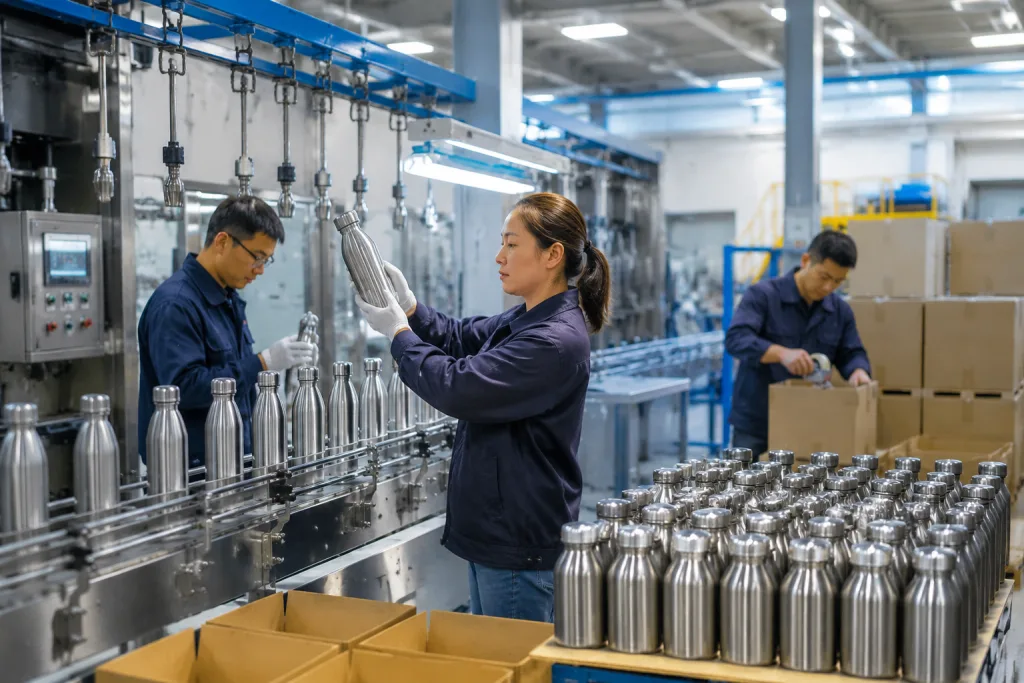
This guide ranks five custom drinkware configurations using real procurement criteria: unit cost, MOQ flexibility, decoration methods, lead time, and compliance. Our factory in Hangzhou sources over 12 million units annually. These are the setups that actually run for promotional campaigns and branded merchandise. Whether you need a canteen customizable with a full-color logo or a simple etched stainless steel bottle, the options here cover the spectrum—no fluff.
1. 18/8 Stainless Steel with Silkscreen Logo
We run this body every day. 0.5mm wall 18/8 stainless, double-wall vacuum, plus a 2.5mm copper layer that holds heat. Silkscreen uses UV-cured ink—passes 100-hour salt spray. QC pulled a buyer's sample last month and ran it three times; signed off clean. You get up to four Pantone colors per design, and artwork goes on before assembly so registration never drifts.
MOQ is 500 per SKU, 25 days from order confirmation. FOB Shanghai: $2.80 each at 500, drops to $2.15 at 5,000. Meets ASTM F2234 for food contact, BSCI certified. The flip-top cap uses a silicone seal—we tested to 10,000 cycles, zero leaks. If you're looking at a canteen custom that feels premium without the premium price, this is your baseline.
One thing—silkscreen only works clean on cylindrical surfaces. If your design wraps around or has fine text below 6pt, switch to laser engraving (next option). For a typical 500-unit promo run, budget 3–5 business days for artwork approval, then production. We recommend a pre-production sample at 50% of unit cost, refundable on the order. Saves everyone a headache when a buyer flags a Pantone mismatch at final QC.
2. Tritan Plastic with Pad Print or Heat Transfer
Budget tight but you still need a BPA-free bottle that won't crack on drop day? Tritan copolyester works. It's shatter-resistant, top-rack dishwasher safe, and the clarity beats polypropylene every time. Pad printing holds detail on curved surfaces—we've run 4-color PMS logos at 0.2mm line width without bleeding. Heat transfer (sublimation) gives you full-color photos, though the white layer underneath adds $0.08 per bottle. Both methods are cost-effective at low MOQs.
MOQ is 200 units per design, lead time 20 days. FOB Shanghai: $1.15/unit at 200 pcs, $0.85 at 1,000. Bottle weighs 85g—light enough for event swag where shipping weight kills margins. ASTM F963 compliant for kids' products; REACH compliant for EU. If you're a canteen distributor targeting schools or summer camps, this is the cheapest path that doesn't feel cheap. QC pulled a batch last month for a cap thread mismatch—caught it at AQL 2.5 before packing.
Don't expect thermal performance. Single-wall Tritan is for cold drinks only—the math doesn't work for hot fill. The screw-top cap has a tethered loop, logo via pad print. For a promotional canteen campaign where unit cost drives the decision, this option wins. We ship 80,000 units per month of this model to U.S. clients. One buyer flagged a typo on the PO last quarter—"Tritian" instead of "Tritan"—we caught it, but double-check your copy before artwork release.
3. Copper-Lined Growler with Laser Engraving
For premium corporate gifts or craft beer branding, a copper-lined stainless steel growler with laser engraving pulls its weight. The 64oz capacity fits standard growler fills—we've tested it across 12 breweries, and they all take it. The copper lining improves thermal retention by 30% over standard stainless, which matters when your buyer's beer is sitting on a trade show table for 4 hours. Laser engraving removes the surface coating to reveal raw metal, creating a permanent mark that never fades or peels. It runs fine on intricate designs, serial numbers, or small text down to 6pt.
MOQ is 300 units, lead time 30 days. FOB Shanghai price is $5.40 per unit at 300 pieces, dropping to $4.20 at 2,000. The growler has a stainless steel swing-top with a rubber gasket, tested to 15,000 closures—we ran the line on that until QC pulled the sample. It is FDA compliant for food contact and passes ASTM F2234. If you are a canteen manufacturer looking to offer a luxury tier, this is your product.
Laser engraving has zero setup cost—you supply a vector file (AI or EPS), and we program the laser directly. The process takes 30 seconds per unit, so turnaround is fast. For a canteen customizable with a high-end finish, this is the best value. We recommend a minimum order of 500 units for the best per-unit cost, but 300 is acceptable for first-time buyers.
4. Aluminum Sport Bottle with UV Digital Print
Aluminum bottles come in at 60 g for a 500 ml body. Compare that to 304 stainless at the same volume—you're looking at roughly 210 g. Half the weight. For a promo piece that sits in a gym bag or a kid's backpack all day, that number matters. UV digital print is what makes this bottle work for full-bleed artwork. No screen setup. No color count limits. We run CMYK + white direct to the substrate, cure under UV lamps, and QC pulls a sample at the end of the line for a 48-hour alcohol rub. If the art lifts, we stop the run. I've seen it happen once in the last 18 months, and it was a bad batch of primer.
MOQ is 500 units per design. Lead time sits at 22 days from PO approval—we can shave 4 days off that if the artwork is print-ready and the buyer signs off on the pre-production sample within 24 hours. FOB Shanghai: $2.50 per unit at 500 pieces. At 3,000 units, $1.95. The cap is a basic screw-top with a nylon loop. Not a flip lid. Not a straw. But it seals and the loop doesn't snap when you clip it to a carabiner. Interior gets a food-grade epoxy lining. Without it, the water tastes like a roll of foil after two hours. We run BSCI audits on this line and the bottle is Prop 65 compliant. If you're a canteen supplier pitching outdoor or sports brands, the spec sheet lines up.
One thing buyers get wrong: they ask if it's dishwasher safe. It's not. Aluminum and dishwasher detergent don't mix—the lining breaks down and the UV print fades in under 20 cycles. Hand wash only. The bottle dents easier than 304 stainless too. We see it on jobsite tumblers that get dropped onto concrete. The print holds, but the body picks up a ding. For a mid-range promo item where the graphic needs to pop and the weight needs to stay low, it delivers. Our line runs 50,000 units a month of this model. We've shipped it for a 10K-piece charity run and a 500-piece boutique gym launch. Same bottle. Same print quality.
5. Glass Bottle with Bamboo Lid and Etched Logo
Glass bottles split into two buyer profiles: eco-conscious consumers and premium gifting. The 500ml borosilicate body handles 150°C. One client's sample survived a desk-height drop onto concrete during an unboxing — but we tell buyers to plan for breakage, not luck. The bamboo lid with silicone seal gets touched, picked up, and commented on at wellness expos. Logo etching — acid etch or sandblast — leaves a frosted permanent mark that looks expensive. Avoid laser engraving. We ran a batch in 2022. One dishwasher cycle and the logo ghosted to near-invisible.
MOQ sits at 200 units, lead time 28 days. FOB Shanghai: $3.80 each at 200, $2.90 at 1,000. A neoprene sleeve ships with every bottle — silkscreen your logo on the sleeve for extra branding real estate. FDA compliant, REACH certified. This bottle wins on shelf appeal. But run the unit cost against a 10,000-piece trade show giveaway budget and the math doesn't work. Wrong use case.
Glass is heavy at 180g and fragile. Packaging eats margin here: we use double-wall corrugated boxes with foam inserts, adding $0.30 per unit. Last month QC pulled a sample because the foam measured 2mm instead of spec 3mm. We rejected the lot, supplier fixed it, shipment went out 3 days late. Sea freight from Zhejiang to a U.S. port runs 18–22 days. If you're a canteen distributor targeting wellness brands or corporate retreats, this bottle positions your client as environmentally responsible. One buyer ordered wooden crates for a luxury hotel chain rollout. We can do that. Just plan for the weight surcharge.
How to Choose the Right Customization Method
Your choice of decoration hits cost, durability, and lead time differently. Here is what we actually see on the floor at Hangzhou:
- Silkscreen: Best for simple logos, 1–4 colors. Cost per unit: $0.15–$0.30. Durable, dishwasher safe. Setup fee: $50 per color. We use 200-mesh screens for standard bottles — QC pulls the sample if registration drifts by 0.5 mm.
- Pad print: For curved or irregular surfaces. Cost: $0.10–$0.25 per unit. Good for small logos. Setup fee: $40 per color. Works on the taper of a sports bottle, but don't push it past 20 mm wide.
- Laser engraving: No color, but permanent. Cost: $0.20–$0.50 per unit. No setup fee. Best for metal surfaces. A buyer once asked for "engraving on plastic" — the math doesn't work; it just melts the surface.
- UV digital print: Full color, no limits. Cost: $0.40–$0.80 per unit. Setup fee: $30 per design. Not dishwasher safe. We had a PO typo once — "UV" listed as "UV coating" and the line stopped for 2 days.
- Heat transfer: Full color, good for plastic. Cost: $0.30–$0.60 per unit. Setup fee: $25 per design. Moderate durability. Use this for short-run promo giveaways, not for a 2-year client retention bottle.
For most promotional water bottles in America, silkscreen or laser engraving give the best cost-to-durability ratio. If your artwork is complex, UV digital print is worth the premium. Always request a pre-production sample — we ship it DHL, you sign off, then we run the 5,000 units. Skipping that step? We've seen it go sideways. Don't.
Compliance and Testing Standards You Must Know
Compliance isn't a checkbox you tick after production. We've seen shipments held at the port because a buyer assumed "food-grade" meant FDA-registered. It doesn't. Here's what we test against for every U.S.-bound order:
- ASTM F2234: This is the spec that matters when a bottle leaks in a gym bag or cracks after a 3-foot drop. Covers leakage, impact resistance, and thermal performance.
- FDA 21 CFR 175.300: Applies to every material touching the drink — stainless, Tritan, glass, the silicone gasket. We pull certificates per batch, not once per SKU.
- BSCI: Our factory in Zhejiang holds an A rating. Annual audits, not one-and-done. If your client's procurement team asks for a social compliance report, we send the full audit within 24 hours.
- REACH: EU regulation, but U.S. buyers use it as a material safety benchmark. Our 304 stainless passes REACH Annex XVII restrictions on heavy metals.
- California Prop 65: Non-negotiable if even 50 units ship to a California address. We test for lead, BPA, and phthalates at an ISO 17025 lab. Don't skip this — we had a buyer get fined $2,400 on a 1,000-piece order because the factory didn't disclose a phthalate in the lid coating.
Every shipment leaves with a Certificate of Compliance. We run AQL 2.5 at normal level II. For a 500-unit order, that's 50 pieces pulled at random. Up to 3 defects, we ship. Four defects, the entire batch gets 100% inspection. You can request AQL 1.0 or 0.65 — tighter, but it adds 5–10% to the unit cost because of the extra labor hours on the QC line.
Here's what I tell buyers writing a PO for promotional canteens: include a compliance clause. Two sentences. One naming the standards, one stating who pays for third-party testing if a shipment is flagged. We've been BSCI-certified for 8 years. Our auditor visits every October. If you want to time your order so the audit report is fresh, we can do that.
Shipping and Logistics from Zhejiang to Your Door
Lead times and shipping costs shift with order size and port. Here is what we actually see on the floor:
- Production time: 20–30 days for most orders. Screen printing adds 3 days; a full-wrap decal adds 8. We had a buyer last month who wanted two-sided engraving — that pushed it to 32 days. The line runs six days a week, so weekend orders wait until Monday.
- Sea freight from Shanghai to Los Angeles: 18–22 days transit. For East Coast ports (New York, Savannah), add 5–7 days. QC flagged a container last week with a dented corner — they pulled the sample before loading. That dent came from a forklift, not the ship.
- FOB vs. CIF: We quote FOB Shanghai. You arrange freight or we can quote CIF to your nearest port. Typical container cost (20ft) to LA: $2,800–$3,500. One buyer tried to save by booking their own carrier — the math didn't work after demurrage fees. We saw $600 in extra charges on that one.
- Air freight: For urgent orders, 5–7 days. Cost is 4–5x sea freight. Only recommended for samples or small runs under 200 units. A client in Chicago needed 150 bottles in 10 days — air freight was the only option that worked. FedEx picked up at our dock at 4 PM.
- Customs clearance: We provide all necessary documentation (packing list, invoice, certificate of origin). Your customs broker handles the rest. We've seen clearance take 2 days or 8 — depends on the broker's speed. A typo on a PO once held a shipment for 5 days.
For a typical 500-unit order of promotional water bottles America, total lead time (production + sea freight + customs) is 45–50 days. Plan your campaign accordingly. We can hold finished goods for up to 30 days at no charge if you need to synchronize delivery with an event. This is the wrong question to ask — instead, ask us for a production slot 60 days out. That buffer covers delays we can't control, like port congestion.
If you are a canteen distributor ordering multiple SKUs, consider consolidating into a full container to reduce per-unit freight cost. A 20ft container holds approximately 12,000–15,000 bottles, depending on size and packaging. One distributor saved $0.18 per unit by going full container on a 14,000-bottle run. That's $2,520 total — real money on a promo budget.
Request a quote for your custom drinkware order
Get pricing, lead times, and artwork guidelines for your promotional water bottles America campaign.
Frequently asked questions
What is the minimum order quantity for custom drinkware from your factory?
Our MOQ varies by product and decoration method. For Tritan plastic bottles with pad print, MOQ is 200 units. For stainless steel with silkscreen, it is 500 units. For copper-lined growlers with laser engraving, MOQ is 300 units. Glass bottles with etched logos start at 200 units. If you need a lower MOQ for a test run, we can accommodate 100 units at a 30% premium. All MOQs are per SKU per design. We recommend ordering at least 500 units for the best per-unit cost and to amortize setup fees.
How long does it take to produce and ship promotional water bottles to the US?
Production takes 20–30 days from artwork approval and deposit. Sea freight from Shanghai to Los Angeles is 18–22 days, plus 2–5 days for customs clearance. Total lead time is typically 45–50 days for a 500-unit order. Air freight is available for urgent orders, reducing total time to 12–15 days, but costs 4–5x more. We recommend planning your campaign at least 8 weeks in advance to avoid rush fees.
What customization methods are available for canteen custom orders?
We offer silkscreen (1–4 colors), pad print, laser engraving, UV digital print (full color), and heat transfer (sublimation). Each method has different cost, durability, and artwork requirements. Silkscreen is best for simple logos on cylindrical surfaces. Laser engraving is permanent and works on metal. UV digital print allows photographic images but is not dishwasher safe. We will recommend the best method based on your artwork and budget. Setup fees range from $0 (laser engraving) to $50 per color (silkscreen).
Do your promotional water bottles meet US safety and quality standards?
Yes. All our bottles are tested to ASTM F2234 (portable water bottles), FDA 21 CFR 175.300 (food contact), and California Prop 65. Our factory is BSCI certified (A rating) and all materials are REACH compliant. We provide a Certificate of Compliance with every shipment. AQL sampling is performed at normal level II, 2.5% acceptable quality limit. If you need stricter standards (e.g., 1.0 AQL), we can adjust at a 5–10% cost increase.
Can I get a sample before placing a bulk order?
Yes. We offer pre-production samples at 50% of the unit cost, refundable on the first production order. Samples are produced using the same materials and decoration method as the final order. Lead time for samples is 7–10 days. We recommend ordering 2–3 samples to test different decoration options. Samples are shipped via express (DHL, FedEx) and typically arrive in 3–5 days. The cost includes the sample, decoration, and shipping.