Key Takeaways
- Choose material first: stainless steel (18/8) for durability, Tritan for clarity, or aluminum for low cost.
- MOQ for custom canteens typically starts at 1,000 units for screen printing; laser engraving may allow 500.
- FOB price per unit for a 500ml stainless steel canteen ranges from $2.80 to $4.50 depending on volume and decoration.
- Request AQL 2.5 sampling and BSCI certification from any canteen factory you evaluate.
You need a promotional water bottle people actually reach for—not one that ends up in a drawer. Most sourcing advice falls into two traps: too generic to use, or too technical to follow. If you're a procurement manager or brand owner, you need a practical way to size up canteen suppliers, weigh customization options, and stay within budget without cutting corners. This guide covers the four key decisions when ordering custom drinkware for your next campaign.
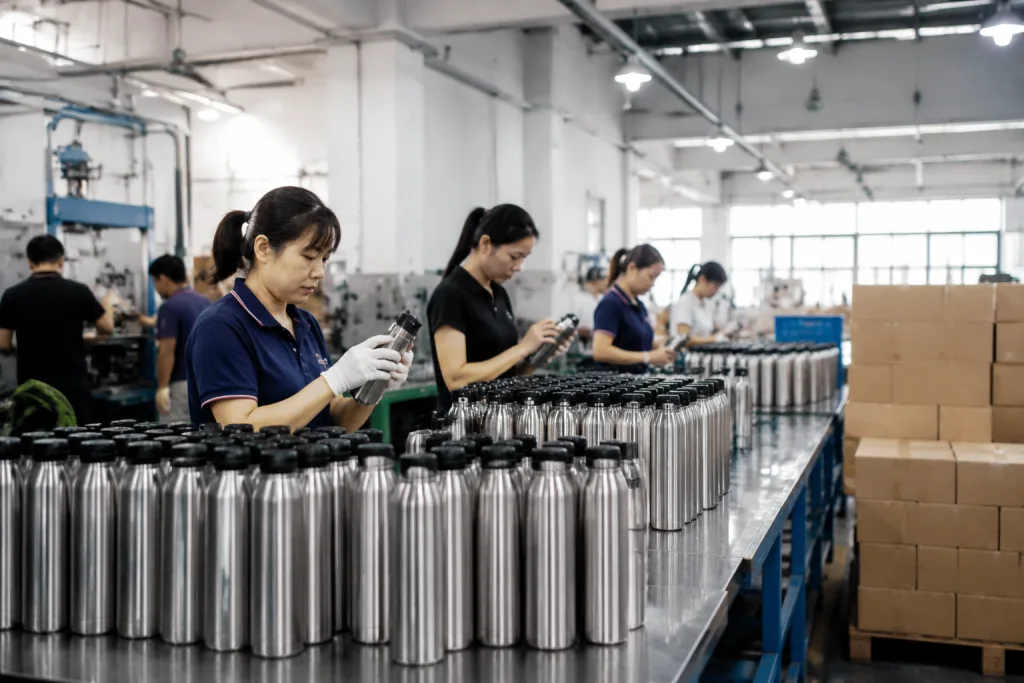
We'll walk through material selection, decoration methods, MOQ trade-offs, and supplier vetting—using real numbers you can apply today. We run a 12-day lead time on standard orders, and QC pulled a sample last week because the silk screen was off by 1.5 mm. Whether you're sourcing a custom growler for a brewery or a lightweight canteen for a corporate giveaway, these criteria will help you avoid expensive mistakes. We manufacture in Hangzhou, Zhejiang, and ship 500,000 units monthly, so we'll include specific factory metrics where they matter.
Decision 1: Material & Construction
Your water bottle's material sets its price, feel, and how long it lasts. Three options cover nearly every buyer we ship to:
- Stainless steel (18/8, food-grade): Best for durability and insulation. Double-wall vacuum-insulated canteens hold hot coffee at 65°C after 12 hours. We run 0.4mm–0.6mm wall thickness standard. FOB for a 500ml double-wall: $3.20–$4.50 at 3,000 units. MOQ from our shop: 1,000–2,000 pieces. QC pulled a sample last month that failed vacuum seal at 0.35mm wall — we don't go below 0.4mm.
- Tritan copolyester: BPA-free, crystal clear, shatter-resistant. Best for sports bottles where the buyer wants to see the liquid level. Lighter than steel by 40 grams on a 500ml. Cost: $1.80–$2.80 per unit at 3,000 MOQ. Not insulated — that's the trade-off.
- Aluminum: Low cost, lightweight. Prone to denting and needs an internal spray coating or you'll taste the metal. FOB: $1.20–$2.00. We ship these mostly for budget trade show giveaways where 4,000+ units go out in a weekend.
If your brand sells outdoor gear or premium corporate gifts, stainless steel pays for itself. For a high-volume giveaway where the math works under $2 per piece, aluminum fits. One thing: always request a material test report (REACH and FDA compliance) from your canteen supplier before sampling. A buyer flagged a substandard coating on an aluminum run last year — we caught it at pre-shipment inspection, not after.
Decision 2: Customization Method & Cost
Your logo hits the bottle three ways. Pick the method first, then the price starts making sense. Skip that order and the math doesn’t work; we’ve seen buyers chase a cheap setup and pay for a reprint when the line drifted on a curved wall. Here’s how we run it.
- Screen printing: Good for one-color logos on flat panels or a gentle curve. Setup sits at $40–$80 per color, mostly for registration and labor, not the screen itself. Per-unit is usually $0.15–$0.30. We stop at 3 colors because the fourth screen turns into delay. A 200mm-tall bottle gives us less room than the PO sketch suggests, and gradients are a bad fit here—the halftone dots start closing up after the third wash.
- Pad printing: This is the move for the domed shoulder of a canteen or the concave base of a mug. Setup runs $50–$100 per color, with the silicone pad and jig doing most of the work. Per-unit lands at $0.20–$0.40. Keep the artwork under 60mm wide. The buyer flags this all the time: they want photo detail on a curved part. Pad print does not hold fine serifs or hairlines on a 200mm-radius surface; the pad stretches them at the edge. Keep it bold. Keep it small.
- Laser engraving: No ink, no curing, no peeling. Setup is $30–$60 for the fixture, not the laser. Per-unit on stainless sits at $0.25–$0.50. On raw 304 stainless, the mark reads gray on silver, so the contrast is clean but quiet. That is fine for internal gifts and retail sets. We run this at 500-unit MOQ when the buyer wants zero color. If you want black-on-steel, you are asking for annealing mark, and the unit price jumps to $0.60.
If the artwork is a full-color photo or a tight illustration with gradients, screen and pad are the wrong question to ask. UV digital printing is the lane. Setup is only $20–$40 for file prep, but per-unit sits at $0.50–$1.00 because the cycle is slower and the ink costs more. The risk is not the setup fee; it is color drift across a 3,000-unit run. Ask for a Pantone match in writing, and get a physical sample before you green-light the line. QC pulled the sample for a buyer last quarter, and the cyan channel ran 12% heavy on the finished bottles. That reprint cost $4,200. A $35 sample would have caught it. The PO had one typo too: the buyer wrote CYAN-4 on the proof and CYA4 on the order, and that extra back-and-forth burned two days.
Decision 3: MOQ, Lead Time & Logistics
MOQ tracks the decoration method. On our Zhejiang line, screen print starts at 1,000 units, laser engraving at 500, and custom-molded color at 3,000. QC pulled the sample twice on a 1,000-piece order after the buyer flagged a 1.2 mm print shift. That miss kills a run.
Need a smaller run? Ask for stock bottle bodies with decoration only. We ship those at 200-500 units, and that math works better than opening a new mold for a 300-piece promo job. For 10,000+ units, buyers usually push for a 5% discount and mold amortization. Fair enough. The line is busy, the artwork is locked, and we have seen this go sideways when someone tries to squeeze price without fixing the spec.
FOB Shanghai or Ningbo is standard. A 40-foot container takes about 30,000-40,000 500ml canteens, and sea freight to the US West Coast usually runs 10-15 days on the water after 25-35 days of production. Air freight can save a launch, but it adds $1.50-$3.00 per unit. Confirm FOB, CIF, or EXW before we cut the PO; a typo on the incoterm has burned more than one shipment. That is the wrong place to learn the lesson.
Decision 4: Quality Standards & Certifications
Your brand pays for leaks and bad smells. We had a 500-piece order flagged on day 2 because the cap ring split at the 1.2 mm weld line, so this is not the place to guess. Ask every vendor for these minimum standards:
- AQL (Acceptable Quality Level) 2.5 for cosmetic defects, with 0 allowed for leaks, cap failure, or thread stripping.
- BSCI or SMETA social compliance audit. Most European buyers ask for it before price talks start.
- FDA or LFGB food-contact material compliance. For stainless steel, ask for 18/8 certification.
- ISO 9001 for production quality management.
A solid canteen factory sends these papers fast. If the sales rep starts stalling, the math does not work. QC pulled the sample on our line with an ink dot test and found a slow seep at the lid, so we know what that delay usually means. For the first order, we push a third-party inspection from SGS or Intertek; budget about $300–$500 per container. Cheap insurance.
Top 5 Use Cases & Best-Fit Canteen Types
Not every promotional water bottle does the same job. Start with the campaign, then match the canteen. We run that check on the line before we quote.
- Corporate wellness program: 750ml stainless steel vacuum-insulated canteen with laser-engraved logo. It holds coffee around 60°C for 6–8 hours, and the bottle moves from desk to car to meeting room all day. Daily-use gear. The buyer usually wants a premium logo while keeping the unit cost in line.
- Trade show giveaway: 500ml aluminum canteen with screen-printed logo. Low unit cost, fast packing, easy to stack in cartons. Budget $1.50–$2.00 per unit, and the math works only at 5,000 pcs or more. Any smaller, and the freight bites hard.
- Brewery or beverage brand: Custom growler (64oz) with swing-top cap. Screen print or UV print. MOQ 1,000. FOB $5.00–$7.00. QC pulled the sample at 165mm neck height, because a loose cap becomes a leak claim fast.
- Sports team or event: Tritan squeeze bottle with custom color and pad-printed logo. Light, tough, easy for runners and school teams to grip with one hand. Cost $2.00–$3.00, and we have seen the buyer flag a 2mm cap gap before shipment. Small gap, big headache.
- Retail or e-commerce brand: Customized canteen with unique color, embossed logo, and gift box. MOQ 3,000+. Price $4.00–$6.00 FOB. One wrong Pantone code on the PO can hold the batch for a full day, so this is the wrong question to rush past.
For each use case, ask your canteen supplier for a sample pack of 3–5 units before full production. That catches print drift, cap mismatch, and carton damage early. We have saved orders from a 12-day delay that way. We have seen this go sideways when a buyer skipped samples to save $80.
How to Vet a Canteen Factory in China
You’ve locked the spec. Now pick a canteen factory that can run it without drama. We check the line like this:
- Step 1: Ask for a factory audit or live video tour. We want the blow-molding line, a taped-off packing zone, and raw-material bins with labels, not a clean office corner. On a real run, we also ask to see the 24-cavity mold tag and the drying hopper log. One phone call. That is enough to see if they actually run the plant.
- Step 2: Ask for at least three client references in your region or category. Call them. A buyer in Germany told us the supplier answered fast before PO, then went silent for 12 days after the deposit cleared. That gap kills a launch. We’ve seen it before.
- Step 3: Request a pre-production sample (PPS) and a top-of-production sample (TOP). Put them side by side. QC pulled one with a 0.8 mm wall mismatch last month, and the buyer flagged it before we shipped 20,000 pcs. A caliper does not lie. Neither does a split seam at 0.8 mm.
- Step 4: Confirm payment terms: 30% deposit, 70% balance after inspection. Do not send 100% upfront. The math does not work, and we’ve seen it go sideways when one PO typo turned “5000” into “50000”. We ship against the signed sheet, not hope. That typo cost a week on the line.
- Step 5: Check the factory’s export history—ask for copies of past bills of lading or customs declarations. A real exporter can show paper trails, not just a sales pitch, and we usually keep 6 to 12 months of records on file. If they cannot pull a B/L in 5 minutes, that is a warning sign. A drawer full of old stamps is not proof.
A solid canteen factory in Zhejiang will have a dedicated export team and English-speaking sales engineers. Slow replies in the inquiry stage usually mean slow replies on the line. Ask who owns updates when the carton test fails or the artwork file has a 2 mm shift. If they dodge that, walk away. We’ve seen that go sideways on a 3,000 pcs order before. This is the wrong question to ask if you still think price tells the whole story.
Cost Breakdown: What You’ll Actually Pay
Let’s put numbers on it. For a 500ml double-wall stainless steel canteen with screen-printed logo, we run this line in Zhejiang every week. The quote starts here:
- Unit price (FOB): $3.50 at 3,000 pieces
- Screen printing setup: $60 per color (2 colors = $120)
- Pre-production sample: $50 (refundable on order)
- Third-party inspection: $400
- Sea freight (to LA): ~$2,500 for a 20ft container (holds ~30,000 units)
- Customs & duties: ~5% of FOB value
The landed cost for 3,000 pieces usually lands at $4.20–$4.80 per unit once freight and duty are in. At 10,000 pieces, the FOB price drops to $2.80–$3.20, and landed cost sits at $3.50–$4.00. QC pulled the sample for a 0.2mm print shift before packing, and the buyer flagged the same thing we see on the line every month: FOB alone is the wrong question. We had one PO where the ship-to line said "Los Angles," and the whole booking sat for a day. Ask for the full landed-cost sheet before you sign.
Ready to Source Your Custom Canteen?
Request a free sample pack and factory audit report from our Zhejiang facility. We ship 500,000 units monthly.
Frequently asked questions
What is the typical MOQ for a custom canteen?
For a promotional water bottle with screen printing, MOQ is usually 1,000 units. Laser engraving can go as low as 500 units. If you need a custom-molded color or shape, expect MOQ of 3,000–5,000. Some canteen manufacturers offer stock bottles with custom decoration only, which can lower MOQ to 200–500. Always confirm with your canteen supplier.
How long does it take to produce custom drinkware in China?
Production lead time for a standard canteen is 25–35 days from sample approval. Add 10–15 days for sea freight to the US or Europe. Air freight takes 3–5 days but costs $1.50–$3.00 per unit extra. If you need faster turnaround, some canteen factories in Zhejiang can expedite to 15–20 days for a 20% rush fee.
What certifications should I require from a canteen manufacturer?
Minimum: BSCI or SMETA social compliance, FDA or LFGB food contact compliance, and ISO 9001. For stainless steel, request 18/8 material certification. For Tritan, ask for BPA-free test reports. A reliable canteen supplier will provide these documents freely. If they don’t, consider it a red flag.
Can I get a sample before placing a bulk order?
Yes, most canteen manufacturers offer pre-production samples. Cost is typically $30–$80, refundable if you place the order. We recommend ordering 3–5 samples with different decoration methods to compare. This step can prevent costly mistakes and ensure your canteen customized with your logo looks exactly as expected.
What is the difference between FOB and CIF pricing?
FOB (Free On Board) means the price includes all costs up to loading the container onto the ship at the port (usually Shanghai or Ningbo). You pay freight and insurance separately. CIF (Cost, Insurance, Freight) includes freight and insurance to your destination port. FOB is more common for experienced buyers; CIF is simpler for first-time importers. Always ask your canteen vendor for both quotes.