Key Takeaways
- A normal MOQ for promotional stainless bottles is 500-1,000 pcs per SKU, with lead times of 25-35 days after sample approval.
- FOB China pricing for basic custom drinkware often starts around USD 2.10-3.80 per unit, depending on material, lid, and print method.
- For export to the US and EU, ask for REACH, food-contact declarations, and an AQL 2.5/4.0 inspection plan before production.
- A credible canteen manufacturer should show monthly output, often 150,000-300,000 units, plus carton and drop-test details.
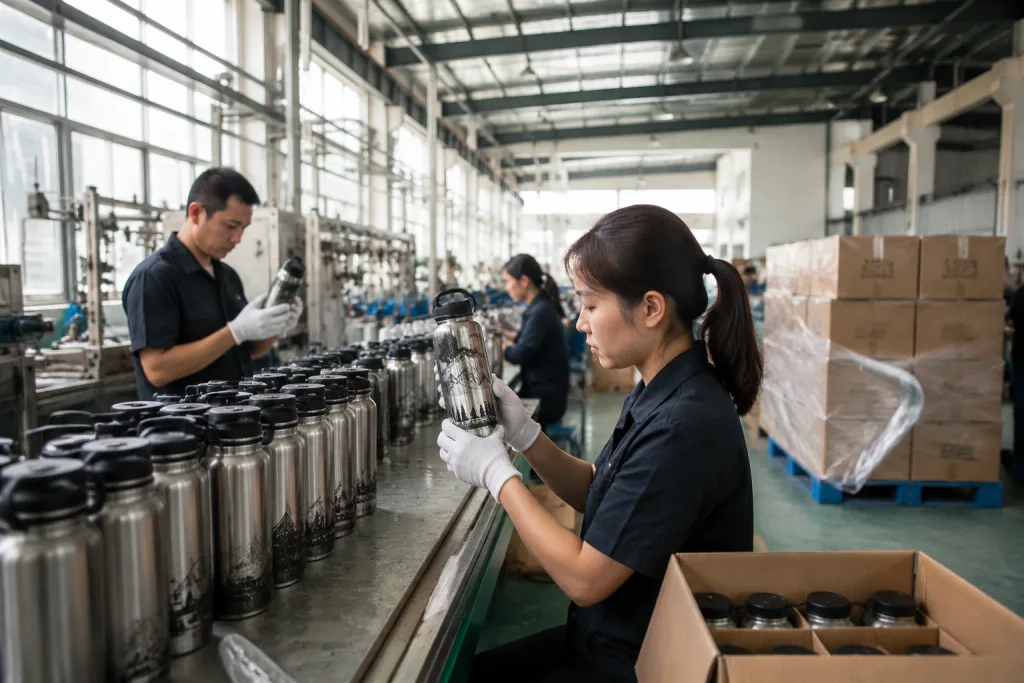
If you are buying promotional water bottle us stock for a brand program, distributor bundle, or retail push, the bottle is the easy part. The hard part is finding a factory that keeps print registration on spec, passes REACH, and still ships after the buyer flags a logo change on day 6. We have seen a 1 mm logo shift turn into three rounds of email and a missed ship date. That is normal.
We treat custom drinkware as a sourcing job, not a merch order. Compare material, lid type, wall thickness, carton pack, and whether you are dealing with a real canteen line or a trading company that outsources the run. In Zhejiang, we ship bulk export every week, and the math does not work if you skip the sample: lock the spec, confirm the proof, then push lead time, MOQ, and QC before price talks start. QC pulled the sample on the line last week and caught a 2 mm cap mismatch before it hit packing.
Start with the real use case
The first question is not “what bottle do you want?” It is “where will this promotional water bottle us order be used, and who is carrying it?” A trade show giveaway, a gym membership gift, and a distributor sell-in sample need different specs. We ran a 24 oz sample on the line with a 56 mm cap, and the buyer flagged it because the shape looked fine but the hand feel was off. Skip that step, and you pay for features nobody asked for, or strip the bottle down until it feels cheap.
For a 16 oz or 24 oz promotional bottle, the call is usually clear. If the buyer wants low landed cost, we ship PET, PP, or basic single-wall stainless. If they want higher perceived value, move to a 304 stainless canteen custom option with powder coat, laser logo, or full-color wrap. For a canteen distributor or distributor drinkware program, consistency beats novelty every time. QC pulled the sample and found a 1.5 mm print shift; one carton mismatch can cost more than a small decoration upgrade.
Checklist:
- Use case: event giveaway, retail promo, employee gift, or distributor program
- Capacity: 12 oz, 16 oz, 20 oz, 24 oz, 32 oz
- Target unit cost: under USD 2.50, USD 3.50, or above USD 5.00
- Decoration: one-color silkscreen, laser, wrap print, or emboss
When a canteen supplier asks the right questions at the start, that is the better sign. A PO typo on “24oz” versus “240z” once stalled a run for 3 days, and the math does not work any other way.
Pick the right bottle body
The body material sets the cost stack. For custom drinkware in the US market, we run four standard options: single-wall stainless steel, double-wall vacuum stainless, Tritan, and aluminum. A single-wall metal bottle is lighter and cheaper, but it sweats on the sample table. Double-wall insulated stock usually adds USD 1.20-2.40 per unit, and that gap shows up fast when the buyer is comparing retail sell-through or corporate gift value. The math is plain.
If you need a customizable canteen for an outdoor brand, start with durability. A 0.5 mm to 0.6 mm 304 stainless wall is standard on a lot of export SKUs. We have seen buyers push for 0.4 mm to hit price, then flag denting after QC pulled the sample off the drop test rack. That is a cheap bottle, not a premium one. A serious canteen manufacturer will tell you the gauge, the forming line, and the lid spec, not just the finish. We run the same callout on every spec sheet.
Practical rule: if the artwork is the hero, keep the body simple. If the bottle is the hero, spend on the structure and lid, not on a busy print that adds scrap and rework. This is the wrong question to ask: “Can we print more?” Ask whether the 28 mm neck, wall thickness, and cap torque match the use case.
A good canteen vendor should also say straight whether the bottle is fit for hot fill, carbonated beverage pressure, or dishwasher exposure. We had one PO where the buyer typed "dishwaser" and expected a full retail claim set anyway. No. If they cannot answer those three points cleanly, keep moving. We ship fewer surprises that way.
Decoration changes the margin
Decoration is where margin slips. A custom canteen with one-color silkscreen usually adds USD 0.10-0.30. Laser engraving sits in the same band, sometimes lower if we already have the fiber laser running. Full-wrap heat transfer, UV print, or gradient coating can push decoration to USD 0.40-1.20 per unit, and setup, fixtures, and reject risk still sit on top. QC pulled a 200 pcs sample last month and found 7 bad marks at the bottle shoulder. That is the cost line.
For a canteen promotional program, pick the print method by run size, not by taste. At 500 pcs, silkscreen or laser usually wins. At 5,000 pcs, richer decoration starts to make sense. For a custom growler or customized growler, the large curved body and heavier steel shell fit laser or pad print better because registration is easier to hold. A customizable growler with a matte powder coat and a small laser mark usually sells cleaner than a crowded full-color layout. The math doesn't work the other way. We ship a lot of these, and the buyer flagged it when a 4-color wrap added more cost than the bottle could carry. We run the same calculation on 28 mm necks every week.
Ask for decoration proof photos on the exact substrate, not a generic sample. On stainless, ink adhesion changes on brushed, polished, and powder-coated surfaces, and a 0.2 mm shift on the logo edge shows up fast. If the supplier says “same effect,” that is not a technical answer. We saw one PO with “bluck” instead of “black,” and the plate came out wrong. That typo cost a day.
Good decoration supports the product. Bad decoration covers weak sourcing for about two weeks, then shows up in returns.
That is why experienced canteen suppliers give you a print tolerance, a color reference, and a clear approval path before production starts. The buyer gets a sample drawdown, the line signs off, and everyone knows the limit before we start the press. QC keeps the first-off on the bench until the logo sits inside 0.2 mm.
Treat compliance as a gate
For the US and EU, compliance is the gate, not a paperwork bonus. One missing sheet turns a saleable lot into warehouse pain. We ask for food-contact declarations, REACH files, and traceability on the bottle body, lid, gasket, and coating. On a distributor drinkware order or an Amazon FBA shipment, a missing pack can hold receiving for 12 days instead of 2, and the buyer flagged it the same day.
On stainless canteen custom orders, the file set usually means 304 or 316 material reports, BPA-free statements for plastic parts, and migration test results when the customer asks for them. We run ISO 9001 here, and QC pulled the sample against AQL 2.5 for major defects and 4.0 for minor defects on the 800 mm inspection table. That does not rescue a bad spec. It gives you a control point, and that is the part that matters.
Ask these before deposit:
- Which standard applies: REACH, LFGB, FDA food-contact, or a customer-specific test plan
- Can you provide batch traceability for lids and seals
- Do you inspect 100% of leakage or only spot-check
- What is the carton drop-test requirement for your shipping route
A canteen manufacturer in China should not take those questions personally. In Zhejiang, they are standard. We have seen this go sideways on a PO with one typo in the carton count, so asking early saves money later. The factories that answer fast usually ship cleaner files and fewer surprises.
Compare factory strength, not sales tone
There are canteen manufacturers, canteen suppliers, canteen vendors, and trading desks that all sound the same in email. The split shows up when you ask for output capacity, tooling control, and line stability. A real canteen factory should give a monthly number, like 150,000 units or 200,000 units, and say which model runs on which line. Last month, a buyer flagged a quote because the rep side-stepped that question. The math does not work if capacity stays fuzzy.
For a promotional water bottle us program, check whether the factory can run mixed SKUs without pushing one design behind another. A small MOQ of 300 pcs looks good on paper, but if it turns into 45 days, that low entry price is dead weight. We run a different check here: 500 pcs per design and 25-35 days after sample approval is a normal lane for custom drinkware. QC pulled the sample on a 28-day run and found a 1.5 mm print shift. For a canteen distributor program with repeat drops, ask for reorder consistency on the same mold and the same decoration path. This is the wrong question to dodge.
What a stronger factory usually shows you:
- Photo evidence of the production line, not just the showroom
- Inspection records with date, batch number, and AQL 2.5 notes
- Pack-out standards, master carton dimensions, and pallet pattern
- Clear monthly capacity by process, not just total headcount
That is the difference between a canteen customized order that lands cleanly and one that gets corrected on arrival. We ship enough of those to know the pattern.
Build a sourcing checklist
Use a short checklist and keep every quote in one format. We run this on a canteen custom order, a customizable drinkware line, or a customized drinkware launch. Simple work. Put the quotes side by side and compare facts, not a low unit price that gets buried in freight or packing. On the line, a 0.6 mm wall spec or a missing lid type changes the math fast.
Procurement checklist:
- Product: body material, capacity, lid type, finish, and wall thickness
- Decoration: logo size, print method, color count, and artwork format
- Packing: polybag, egg crate, color box, master carton count, and barcode
- Compliance: REACH, food-contact, test report date, and buyer-specific standards
- Commercials: MOQ, sample fee, FOB port, lead time, and payment terms
If you are sourcing a custom growler or customizable canteen for a distributor channel, add a reorder test. Place a 50-piece pilot after the sample, then check whether the second run matches the first. QC pulled the sample against the carton mark, and a 2 mm print shift showed up before shipment. That tells you more than a polished sales deck. The buyer flagged it, and they were right.
Export buyers who ship well do not ask for more promises. They ask for fewer variables. We have seen this go sideways when a PO typo changed the carton count from 24 to 12. In Hangzhou, that mistake still cost one shift on the packing table.
Price the order like a buyer
Price is not the factory quote. We price from the door out, because a promo run falls apart fast when freight, duties, and packing push unit cost past target. On a 500-piece order from Zhejiang, FOB China usually sits around USD 2.10-3.80 per bottle, depending on material and decoration. Then we add ocean freight, customs clearance, and last-mile domestic handling. If the math does not work, stop there.
For a canteen promotional campaign, we run three bands. Entry giveaway: under USD 3.00 landed. Mid-tier corporate gift: USD 3.50-6.00 landed. Premium distributor drinkware: above USD 6.00 landed. Simple. A buyer once pushed back on a USD 0.18 carton upgrade, then flagged the retail shelf look later. That is the wrong question to ask if the product has to sell itself. We see this go sideways at the packing table.
Simple margin check: if you want 30% gross margin at resale, landed cost has to leave room for carton damage, one reprint, and one partial replacement. We learned that after QC pulled the sample and found a 2 mm lid gap on a black bottle. Tight orders look fine on paper. The caliper said otherwise.
The best vendors break price into body, lid, print, packing, and freight, line by line. We ship that sheet with the quote because a PO typo on decoration color can add a second screen setup fee, and the buyer sees the real cost only after the samples are already on the bench. One bad code, one extra setup.
Lock the sample before production
Sampling is where expensive mistakes get caught. We ask for a pre-production sample with the exact material, lid, logo, and carton, not a “similar” piece. On a 500 ml bottle run, QC pulled the sample and found a 1.2 mm logo shift; we stopped it there, and that saved us from reworking 8,000 units later. For a customized canteen or customized growler, check lid torque, leak resistance, logo alignment, and coating uniformity. On a retail-style canteen customizable run, we also check it under store lighting. Factory photos hide a lot.
A clean sample gate is simple: artwork confirmed within 24 hours, sample photos in 3-5 days if stock exists, physical sample approved in 7-12 days, then production starts. We had one buyer flag a PO typo on the carton spec before the line ran, and that typo would have blown the whole label job. If a factory wants to skip sample sign-off and go straight to bulk, the math does not work. They are pushing their risk onto your warehouse shelf. Bad trade.
Final sample questions:
- Does the lid seal after 50 open-close cycles?
- Does the logo scratch under a simple rub test?
- Does the carton survive a 76 cm drop on corners?
- Are the instructions and barcode correct for your market?
When the sample is right, the bulk order runs on rails. We ship cleaner, QC has less to chase, and the whole job gets boring in the best way. That is the goal.
Get a factory quote that you can trust
Send the spec, artwork, and target landed cost. We will return a practical quote, MOQ, lead time, and compliance path from Zhejiang.
Frequently asked questions
What MOQ should I expect for a promotional water bottle us order?
For most custom drinkware programs, a realistic MOQ is 500-1,000 pcs per SKU. Some canteen suppliers will quote 300 pcs, but the unit cost usually rises by 15-25% and the lead time can stretch beyond 35 days. For mixed color lids or multiple logos, expect a higher MOQ per variant. If you are testing a new canteen promotional concept, it is often smarter to place one 500-piece run than split into three tiny orders. You will get better print consistency and better freight efficiency.
How much should I budget per unit from China?
For FOB China, basic single-wall stainless or simple Tritan custom drinkware often starts around USD 2.10-3.80 per unit at 500-1,000 pcs. Double-wall insulated bottles, powder coating, or laser engraving usually move the quote into USD 4.00-7.50. Add freight, duty, and domestic handling to get landed cost. A Zhejiang factory quote that looks cheap but omits packing upgrades or testing is not a real comparison. Always ask for the same carton count, same lid, and same decoration method across suppliers.
What compliance documents do US and EU buyers need?
At minimum, ask for food-contact declarations, REACH support for the EU, and material traceability for steel, plastic lids, and silicone seals. For US programs, many buyers also ask for FDA food-contact alignment and ink or coating details. If the bottle uses stainless steel, request the grade report, usually 304 or 316. For a canteen manufacturer in China, these documents should be routine. If a canteen vendor cannot provide them quickly, that is a warning sign before deposit, not after shipment.
How long does production usually take?
For standard custom canteen or customizable drinkware orders, lead time is usually 25-35 days after sample approval and deposit. If the order needs new tooling, special coatings, or complex packaging, add 10-15 days. Rush orders are possible, but they often compress inspection time and create risk. A capable canteen factory should tell you which step is the bottleneck: printing, coating, assembly, or cartons. That answer matters more than a vague promise to “speed up.”
How do I choose between silkscreen and laser engraving?
Silkscreen is usually cheaper for larger logos and color branding, often adding only USD 0.10-0.30 per unit. Laser engraving is better for a clean, durable mark on stainless and can be similar in cost for small runs. For a custom growler or customized canteen with powder coat, laser often gives a sharper premium look. If your artwork has fine text or multiple colors, silkscreen may not hold up as well. Ask for a sample on the exact surface finish before you commit to bulk.