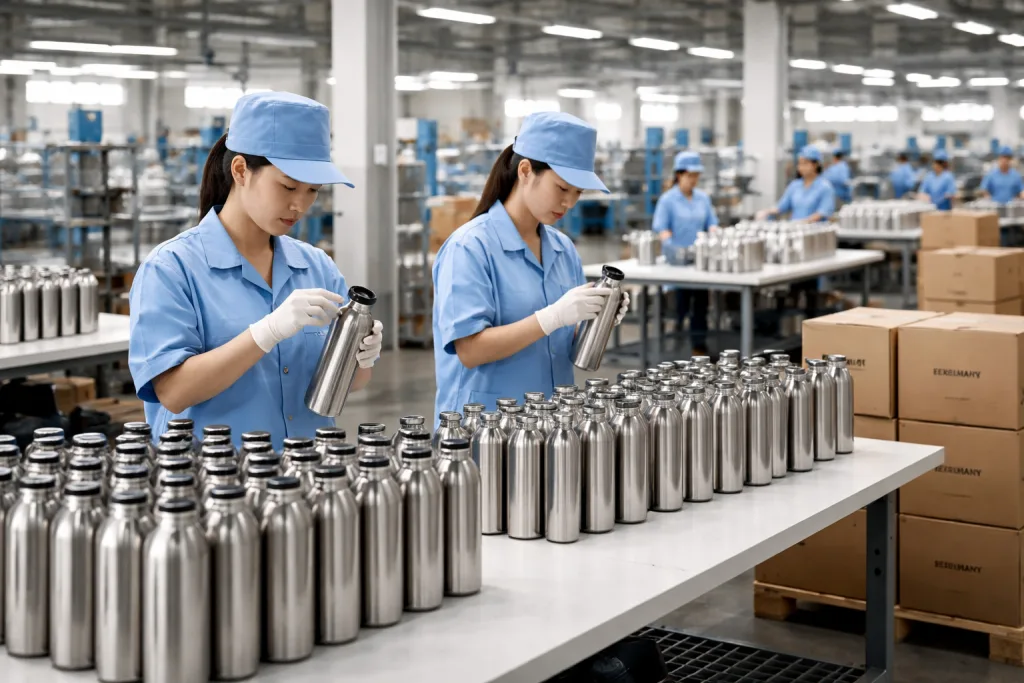
Key Takeaways
- Specify 0.5 mm minimum wall thickness for stainless steel canteens to avoid denting; many factories default to 0.3 mm.
- Require a 48-hour water immersion test on the liner to catch pinhole corrosion before production.
- Mandate AQL 2.5 (normal level II) for all promotional water bottle Germany orders to guarantee quality.
- Use a 3D-printed sample before committing to a custom mold for a customized growler or canteen shape.
A 12-day turnaround. A sharp stainless steel canteen. Logo art locked in. Then the samples hit your desk and everything falls apart. The laser engraving is barely visible—more scuff than mark. The liner leaves a metallic tang that kills the drinking experience. Wall thickness comes in at 0.35 mm. Squeeze it once and it dimples. The factory blames your spec sheet. The distributor blames the factory. You're holding a container of dead stock and a client who refuses payment.
We see this play out roughly twice a week. Buyers skip the spec details that matter, and the whole order turns into a write-off. Last Tuesday on our floor in Hangzhou, QC pulled a batch at AQL 2.5 and flagged pitting across 40% of the units. The buyer had written "304 stainless" on the PO and stopped there. Never asked about surface finish grade. Never mentioned polishing spec. That omission cost them the entire run. This guide covers the five failure modes we encounter most often—and what to put on your spec sheet to prevent each one. Same rules apply whether you're ordering 500 custom growlers for a craft brewery or 5,000 promotional canteens for a corporate campaign.
Failure Mode 1: Paper-Thin Walls That Dent on Day One
German distributors call us about one thing more than anything else: the promotional water bottle Germany order showed up dented. The math is simple — wall thickness below the minimum. Some Chinese factories quote 0.3 mm for stainless steel. Saves them about $0.15 per unit on material. Produces a bottle that feels like a cheap toy and deforms under normal handling. We've watched buyers try to save that $0.15 and end up replacing 30% of the batch.
For a standard 500 ml promotional water bottle, specify minimum 0.5 mm body thickness and 0.6 mm bottom. For a 1 L custom growler (32 oz), bump that to 0.6 mm body and 0.7 mm bottom. Ask for a cross-section sample or a certified material test report — don't just take their word. At our Zhejiang factory, we run a micrometer gauge on every incoming coil of 304 stainless steel. QC pulled a coil last month at 0.42 mm. We rejected it before it hit the press. That's the difference between a bottle that holds up and one that folds under a warehouse cart.
If your canteen supplier cannot put a wall thickness guarantee in writing, move on. The cost difference at FOB Shanghai between 0.3 mm and 0.5 mm is about $0.20–$0.30 per unit. That's nothing compared to replacing 5,000 dented bottles and explaining to your client why their logo arrived crumpled.
Failure Mode 2: Liner Corrosion That Ruins Taste
Nothing kills brand trust faster than a promotional water bottle that makes water taste like a tin can. The liner, the inside coating or surface treatment, is the spec most buyers skip. We see it on the line all the time. Most canteen factories run a standard electropolished interior. It looks clean at first. After 10 to 15 wash cycles, micro-pinholes open up, and those holes hold moisture. Corrosion starts there. By day 90, the buyer opens the bottle and gets stale metal instead of water.
For a customizable canteen that sees daily use, we run a food-grade epoxy coating or a PVD liner. PVD adds about $0.50 per unit and stops pinhole corrosion. Our stack is simple: electropolish, clear PVD layer, then a 48-hour immersion test at 60 °C on every batch. QC pulled the sample, and if the water shows metallic residue or a pH shift above 0.2, we reject the whole run. We learned that after a German buyer flagged metallic taste on a 5,000-piece order in 2021. The math doesn't work any other way.
Ask your canteen distributor for a liner durability report with a salt-spray test (ASTM B117) at 24 hours minimum. No report, assume the liner is marginal. We had one PO last year with a typo on the spec sheet, “epoxi” instead of epoxy, and the buyer caught it before the line started. This matters just as much for a customized growler that holds beer or kombucha—trace metal at 0.5 ppm can flatten the hop profile. One brewery customer told us their sales rep did not know what ASTM B117 meant. That is the wrong question to ignore. Don't accept it.
Failure Mode 3: Logo That Fades or Peels After Two Dishwasher Cycles
Your client is a German automotive parts supplier. They place 10,000 promotional water bottle Germany units with a full-color logo on the front. Six weeks later, the distributor sends photos of bottles with the print lifting at the edges. We checked one returned sample under a loupe at QC, and the ink had not gone through a proper cure for dishwasher use. The PO had no test standard. That is where the trouble starts.
For any custom drinkware order that will go through a dishwasher, put the test protocol on paper before we run the line. We use a 100-cycle dishwasher test at 70 °C with industrial detergent. The logo should show no more than 10 % fading and no peeling. For a custom canteen with a complex design, laser engraving or a pad-printed epoxy overlay holds up better than standard silk screen. Laser engraving adds about $0.10 per unit and stays put.
If your canteen supplier offers a cheaper print method, ask for a written guarantee that it passes a 50-cycle dishwasher test. We have seen this go sideways when a buyer took a low quote, then the line came back with logos flaking after the second wash. The math does not work. Ask now, not later.
Failure Mode 4: Lids That Leak or Break at the Hinge
A leaking lid is the first complaint on promotional water bottle Germany orders. The hinge on a flip-top and the threads on a screw cap take the hit. Once the plastic wall drops below 1.8 mm, cracks show up fast. We run a torque check on the line because a lid mold that misses the bottle thread pitch will cross-thread and drip.
Set the spec in plain numbers: 24-hour leak test, 45-degree angle, bottle filled to capacity. For a custom growler with a swing-top stopper, ask for a silicone gasket at Shore A 50–60. We use 55 Shore A on our growler lids, and QC pulled the sample from each mold cavity before production. Softer seals grab better, but they wear out sooner. Harder seals last longer. That is the wrong trade if the glass rim is uneven.
If your canteen supplier buys lids from a third party, ask for the lid maker's name and the audit report. We have seen the buyer flag a PO typo on the lid code, then the shipment landed with brittle hinges because the compound changed without notice. That batch was 5,000 units. A 10,000-cycle hinge test would have caught it before we shipped.
Failure Mode 5: Inconsistent Color Matching Across Production Runs
Your promotional water bottle Germany order is split into five colors, one for each product line. Run one is clean. Run two, three months later, comes back with a blue one shade off and a green that the buyer flagged on sight. The line still shipped 8,000 pcs, but those mixed pallets do not sell as a set.
Color drift shows up fast on powder coat and anodized finishes. “Close enough” is the wrong question. We run a HunterLab on batch samples, set ΔE ≤ 2.0 in CIE Lab, and check every lot before release. If QC pulls the sample and the reading is over 2.0, we rework it or hold the shipment. A missing spectrophotometer report is a real warning sign.
For a customizable canteen with a Pantone-matched logo, lock a physical color chip in writing and get both sides to sign it. Keep that chip on file for repeat orders. We have seen this go sideways when a PO had a typo on the color code and the buyer only caught it after cartons were packed. Once the container leaves China, fixing a color mismatch costs more than the bottle margin.
How to Write a Spec Sheet That Protects Your Order
A tight spec sheet stops most order problems before they start. We see it on the line: loose buyer notes turn into PO fights, then the buyer flags a sample two days before approval. For a promotional water bottle Germany order, this is the sheet we ask for at BottleForge Industrial:
- Material grade: 304 or 316 stainless steel, 18/8 food-grade, with mill certificate.
- Wall thickness: 0.5 mm body, 0.6 mm bottom (minimum).
- Liner treatment: PVD coating or food-grade epoxy, with 48-hour immersion test report.
- Logo method: Laser engraving or pad-printed epoxy overlay, tested to 100 dishwasher cycles.
- Lid test: 24-hour leak test at 45°, 10,000 hinge cycles.
- Color tolerance: ΔE ≤ 2.0, spectrophotometer report per batch.
- Packaging: Individual polybag, then 12-unit inner box, then master carton with edge protectors.
Send the spec sheet before quotation. If a supplier pushes back, ask for the reason in writing. We had a buyer leave out the bottom thickness once, and QC pulled the sample at 0.42 mm; that order slipped 12 days, and the margin was gone. This is the wrong question to ask after production starts. A plant that can run these numbers will answer fast. A plant that cannot will stall on the first line item.
Why Factory Location Matters for Lead Time and Quality
You may ask why we keep bringing up Zhejiang. The answer is on the truck schedule. In the Hangzhou belt, we run stainless steel and aluminum drinkware next to coil stock, cap suppliers, mold shops, and powder coat lines. That trims handoff time. A PO with one wrong cap code can still slow a run, but a local supplier usually fixes it the same day. We had one buyer flag a lid code typo on a 5,000-piece PO. The rework took 6 hours, not 2 days.
For a promotional water bottle Germany order, that matters because your client is counting on delivery in 8–10 weeks. We ship faster from this side because a custom canteen order from a Zhejiang factory often moves in 30–45 days from sample approval to FOB Shanghai, while a factory farther from the supply base is more like 60–90 days. QC pulled the sample, found a coating pinhole, and the line had a replacement panel in 24 hours. That is the gap. The wrong question is to ask only for a low unit price.
Ask a vendor where the factory sits and how far the nearest stainless steel coil supplier is. If they are 100 km or more from a major distributor, the math does not work as well as the sales pitch. We have seen this go sideways on a 2,000-unit run when the buyer flagged a missing coil spec and the shop had to wait a full week for material. Geography decides the lead time. A tape measure and a coil map tell the truth faster than a polished brochure.
The Real Cost of Cutting Corners on QC
Let’s put the numbers on the table. A 500 ml promotional water bottle Germany order of 10,000 units at FOB Shanghai runs about $2.80 a piece, or $28,000 total. If the wall slips thin and 1,000 units land dented, you lose $2,800 in product value before return freight and rework. We saw one lot drift to a 0.7 mm wall spec, and the buyer flagged it the day the cartons hit the dock.
Prevention costs less. A wall thickness check adds about $200 to the inspection bill. A liner immersion test adds $150. A spectrophotometer report adds $100. Total: $450. On this order size, that is a 62:1 return if it catches one rejection. The math does not work any other way. QC pulled the sample with a caliper on the line, and that saved one shipment.
We run AQL 2.5 (normal level II) on custom drinkware orders. QC pulls 200 units from a 10,000-unit lot and allows up to 10 defective units. If the defect rate goes over 2.5%, the lot gets re-inspected and sorted on the line. Put that in the PO. A buyer once left it out, the supplier “confirmed” default QC, and the shipment still failed on cap fit by 1.5 mm. We’ve seen that go sideways fast. This is the wrong question to ask.
Get a Custom Quote for Your Promotional Water Bottle Germany Order
Send us your spec sheet or design file. We will respond within 48 hours with a detailed FOB Shanghai quotation, including QC test reports and lead time.
Frequently asked questions
What is the minimum order quantity for a custom canteen from a Chinese factory?
For a standard promotional water bottle Germany design with an existing mold, the MOQ is typically 1,000 units per color. For a fully customized canteen with a new mold (a unique shape or custom growler design), the MOQ jumps to 5,000–10,000 units. At BottleForge Industrial, we offer a stock-mold option with MOQ 500 units for simple laser engraving. Mold costs for a custom shape range from $1,500 to $4,000, amortized over the first order.
How do I verify that a canteen manufacturer in China is legitimate?
Request a factory audit report from a third party like SGS or Bureau Veritas. Look for BSCI or SMETA certification, which indicates social compliance. Ask for a video tour of the production line, not just the showroom. Verify their business license via the Chinese government's National Enterprise Credit Information Publicity System. A reputable canteen supplier will provide these without hesitation. We provide all three for any prospective buyer.
What is the typical lead time for a promotional water bottle Germany order?
From sample approval to FOB Shanghai, a standard order of 5,000–10,000 units takes 35–45 days. This includes 7–10 days for sample production, 20–25 days for mass production, and 5–7 days for QC inspection and packing. A custom growler with a new mold adds 15–20 days for mold making. Always add 10 days buffer for shipping from Shanghai to Hamburg, which takes about 30 days by sea.
Can I get a custom canteen with a matte finish instead of glossy?
Yes. Matte finishes are achieved through bead blasting or a matte powder coat. Bead blasting adds about $0.15 per unit and is more durable than powder coat, which can chip. For a promotional water bottle Germany campaign targeting outdoor enthusiasts, a bead-blasted matte finish is ideal because it hides scratches. Specify the surface roughness (Ra 0.8–1.2 µm for matte) in your spec sheet. We offer both finishes with a 48-hour abrasion test.
What certifications do I need for selling custom drinkware in Germany?
For the German market, you need REACH compliance for materials and LFGB (German Food and Feed Code) certification for food contact. Many buyers also require EU Declaration of Conformity. For a custom canteen with a plastic lid, ensure the plastic is BPA-free and tested per EU 10/2011. We provide LFGB test reports from a third-party lab in Germany for every material batch. The cost is included in our FOB price.