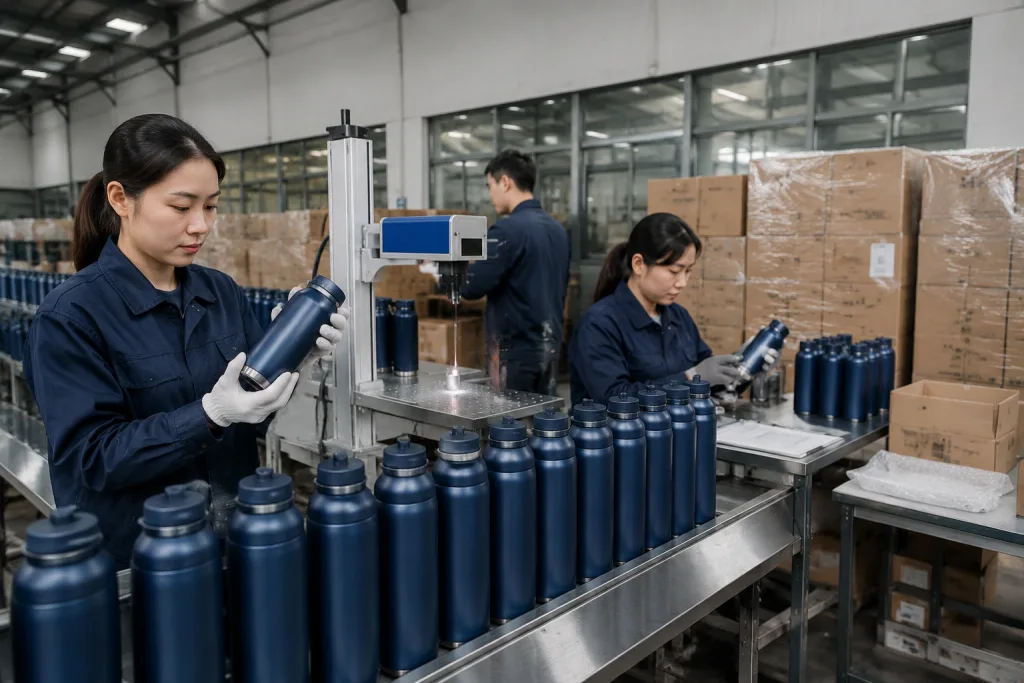
Key Takeaways
- A workable promotional vacuum flask US quote starts with 9 core specs, not just logo artwork.
- Typical MOQ for a custom stainless thermos is 500 units per SKU, with sample lead time around 7-10 days.
- For bulk thermos orders, FOB China pricing often lands between USD 4.20 and USD 8.90 depending on capacity, finish, and lid.
- A proper PO should separate product, print, packaging, and test requirements so your thermos supplier cannot under-quote and overcharge later.
You can source a promotional vacuum flask US program from plenty of suppliers. Finding one is easy. The hard part is getting a custom thermos through transit with clean print, REACH paperwork, and enough margin left for the promo buyer or distributor. We have seen this go sideways: a buyer sends "send me a quote," then the sample slips by 12 days, the logo lands fuzzy, or the carton fails a 1.2 m drop test after the line is already booked.
From our Hangzhou, Zhejiang factory, the fastest buyers treat stainless drinkware like a spec sheet, not a gift pickup. They lock the wall thickness, steel grade, lid type, box count, and test standard before they ask for unit price. That is the only way to compare thermos bulk quotes from a supplier thermos, a factory thermos, or a thermos manufacturer in China without guessing what is in the carton. QC pulled the sample at 304 stainless and 0.5 mm wall, and that is the level we run on when the PO says "promo."
Start With the RFQ, Not the Logo
Most bad thermos custom projects start with a logo file and nothing else. Don't do that. A useful RFQ for a promotional vacuum flask leads with the product spec — capacity, liner structure, finish, lid type — because each one changes the quote by 15–30% and you don't want to redo the PO after QC pulls the first sample. If you want a reorderable custom thermos six months from now, write the RFQ like a purchase spec, not a marketing brief.
At minimum: capacity, target retail use, lid style, insulation time target, finish, logo method, carton count. For a standard 500 ml stainless thermos, tell us whether you want single-wall or double-wall vacuum, 18/8 stainless inner liner, and powder coat vs. sprayed paint vs. brushed steel. Zhejiang factories quote faster when you give exact numbers — the BOM clicks into place. A decent custom thermos RFQ also states your target order size. 2,000 now and 20,000 later? Say so. That changes tooling and print setup decisions. We've seen RFQs with no capacity and a logo file; the math doesn't work that way.
- Capacity: 350 ml, 500 ml, 750 ml, or 1,000 ml
- MOQ target: 500, 1,000, or 3,000 units
- Performance: 6-hour hot hold, 12-hour cold hold, or better
- Compliance: REACH, LFGB, BPA-free, carton drop test
Choose the Thermos Spec That Sells
Pick the right spec for your channel. That matters more than chasing one "best" thermos. Outdoor retailers need a sturdier lid and a grip that holds up after a season in muddy backpacks. Promotional buyers want lower unit cost and a box that makes the flask feel pricier than it is. Both are fine. Just don't blur the product definition.
The main cost drivers in a bulk thermos order: steel thickness, vacuum quality, cap complexity, and decoration method. Entry-level models run a 0.35 mm inner wall. Bump it to 0.4 mm or 0.45 mm and dent resistance improves—cost goes up about 12–18 cents per unit. A straight stainless lid is cheap. A dual-use lid with a carry loop and tea filter? We had a buyer last month try to squeeze both into a 1,000-unit budget and the math didn't work. For a thermos customizable for U.S. promo campaigns, keep the base SKU simple. Vary the logo, box sleeve, and insert card per campaign. That way you can reorder from a thermos factory in China without retooling the whole line. QC pulled a sample last week where the sleeve color was off by one Pantone number. The buyer flagged it, and we swapped it in 3 days.
Typical FOB China ranges: 500 ml powder-coated vacuum flask: USD 4.20-5.60 at 1,000 units; 500 ml with premium lid and retail box: USD 6.10-7.80; 750 ml insulated flask with laser logo and color box: USD 7.20-8.90.
Request Samples Before You Argue Price
Sampling tells you whether the supplier can actually make what they quoted. Start with a plain sample if you're still choosing the shape, then a pre-production sample with your artwork. Do not approve bulk from a render — a polished PDF won't show you whether the vacuum seam is clean or the lid leaks at a 45-degree tilt. We had a client approve from photos once; the first 500 pieces had a 2mm gap at the lid hinge.
For a standard custom thermos, sample lead time runs 7–10 days if the mold exists, or 15–20 days if we need new lid or body tooling. Sample charges land around USD 30–80 per style, plus courier. That money is not the issue. The real risk is approving an oversized logo or a coating color that reads completely different on stainless than on coated plastic. Ask for the logo method in the sample exactly as it will be used in bulk: silkscreen, laser engraving, UV print, or heat-transfer wrap. If you are a distributor buying for several accounts, request two identical samples. One gets damaged during internal review faster than you expect — coffee spill, dropped on concrete, lost by the marketing team.
Approve samples with a written checklist: leak test, lid fit, finish uniformity, logo placement, and carton condition. If one item fails, do not call it "close enough." QC pulled a sample last month that passed four checks but had a burr on the drinking rim — we redid the tooling before bulk.
Build the PO Line by Line
Your purchase order should be boring. Boring is good. A clean PO keeps the factory from reinterpreting your specs after the deposit clears. For a promotional vacuum flask US shipment, separate the line items: product body, decoration, packaging, testing. If your PO just says "custom thermos, 5,000 pcs," you are leaving room for arguments on print method, color, and carton spec. We once saw a vendor claim the quote did not include individual boxes or drop testing — that gets expensive. The math doesn't work when you have to back-order 500 outer cartons at $4.80 each.
Write PO language the factory can execute without interpretation. Example: 500 ml stainless steel vacuum flask, 18/8 inner liner, powder coat navy, laser logo 1 color, 1 pc/white box, 50 pcs/master carton, outer carton with FNSKU label applied, REACH-compliant materials, production sample confirmed. If you need Amazon prep, state the FNSKU requirement and carton barcode format before the line runs. For outdoor retail, add the case pack and shelf-ready insert dimensions — we had a buyer once skip the insert spec and got flimsy trays that collapsed in transit. QC pulled the sample and the tray walls measured 1.2 mm instead of the standard 2.0 mm. A good factory thermos quote should mirror your PO almost line for line. That is how you avoid hidden change orders.
- PO line 1: Product spec and capacity
- PO line 2: Logo method and artwork version
- PO line 3: Inner box, master carton, and label requirements
- PO line 4: Inspection standard, usually AQL 2.5 major and 4.0 minor
Ask for the Right Tests
If you sell in the U.S. or Europe, compliance is part of the sourcing math — not a nice-to-have. A serious thermos factory in China should back up REACH declarations, BPA-free statements, and food-contact testing for your market. Need extra confidence? Ask for migration testing against the relevant food-contact rules, and confirm the finish holds up to abrasion without flaking after normal use. We once had a buyer who skipped that step and got flagged by QC for coating peel on the first 500-piece run.
For a promotional thermos, test requests should match the channel. Outdoor retailers care about leak resistance, temperature retention, and coating durability. Promo brands care about safe materials, decoration consistency, and pack-out quality. A common retention target for a 500 ml double-wall stainless flask is 6-8 hours hot and 12-18 hours cold, depending on lid type and fill temperature. Do not accept "good insulation." A thermos distributor in the U.S. needs hard numbers — their buyers will ask. In Zhejiang, many factories can meet these specs, but only if you define them before the first sample run. We ship 30,000 units a month to one promo client; the difference between a pass and a reject came down to one spec on the PO.
Useful references: ASTM-style drop and closure checks, ISO-based internal process control, and AQL inspection at final random inspection. The math doesn't work if you skip the AQL step.
Compare Quotes Like a Buyer
Quote comparison trips up buyers more than pricing errors do. Two suppliers quote the same promotional vacuum flask, and the price gap hits 40%. They aren't offering the same product. One includes a premium lid—say, a push-button with locking ring—a stronger carton, and a ceramic coat that holds up after 500 dishwasher cycles. The other leaves all that out and still calls it comparable. Compare total landed build, not unit price.
When you review bulk thermos offers, split the quote into four buckets: product body, decoration, packaging, and freight. Then check steel grade (304 vs 201), wall thickness (0.4 mm vs 0.5 mm), lid material (PP vs Tritan), and carton count. If the quote uses the words "factory direct," ask who the actual manufacturer is and whether they own the line or only source it. A real thermos factory in China should tell you monthly output without hesitation. At our Hangzhou plant, we run 120,000 units per month across stainless drinkware lines. That matters when you need a staggered shipment—say, 30% now, 70% in 45 days—or a repeat run before peak season. If a thermos supplier cannot state lead time clearly—usually 25–35 days for standard runs—you are not comparing serious offers.
Good quote checks: MOQ, unit price at 1,000 and 5,000 pcs, sample charge, mold charge if any, lead time, carton spec, and payment terms.
Plan Bulk Production Around Seasonality
Seasonal thermos orders fail on timing, not product. If you need Q4 delivery for a holiday campaign or outdoor launch, your PO should hit the factory floor 45-60 days before ship date. For China export out of Zhejiang, the sequence is sample approval, deposit, bulk production, final inspection, then booking. Your artwork changing after approval? That schedule collapses. We've seen it — a buyer swapped a Pantone code six days before the line ran and lost three weeks of capacity.
Keep a production calendar. Days 1-10: sample signoff and print file lock. Days 11-25: body forming, vacuum sealing, curing — our brazing furnace runs a 9-hour cycle per batch. Days 26-32: decoration, assembly, packing. Days 33-40: inspection and export booking. That's a standard outline for stainless thermal flask runs. Complex lids or multi-color printing can add a week. Ask your distributor thermos buyer for a spare parts policy. If one lid color gets discontinued, you need backward compatibility confirmed. China factories can support that, but only if the SKU file is disciplined from the start. One buyer forgot to spec the gasket durometer — QC pulled the sample and flagged a 0.5 mm leak gap.
Use Reorder Data to Lower Risk
Every custom thermos program we run gets cheaper by the third order. Not because the factory gives us a discount — because the data is already locked. Keep your approved artwork, test reports, carton spec, and signed sample in one master file. That file becomes your internal standard. If your sales team changes the box count from 48 to 36 or shifts the print position 10mm left without updating that master spec, you are paying to relearn the same lesson. We've seen this go sideways on a re-buy where QC pulled the wrong sample and the whole line stopped for 90 minutes.
For promotional brands, the reorder advantage is real. A steady thermos distributor program saves 5-12 percent on repeat runs because tooling is already stable and the factory no longer needs a long approval cycle. One SKU, one drawing, one approved sample, one PO template. If you source from Zhejiang or anywhere else in China, this discipline saves more money than bargaining over a few cents on the first order. A customizable thermos is only valuable if it stays repeatable.
Send your thermos spec and get a real quote
Share capacity, logo method, and target MOQ. We will return a line-item quote, sample plan, and lead time from Zhejiang.
Frequently asked questions
What is the typical MOQ for a promotional vacuum flask US order?
For a standard stainless promotional vacuum flask US program, MOQ is usually 500 units per SKU if the mold already exists. For custom color, custom lid, or special packaging, 1,000 units is more common. New tooling can push it to 3,000 units. At a Zhejiang factory, a simple 500 ml model can often be produced in 25-35 days after sample approval, depending on season and artwork lock. If you need mixed colors, ask whether color can be split within the same MOQ or whether each color needs its own minimum.
How much does a custom thermos cost FOB China?
A basic 500 ml custom thermos with powder coat and one-color logo often lands around USD 4.20-5.60 FOB China at 1,000 pieces. Add a better lid, retail box, or laser engraving and you may see USD 6.10-7.80. Larger 750 ml units usually run USD 7.20-8.90. The final price depends on steel thickness, finish, lid complexity, and carton spec. A reliable thermos manufacturer in China should quote the same spec in a line-by-line format so you can compare properly.
What testing should I request before bulk production?
At minimum, request leak testing, insulation performance, material declarations, and final random inspection under AQL 2.5 major and 4.0 minor. For U.S. and European sales, ask for REACH support and a food-contact compliance statement. If your promotional thermos will be sold through outdoor retail, add drop testing and coating adhesion checks. For Amazon or marketplace programs, make sure carton labels and FNSKU placement are defined before production. Good factories in Zhejiang already know these requirements, but you still need them written into the PO.
Should I use laser engraving or silkscreen for a promotional thermos?
Use laser engraving when you want durability and a premium look on stainless steel. Use silkscreen when the logo needs a solid color and larger print area, but expect wear sooner than laser on heavy-use drinkware. For many custom thermos orders, laser on the body plus a printed box gives the best balance. If the logo has fine text or small lines, laser is usually safer. A good supplier thermos can show you both methods on the same sample so you can judge legibility and finish in hand, not on screen.
How do I know if a thermos supplier is actually a factory?
Ask for monthly output, production line photos, inspection process, and the sample-to-bulk lead time. A real thermos factory in China can usually state a monthly capacity number, such as 120,000 units, and explain how vacuum sealing, coating, and packing are handled. If the answer is vague, you may be dealing with a trading layer. A direct manufacturer thermos should also be able to reference its QC flow, carton packing count, and current material grades. That saves you from price surprises later.