Key Takeaways
- A typical MOQ for a custom thermos is 3,000 units, with 30-45 days lead time after sample approval.
- 304 stainless steel inner and outer walls, with 0.4-0.5 mm thickness, is the practical baseline for most promotional thermos orders.
- For Britain-bound shipments, ask for REACH, food-contact declaration, and drop-test evidence before you place a bulk thermos order.
- A reliable factory thermos line should hold 55-65°C after 12 hours and 45-55°C after 24 hours, depending on capacity and lid design.
A promotional flask isn't a flask. It's your margin, your deadline, and the complaint rate you'll field if lids leak in transit. For a UK campaign, the unit has to land clean, hold heat past lunchtime, survive a courier drop, and still leave room for a logo that reads at arm's length. Most orders go sideways because the buyer fell in love with a sample and never walked the production line.
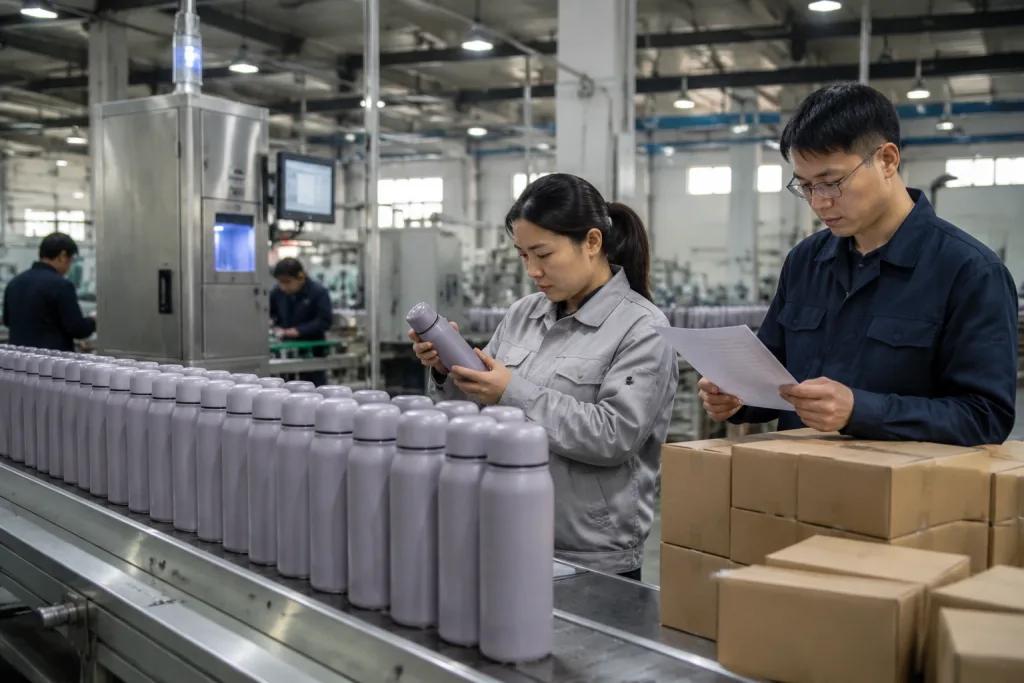
We run these orders at BottleForge in Zhejiang—outdoor retailers, promo distributors, brand teams. The math is simple if you spec early. Judge a factory on five things: the grade of the 304 inner, the vacuum pull (we test at 85°C fill, 6-hour drop), coating adhesion on a cross-hatch tape test, lid gasket compression set, and how the units cube out in a 40HQ. We've had a buyer flag a full shipment because the lid silicone swelled after hot-fill cycling—traceable to a batch of O-rings from a sub-supplier. That's the detail that matters. If you're buying bulk for the UK, the checklist below is the one QC uses on our floor.
What buyers really ask first
On the first call, nobody asks about 304 stainless. They ask three things: lead time, print quality, and whether the unit cost actually holds. That's the right starting point. Get any one wrong and the campaign budget evaporates.
A 500 ml promotional vacuum flask at 3,000 pieces lands between USD 2.80 and USD 4.60 FOB Ningbo. We've shipped enough of these to know the spread is real—lid type alone can swing it USD 0.40. If you ask for a quote without specifying body finish, vacuum retention target, and decoration method, the number you get back is fiction. A supplier who knows their line will reply with carton dimensions, gross weight per carton, and exact print area in the first email. The Zhejiang factories that run tight don't hide these figures—they lead with them because it saves everyone a week of back-and-forth.
- Capacity: 350 ml, 500 ml, or 750 ml
- Wall structure: double-wall vacuum, 0.4-0.5 mm 304 stainless
- MOQ: 3,000 pcs for most custom orders
- Lead time: 30-45 days after sample sign-off
Spec the flask before you price it
Get the spec locked down before you ask for a price. Start with the stainless grade. In the UK and North America, 304 is the standard for both inner and outer walls. 201 is cheaper, but you are buying a headache—corrosion issues and a buyer on LinkedIn asking why the flask rusted after two dishwasher cycles. If your brand goes near outdoor or workwear, just spec 304 and stop second-guessing yourself.
Wall thickness is where most first-timers get burned. A body at 0.35 mm prints fine out of the box, but it dents in fulfillment. We had a pallet of 350-piece order arrive with six crushed flasks just from stacking. We run 0.4 mm as the floor, and 0.5 mm for any premium program where the client expects the thing to survive a trade show bag. On heat retention, the lid is half the battle. A single screw cap saves you 15p a unit, but a two-piece lid with a gasket and sealing insert cuts leakage claims way down. Ask your factory for test data at 20°C ambient with a 95°C fill. Brochures look nice. Real numbers tell you what you are shipping.
Practical spec points
- 304 stainless steel inside and outside
- 0.4-0.5 mm wall thickness
- BPA-free lid and gasket materials
- Powder coating if you want better scratch resistance
- Laser engraving if you need a durable logo
Logo methods that survive use
A custom thermos can look polished on day one and worn by day fourteen if you pick the wrong decoration method. For a promotional vacuum flask Britain order, the logo has to survive bag-to-bag friction, the dishwasher warning sticker, and fifteen handoffs in a booth queue. Screen print works for short campaigns and keeps unit cost under ¥4. But we’ve seen it peel on matte powder-coat after six hot wash cycles. Laser engraving is cleaner and holds up better — especially on brushed 304 stainless, where the mark reads as a texture, not a layer of ink.
For complex branding, you might want spot color, a wrap print around the 500 ml body, or a debossed mark on the cap. The catch: every extra effect adds process steps and a new inspection pass. If the flask is a premium retail insert, laser engraving is the honest call. If it’s a giveaway at 5,000 units with a 35% margin, a single-color print on the stable flat panel is more sensible. A thermos custom project should define logo size in millimeters — I’ve seen a PO that said “large logo” and got a 10 x 10 mm mark on a 500 ml body because the factory guessed. 35 x 35 mm is our standard. 40 x 60 mm works if the curve is gentle, but QC will flag any print that wraps into the taper.
Do not approve decoration from a PDF mockup alone. Ask for a physical pre-production sample with the final print method — curved stainless reflects light differently than screen art, and we’ve seen a buyer approve a mockup that looked clean, then reject the first run because the logo read faded on the actual curve.
UK compliance without guesswork
For Britain, check the compliance stack before tooling or print plates get approved. A serious thermos supplier hands over REACH material declarations, food-contact documentation, and battery-free product paperwork — your importer will ask. If you're sending stock through a distributor thermos channel or a retail fulfillment center, customs and marketplace onboarding require clean documents. We've seen POs held up for a missing gasket declaration.
Ask for material traceability on stainless (grade 304 or 316?), coating statements, and gasket composition. Outdoor retailers often request migration test references under applicable food-contact rules. ISO 9001 tells you the factory has a system, not that the flask passed the right checks — we've had buyers assume that, and the math doesn't work. For shipment quality, use AQL 2.5 for major defects and 4.0 for minor defects on a promotional line. For a major campaign, some brands tighten that to AQL 1.5 on leakage and cap fit. That's reasonable. A promotional thermos should not leak in a branded box. Full stop. QC pulled a sample last month where the cap seal was 0.3 mm off spec — it failed at AQL 1.5.
- REACH declaration
- Food-contact material statement
- ISO 9001 factory system
- AQL inspection plan
- Drop-test and leakage-test records
What a good QC plan catches
Most quality failures on a factory thermos are boring, not exotic. A bottle leaks because the gasket is poorly seated—we've seen it on a 500-piece run where QC pulled the sample and found three different gasket profiles. Vacuum performance drops when the sealing process drifts off by 15°C during production. Print chips because the coating cure was rushed to hit a Friday container deadline. None of this is mysterious. It happens when a thermos factory moves too fast without a clear checkpoint list.
For a bulk thermos order, you need a QC plan that checks the sample, the first batch, and the carton pack-out. A practical plan includes vacuum retention (we target 12 hours with less than 5°C drop), lid torque at 2.5 Nm, visual surface defects under 800 lux lighting, logo alignment within 1mm, carton compression to 80 kg, and leak testing at inversion for 30 minutes. For outdoor retail, add a 1-meter drop test onto plywood or tile—that's what actually happens in distribution. If you ship thermos bulk into e-commerce, carton strength and FNSKU placement can matter as much as the bottle itself. A factory thermos line in Zhejiang handling export should show you inspection photos and batch codes without being asked twice. One buyer flagged a typo on a PO last quarter—that's the kind of detail a solid plan catches.
Don't accept a shipment where the sample is excellent but production tolerance isn't written. The difference between a good thermos manufacturer and a careless one is visible in the paperwork—AQL 2.5 major defects written into the contract, not assumed.
Choosing the right use case
A 350 ml screw-lid flask works fine for a school giveaway. That same build flops in an outdoor retailer bundle. And a premium brand launch needs a matte-finish bottle in a gift box, not a cheap one-color print. Treat all three as the same custom thermos and you overpay on one, underdeliver on another. Pick the flask around the channel, not around the photo in your catalog.
Best for budget promotions: 350-500 ml, single-wall exterior coating, simple screw lid, one-color print. Landed cost stays under $2.50. Carton count: 60 units per box. We ship these by the container to promo distributors who need a low unit price and don't care about a powder coat chip.
Best for outdoor retail bundles: 500-750 ml, 304 stainless, powder-coated body, leak-proof lid, laser logo. First sample came back with a chipped powder coat—buyer flagged it. We switched to a thicker application. That fix added 8 cents per unit but cut the return rate. This is the safer build if the product will be handled hard.
Best for premium campaigns: matte finish, gift box, engraved logo, tighter vacuum target, cleaner lid mechanism. The bottle feels like merchandise, not a giveaway. Wrong question: "can you add a carabiner loop?" Right question: "will the client display this in a retail window?" We had one client who added the loop and the lid didn't seal. QC pulled the sample. We killed the feature.
A smart thermos distributor or thermos supplier should say no to features that don't support the channel. That honesty saves you money. In Zhejiang, the better manufacturers don't force every function onto every order. They ask how the bottle will be sold, stored, and shipped—then recommend the right build. We run 12-day lead time on standard builds, 18 on custom colors. The math changes fast if you add a lid you don't need.
How to order without friction
Give your supplier a complete brief and the order moves cleanly. Capacity, steel grade, finish, logo method, box type, test standard, target market, delivery window — put it all in writing. When you compare manufacturers thermos options, keep the quote sheet identical across factories. Same line items, same quantities, same assumptions. The cheapest quote is usually the one hiding missing detail. We've seen that pattern hold across 200+ RFQs this year.
A solid thermos manufacturers quote shows unit price at 3,000 and 5,000 pcs, sample cost, plate or laser setup fee, carton size, and estimated shipping volume. Take a 500 ml flask in a single box: it packs roughly 48 to 72 units per carton, depending on insert design. That volume hits freight harder than most buyers expect. If you run a supplier thermos route for Amazon or a distributor program, confirm barcode placement, carton label format, and outer pack strength before production starts. One missed label spec — font, position, or barcode height — can delay a launch by 7 to 14 days. Last year a buyer's QC rejected an entire batch because the label font was italic instead of bold. Cost them two weeks and a reprint. The math on that rework ate their margin.
At BottleForge, our Zhejiang line pushes 120,000 units per month across stainless drinkware SKUs. Capacity is rarely the bottleneck. Clarity is. The more exact your brief, the fewer sample loops and rework rounds you burn. That is the real procurement advantage.
Send your thermos brief for a fast quote
We can quote a custom stainless thermos with MOQ, lead time, print method, and UK-compliant documentation within 24 hours.
Frequently asked questions
What MOQ should I expect for a custom promotional vacuum flask Britain order?
For most custom stainless thermos projects, expect an MOQ of 3,000 units per design and color. If you add multiple logo positions, special lids, or gift packaging, the practical MOQ can move to 5,000 pieces. A simple thermos custom order with one-color print is the easiest to keep at the lower end. For urgent promotional runs, a factory may offer 1,000 to 2,000 pcs, but the unit price usually rises by 12% to 25% and the decoration options narrow. Ask for the exact MOQ by capacity, because a 350 ml and a 750 ml build are not priced the same.
How long does production usually take in China?
For a standard promotional thermos with confirmed artwork and approved sample, lead time is typically 30 to 45 days. If you need a new mold, special lid, or custom carton, allow 45 to 60 days. After that, sea freight to the UK is usually 30 to 40 days, depending on port and routing. If your deadline is fixed, tell the thermos manufacturer the in-store date, not just the PO issue date. A few days saved in approval can be worth more than a small price cut. Zhejiang factories that run export schedules well will give you a production calendar, not a guess.
Is 304 stainless steel enough for a promotional thermos?
Yes, 304 stainless is the standard baseline for a promotional vacuum flask Britain program. For most bulk thermos orders, 304 inner and outer walls balance cost, corrosion resistance, and food-contact confidence. You should still confirm the wall thickness, ideally 0.4 to 0.5 mm, and ask for material declarations. If the product will face harsher retail or outdoor use, 316 can be considered, but it usually adds cost without being necessary for ordinary promotional use. The bigger quality risk is not the steel grade alone; it is poor welding, weak vacuum sealing, or an inferior gasket.
Which logo method lasts longest on a stainless thermos?
Laser engraving usually lasts longest because the mark is physically etched into the surface rather than sitting on top of a coating. It is especially reliable on brushed stainless or matte powder-coated bodies. Screen print is cheaper and fine for short-life campaigns, but it can scuff if the bottle is carried in bags or used outdoors. For a promotional thermos, if the brand image matters over 12 months or more, laser is the safer choice. If your budget is tight and you need a large print area, one-color silk screen is still common. Always approve a physical sample before mass production.
What quality checks should I ask for before shipment?
Ask for leakage testing, vacuum performance checks, surface inspection, logo alignment review, and carton drop testing. AQL 2.5 is common for major defects on a custom thermos order, but some buyers tighten leakage-related checks to AQL 1.5. You should also request photos of the first 20 cartons and batch codes for traceability. If the order is going into retail or distributor thermos channels, verify carton dimensions and master carton labeling before shipment. The best thermos supplier will give you a pre-shipment report that includes defect counts, not just a generic pass statement.