Key Takeaways
- For a 17 oz to 24 oz promotional vacuum flask American buyers usually spec 304 inner / 201 outer steel, 0.35-0.45 mm wall thickness, and MOQ around 1,000-3,000 pcs.
- Vacuum performance should be checked at 24 hours: a decent stainless thermos should keep hot water above 60 C after 6-8 hours, depending on lid style.
- Logo failure usually comes from poor curing, not bad artwork; laser engraving holds up best, while silkscreen needs tighter ink and wash control.
- A practical FOB China target for a customized thermos is often USD 4.20-8.50 per piece, with 25-35 days production after sample approval.
You do not lose a stainless thermos deal because the price is $0.20 too high. You lose it when the lid leaks in a truck, the logo peels after 40 washes, or a 24 oz flask lands at 21.8 oz usable capacity and the buyer flags it. We run that check on the line every shift. The wrong question is, "Who is the cheapest thermos supplier in China?" The right one is, "Can this promotional vacuum flask American buyer sell it without a pile of callbacks?"
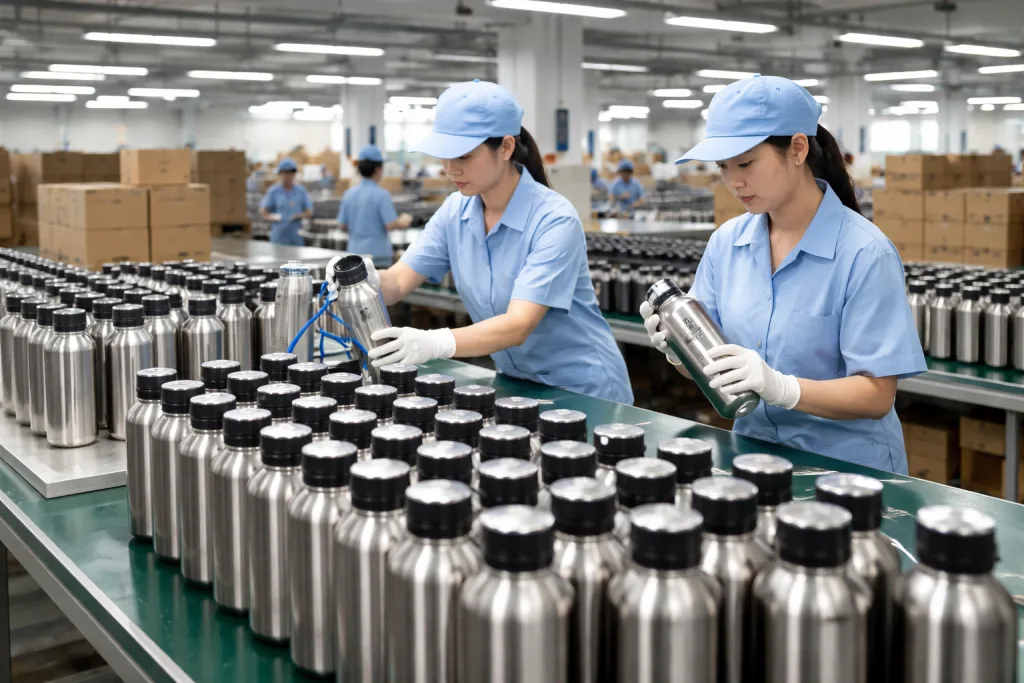
At BottleForge in Hangzhou, Zhejiang, we see the same failures on bulk thermos orders: weak vacuum retention, uneven finish, bad cap fit, and decoration that looks fine on a sample but falls apart in production. QC pulled the sample with a 0.2 mm paint ridge by the logo, and that ridge becomes a claim later. We had one PO with "24oz" typed as "240z"; the buyer flagged it before we shipped. If you buy from a thermos manufacturer in China, lock down material grade, wall thickness, vacuum leak rate, AQL, and packaging before the order hits the line. A spec does the work. China can make solid promotional thermos products, but only if you treat the flask as a controlled assembly, not a blank.
Start with the failure, not the flask
Buyers usually start with shape, color, and logo placement. Wrong order. We had a 2,000-piece PO bounce back after QC pulled the sample on a thread gauge: the lid cross-threaded after 40 open-close cycles, and the buyer flagged the carton seam, not the print. A promotional thermos needs to be spec'd from the failure points first, then the look. On the line, the weak spots are predictable: a vacuum seam that loses insulation after one hard hit, powder coat chipping at the rim, and a cap gasket going stiff in cold storage. Those misses cost more than the unit-price gap, especially in thermos bulk for outdoor retail.
The faster way to tighten the order is to lock the use case before the artwork. Is it a commuter bottle, a hiking flask, or a desk-side giveaway? A thermos promotional item for a trade show can run with a simpler cap and lighter carton; a distributor thermos for outdoor retail cannot. We've seen that go sideways. For America-focused programs, we tell buyers to pin down four controls on day one: 18/8 or 304 food-contact steel for the inner wall, minimum 0.4 mm body thickness, hot-hold target after 6 hours, and drop-test language tied to ASTM or an agreed internal method. We run these specs every week in Hangzhou. No guessing.
Practical baseline: 500 ml capacity, 304 inner / 201 outer, BPA-free lid, powder coat or painted finish, and a carton drop test from 60 cm. That is the starting point for promotional brands that want low returns and steady repeat orders. The math works.
Vacuum loss is usually a process issue
Vacuum insulation looks simple from the outside, but this is where a lot of thermos orders go off track. The shell can look clean and still fail because evacuation time was short, a seam got a weak weld, or dust sat on the sealing face before the cap went on. QC pulled one sample with a 0.3 mm seal mark last month, and it looked fine until the 10-day warehouse check. That is the wrong point to argue about finish. We ask for vacuum retention checks on every lot, not just the pre-production sample.
For a stainless thermos, the process points are welding consistency, annealing control, and seal quality. A factory that ships real volume should have leakage records and temperature-retention logs by lot. We run a 24-hour hot-water hold at ambient conditions, then check again at 6 hours. On a 500 ml promotional vacuum flask, one American buyer pushed for 60 C after 6 hours with 95 C water, then flagged the push-button lid because it bled more heat than the screw cap. The math does not work if you force one number across every lid.
Ask for these controls:
- Vacuum leak test or equivalent retention test on each production batch
- Documented hot-hold curve by capacity and lid style
- Drop test on full bottles, not empty shells
- Lot traceability for weld and seal issues
Lid design decides the complaint rate
If you want fewer returns, put the time into the lid before you worry about bottle art. The lid is where a promotional vacuum flask American buyer touches the product every day, and it is where abuse shows up first. We ran one lot with a 2.5 mm thread pitch mismatch, and QC pulled the sample when the cap bound on the line. Cheap caps fail in four places: sloppy thread pitch, a silicone gasket that is too soft or too hard, a button that sticks, or a vent path that leaks after temperature cycling. Those are retail defects, not cosmetics.
A custom thermos for outdoor retail should usually use a threaded lid with a replaceable silicone seal, or a two-piece lid with a locking button if ease of use matters more than maximum insulation. For hot-fill jobs, PP or Tritan lid parts need heat resistance that matches the use range. Ask your supplier thermos partner for gasket hardness in Shore A, not a loose “food-grade silicone” claim. A 50-60 Shore A gasket is common; too soft and it deforms, too hard and it stops sealing when torque shifts. We run open-close cycle testing, and 3,000 to 5,000 cycles is the number that keeps us honest. The buyer flagged one PO because the cap opened fine at room temp and leaked after a 24-hour heat soak. The math does not work.
Good thermos design is boring. If the lid works, the buyer stops thinking about the product. That is the point.
Decoration fails when curing is rushed
Most logo complaints start with process control, not artwork. We see it on the line every week. A custom thermos can pass packing QC and still lose print after 3 dishwasher cycles or one rough drop in a retail chain. For promotional brands, that is hard cost because the flask is the ad. When the logo flakes, the buyer flags it fast.
Laser engraving is the hardest option on a steel body because there is no ink layer to peel. Silkscreen still works when you need solid color and lower unit cost, but the cure window has to match the coating. On a powder-coated bottle, one bad prep pass kills adhesion fast. We had a 2,000 pcs job where the buyer blamed the artwork, then QC pulled the sample and found oil on the cup wall. This is the wrong question to ask: do not test the logo on a flat coupon. Test it on the actual coating, then run abrasion, dishwasher simulation if that claim is on the carton, and color match under daylight at the packing table.
For a custom thermos order in China, the usual choice is 1-color silk screen, UV print, laser engraving, or heat-transfer sleeve decoration. Laser often adds only USD 0.15-0.40 per piece, while multi-color print can add more depending on coverage. If the bottle is going into distributor thermos channels, I would take durability over graphics complexity every time. We ship plenty of 12 oz and 20 oz units where the buyer pushed for a busy logo, then came back after the first shipment and asked for the simple version. A logo that is still there after 18 months beats one that looks loud on day one.
Steel grade and thickness matter more than claims
There is plenty of lazy language in this category. We hear “premium stainless,” “double wall,” and “food safe” on nearly every RFQ, and none of it tells us what is on the mill cert. For a real thermos program, ask for the metal spec first: 304 inner wall, sometimes 201 outer wall for cost control, then the wall thickness that fits the bottle size. For most promotional vacuum flask American jobs, 0.35-0.45 mm is the working band. We run the line at 0.38 mm a lot. Go thinner and dents show up fast. Go thicker and the math does not work.
For outdoor retail, durability matters because the bottle takes backpack compression, drops, and cold hands on a truck tailgate. We have seen 12-day samples come back with a dented shoulder after a 1.2 m drop test, and the buyer flagged it right away. If the use case is field work, ask for a thicker shell or a textured powder coat that hides abrasion better. A custom thermos from a thermos factory in Zhejiang should also be checked for rim finish, neck concentricity, and weld consistency. QC pulled the sample on the V-block gauge, and that check says more about leak resistance than a brochure ever will.
Ask your thermos manufacturer for a material declaration and, where required, compliance documents like REACH or FDA food-contact support letters. We ship a lot of North America orders, and the weak point is usually the paperwork, not the bottle. One PO came in with “stainless stell” typed on it; that typo was harmless, but a missing declaration is not. This is the wrong question to ask: whether a supplier says “food safe.” Ask for the file, then read it line by line. For Europe, the same discipline applies on REACH and food-contact expectations.
MOQ, price, and lead time are linked
Buyers often ask for the “best price” before they lock capacity, finish, and decoration. That is the wrong question to ask. Price follows process load as much as steel. The bottle body is cheap; a custom lid, two print colors, or retail carton art pushes the number up fast. In our Zhejiang plant, we run about 200,000 units a month, but MOQ still moves by model and decoration. A stock shape starts at 1,000 pcs. A fully custom thermos with a new lid and printed carton often needs 3,000 pcs or more. QC pulled the sample at 1.2 mm wall thickness, and the buyer still tried to squeeze the MOQ down. It did not work.
For FOB China pricing, a plain promotional thermos usually lands around USD 4.20-6.50 on basic spec, while a build with extra tooling, color wrap, or special coating can hit USD 7.00-8.50 or more. Lead time after sample approval is usually 25-35 days for standard finishes. Molded parts or a special surface treatment stretch that to 40-50 days, and we have seen that gap kill a launch. A buyer once flagged a PO typo on the lid color code, and the line stopped for a full day. If your sales window is tight, do not ask for a full custom tool and expect it in two weeks. The math does not work.
When you compare thermos bulk quotes, put the same items on the table: capacity, steel grade, decoration method, carton count, master carton drop test, and whether the price is FOB Ningbo or FOB Shanghai. We ship a lot of quotes where one supplier is using 304 stainless and another is quoting vague “food grade” wording. That is not a clean comparison. Ask for the same cap gasket spec, the same box count, and the same carton test result. If one quote hides the packaging cost, you will feel it later when the buyer flags the balance sheet.
Quality control should match the claim
If you sell into outdoor or promo channels, QC has to show up in the paperwork. A pretty pre-production sample is not enough. We run golden sample approval, inline checks, and final inspection under AQL 2.5 for majors and 4.0 for minors on most drinkware jobs. On a 5,000-piece thermos order, that catches the misses before the buyer flags them.
For a customized thermos, major defects are plain: leakage, weak vacuum retention, missing parts, denting that breaks the wall, or a logo off position by 2 mm. Minor defects are lighter surface marks, packaging color drift, or print variation inside the agreed limit. Ask for pressure testing, cap torque checks, seal inspection, and a photo standard. QC pulled the sample on a line with a digital torque meter set at 0.8 N·m, and that is the level you want in writing. If you are shipping to Amazon or a big retail DC, check carton layout for FNSKU labels, barcode direction, and scannable outer packs. Basic work. It saves chargebacks.
A proper thermos process in China is not mysterious. It is disciplined. We ship better when the factory shows test records, not talk. If they cannot name the checkpoint, the gauge, and the fail limit, the math does not work. One PO typo on a logo position can turn into 12 days of rework versus 18 days of clean production if you catch it late. Ask for numbers, not promises.
Spec your thermos before you place the order
Send us your capacity, lid style, logo method, and target price. We will map the production risks and quote a factory-ready promotional thermos spec.
Frequently asked questions
What is a realistic MOQ for a promotional vacuum flask American buyers can order?
For a standard shape, 1,000 pcs is a realistic MOQ in many China factories. If you need custom lid parts, special finishes, or multi-color logo work, 3,000 pcs is more common. For fully customized tooling, the MOQ can go higher. The right number depends on whether you are buying stock thermos custom decoration or a true new build. A clean quotation should show MOQ by model, not a vague promise.
How much does a custom stainless thermos usually cost FOB China?
A basic promotional thermos usually sits around USD 4.20-6.50 FOB China, depending on capacity, coating, and decoration. Better lids, laser engraving, or premium packaging can push it to USD 7.00-8.50. If a quote is far below that, check the steel grade, wall thickness, and lid quality carefully. Cheap thermos suppliers often cut value in places you cannot see on the first sample.
What insulation performance should I ask for?
For a 500 ml stainless thermos with a standard screw lid, ask for a hot-hold target that keeps water above 60 C after 6 hours when filled at 95 C. If the lid is more complex, the number may be lower, and that is normal. Do not accept a generic “12-hour insulation” claim without test conditions. Ask for the fill temperature, ambient temperature, bottle size, and lid type used in testing.
Which logo method is best for promotional thermos orders?
Laser engraving is the most durable for a custom thermos because it does not rely on ink adhesion. Silkscreen is still good for color branding, but it needs better surface prep and curing control. UV print works when you need more detail, but it can be more sensitive to abrasion. For outdoor retailers, I usually recommend laser or a single-color print on a stable powder coat. That keeps defect risk low.
What compliance documents should a thermos manufacturer provide?
At minimum, ask for material declarations and relevant food-contact support. For Europe, REACH-related support is often needed. For the U.S., buyers may ask for FDA food-contact documentation or equivalent supplier statements. If your program uses packaging with barcodes or Amazon inbound labeling, confirm FNSKU readiness as well. A professional thermos factory in China should not treat paperwork as an afterthought; it should be part of the quotation.