Key Takeaways
- A workable promotional vacuum bottle Germany order usually starts at 1,000 units and 25-35 days lead time after sample sign-off.
- For outdoor retail, 18/8 stainless steel with 0.5 mm inner and outer wall is a sensible baseline for a custom thermos.
- Germany-bound shipments should be checked for REACH, food-contact declarations, and a real AQL 2.5 inspection plan.
- A branded thermos bulk program is easier to control when you lock lid type, print method, and carton spec before mass production.
You are not buying a mug with a logo. For a promotional vacuum bottle Germany program, you are buying a reusable item that has to survive transit, branding, customs, and daily use without leaking, denting, or looking cheap after two wash cycles. We had a buyer flag a 0.3 mm lid gap on a sample last month; that was the real issue, not the color. The stainless body, lid seal, coating, and print all have to line up on the same order.
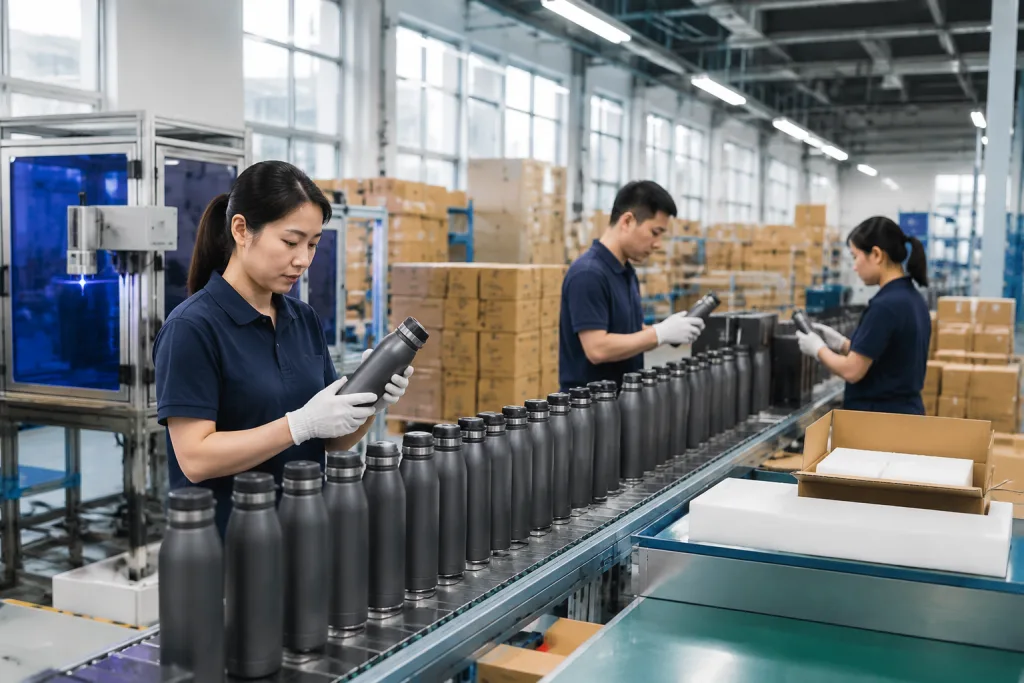
At BottleForge in Zhejiang, we run these projects as production, not decoration. A typical custom thermos run starts at 1,000 units, with 25 to 35 days of lead time after sample approval. QC pulled the sample at the torque tester, and the cap held 1.8 N·m without slipping. If you are an outdoor retailer or promotional brand in Germany, you need a thermos factory in China that knows REACH, drop resistance, and repeatable branding. The math does not work any other way.
Start with the use case
When a buyer says they need a promotional vacuum bottle Germany, I ask where it will live. A hiking shop in Bavaria needs a different bottle than a trade-show giveaway in Hamburg. We had one PO where the buyer wrote “camping” in the notes and “desk use” in the email; QC pulled the sample back and the lid failed a 1.2 m drop test. Simple point: start with use case, not artwork.
For outdoor retailers, 500 ml or 750 ml is the range we run. Under 500 ml, the shelf price gets squeezed. Over 750 ml, the bottle gets heavy and people leave it at home. We usually quote 18/8 stainless steel, double-wall vacuum structure, and 0.4 to 0.5 mm wall thickness; that is standard factory thermos work in Zhejiang, and the caliper needs to stay inside that band or the batch drifts.
Do not treat a promotional thermos like throwaway stock. A weak lid or soft coating brings returns, and returns eat the FOB win fast. We’ve seen this go sideways on a 3,000-piece order because the buyer wanted the cheapest cap and then flagged condensation on the carton line. Ask for the real use case: commute, school, retail shelf, or event giveaway. Then choose the lid. Screw cap, push-button lid, tea infuser, or plain sports cap. The wrong lid turns a thermos program into a complaint file.
Choose the right steel build
A custom thermos starts with the body. For Germany and the wider EU, 304 stainless steel is the answer we give first. It clears food-contact checks, welds clean on the line, and holds vacuum bottle performance without drama. We ran a 500 ml sample last month with 304, and QC pulled the neck weld under the light box at 10x magnification. If a buyer asks for 316 stainless, we build it, but the math only works when there is a real chemical or corrosion spec behind it.
The pitch matters less than the build. Vacuum gap, weld consistency, and coating adhesion decide whether the bottle ships clean or comes back with a dented margin. A proper custom thermos order uses laser or TIG welding with no heavy oxidation at the neck. We target 6 to 12 hours hot and 12 to 24 hours cold, depending on lid design and fill volume. One buyer flagged a quote that claimed 24-hour heat on a thin promo bottle, and they were right to push back. Ask for the test report. We run a drop test at 1 meter, too.
For customized thermos orders, I check three numbers early: outer diameter, wall gauge, and weight. A 500 ml bottle at 280 to 350 g is normal, depending on the lid and base. Below that, the metal is often too thin; above it, the bottle starts to feel clumsy on shelf. We had a PO last season with a typo on the weight column, and the line built the wrong spec until the buyer caught it. Zhejiang factories can run both entry and premium builds, but only if you state the target. Otherwise the thermos team takes the fastest mold path, and that is the wrong question to ask.
- Standard body: 18/8 stainless, 0.4-0.5 mm wall thickness
- Premium body: tighter weld polish, heavier base, better coating consistency
- Test point: lid leak test after 1 meter drop and inverted shake
Branding that survives use
Logo work is where a lot of thermos distributors make the wrong call. A promotional vacuum bottle Germany order is not about sticking a mark on the side and moving on. The real question is whether that mark survives abrasion, dishwasher talk, and the handling a bottle gets after 3 months in a sales kit. We run silkscreen on matte powder-coated bodies when the buyer wants strong color and a lower setup cost. Laser engraving gives a permanent mark, but it reads weaker on dark coatings. Pad printing works for small logos, though it wears faster at the grip and lid edge.
For outdoor retail, I push a one-color silkscreen or laser mark on the front. Wrap print only makes sense when the brand pays for the extra setup and QC time. On a 1,000-unit run, branding cost usually lands around USD 0.25 to 1.20 per bottle, depending on color count, logo size, and whether the buyer adds a second position. The math does not work any other way. We’ve seen buyers ask for full-wrap art on a 500 pcs MOQ, then complain when the print price eats the margin. That is the wrong question to ask.
Keep the imprint area honest. A 30 x 60 mm logo is enough for recognition. Push the artwork past that and it starts to crawl over curves and lose sharpness. We check ink adhesion with a cross-hatch tape test, and QC pulled the sample on a matte cup at 100 mm from the seam last week. The buyer flagged a PO typo on the logo width, and that saved a bad run before the line started. In China, the better thermos factory teams print on the actual coating, not just a paper proof. That part gets skipped at your cost.
Sample before you commit
Do not start mass production from a PDF. Get a physical sample first. For a logo job, ask for a pre-production sample with your artwork on it. QC pulled one cap last week that looked fine on screen but rocked 1.5 mm on the thread gauge, and that is the kind of miss that turns into a claim later. One bad sample is cheap. One wrong lid in a 5,000-piece run is not.
Our normal sample cycle for a customized thermos runs 5 to 7 days for a stock body, or 7 to 12 days if we need to adjust the mold, lid, or finish. Sample charges are often refunded against the first bulk order once you move forward. The buyer once pushed back on a USD 50 sample fee; the math does not work that way, because we are checking the part that gets copied 1,000 or 5,000 times on the line. We ship samples before the line starts, not after.
During sampling, we run a simple checklist:
- Leak test at room temperature and after hot fill
- Thermal retention check at 6 hours and 12 hours
- Logo placement and color match under daylight
- Carton fit with inner sleeve and drop protection
If you are buying thermos stock for distribution, use the sample stage to confirm barcode space, retail hangtag area, and whether your market needs FNSKU or a specific carton label format. We saw one PO with a barcode typo and a carton height of 318 mm instead of 310 mm, and that kind of slip is easier to fix before production than after the pallets reach the port. That is the wrong question to ask once goods are packed.
QC that keeps claims honest
This is the part most buyers skip until a carton opens in Hamburg and the claims fall apart. A thermos bulk order needs a real inspection plan, not a vague promise of “good quality.” We run AQL 2.5 for major defects and 4.0 for minor defects on appearance-led drinkware, with checks on leakage, vacuum loss, cap torque, and logo position within 1 mm. Ask for the QC sheet before the line starts. That is the right question.
For Germany-bound orders, the buyer should keep the compliance file ready: REACH statement for coatings and plastics, food-contact declaration, and the stainless steel material spec sheet. If the bottle includes silicone or PP parts, those components need their own declarations. A customs broker will ask. So will a retail buyer. We had one PO where the buyer flagged “sielicone” in the paperwork; that typo stalled the file for 2 days while the metal shop had already started engraving. A factory thermos supplier that cannot produce this paperwork is the wrong place to cut corners. The math does not work.
We check pressure leakage, vacuum performance, surface defects, and carton drop resistance. On a 1,000-unit batch, I expect pre-shipment inspection to pull samples from at least 80 cartons, depending on shipment size and risk profile. QC pulled the sample once and found three caps loose at 0.8 N·m, which is enough to trigger a complaint after a cold-chain run. If the order is for promotional thermos use only, we can allow a few cosmetic marks, but the seal and insulation stay fixed. A bottle that leaks once is failed stock, full stop.
Price and MOQ realities
Buyers ask for a promotional vacuum bottle Germany price like there is one fixed number on the line sheet. There is not. A plain 500 ml stainless custom thermos with one-color logo and a standard gift box usually sits around USD 2.40 to 3.60 FOB China at 1,000 units, depending on lid type, coating, and carton spec. Add a push-button lid, laser logo, or matte powder coat, and you can pass USD 4.00 fast. We run that math every week. The margin decides it.
MOQ comes down to the body, lid, and print setup. For stock molds, 1,000 units is a normal start. For a new color or a custom mold part, 3,000 units is more common. A 38 mm lid insert needs one more setup on the line, and that is where the cost sits. If a thermos supplier offers 300-unit pricing on a complex build, the buyer flagged it for a reason. Something is missing. Usually it is the decoration depth or the real test scope.
For buyers comparing bulk thermos options, do not chase the lowest piece price without checking packaging and freight. A bottle at USD 2.85 FOB with weak cartons can land worse than a USD 3.10 unit that stacks cleanly and survives European transit. We saw this go sideways on a 24-drop test: two outer cartons split, and QC pulled the sample because the inner tray was 2 mm too loose. This is the wrong question to ask. It is a commercial product, not a sample giveaway. The right thermos supplier protects landed cost, not just ex-factory cost.
Shipping into Germany cleanly
Once production is approved, logistics is where a clean order starts to slip. For a promotional thermos shipment into Germany, carton size, pallet height, and HS code accuracy matter more than first-time buyers think. We ran a 1,000-unit lot last quarter, and a 5 mm carton overhang was enough for the buyer’s warehouse to flag it at inbound. Ask for master carton drop tests. Print the marks in English, then add German only if the retailer asks for it.
FOB China is the clean pricing basis when the buyer already has a freight forwarder. If you need DDP, get the supplier to spell out VAT handling, last-mile delivery, and import clearance before the PO goes out. I still prefer FOB for an experienced buyer; the responsibility line stays clear. On our side, Ningbo and Shanghai ports move fast, but only if the file is complete: commercial invoice, packing list, form details, and exact carton count. One missing line slows China customs first, not Germany later. The math doesn't work any other way.
For retailer programs, pack by SKU. Don't mix by luck. If you need mixed colors, lock the ratio early, like 60 percent black, 30 percent silver, 10 percent white. We saw this go sideways when the buyer wrote “mix colors ok” on the PO and expected the line to guess. QC pulled the sample, checked the 5-layer master carton, and the order still needed a reset. Clean pallet loading starts with the box map. The bottle is only half the job.
What a good supplier looks like
A good thermos supplier is not the one that replies in five minutes. It is the one that sends a clean spec sheet, shuts down unsafe shortcuts, and ships order two and order three the same way. We run 300,000 units a month across our core stainless lines in Hangzhou, so the line is set for branding changes, carton swaps, and export timing without guesswork. QC pulled a 500 ml sample with a 0.8 mm wall yesterday. That is the bar.
When you vet manufacturers thermos candidates, ask for the paper first: REACH, food-contact files, exact MOQ for your lid and print combo, sample lead time in days, and the leakage test method. We had a buyer flag a PO typo on the cap color before the run started, and that saved a rework. A serious manufacturer thermos partner answers in numbers, not adjectives. The math does not work any other way for thermos distributors who need stable supply.
What you want is not a cheap bottle. You want a repeatable bottle that can be reordered in 90 days without redesigning the job.
That is the gap between a one-off thermos promotional campaign and a line that keeps moving. We saw this go sideways when the buyer tried to save 3 cents and ignored the lid gasket spec. China can do both, and Zhejiang does a lot of it well, but only if you treat the order like production, not a mood.
Send your thermos spec for a real quote
We can quote your logo, lid, carton, and compliance needs from China with clear MOQ, lead time, and FOB terms.
Frequently asked questions
What is the usual MOQ for a promotional vacuum bottle Germany order?
For a stock-body custom thermos with one-color logo, 1,000 units is the practical MOQ. If you change the lid, finish, or packaging, 3,000 units is more realistic. For a plain thermos custom project with no special molding, some Chinese factories in Zhejiang can work lower, but the unit price usually rises by 10 to 20 percent. A serious thermos supplier should tell you the MOQ by decoration method, not give one fake universal number.
How long does production take for a customized thermos?
A standard order usually takes 25 to 35 days after sample approval. If you need a new coating, special lid, or extra packaging insert, allow 35 to 45 days. Sample making usually takes 5 to 12 days depending on whether the body is stock or modified. For buyers in Germany, I would not promise retail launch dates until you have approved artwork, carton spec, and QC checklist in writing.
Which print method is best for a promotional thermos?
For most promotional thermos work, silkscreen is the best balance of cost and visibility at 1,000 units or more. Laser engraving is more durable and looks cleaner on dark powder coat, but it is less visible from a distance. Pad print works for small logos and curved areas, but it is less robust. If the bottle will be handled daily, I would avoid complex multi-color prints unless the brand budget clearly supports the extra setup and QC.
What compliance documents should I ask for when sourcing from China?
At minimum, ask for a food-contact declaration, REACH statement for coatings and plastic parts, and material specification for the stainless steel. If the thermos includes silicone or PP components, those need supporting documents too. For Germany shipments, your buyer or customs broker may also want carton labels, origin documents, and packing lists with exact quantities. A thermos manufacturer in China should be able to provide these without delay.
What FOB price should I expect for a bulk thermos run?
For a 500 ml stainless thermos bulk order at 1,000 units, a realistic FOB China range is about USD 2.40 to 3.60 for a standard build with one-color logo and basic box. Premium lids, laser engraving, or special coatings can move it above USD 4.00. Freight, duties, and inland handling are separate. If a quote is far below that range, check whether the supplier thermos offer excludes proper packaging or QC.