Key Takeaways
- A workable promotional vacuum bottle program usually starts at 1,000 pcs MOQ and 35-45 days lead time after sample approval.
- For retail-facing use, specify 304 stainless on the inner wall and at least 0.35 mm wall thickness where the structure allows it.
- Insulation claims should be backed by testing, such as 12-24 hour hot retention and 24-48 hour cold retention under ISO-style methods.
- Decoration failures are common: laser engraving is stable, while poor screen print setup can lose 10-20% of yield on curved bodies.
Six out of ten custom thermos programs we see hit the same wall. The buyer approves a glossy mockup, then QC pulls the sample six weeks later and finds the lid leaks at tilt, the print flakes off after 40 dishwasher cycles, and the vacuum reading barely holds 3 hours in a -5°C test. That is the real cost of a promotional vacuum bottle deutschland — not the unit price, but the rework, the air freight, the retailer chargeback.
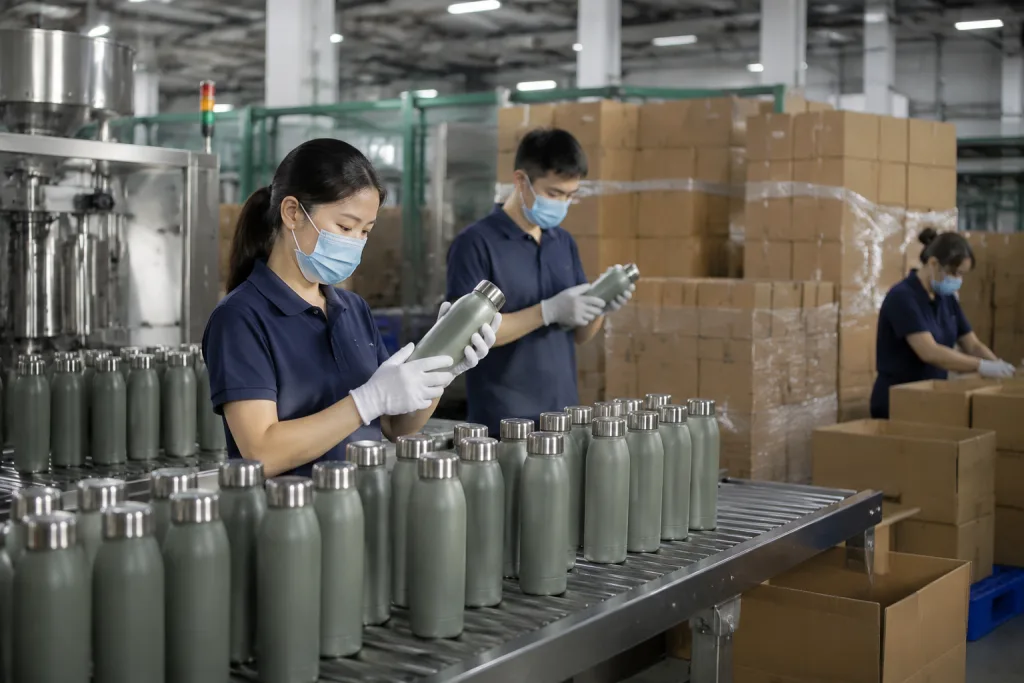
We run three vacuum test stations on the factory floor in Hangzhou. Every production lot gets a live reading: we reject anything below 10⁻³ Pa. The math is simple — if the vacuum fails, the bottle is a paperweight. Most buyers skip this spec because the supplier says "full vacuum insulation" on the sheet. Don't. Ask for the test protocol and the AQL 2.5 level on insulation hold time. That one question separates a promo thermos that builds a brand from a giveaway that builds a complaint log.
Where thermos programs break first
Ask for the cap CAD, the gasket material spec, and the vacuum seam position on the inner liner. Not the outer shell—the inner liner. If the factory won't share those three files, you're buying a decoration that happens to hold liquid, not a thermos. A German buyer flagged this at sample stage because the seam sat 4 mm too high and interfered with thread engagement. That was a 12,000-unit rework.
- Cap torque target: 0.8–1.5 N·m. Under 0.8 and the cap loosens in a gym bag. Over 1.5 and your end user can't open it one-handed. We test on a digital torque meter, not by feel.
- Leak test: 2 minutes inverted after thermal cycling. Fill at 95°C, cap it, chill to 5°C, then flip. The thermal shock is what exposes a bad gasket seat. We've caught leaks that passed a cold-water test but failed here.
- Carton compression: 5-layer export master carton, B-flute. A 3-layer carton saves $0.12 per unit and costs you a pallet of crushed boxes in Hamburg. QC pulled a carton last month that buckled at 380 kg. We rejected the lot.
These numbers aren't marketing copy. They're where 80% of promotional thermos programs bleed money before the product ever reaches the giveaway table.
Steel grade and wall thickness
Steel grade decides whether your promotional thermos survives year one. 304 stainless is the only safe choice for the inner wall. 201 steel belongs on the outer shell, and only when margin pressure forces the trade-off. Even then, put it in writing on the spec sheet. We watched a Hamburg buyer order 5000 pieces with a 201 inner liner — nothing mentioned in the PO. QC caught it at 800 units. The line stopped. Rework cost ate the profit.
Wall thickness gets slippery fast. A workable range is 0.35-0.45 mm for both inner liner and outer shell. Drop to 0.28 mm and you save three cents per unit. You also get denting in transit and vacuum failures at the neck weld. Last year a 0.28 mm inner wall pushed our QC reject rate to 4%. Too thick and the weight climbs. For a 500 ml bottle, 280-340 g finished weight is the sweet spot. Outdoor retailers handling a commuter line flag anything over 350 g as too heavy for a hike.
Ask suppliers for steel certificates. Verbal claims mean nothing. Zhejiang factories that export regularly keep traceable coil records and deliver paperwork in 48 hours. A general trading setup wastes two weeks chasing mill batch numbers. That is the difference between a quote you can use and one that drives you crazy.
- Inner steel: 304 preferred
- Wall thickness: 0.35-0.45 mm
- Volume tolerance: +/- 5%
- Weight tolerance: +/- 8%
Vacuum loss and insulation claims
Use one line in the PO that removes ambiguity:
“Test 500 ml sample at 95 C fill, 20 C ambient, closed cap, acceptable external surface after 6 hours: no sweating, retention target based on approved golden sample.”
We run this exact check on the line with a calibrated probe and a 500 ml flask, because “good insulation” is where buyers and factories talk past each other. The math does not work if the PO stays vague.
Logo methods that survive handling
Decoration is where a lot of promotional thermos orders lose margin. We have seen screen print look fine on day one, then chip after 3 dishwash cycles, rub in transit, or fade after a week of office handling. Laser engraving usually holds up better on a customizable thermos because it cuts into the surface instead of sitting on top of it. On coated bodies, powder coat plus laser reveal gives a crisp edge and is hard to scratch off. If the brand needs color, UV print can work, but we run it as a controlled process. Our line checks 0.2 mm registration, not by eye.
For a custom thermos sold into outdoor retail, the decoration has to match the use case. A travel-focused distributor order may need a polished stainless body with laser branding and a quiet look. A thermos promotional campaign for events may accept a larger print area and lower abrasion resistance if the bottle is short-lived. Asking one method to cover every channel is the wrong question. Last month, QC pulled a sample with a 1.5 mm logo shift, and the buyer flagged it on the spot.
Ask for abrasion testing, 50-100 dry rub cycles, and a tape adhesion check before packing. Ask where the logo sits against weld lines, seams, and curvature too. A logo crossing a shoulder radius prints rougher than one on a flatter section. We have seen that go sideways on a 500 ml body with a 42 mm shoulder radius. One PO came in with a typo on the logo size, and the buyer only caught it after pre-shipment photos. The better thermos suppliers in China call this out before sampling. In Zhejiang, the decent factories do. The weak ones say yes to everything and let the return rate explain the rest.
- Laser engraving: best for durability
- Screen print: best for cost on simple logos
- UV print: best for color complexity, but needs tighter QC
Lids, gaskets, and leak risk
- Hot-fill invert test: hold it cap-down on the bench for at least 2 minutes, then inspect the lid seam under the light
- Side leak test after carton vibration: no seepage at the gasket line, even after 30 minutes on the shaker table
- Cap cycle test: 500 cycles for promo, 5,000 for retail, using the torque wrench we keep at the packing station
We run these three checks before packing. Last week QC pulled a sample on the line, and the buyer flagged a loose cap after a 1.5 m drop; that is how a small PO typo turns into a claim, so this is the wrong question to ask after shipment.
Packaging for Germany and export
Packaging is where a good thermos turns into a bad buyer story. We have seen a 1.2 m pallet stack crush a lid ring because the carton wall was 4 mm, and the buyer flagged it on arrival. Germany-bound cartons need more compression strength than a lot of people expect, especially on rough lanes and double-stacked freight. A promotional vacuum bottle deutschland order should not ship like a cheap gift set. Use an inner box that protects the finish and a master carton that survives export handling without pressing the shoulder.
For FOB China pricing, packaging sits inside the cost. A plain white box, insert, and export master carton may add USD 0.20-0.45 per unit, while a printed box can add USD 0.60-1.20 depending on board and finish. The math matters. On one Amazon run, QC pulled the sample because the FNSKU panel sat under tape and the barcode scanner read only 92%. If the client uses FNSKU labels for retail intake, keep the label panel flat and leave space for shrink film and tape.
Ask your thermos supplier for carton specs in CBM, gross weight, and master carton count. We run 24-48 pcs per carton on a clean export setup, and 500 ml bottles need a layout that does not waste air. A box that is 8 mm too wide costs more in ocean freight and warehouse space; one that is too tight gives you dents and scuffed paint. This is the wrong question to ask if someone says “can we make it look nicer” without giving the stacking target. Put the spec in writing.
For outdoor retail, I prefer packaging that can handle shelf abuse and returns without looking cheap. For promo campaigns, I prefer packaging that keeps the bottle safe and simple. Choose one goal, then write it down. We had a PO last month with “master ctn” typed as “mastar carton,” and the line held the file until the buyer confirmed the pack-out. Clean instructions save time.
MOQ, price, and lead time reality
Buyers often ask for a thermos price before the spec is fixed. That is the wrong question. We run the quote after body finish, cap type, logo method, and carton style are locked. For a 500 ml stainless promotional thermos from a China factory, FOB usually sits at USD 3.20-4.80 at 1,000 pcs. A cleaner insulated bottle with a premium cap, laser logo, and color box lands around USD 4.90-7.20. Factory numbers only. Not retail stickers.
MOQ moves with tooling and decoration. A standard body shape may start at 500-1,000 pcs, while a fully custom thermos shape often starts at 3,000 pcs because the forming die and lid tooling both change. Lead time is usually 35-45 days after sample approval for standard builds, and 50-60 days for new mold or special coating programs. QC pulled the sample on a 0.8 mm wall, found a lid gap at 1.2 mm, and the buyer flagged it the same day. If a vendor offers 15 days at low volume, the math does not work.
Our Hangzhou site runs around 180,000 units per month across stainless drinkware lines. That gives a clean read on what an export-ready thermos line should look like: stable output, enough assembly hands, and space for pre-shipment inspection. We had one PO with a typo on the carton mark, and the buyer caught it before booking. A plant can quote that volume all day; the real check is whether your order sits on the line that actually ships at that rate.
Compare suppliers on FOB terms, sample charge, mold fee if any, and whether AQL 2.5/4.0 is used for final inspection. Ask for the commercial sheet in writing. A low unit price without those lines is just noise.
Spec your next thermos order the hard way
Send the bottle size, cap type, logo method, and target price. We will turn that into a production-ready custom thermos spec for China or Germany.
Frequently asked questions
What is a realistic MOQ for a promotional vacuum bottle deutschland order?
For standard shapes, 500-1,000 pcs is common. For a fully customized thermos with new tooling or a special cap, 3,000 pcs is more realistic. If you need multiple SKUs, ask the supplier to split MOQ by body color or logo method. A serious factory thermos line in Zhejiang will usually quote lead time from sample approval, not from deposit date.
Which decoration method lasts best on a stainless thermos?
Laser engraving is the most durable on a custom thermos because the mark is part of the finish rather than sitting on top of it. On powder-coated bodies, laser reveal holds up well to abrasion. Screen print is cheaper but can chip after repeated handling or washing. For promotional thermos programs, I usually push laser for retail, and screen print only when the budget is tight and the wear expectation is low.
How do I test for leaks before shipment?
Use hot fill, invert the bottle for at least 2 minutes, then repeat after a thermal cycle. For a distributor thermos order, add a vibration or carton shake test on random packed units. If you are running AQL, inspect closures at AQL 2.5 and critical leakage points at a tighter internal rule. The lid and gasket are the main leak sources, not the vacuum wall itself.
What stainless steel should I specify for a custom thermos?
304 stainless is the normal choice for the inner wall of a promotional thermos. It gives you better corrosion resistance and a safer marketing story than mixed-grade builds. Wall thickness around 0.35-0.45 mm is workable for most 350-750 ml sizes, depending on geometry. If a supplier offers a lower price using 201 everywhere, ask exactly which parts are 201 and whether that affects food-contact confidence.
Can I ship these to Germany with retail labels already applied?
Yes. If your program needs Amazon or retail distribution, ask for FNSKU, EAN, or barcode placement early. The label panel should be flat, and the carton format should accept your warehouse flow. A thermos manufacturer that handles export regularly can pack 24-48 pcs per master carton, apply shelf labels, and still keep carton compression strong enough for pallet stacking.