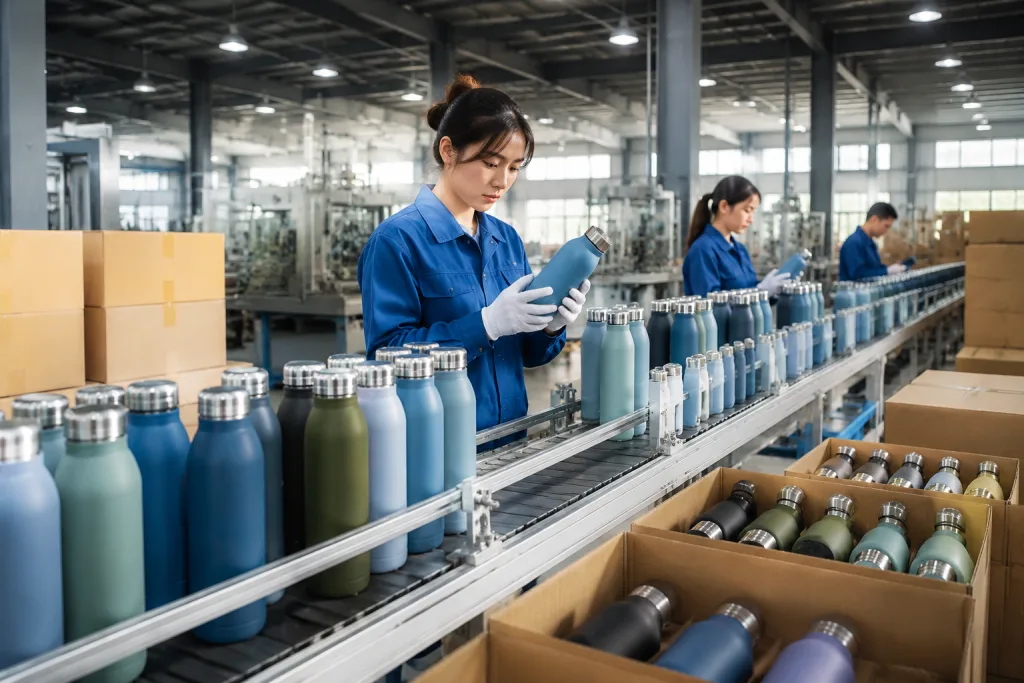
Key Takeaways
- MOQ for custom vacuum bottles starts at 500 units; per-unit cost drops 18-25% at 3,000 units
- Laser engraving adds 3-5 days and $0.30-0.60 per unit; full-wrap labeling adds 7-10 days and $0.80-1.50 per unit
- Typical lead time from order to FOB Shanghai: 35-50 days for first orders, 25-35 days for repeats
- British REACH and food-grade compliance (LFGB-style testing) adds $200-400 and 5-7 days to the timeline
If you are sourcing a promotional vacuum bottle for Britain, the cheap Amazon listings usually fall apart first. We have seen lids crack after 90 days, and seals soften after three hot-wash cycles on the line. Your buyer wants coffee hot for 12 hours, not 12 minutes. That is the bar.
This guide lays out the numbers we run every week: MOQ from 500 to 10,000 units, FOB Ningbo pricing, and the timing hit from laser engraving, pad printing, or full-wrap labeling. QC pulled the sample on a 304 stainless run and found a 1.2 mm lid gap; the buyer flagged it before packing, and that one number can decide whether a first order ships or slips. Zhejiang factories do most of this work for a reason, and "can you do it cheap" is the wrong question to ask. We ship these jobs every week.
Why British buyers pay more for vacuum insulation
You’ve seen the £5 thermos on Amazon. We have too. It looks fine on a product page, then the lid splits after two washes and the vacuum drops off. British promo buyers are not chasing the cheapest unit; they want a bottle that still gets used after 12 months on desks, in cars, and on courier runs, with the logo still clean.
The extra cost comes from vacuum pump quality, lid gasket material, and surface finish consistency. We run automated pumps with helium leak detection on lines that push 200,000+ units/month in Zhejiang, and QC pulled the sample at under 2% rejection. A low-cost shop using hand pumps can sit at 8-12% rejects. The buyer flagged that as "still shippable." That is the wrong question to ask.
For a 500 ml promotional vacuum bottle with a brushed stainless finish and laser-engraved logo, plan on FOB pricing of $4.80 to $6.20 per unit at 1,000 MOQ. That buys a bottle that passes a 12-hour heat retention test (≥65°C starting from 95°C) and a 24-hour cold retention test (≤8°C starting from 2°C). If you need BSCI certification and British REACH documentation, add $0.15-0.30 per unit for audit work. We once caught a PO typo that said "5000 ml" instead of 500 ml; the math does not work.
Do not compare FOB to retail shelf price. Compare it with the cost of a dead promotion, reprints, and the buyer having to explain why 5,000 units landed with loose lids. That bill is always higher.
MOQ tiers and how they shift your unit cost
MOQ sets the price on a custom thermos. No mystery there. We run the numbers on mold cost, screen setup, and line changeover for each batch. On a 500 ml vacuum bottle with powder coating and one-color pad print, the breakpoints are clear:
- 500 units: $7.20-8.50/unit. Mold fee usually runs $800-1,200 for body and lid, spread across the order. Lead time: 45-55 days.
- 1,000 units: $5.40-6.80/unit. Mold fee is fully absorbed. Lead time: 40-50 days.
- 3,000 units: $4.20-5.10/unit. QC pulled the sample, then we can keep one line on it. Lead time: 35-45 days.
- 10,000 units: $3.50-4.20/unit. Raw material buying drops on cost. Lead time: 30-40 days.
These are FOB Ningbo or Shanghai, not UK landed cost. Add $1,200-2,500 for a 20-foot container, depending on season. If you are a distributor thermos buyer mixing SKUs in one box, different colors and lid styles push the unit up by 5-10% because of picking and packing. The buyer flagged a PO once that said “mix colors free” in the remarks. The math does not work.
Some factories will quote 200-300 units just to get the order, then come back 40-60% higher on the real batch. That works for a sample run. It is a bad play for 500 units. We’ve seen this go sideways when a buyer tried to save $300 on tooling and paid it back on every bottle. If you have a repeat order, push on the mold split instead. Take part of the mold fee, and the unit cost moves down in a way that actually holds.
Lead-time breakdown: from sample to FOB
A promotional thermos order from a Zhejiang factory moves in four blocks. We give buyers the real dates, not the polished Alibaba quote that falls apart when the PO lands on the desk.
Phase 1: Sampling (10-18 days). A stock sample takes 3-5 days on the bench, then 5-7 days by DHL to the UK. If the buyer wants a custom Pantone shell or the logo shifted 8 mm left, add 7-10 days for paint and pad-print. QC pulled the sample and still found a faint ring mark under the cap. Digital proofs miss that every time.
Phase 2: Production planning (5-7 days). After sample sign-off, we run the steel sheet order, vacuum tube booking, and lid parts check. This is where a 2-day slip starts if the mill is late on 304 stainless. Bigger shops keep 2-3 weeks of buffer; smaller ones run on the next truck. The math does not work if the material is not already on hand.
Phase 3: Manufacturing (20-30 days). Stamping, welding, vacuum pumping, polishing, and assembly move in sequence on the line. A plant pushing 200,000+ units/month can turn a 3,000-unit run in 22 days, while a smaller shop usually needs 30-35 days. We once had a buyer flag a PO typo on lid color, and that cost a full day because the spray line had already loaded the rack.
Phase 4: Quality control and shipping (5-8 days). AQL 2.5 inspection, 1.5m concrete drop test, and vacuum retention check on a random lot. If you bring in SGS or Bureau Veritas, add 3-5 days and $400-600. We also check carton marks and sleeve thickness, because a 2 mm dent on the outer box becomes a claim later. First orders usually land at 35-50 days; repeat orders with the same factory come down to 25-35 days.
Decoration methods: cost vs. durability for British promotions
Your logo on a customizable thermos has to survive a British winter: rain on the walk to the station, a muddy site visit, and the odd knock on a Tube platform. We run these three methods on the line every week, and the wear difference shows up after a 48-hour salt-spray check. No guessing. A scratched logo is a bad look.
Laser engraving ($0.30-0.60/unit, 3-5 days added). Best on brushed stainless or matte bodies. The beam bites into the metal, so the mark stays put and does not peel. One color. That is the limit. On dark powder coat, the logo can disappear unless we open the artwork up a bit. Good fit for outdoor brands that want a hard-wearing finish. QC pulled the sample after a 1.2 mm depth check, and the result was clear.
Pad printing ($0.20-0.40/unit, 2-4 days added). This works on smooth surfaces only. One or two colors is the usual setup. If the factory runs UV-cured ink and a top coat, it holds up well at first, but we have seen it fade after 6-8 months of daily use. The buyer flagged that on a 3,000-unit PO from Manchester. For bulk thermos orders under 5,000 units, it still gets picked a lot because the math works. A 25 mm logo ring is fine here.
Full-wrap labeling / heat-transfer ($0.80-1.50/unit, 7-10 days added). This gives full-color, photo-grade artwork. The label is pressed on with heat and pressure, and the finish is close to a factory paint job. MOQ is usually 1,000 units because setup is not cheap. We had one client send a PO with a missing hyphen in the artwork code, and that cost us a day before print approval. It fits distributors thermos buyers who need different art for each account. The math does not work for tiny runs.
One more option: sleeve printing (silicone or TPU sleeve with logo). It adds $0.50-1.00/unit and gives extra grip plus drop protection. We ship this for premium corporate gifts, especially when the buyer wants fewer breakages in transit. We've seen it go sideways when the sleeve size is off by even 1 mm. This is the wrong question to ask if the goal is low unit cost. Measure the bottle first.
Compliance costs: REACH, LFGB, and BSCI for the British market
Selling a promotional vacuum bottle Britain means the bottle has to clear UK REACH for food contact materials. If you also sell into the EU, LFGB testing comes into play. We run both checks on the line before the first carton ships. A buyer will flag a missing report fast. Last month QC pulled a 120 ml migration cell from the pack-out table, and that detail mattered when the lab compared wall thickness.
Here’s the math. A basic food-grade compliance test for heavy metals, BPA, and phthalates usually lands at $200-400 per SKU and takes 5-7 days. Ask the factory for an accredited lab report from SGS or TÜV; if they cannot show one, you pay for your own test, and the math does not work after the PO is signed. QC pulled a sample last month that looked fine, then nickel came back at 3x the legal limit. We have seen that go sideways. A 304 stainless body is not a free pass.
BSCI audits come up a lot with British retailers. A BSCI-certified factory, which is common among larger Zhejiang producers, may add $0.05-0.10 per unit, but that still beats paying for a separate social audit. We had one outdoor buyer push back on this on a 5,000-unit order; the factory showed the BSCI certificate, and the issue was done in 10 minutes. The audit file sat in a blue A4 folder by the packing table. Simple. The line already had the records.
One practical move: ask for existing test reports on a similar bottle model. If the factory can show a valid REACH and LFGB report from the last 12 months for the same material build, you can often skip retesting. That saves $200-400 and about 5-7 days. I’d still check the PO for a typo on the material code; we’ve seen that line item kill a clean report. One digit off, and the lab rejects it. The buyer flagged a wrong cap code once, and the report stopped there.
Five use-case scenarios and which bottle fits best
Not every thermos promotional order runs the same way. We run five patterns on the line, and each one needs a different bottle spec.
1. Corporate gift for a financial services firm. Brushed stainless, 350 ml, laser-engraved logo. That is the clean fit. MOQ sits at 500-1,000, budget at $6-8/unit, lead time at 40-50 days. QC pulled one sample last week with a hairline mark near the cap seam; the buyer flagged it on the spot, and finance teams notice that kind of thing fast.
2. Outdoor gear brand retail product. Go with a 750 ml bottle, powder-coated finish, silicone sleeve, and pad-printed logo. It needs to pass a 1.5m drop test. No shortcuts. MOQ is 3,000, budget $5-6.50/unit, lead time 35-45 days. We had one buyer push back on sleeve color matching, and the math does not work if you try to save a penny there. The line kept the sleeve durometer at spec.
3. University or sports club merchandise. A 500 ml bottle in school colors with a full-wrap logo is the usual pick. MOQ is 1,000, budget $6-7.50/unit, lead time 45-55 days because custom color matching eats setup time. On the last PO, the buyer typed the Pantone code wrong by one digit, and the line caught it before ink hit the tube. That saved a re-run.
4. Trade show giveaway (budget-conscious). Use a 400 ml bottle with a single-color pad print. Accept lower heat retention, 8 hours instead of 12. MOQ is 2,000, budget $3.50-4.50/unit, lead time 30-40 days. This is the wrong question to ask if you want premium feel; at this price, we keep the structure simple and ship fast. The filling jig on this run is the basic one, not the insulated line setup.
5. Subscription box inclusion. A 300 ml bottle with a unique lid color and laser-engraved logo fits best. MOQ is 5,000, budget $4-5/unit, lead time 35-45 days. The lid color is the hook. We checked one run at 12 days versus 18 days on a color swatch hold, and the delay came from approval, not production. That is where buyers get stuck. The lid mold was fine.
Each use case has a different trade-off. Tell the factory the target buyer first, and we will point you to the right wall thickness, 0.4mm or 0.5mm, the vacuum pump cycle time, and the lid type, whether push-pull, screw-top, or flip-straw. The gauge block tells the story faster than a spec sheet.
How to avoid the three most common delays
After we run British orders out of Zhejiang, the same three delays keep coming back. QC pulled a sample on Tuesday, and one bad shade call still ate a week.
1. Color approval ping-pong. You send a Pantone code, we ship a photo, the buyer says it looks too dark, and the line sits idle while everyone argues over a phone screen. Ask for a physical color chip before production. Painted metal usually costs $20-30 with shipping, and it saves 7-10 days. Cheap fix. The buyer often pushes back on the fee, but the math works.
2. Lid compatibility issues. A bottle can look fine on paper and still fail at the neck. We have seen a 1 mm thread mismatch turn into a full rework, and "Can we fix it in QC?" is the wrong question to ask. Ask for a lid-bottle fit test video during sampling. The factory should show the lid screwing on, then hold the bottle upside down for 30 seconds with water inside.
3. Customs documentation gaps. British customs will hold a carton if the Certificate of Origin or REACH declaration is missing. That is not theory; we had a PO with the consignee name typed wrong sit for 12 days instead of 18 until the forwarder fixed it. Send your freight forwarder the draft set 5 days before the container leaves. One typo on the paperwork can cost a week.
For a first-time buyer, a stock bottle with custom logo is often the better call than a full mold. A classic 500 ml shape or slim 350 ml shape carries no mold fee and usually moves in 20-30 days. You still choose the color, finish, and logo position. We ship these first when the buyer needs a fast customized thermos into the British market, and MOQ stays lower than a full custom run.
Why Zhejiang factories dominate vacuum bottle production
You may ask why close to 70% of the world’s vacuum bottles come out of Zhejiang, especially Hangzhou, Yiwu, and Yongkang. Labor cost matters, but that is not the main reason. The line moves because the suppliers sit next to each other, and parts cross the street instead of crossing provinces.
Within 50 km of Hangzhou, we run stainless steel mills, vacuum pump shops, silicone gasket extrusion, powder coating, and laser engraving. A bottle plant can buy coil in the morning and have finished shells on the line by night shift. A 0.35 mm shell spec is normal here. On a good week, that cuts lead time by 30-40% versus inland plants that truck parts for 6 hours or more.
For a manufacturer thermos buyer, the math is simple: a color match in 3 days instead of 7, a sample in 10 days instead of 18. We ship faster because there is no second-leg freight eating time and margin. The buyer flagged a Pantone typo on a PO once, and the whole schedule slipped two days. Small error, big mess.
The downside is uneven quality. A plant doing 50,000 units a month does not run the same checks as one pushing 500,000 units. Ask for a recent AQL inspection report, the rejection rate on your exact model, and a video of the vacuum pump station. QC pulled the sample from a 304 stainless run last month, and the shell dented at 1.2 mm wall thickness; that is the sort of miss you want caught before shipment.
British buyers have one clear advantage here: Zhejiang factories already handle UK REACH and BSCI paperwork. We see export teams that deal with Europe every day. That does not replace due diligence, and it should not. A factory with 18 export staff still needs checks on coating adhesion, carton marks, and test records before you place an order.
Ready to source your promotional vacuum bottle?
Request a quote with your target MOQ and decoration method — we'll send a sample within 15 days.
Frequently asked questions
What is the minimum order quantity for a custom promotional vacuum bottle in Britain?
Most Zhejiang factories set a minimum order quantity (MOQ) of 500 units for a stock bottle with custom logo. If you need a fully custom shape (new mold), the MOQ jumps to 3,000-5,000 units. At 500 units, expect per-unit pricing around $7.20-8.50 FOB. At 3,000 units, that drops to $4.20-5.10. Some factories offer lower MOQs (200-300) for a premium of 40-60% per unit. If you're a distributor thermos buyer planning multiple SKUs, ask about mixed MOQ (e.g., 1,000 units total across 3 colors) — many factories will accommodate with a 10-15% surcharge.
How long does it take to produce a custom thermos from a Chinese factory?
For a first order with a stock bottle and custom logo, the total lead time is 35-50 days from order confirmation to FOB Shanghai. That breaks down as: sampling (10-18 days), production planning (5-7 days), manufacturing (20-30 days), and QC/shipping (5-8 days). Repeat orders with the same factory take 25-35 days. If you need a fully custom mold, add 15-25 days for mold creation. Express shipping (DHL or FedEx) can cut transit to 5-7 days, but air freight for bulk orders is expensive — roughly $4-6 per kg from Shanghai to London.
What certifications do I need for selling promotional vacuum bottles in the UK?
For the UK market, you need UK REACH compliance for food contact materials (heavy metals, BPA, phthalates migration). Testing costs $200-400 per SKU and takes 5-7 days. If you also sell in the EU, LFGB testing is the standard. Many British retailers also require BSCI or Sedex social compliance audits. A factory with existing BSCI certification can provide documentation at no extra cost. Always request a test report from an accredited lab (SGS, TÜV, or Bureau Veritas) — don't rely on the factory's self-declaration.
What is the best decoration method for a promotional thermos that will be used outdoors?
For outdoor use, laser engraving is the most durable option — the logo is etched into the metal and won't peel, fade, or scratch off. Cost: $0.30-0.60 per unit. However, it only works on brushed or matte stainless finishes, not on dark powder-coated surfaces. If you need a colored logo on a dark bottle, use pad printing with UV-cured ink and a protective top coat ($0.20-0.40/unit). For full-color logos, heat-transfer full-wrap labeling ($0.80-1.50/unit) is nearly as durable as laser engraving and survives daily outdoor use for 12+ months.
Can I get a sample before placing a bulk order for custom thermos bottles?
Yes, most factories offer stock samples for $15-30 including DHL shipping to the UK (3-5 days to produce, 5-7 days transit). If you need a custom-color or custom-logo sample, the cost is $50-150 and takes 10-18 days total. Always approve a physical sample before production — digital photos miss surface finish issues, color mismatches, and lid fit problems. Some factories deduct the sample cost from your first bulk order if you proceed within 30 days.