Key Takeaways
- Most promotional vacuum bottle america programs land at MOQ 1,000-3,000 pcs and FOB USD 3.20-8.90 depending on steel grade, lid, and print method.
- 304 stainless with a 0.5 mm wall is the common baseline; 316 inside adds corrosion resistance but usually adds 8%-15% to unit cost.
- Laser engraving is best for durability; silkscreen or pad print is cheaper for 1-3 spot colors, typically saving USD 0.18-0.55 per unit.
- A serious thermos factory in Zhejiang can hold 80,000-150,000 units/month, with typical lead time 25-35 days after sample approval.
A promotional vacuum bottle america program is not a simple merch buy. That is the wrong question to ask. We have seen a lid miss at 1.5 mm tolerance, coating peel after 12 days in salt spray, and a logo pass on 200 units before it started cracking on 20,000. For outdoor retailers and promo brands, the real job is holding landed cost, keeping the carry feel, and avoiding a freight headache.
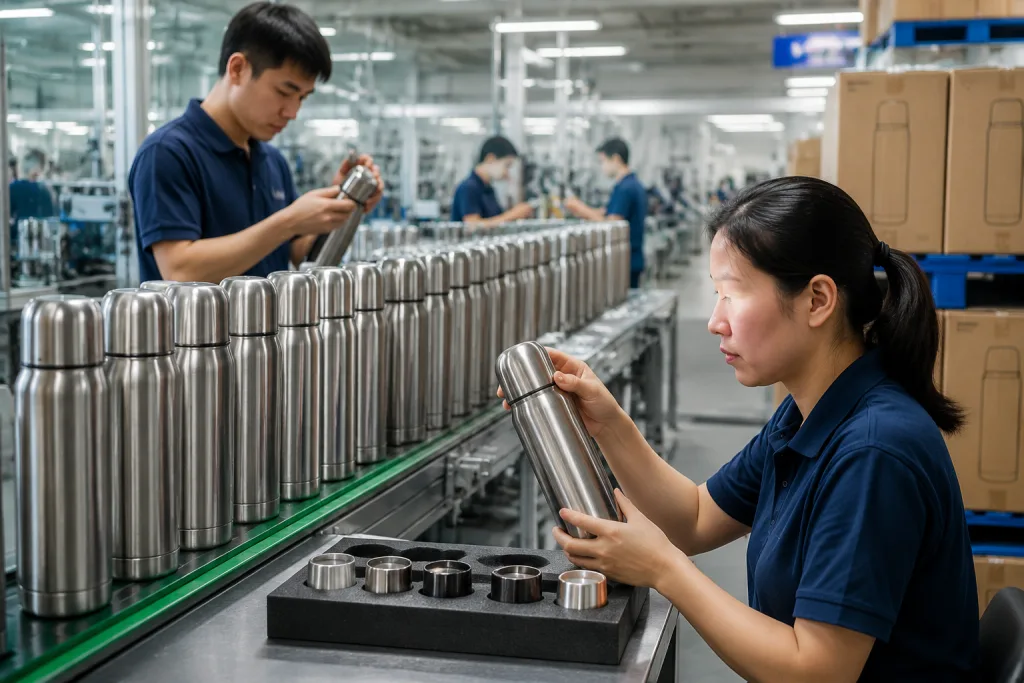
We build these in China and ship from Zhejiang every week, so the line tells you fast. A 500 ml double-wall bottle with 0.5 mm 304 inner and outer shells runs differently from a 750 ml powder-coated bottle with a bamboo cap, and QC pulled the sample before we signed off on the neck ring. Buyers who know the business define the use case first, then lock the spec. We’ve seen it go sideways on a PO typo that changed the cap finish. Clear requirements beat a catalog every time.
Start with the use case
Before you talk lid style or print method, pin down where the bottle gets used. A promo thermos for a golf outing, a campus handout, and a reseller pack for outdoor retail do three different jobs, even if all three use double-wall stainless steel. The use case sets the size, lid, and price ceiling. We ran this on the line with 316 samples once, and the buyer flagged the wrong question right away.
If your buyer wants an everyday carry, 500-600 ml is the clean range. For outdoor retail, 750 ml to 1 L moves better because it feels like a real tool, not a throwaway gift. For promo runs, the bottle that fits a car cup holder and holds hot water for 8-12 hours or cold water for 18-24 hours usually wins. Those hours beat a glossy sample photo every time. QC pulled the sample, checked the 68 mm mouth, and that was the end of the debate.
Ask it straight: are you selling utility or impressions? If you are buying thermos promotional stock for trade shows, a lighter body, lower MOQ, and a plain lid keep the math in line. If you are sourcing distributor thermos inventory for retail, finish consistency, scratch resistance, and a repeat order plan matter more. We have seen this go sideways when a PO typo changed the lid code, so we keep the body mold fixed and swap lid options instead. That saves weeks.
Pick the steel and wall spec
Most buyers start with the steel grade. That is where claim risk lives. For a promotional vacuum bottle america order, 304 stainless is the standard, and we run it on the line every week. It stamps cleanly, clears most import checks, and gives the buyer a simple answer when the spec sheet gets pulled apart. For salt spray, acidic drinks, or beach use, 316 on the inner wall holds up better. QC pulled a sample last month and the buyer flagged tea staining on a low-grade inner wall. Saving $0.08 there is the wrong question.
Wall thickness is where new buyers get burned. 0.5 mm on the inner and outer wall is the usual spec. Go thinner and the bottle dents, the vacuum suffers, and the hand feel drops fast. Go thicker and you add weight and cost without moving sales. A 500 ml bottle at 0.5 mm usually lands around 260-330 g, depending on the lid. We check that on a digital scale at packing. One PO came in with “0.05 mm” typed by mistake. The math does not work.
- 304 inner + 304 outer: the safest standard for bulk thermos programs, with fewer surprises in transit and QC
- 304 inner + 201 outer: lower cost, but it dents easier on the carton drop test and looks weaker at retail
- 316 inner upgrade: the better call for premium custom thermos lines that face acidic drinks or coastal use
If a thermos quote looks too cheap, check the steel grade and wall thickness first. We have seen POs with “304/201” swapped in the same file, and we have seen quotes built on a 0.4 mm wall while the sample was 0.5 mm. The buyer flagged that fast. In Zhejiang, that usually means the quote was built on paper, not on a production sheet you can ship.
Choose the right lid
The lid is where a lot of custom thermos jobs go sideways. The body can pass, then QC pulls the sample and the cap leaks in transit or the sip feel comes off cheap. Choose the lid by use case, not by the render on page 3.
For promo work, a screw-on leakproof lid with a simple carry loop is the clean pick. For retail or outdoor use, a flip lid or one-touch sip lid moves better, but it adds parts, more assembly minutes on the line, and more failure points. We had a buyer flag a bamboo cap after 3 wash cycles because the finish looked nice and the math still did not work. If the order will see dishwashers or rough travel, a bamboo lid is the wrong question to ask.
We run inverted leak tests for 24 hours at room temperature, then repeat after hot-fill shock testing. If a thermos supplier cannot show that protocol, walk away. A solid shop in China will also check lid torque and gasket fit across the first 500 pieces, not just the approved sample. One PO typo on the lid spec can turn into a 2 mm gap, and we have seen that go sideways fast.
For promo orders, the lid drives complaints more than the bottle body does.
Decoration that survives handling
Decoration is where a promo bottle gets kept or tossed. We run silkscreen, laser, and UV on the same line, and the fixture gap sits at 0.3-0.5 mm; if the jig drifts, the logo walks and the buyer flags it on first sample. For a short-run thermos with one color, silkscreen is usually the cheapest. If the mark has to survive a gym bag, desk drawer, or truck tray, laser engraving is the better call. Powder-coated bodies give a solid base, but print adhesion still comes down to surface prep and cure time.
The wrong question is, "What is the fanciest decoration?" The math doesn't work that way. On matte black or navy, a clean one-color silkscreen can look tighter than a busy multi-color print, and QC pulled the sample last week because the second color sat 1.2 mm off center. Laser engraving suits outdoor retailers because it does not peel and it holds up after repeated handling. Pad print works on curved shoulders or small panels, though we do not push it for large artwork; the image breaks up fast. We've seen that go sideways on a 500-piece order.
Typical decoration costs in China are simple enough. Silkscreen may add USD 0.18-0.35 per unit, laser engraving USD 0.25-0.55, and full-color UV print more when the art has tight gradients or tiny text. For thermos custom quotes, ask whether artwork setup, fixture fees, and Pantone matching are already in the price. We had a PO typo turn "navy" into "Navy Blue 19-4052" on the paperwork, then the buyer spent two days untangling it. A supplier that hides those items usually creates a mess later.
- Silkscreen: best for 1-3 colors and sharp bulk thermos pricing
- Laser engraving: best for durable premium branding
- UV print: best for detailed graphics, but more sensitive to abrasion
Price is a spec, not a number
Buyers ask for price first because it is the easiest line to type into an email, but price only means something after the spec is locked. On a promotional vacuum bottle america run at 1,000 pcs, a basic 500 ml 304 stainless bottle with a simple screw lid and one-color print usually lands around FOB USD 3.20-4.60. We shipped one lot with a 0.35 mm logo shift, and the buyer flagged it before packing. Move to a powder-coated surface, upgraded lid, and laser logo, and you are often in the USD 4.80-6.80 range. Premium vacuum bottles with 316 inner walls or gift-style packaging can go above USD 8.00. The math is plain. The PO typo that hurts is the one that forgets the lid spec and expects the same price.
The trap is chasing a low unit price by stripping out the parts the customer will touch. A thermos distributor will take a slightly higher FOB if the carton burst strength is better, the logo sits in the same spot every time, and the lid passes a leak test at 48 hours. Retail buyers pay for clean finishes and fewer dent claims. We run that check on the line with a torque gauge and a drop test. The wrong question is "how low can you go?" A distributor thermos deal is won on repeatability across the second and third order. We have seen a 12-day repeat order turn into 18 days just because the lid insert was changed without warning.
In Zhejiang and across China, the factory thermos partners worth keeping quote by component, not by a headline number. That shows the split between a better cap, heavier steel, and a tougher coating. Ask for an itemized quote. If the manufacturer cannot break the cost down, you are not buying a controlled program. QC pulled the sample on a 500 ml body once and found a 0.2 mm wall variance; that kind of miss turns into claims later. This is the wrong question to ask if the quote hides the tool cost and the MOQ behind one neat line.
Lead time, MOQ, and factory capacity
Real sourcing starts with the numbers. For a custom thermos order, MOQ usually sits at 1,000 pcs per color or 3,000 pcs per model if you want the full spec set. We have opened at 500 pcs on a new design, but the unit price jumps and the finish menu gets trimmed. QC pulled that sample last month and caught a lid-ring color shift at 2.1 Delta E. Normal stuff.
Production lead time usually lands at 25-35 days after sample approval, then 5-12 days for ocean transit depending on the U.S. port and the season. A Zhejiang factory that ships real volume may run 80,000-150,000 units per month across 3 lines, and that is what matters when the launch date is fixed. The math does not work any other way. Capacity decides whether your repeat order jumps ahead of a 20,000 pcs refill or sits behind it.
When you ask for sample timing, say whether you need a stock sample, a blank pre-production sample, or a decorated approval sample. That one line can save a week. We once saw a PO with a typo on the carton size, and the buyer flagged it only after labels were printed. Ask for spare cartons, barcode labels, and drop-test data before you release the PO. A promo schedule gets messy fast when packaging is treated like an afterthought.
Compliance for U.S. and Canada
If your bottle lands in the U.S. or Canada, compliance is part of the order, not a file attachment. We run food-contact declarations first, then check FDA-related food-contact claims, California Proposition 65, and retail pack labels. On one 500 ml line run, QC pulled the sample because the carton print missed the lot code by 1 mm. That sort of miss turns into a buyer headache fast.
A decent thermos supplier speaks plainly about migration testing, coating safety, and the ink or laser engraving on the shell. If the logo sits on a drink-contact part, the math does not work without extra control. We had one buyer flag a cap print because the solvent ink note was missing from the spec sheet. For Amazon or marketplace programs, carton marks, FNSKU placement, and master carton size have to match the booking sheet. The bottle can pass and the order still fails.
For outdoor brands, we treat compliance as product design work, not end-of-line paperwork. It is faster to lock the coating, gasket material, and pack method at sample stage than to redo documents after the PO is signed. We ship this way because we have seen it go sideways: one typo on a PO changed the carton count from 24 to 240, and the buyer spent two days untangling it. A factory with a live system will show test reports, batch records, and current QC forms. Old PDFs do not clear customs.
How to brief your supplier
A tight brief cuts two rounds off the job. We see scope creep when a buyer says “custom thermos for America” and leaves the rest to guesswork. Send the exact volume, steel grade, wall thickness, lid type, finish, logo method, and carton spec. Add target FOB, sales channel, and whether this is promo, retail, or distributor replenishment. Last month, QC pulled a sample with a 0.35 mm wall because the brief was loose; the buyer flagged it, and the quote had to be redone.
Here is the minimum set of data I would send to a factory thermos team:
- Capacity: 500 ml, 750 ml, or 1 L
- Material: 304 or 316 inner, 304 or 201 outer
- Wall thickness: 0.4-0.6 mm target
- Decoration: silkscreen, laser, UV, or deboss
- Packaging: color box, gift box, or master carton only
- Compliance: FDA food-contact, REACH, Prop 65 review if needed
If you send “customized thermos for America,” you get vague answers and a wider price spread. That is the wrong question to ask. Send a disciplined spec and Zhejiang suppliers can usually come back with a usable quote in 24-48 hours. We saw this on a 5,000 pcs PO last week: the buyer wrote “black lid” and the line picked matte PP, while the customer expected gloss; one word in the brief cost a full sample loop. A tight brief turns that into a clean PO faster.
Get a workable thermos spec, not a guess
Send your target price, capacity, and artwork. We will map the right custom thermos structure, MOQ, and decoration method for your market.
Frequently asked questions
What MOQ should I expect for a promotional vacuum bottle America order?
For a standard custom thermos program, expect MOQ 1,000 pcs per color or per decoration setup. Some factories in Zhejiang will do 500 pcs for a stock body with a simple logo, but the unit price usually rises 12%-25%. If you need multiple colors, gift packaging, or a special lid, 3,000 pcs is a more realistic planning number. For distributor thermos replenishment, ask whether the factory can hold your mold and repeat within 20-30 days on reorder.
Is 304 stainless enough for a custom thermos?
Yes, for most promotional thermos and retail programs, 304 stainless is the standard choice. It balances cost, corrosion resistance, and food-contact acceptance. If your customers use acidic drinks, salty environments, or you want a more premium claim, upgrade the inner wall to 316. That usually adds around 8%-15% to cost. For the U.S. market, the key is not just the steel grade but also the coating, gasket material, and whether the supplier can show migration testing and batch traceability.
Which decoration method lasts longest on a thermos?
Laser engraving is usually the most durable because it does not rely on ink adhesion. On a powder-coated body, it stays readable after repeated handling and shipping. Silkscreen is cheaper and works well for one- or two-color logos, but it can wear if the bottle gets heavy abrasion. For a bulk thermos promo run, laser often adds USD 0.25-0.55 per unit compared with silkscreen, which is a fair trade if the bottle is going into outdoor retail or a premium campaign.
How long does production usually take in China?
For a normal custom thermos order, production is typically 25-35 days after sample approval. Add 5-12 days for ocean transit to the U.S., depending on port and season. If you are ordering a new mold or a special lid, tooling can add 15-25 days before mass production. A capable factory thermos line in Zhejiang can output 80,000-150,000 units per month, but your slot still depends on how early you confirm artwork, packaging, and compliance documents.
What should I check before approving samples?
Check leak performance, lid torque, surface finish, logo alignment, capacity tolerance, and whether the bottle holds temperature within the promised range. A practical hot-retention target is 8-12 hours, with cold retention around 18-24 hours for a 500-750 ml stainless thermos. Also inspect the carton strength and drop condition after a simple 1-meter test. If you sell through retail or Amazon, confirm barcode and FNSKU placement before mass production. A sample that looks good but ships badly is not a real approval.