Key Takeaways
- Typical MOQ for a promotional tritan bottle UK order starts at 3,000-5,000 pcs.
- A workable FOB China price range is often USD 1.15-3.20 per unit, depending on mold, print, and packaging.
- Lead time is usually 25-35 days after sample approval; custom colors add 5-7 days.
- Ask for REACH, LFGB where needed, and AQL 2.5/4.0 inspection terms before you approve shipment.
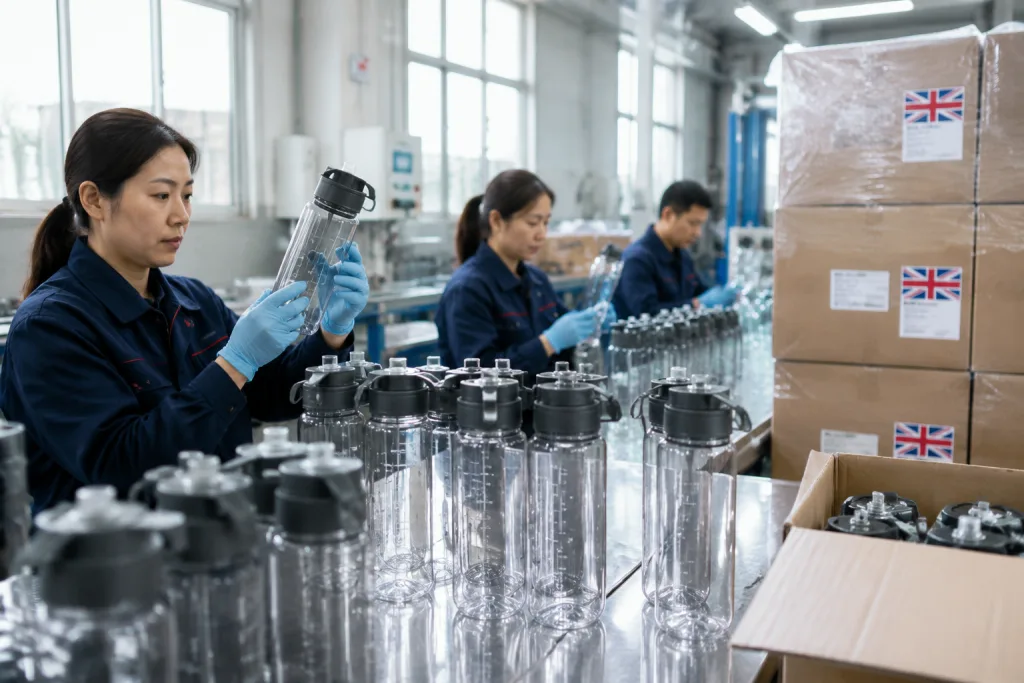
If you are buying a promotional tritan bottle UK for retail, events, or internal branding, do not treat it like a generic water bottle. Tritan looks plain, but the order lives or dies on wall thickness, cap fit, print method, UK compliance paperwork, and whether we can hold the same color and logo across 5,000 or 50,000 units. One buyer pushed for a 0.8 mm wall, then flagged brittle lids after QC pulled the sample on the drop test. Fast quote is easy. Stable re-order is the hard part.
The real question is not whether tritan is “good.” The math does not work that way. It is whether the bottle fits your use case, margin target, and delivery window, and whether the line can keep the cap seal under a 2,000-cycle leak check without drifting on print registration by 1 mm. We ask the same things on the floor: what is the MOQ, what is the FOB price, which test reports are in hand, and what happens when the buyer flags a PO typo on the color code. That is the part that saves money.
What buyers actually need
Start with the use case, not the product name. A promotional tritan bottle UK order for a gym chain is one job; a university store run is another; a distributor program shipping the same bottle to three regions is a third. We ask who holds it, how often it gets dropped, and what the lid has to survive. QC pulled one sample after a 1.2 m drop test, and the buyer flagged a cracked lid. That told us the spec was wrong.
For most B2B buyers, tritan wins on three points: clear body for branding, lower weight than stainless steel, and better impact resistance than basic PET. The basics still need to be in writing: capacity (500 ml, 650 ml, 750 ml), closure type (screw cap, flip top, straw lid), and decoration area. A small logo on a curved wall is cheap on paper and ugly on the line if the artwork is too fine. We ran a 38 mm pad-print sample last month, and the math did not work on a 6 mm curve. Ask for a flat panel or a controlled print zone.
A serious canteen factory should give you monthly output, mold ownership status, and re-order consistency. In Zhejiang, the better lines run 200,000 to 500,000 units per month across bottle lines. If a supplier cannot explain those numbers, you are buying a quote, not a program. We once saw a PO with “6500 ml” typed in by mistake, and that typo burned two days of sample prep before anyone caught it.
Is Tritan worth the price?
Yes, if you need clear walls, good impact resistance, and fewer cracked units than glass. No, if the job is a 10,000-piece giveaway and every cent is under the microscope. Tritan sits in the middle. It costs more than basic PP or PET, less than stainless steel, and it earns its money when the bottle sits on a retail shelf or gets carried through an event hall.
A normal FOB China price for a custom Tritan canteen is USD 1.15-1.80 for a plain 500 ml bottle with one-color print and standard packaging. Add a custom cap, soft-touch finish, or a more complex lid stack, and USD 2.20-3.20 is normal. We run those jobs on the line all the time. The math is real. Last month QC pulled a 500 ml sample after the buyer flagged a 1.2 mm wall mismatch, and that kind of miss costs more than the resin on paper.
- Best value: 500-650 ml straight-sided bottle with a standard PP or Tritan cap.
- Best margin: limited-color body + one print location + kraft carton.
- Best retail presentation: clear bottle, measurement marks, and a tamper seal.
If a canteen vendor comes in 20-30% below market and cannot explain mold reuse, print count, or packaging, slow it down. Asking “why is it cheaper?” is the wrong question. We have seen that go sideways. A PO typo on “500 ml” as “50 ml” once slipped through, and the rework ate the saving before the cartons even landed. Cheap custom drinkware often turns expensive at the warehouse when the first shipment fails drop tests or shows shade drift from bottle to bottle.
Questions to ask the factory
You do not need a long questionnaire. You need the right one. Treat the first call like a technical audit, especially if the supplier calls itself a canteen manufacturer, canteen manufacturers, or canteen supplier. Those labels mean nothing unless they can show the line, the QC sheet, and the mould record. On our side, the mould room keeps a dated tool tag for every cavity, and that tells you more than a sales deck.
Ask these before you request samples
- What is the MOQ per SKU and per color?
- Can you provide REACH, FDA food-contact declaration, and if needed LFGB support?
- What is the exact wall thickness, usually 1.5-2.2 mm for Tritan bodies?
- What decoration methods are available: silkscreen, pad print, laser, heat transfer?
- Do you own the mold, or is it shared tooling?
- What is your standard AQL level for pre-shipment inspection?
If you work with canteen distributors or a distributor drinkware team, ask about packing format too. A bottle going into Amazon FBA may need barcode placement, polybagging, and carton labels that are different from a wholesale pack. We saw a 5,000-piece order stall for 4 days because the buyer flagged a UK EAN typo after the labels were printed. A good canteen vendor should turn that retail spec into shop-floor instructions without making you rewrite the file three times.
Do not accept “same as sample” unless the sample is signed and dated. We run a 0.3 mm pen mark on the neck ring for this reason. One missing mark has cost us a whole PO before.
Compliance is not optional
For the UK and Europe, compliance is where a lot of promo orders go off the rails. Tritan is only one piece. We still need food-contact declarations, traceable resin lot data, and test reports that match the sales channel. For Europe, ask for REACH support. If the bottle will touch food or drinks in one named market, put the market-specific declaration in the purchase file before the line starts. QC pulled one batch at 48 hours because the buyer flagged a missing traceability sheet, and that delay cost 12 days.
Packaging and labeling matter just as much as the bottle. Tell us up front if the order needs outer carton marks, country-of-origin labels, barcode stickers, or carton drop-test handling. A normal export carton is 48 pcs or 72 pcs per master carton depending on size; if you need FNSKU or retailer labels, say it before production, not after packing. We once saw a PO with “UK lable” in the notes. That typo created a useless back-and-forth, and the math did not work for a reprint after the cartons were sealed.
A disciplined factory in Zhejiang keeps material lot numbers, QC records, and packing photos on every run. That matters when a canteen program moves from one warehouse to 6 branches. If the distributor comes back for a second run and the cap fit drifts by 1 mm or the torque shifts, the margin disappears fast. We run the same check with a torque tester and a 24-hour sample hold. We have seen this go sideways. Good suppliers know it. Average suppliers call it a small issue.
Check the build, not the brochure
Buyers get pulled in by renders. So do we, until QC pulls the sample. Put the body, lid, gasket, hinge, and print panel on the bench, not on a brochure page. For a promotional tritan bottle UK order, we ask for one physical sample and run the same checks every time. The caliper does not lie.
- Body clarity: even transparency, no haze, no stress marks.
- Wall thickness: hold it to within +/- 0.2 mm across the body.
- Lid seal: no drip after inversion and shake test.
- Thread engagement: smooth closure, no grinding or cross-threading.
- Logo durability: rub test after washing and light abrasion.
If the order is a custom growler or a customizable growler, the same checks still apply. The wall gets thicker, the handle takes more load, and the closure has less room for error. A bad mold on a 1L bottle costs more to fix than a small one. We’ve seen that go sideways. Ask for the impact test result and the carton drop result; “looks strong” is not a spec. The buyer who skips this usually pays twice.
Finish has to be set early. Frosted, glossy, and matte use different tools on the line, and the buyer flagged this on a PO once by writing “soft matte” with no sample reference. That typo turned into a 12-day delay. Plain finish can save cost, but packaging will not rescue the wrong surface. We run those samples against the same plate every time.
MOQ, lead time, and pricing
These three numbers decide whether the job is real. For a standard promotional tritan bottle UK run, we quote an MOQ of 3,000-5,000 pcs per design. Last month, QC pulled a sample at 2,000 pcs and the line still needed a 300 pcs color-setup run, so the buyer flagged the extra waste. Ask for a custom cap, a PMS color match, or a molded logo on the body, and the MOQ moves up. For one-off canteen custom jobs, some factories will take a lower number, but the unit price jumps so hard that the math does not work.
Lead time is usually 25-35 days after sample approval and deposit. Add 5-7 days if we need a fresh color match. During peak export season in China, I tell buyers to build in another week, because the line does not care about your ship date. A supplier promising 12-15 days for a printed, boxed, compliance-documented order is skipping steps or guessing. We run a calendar against the oven and pad-print station; that is where the delay shows up.
Use these pricing bands as a sanity check:
- Simple bottle, one-color print: USD 1.15-1.80
- Better cap, two-side decoration, retail pack: USD 1.85-2.60
- Complex lid, custom mold detail, premium packaging: USD 2.70-3.20+
For canteen promotional programs, the cheapest quote is usually the one that breaks later. We saw a PO last quarter with “2,00 pcs” typed instead of 2,000 pcs, and the supplier still sent a quote without asking. A solid supplier splits tooling, sample charge, unit price, and packaging cost, so you can compare canteen suppliers without chasing hidden extras after the deposit lands. I trust a quote more when the carton spec and the 32 mm cap detail are written out line by line.
How to compare suppliers
When you compare canteen suppliers, canteen vendors, or a canteen distributor network, put process discipline ahead of unit price. A solid supplier answers the same questions in the same order every time. If sales says one thing, engineering says another, and QC pulls a different sample, the order usually shifts again on the line.
Use this checklist:
- Do they hold ISO 9001 or an equivalent quality system?
- Can they show BSCI or similar social compliance if your buyer asks for it?
- Do they track raw material traceability by batch number?
- Will they send pre-production samples and a golden sample?
- Can they pack to your retail or wholesale spec without excuses?
If you are buying custom drinkware for more than one channel, ask whether the factory can split the pack plan: bulk cartons for distributor drinkware, shelf-ready packs for retail, and labeled master cartons for fulfillment. That is where an experienced canteen manufacturer earns the fee. We run mixed export orders in Zhejiang every week, and the MOQ math only works if the packing room can switch fast without mixing labels.
For buyers in the UK, timing matters as much as spec. This is the wrong question to ask: “Who has the lowest quote?” A smooth canteen custom order comes from a factory that can repeat the same bottle, box, and print when the reorder lands 3 months later, not the one that talked fastest on the first call.
Request a factory quote with real numbers
Send your target capacity, print method, and order size. We will reply with MOQ, FOB pricing, lead time, and compliance details from Zhejiang.
Frequently asked questions
What is the usual MOQ for promotional tritan bottle UK orders?
Most factories will start at 3,000 to 5,000 pieces per design for a promotional tritan bottle UK order. If you want multiple colors, custom lids, or special packaging, the MOQ can rise to 8,000 pcs or more. For a simple one-color print, some canteen factories in China will accept 2,000 pcs, but the unit price is usually higher. Always confirm MOQ by SKU, not by general category, because a canteen customizable program often splits into separate body, lid, and print combinations.
How much should I budget per unit FOB China?
For standard custom drinkware, a realistic FOB China budget is USD 1.15-1.80 per bottle for a simple Tritan body with one-color decoration. Better lids, two-side print, or retail packaging usually push the price to USD 1.85-2.60. Premium custom canteen builds with special molds or complex closures can land around USD 2.70-3.20. If a canteen supplier quotes far below that, check what is excluded: carton inserts, testing, or barcode labeling are often left out.
What documents should I ask for before placing an order?
At minimum, ask for food-contact declarations, material information for Tritan, and any REACH-related support required for your market. If you sell into retail or marketplace channels, also request carton labels, packing list format, and sample photos. For a distributor drinkware program, keep the signed golden sample, spec sheet, and AQL inspection terms in one file. If your buyer needs it, ask for BSCI or ISO documentation as well. A proper canteen manufacturer should send these without hesitation.
How long does production usually take?
A standard order usually needs 25-35 days after sample approval and deposit. If you add a custom color, allow 5-7 extra days for matching and trial. New molds or major tooling changes can extend the schedule to 40-50 days. In Zhejiang and other parts of China, peak-season demand can add another week if you are ordering from a busy canteen factory. Build that into your purchase plan so your launch date is not held hostage by the last carton.
Can Tritan bottles be used for retail, promotion, and distribution together?
Yes, but only if you control the spec. A single custom canteen platform can serve promotional, retail, and distributor canteen channels if you standardize the bottle body and vary only the print, packaging, or accessory set. That is the easiest way to create customizable drinkware without rebuilding the product each time. Keep the same mold and lid family, then create channel-specific packs. It is a practical way for canteen distributors and brand owners to reduce tooling cost while keeping each channel distinct.