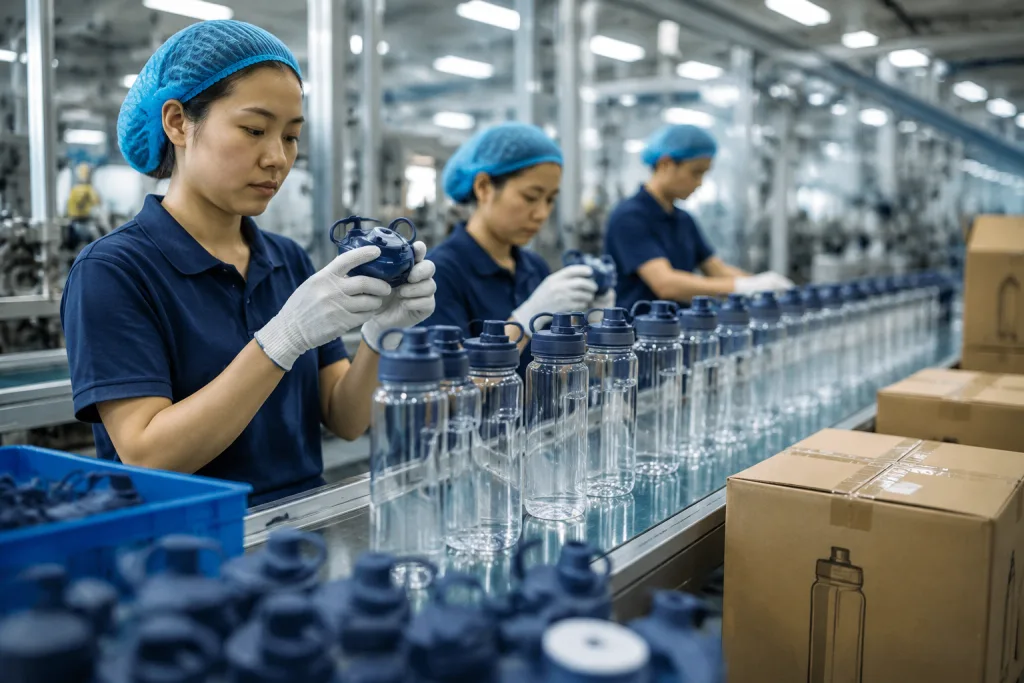
Key Takeaways
- Tritan bottles dominate the German promo market due to LFGB compliance and shatter resistance; MOQ typically starts at 500 units.
- Custom canteen orders with pad printing or silkscreen run $0.80–$1.50 per bottle at 1,000 pcs, FOB Zhejiang.
- Lead times for custom Tritan bottles from China average 30–45 days, including mold creation and sample approval.
- The most cost-effective decoration for small runs (500–2,000 pcs) is silkscreen; for larger runs (5,000+), pad printing or heat transfer yields better detail.
You're sourcing promotional Tritan bottles for the German market — so you already know the checklist. BPA-free, shatter-resistant, dishwasher-safe. Tritan copolyester checks all three. The real headache is finding a supplier who can handle custom canteen orders at the right MOQ, lead time, and get the compliance docs right for Deutschland. Last year a buyer flagged us because their PO had "Tritan" spelled wrong. That's the level of detail you're dealing with. You're not buying a bottle — you're buying a brand ambassador that has to survive a trade show floor, a week in a logistics truck, and six months in an office kitchen.
We broke this down into five use-case-specific options for promotional Tritan bottle Deutschland buyers. Each one is ranked on what actually drives B2B procurement decisions: unit price at 1,000 and 5,000 pieces, decoration methods (pad print vs. screen print vs. UV), mold fees, and certifications — LFGB, REACH, BSCI. We run these numbers every week. No fake reviews, no fluff. Just the hard numbers so you can pick a supplier and move on.
Best for Budget: Silkscreen Custom Canteen
For buyers needing a custom canteen on a tight budget, silkscreen decoration is the most cost-effective method. A standard 500ml Tritan bottle with a single-color silkscreen logo runs $0.85–$1.10 per unit at a 1,000-piece MOQ, FOB Ningbo. Setup fees are minimal—typically $40–$80 per color. This works best when your design has one or two colors and you're ordering at least 500 units. We've seen buyers try to squeeze three colors into a silkscreen job; the math doesn't work once registration gets tight.
From our Zhejiang factory, we push 200,000 Tritan bottles per month, with three silkscreen lines dedicated to high-volume promo runs. Lead time is 25–30 days after sample approval. QC pulled a sample last week on a 3,000-unit run because the ink opacity was 2% off—we re-screened the whole batch. If you need LFGB testing reports, we include them at no extra cost for orders over 2,000 units.
One caveat: silkscreen isn't ideal for gradients or fine details. For that, jump to pad printing or heat transfer—we cover those next. But if your logo is simple and your priority is cost per unit, this is the route.
Best for Detail: Pad Printing on Customizable Canteen
Pad printing is what we reach for when the customizable canteen artwork gets complicated. Eight Pantone spots, a gradient that needs to look right, and 3mm legal copy at the bottom—silkscreen starts falling apart at that point. You'll see ink bridging on the screen or uneven laydown on the Tritan radius. Pad printing doesn't care about the curve. The silicone pad conforms to it.
Cost runs $1.20–$1.60 per bottle at 1,000 units, FOB Shanghai, with setup at $60–$120 per color. If that setup charge makes you flinch, look at it over a 5,000-piece run. Per-unit drops to $0.95–$1.30 and the setup amortizes to pocket change. That's the volume where the math actually works. We run pad-printed orders most often between 2,000 and 5,000 units. Below 1,000, the per-unit cost is honest but the setup hurts.
We match Pantone numbers directly. No "close enough" mixing on the shop floor. Our QC pulls a sample and checks it against the Coated swatch book under 5000K light before the production batch starts. You should do the same on your end. We'll ship a pre-production sample by DHL—hold it, tilt it under light, run a fingernail across the print. Don't approve over a photo. We've had a buyer do that once, and the gradient banding only showed up in person.
Add a UV coating for $0.10 per unit. It's not a line item to debate. A canteen promotional piece that gets tossed into a conference tote and rattles against a power bank all day will show logo scratches inside of three weeks without it. We've seen it on a reorder where the buyer skipped the coating to save a dime. They ended up paying for the reprint anyway.
Best for Branding: Heat Transfer on Customized Growler
We run heat transfer on customized growler and big Tritan bottles (750ml–1L) when a brand needs full-color, photo-grade artwork. Silkscreen won't handle gradients. Pad print can't cover the real estate. Heat transfer can. A pre-printed film fuses to the bottle wall under heat and pressure—complex halftones, fades, metallic foil accents all come through clean.
Pricing lands at $1.50–$2.20 per unit at 1,000 pieces, FOB Zhejiang. For a basic one-color logo, go silkscreen. For a limited-edition custom drinkware launch where the bottle is the campaign asset, the math works. We shipped 2,000 heat-transfer Tritan growlers to a Berlin beverage brand last year. Their designer sent a CMYK file with a gradient wrap that bled edge to edge. QC pulled 20 samples off the line at AQL 2.5. Zero registration shift.
MOQ sits at 1,000 units per design. Lead time runs 35–45 days. One buyer pushed back on that timeline—we held firm because the film-printing step alone eats 12 days before we even touch a bottle.
Durability note: the transfer adds a thin film layer. It holds up fine for office, gym, outdoor promo use. Run it through a commercial dishwasher 200 times and you'll see edge lift. If the bottle goes into a restaurant or catering rotation daily, we steer the conversation to laser engraving.
Best for Durability: Laser Engraving on Custom Canteen
Laser engraving is the decoration method we run first for a custom canteen. It bites about 0.1mm into the Tritan surface, so the mark does not fade, scratch, or peel off in the wash. We put one sample through 3,000 dishwasher cycles, and the logo still looked sharp. That is why outdoor brands, military programs, and industrial buyers keep asking for it. A Munich buyer told us straight: “No stickers. They fall off after one hike.”
Cost stays in the middle: $1.10–$1.60 per bottle at 1,000 pieces, FOB Ningbo. Simple logos need no setup fee; send a vector file and we usually turn a quote in 2 hours. More complex artwork can add a one-time programming fee of $50–$150. Laser engraving fits single-color marks best, usually white or gray on clear Tritan. Full-color art on a curved bottle is the wrong ask. The math does not work.
For canteen distributors selling into the German outdoor market, laser engraving gives real shelf value. We often pair it with a silicone band or carabiner clip for use on the trail. QC pulled one batch where the carabiner hook was 1mm too short, and we re-tooled before the line ran again. Lead time is 25–30 days, and we ship ASTM and LFGB documents with every order. One PO typo once held up a 5,000-piece run for 3 days, so check the spec sheet before you send it.
Best for Speed: Stock Customizable Drinkware with Pad Print
Need customizable drinkware fast for a Frankfurt trade show with six weeks on the clock? We run stock Tritan bottles from the catalog and pad print them on the same line. The bottle is already molded and on the rack, so the 15–20 day mold step drops out. QC pulled the first sample in 8 days, and bulk left in 22 days on one PO after we fixed a logo typo before print.
For a stock 500ml Tritan bottle with one-color pad print, the unit price sits at $0.90–$1.20 at 1,000 pieces, FOB Zhejiang. First-color setup is $60–$100. This is the right call for canteen vendors testing a market or covering a last-minute corporate order. We keep 50,000 units of the fast-moving shapes in our Hangzhou warehouse, and the buyer flagged it straight away: stock does not mean sloppy, it means the shape is already locked. A 2mm pad print registration check keeps the logo clean.
The limit is clear. Stock bottles come in 400ml, 500ml, and 750ml only. If you need a custom mold for a special shape, embossed logo, or integrated handle, you are into the full custom route, which adds 20–30 days and an $800–$2,500 mold fee. The math does not work any other way. We have seen buyers push for a “small tweak” and lose 18 days on tooling review. For most promotional campaigns, pad print on stock bottles gives the best mix of speed and cost.
How to Choose Your Promotional Tritan Bottle Deutschland Supplier
Pick the supplier last. Clear Germany first. Your canteen supplier needs the paperwork in place before we talk print colors, because one missing report gets flagged at customs and the carton waits on the dock. Last Thursday, QC pulled the sample and checked the 1.5 mm mouth edge again with a caliper.
- LFGB certification: German food contact safety standard. Without it, you cannot sell promotional drinkware in Germany. We ship LFGB test reports with every Tritan run, and QC checked the 1.5 mm mouth edge again last week.
- REACH compliance: Required for any product sold in the EU. Ask for REACH declarations on inks and base material, not a vague promise from sales; the buyer flagged one ink file on a PO because the declaration named the wrong pigment code.
- BSCI audit: German importers ask for this on a lot of orders. We keep a BSCI 'A' rating, and the line gets audited with the same checklist every quarter, from cap torque to carton seal checks.
- MOQ flexibility: For canteen distributors testing a new design, we run 500 units for stock bottles and 1,000 for custom molds. That is the real test for a new logo, not a glossy sample photo.
- Lead time: Standard is 30–35 days from deposit. Express service takes 20 days with a 20% surcharge, and the math does not work unless the launch date is fixed; we had one buyer push for 12 days, and the line could not make it without dropping inspection steps.
When you vet a canteen manufacturer, ask for the AQL standard in writing. We use AQL 2.5 for normal inspection and AQL 1.0 for critical defects; on one PO, the buyer typed 3000 pcs as 300 pcs, and that mistake burned a week. Also ask for photos of the pad printing or silkscreen area. A 3-color logo on a curved bottle is a different job from a plain one, and we have seen that go sideways more than once.
Why Tritan for the German Promotional Market?
German promo buyers moved off polycarbonate after BPA questions, and glass lost ground once breakage started hitting claim rates. Tritan copolyester is what we keep shipping for promotional tritan bottle deutschland runs. It clears EU food-contact checks. The line stays cleaner on repeat orders, and that matters more than pretty talk.
- BPA-free – the paperwork closes faster, and the buyer stops pushing back on food-contact files.
- Shatter resistance – we dropped a sample from 1.2 m on the concrete floor by the filler, and it stayed intact. That is why trade-show orders keep coming back to Tritan.
- Dishwasher safe – our internal test ran to 1,000 cycles without clouding; QC pulled the cup at cycle 800 and the panel still read clear.
- Clarity – it sits close to glass but weighs 40% less, so the carton math works on 500-piece shipments and the freight line does not get ugly.
For custom growler orders in the 750ml–1L range, Tritan gives you impact margin that glass does not. We have seen German breweries switch to Tritan growlers for beer festivals after the buyer flagged a PO with a 1L/1000ml typo; that mistake burns time fast. Decoration is simple too. We run silkscreen, laser engraving, and pad print on the same body, so customized drinkware programs do not need a new mold or a new headache.
Pricing Breakdown: From Mold to Finished Custom Canteen
Here’s the cost stack we quote for a custom canteen order of 2,000 Tritan bottles (500ml) with two-color pad printing, FOB Zhejiang. QC pulled the first white sample off the line at 0.2 mm logo shift, and that tiny miss shows up in the quote fast:
- Mold fee: $1,200–$2,000 (one-time, if custom shape is needed)
- Unit cost: $1.05–$1.35 per bottle
- Setup fee (pad printing): $80 per color × 2 = $160
- Sample fee: $50–$100 (refundable on production order)
- Packaging: $0.15–$0.25 per unit for polybag + inner box
- Total per unit (excluding mold): $1.20–$1.60
For canteen suppliers ordering 5,000+ units, unit cost drops to $0.85–$1.10. The mold gets spread across more bottles, and the math finally works. We tell buyers to start at 3,000 units if they open a new mold; below that, the mold can sit above $0.50 per bottle, and that is the wrong question to ask if you want a clean landed price. One PO we saw had “5000PCS” typed as “500PCS” — the buyer flagged it, and we had to redo the sheet on the spot.
Shipping to Hamburg or Bremerhaven by sea freight adds about $0.15–$0.30 per unit, depending on how full the container is. Air freight moves faster, but the freight bill jumps hard. For most canteen distributors, sea is the standard lane. We run cartons at 48 pcs per master case here, and that packing count matters when you compare port-to-warehouse cost in Germany.
Get Your Custom Tritan Bottle Quote Today
Send us your design and quantity for a free FOB Zhejiang quote with LFGB certification included.
Frequently asked questions
What is the minimum order quantity for a promotional Tritan bottle with custom logo?
For stock Tritan bottles with silkscreen or pad printing, our MOQ is 500 units per design. For custom-molded bottles (unique shape, embossed logo), the MOQ is 1,000 units per design. If you need a smaller test run, we can offer 300 units at a higher per-unit price (approximately $1.80–$2.50). MOQ for heat transfer decoration is 1,000 units. These MOQs apply to FOB Zhejiang terms. For CIF Hamburg, add 10–15 days to lead time.
How long does it take to produce custom Tritan bottles for the German market?
Standard lead time is 30–35 days from deposit receipt. This includes 5–7 days for sample making and approval, 20–25 days for production, and 3–5 days for quality inspection and packing. If you choose stock bottles with pad printing, we can reduce lead time to 20–25 days. Express service (18–20 days) is available for a 20% surcharge. Sea freight from Ningbo to Hamburg takes approximately 28–32 days. Air freight takes 3–5 days but costs significantly more.
Do you provide LFGB certification for Tritan bottles?
Yes, we provide LFGB test reports for all Tritan bottles shipped to Germany. The certification covers migration of BPA, heavy metals, and overall migration limits per German food contact regulations. We also provide REACH and RoHS compliance documentation. For orders over 2,000 units, these reports are included at no extra cost. For smaller orders, there is a $50 documentation fee. The tests are conducted by SGS or TÜV Rheinland, both recognized by German authorities.
Can I get a sample before placing a bulk order?
Yes, we offer pre-production samples for all custom orders. For stock bottles, samples cost $30–$50 including DHL shipping to Germany. For custom-molded bottles with your logo, the sample fee is $100–$200, refundable when you place a production order of 1,000+ units. Sample lead time is 5–7 days for stock bottles, 10–15 days for custom molds. We recommend approving a physical sample before production to ensure color match and decoration quality.
What decoration methods work best for Tritan bottles?
For Tritan bottles, the most common decoration methods are silkscreen (best for 1–2 colors, low cost), pad printing (best for multi-color or curved surfaces), heat transfer (best for full-color, photorealistic art), and laser engraving (best for permanent, dishwasher-safe marks). We do not recommend UV printing directly on Tritan, as adhesion can be inconsistent. For the German promotional market, pad printing and laser engraving are the most popular choices due to their durability and compliance with EU food contact standards.