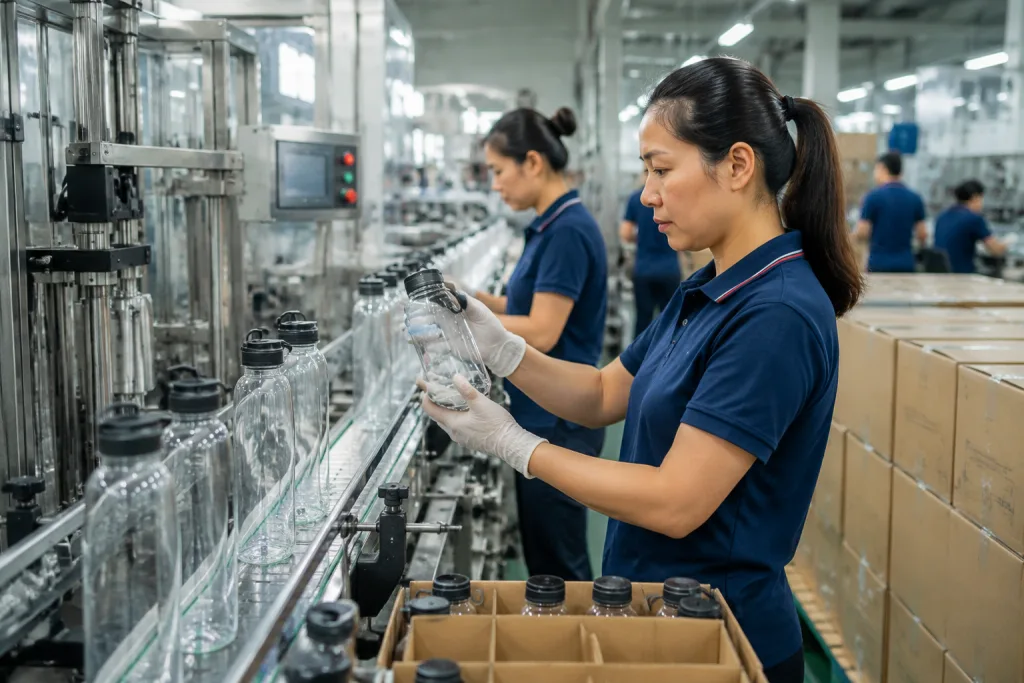
Key Takeaways
- Tritan is not generic copolyester—specify Eastman Tritan™ MXF or TX1001 grade and request a material certificate with each shipment.
- Minimum wall thickness for a 500ml promotional Tritan bottle should be 1.8mm to avoid cracking in drop tests below 1.5m.
- Silkscreen decoration on Tritan requires a two-step UV-cure process; single-cure logos fail after 50 dishwasher cycles.
- AQL 2.5 is standard for promotional drinkware, but for Tritan bottles destined for Britain, specify AQL 1.0 for critical defects like cap leakage or thread mismatch.
You've picked Tritan for your British brand's promo bottle. Smart call—BPA-free, tough, crystal-clear. But here's what nobody tells you: the gap between a sample you like and a load of 10,000 units that pass QC on arrival is where most procurement managers burn their budget. I've flagged caps that fail at 0°C, logged logos peeling after three dish cycles, and seen Tritan color drift across two production runs. That's not your supplier cutting corners—it's specs you never thought to write down.
This guide breaks down the real failure modes we catch on the line: material verification, mold precision, decoration adhesion, export-grade packaging for Britain. We're talking about the Zhejiang manufacturing cluster, where your canteen manufacturer or canteen supplier runs their shop. If you're a distributor, canteen distributor, or brand owner placing a custom drinkware PO, stop guessing. Read this before you sign. We'll walk through how to vet a factory, what questions your QC checklist needs, and why one wrong millimeter on the cap thread sinks your launch date.
Why Tritan Bottles Fail in the Field
Most promotional Tritan bottle failures start in three places: resin swap, mold shortcuts, and print mistakes. You will not catch them on a showroom sample. They show up after 100 units are already in a buyer’s hand. We run a 100-piece pilot for that reason. The first bad bottle usually tells the story.
Material substitution is the biggest risk. We have seen a factory quote Tritan, then load cheaper copolyester into the hopper, usually sold as PCTG or PETG in China. That mix yellows under UV, drops impact resistance, and weakens the BPA-free claim. Eastman Tritan is the copolyester with the tested FDA and EU paperwork. Ask for a material certificate of analysis (COA), then match the lot number against Eastman’s record. On a 2024 order for a UK chain, the buyer flagged a typo on the COA and we stopped the line before molding. A resin drum is 25 kg; if the label is vague, the math does not work. Reputable Zhejiang plants with ISO 9001 and BSCI audits usually hand this over without drama.
Mold design failures are easier to miss and harder to fix later. Uneven wall thickness creates weak spots, sharp internal corners act like crack starters, and thread profiles that miss standard cap molds waste the whole tool. A 500ml promotional Tritan bottle should hold at least 1.8mm at the thinnest point, not the average. Ask for a wall-thickness report from a CMM (coordinate measuring machine) on the first shot of each cavity. QC pulled one sample at 1.62mm last month, and the line had to stop. This is the wrong question to ask: “Does it look fine?” Ask for the numbers.
Decoration fails for a simple reason: Tritan does not like weak adhesion. Silkscreen needs a two-step UV-cure sequence, primer first, then ink, then final cure, or the logo peels after 50 dishwasher cycles. Pad printing holds up better on rough handling, but the line loses fine detail. Laser engraving stays permanent, though it only reads well on darker Tritan tints. We run a 48-hour tape test before packing, and we have seen print lift at the edges when the operator skipped primer. Speak with your bottle vendor before mold cutting. Changing print after tooling is where projects lose 12 days versus 18 days and still miss launch. We’ve seen that go sideways on a clean PO with one wrong logo size.
Specifying Your Tritan Bottle: The Critical Dimensions
Send an RFQ to a Zhejiang bottle factory, and the first thing we ask for is a 3D drawing or a spec sheet with hard numbers. No drawing, no clean start. If you leave it to the mold engineer, the line fills in the blanks, and that is where dimensional drift starts.
For a promotional Tritan bottle, these are the numbers we want on paper. QC pulled the sample, checked the caliper, and the buyer flagged a 2 mm miss straight away.
- Capacity: 500ml (17oz) is the common size for British corporate gifts. Keep the overfill allowance at ±3% at 20°C, and state it clearly or QC will flag the sample.
- Bottle height: Measure with the cap on. For 500ml, 220-240mm is standard, and we keep it under 250mm so it fits most cup holders.
- Body diameter: 65-70mm sits well in an adult hand. Tapered shapes look sharp, but they add mold work and the price goes up.
- Neck finish: Use 38mm or 48mm. A 38mm neck suits narrow-mouth bottles; 48mm works for wide-mouth bottles, which are easier to clean and take ice. Thread pitch must match the cap supplier's standard, usually 4-start or 6-start threads.
- Wall thickness: Do not go below 1.8mm anywhere. We aim for 2.0mm average so the bottle holds up in a 1.5m drop test onto concrete at 20°C.
For a custom canteen with a new shape, the mold math is simple. A single-cavity production mold usually runs $3,000-$8,000 USD FOB Zhejiang, and we have seen buyers push back on that before the PO lands. That pushback does not change the tooling bill. Mold making takes 30-45 days, then 25-35 days for 10,000 units. MOQ for a custom mold is usually 5,000 units per color.
Quality Control: What to Inspect and When
Do not trust a factory QC report by itself. We run ISO jobs here too, and internal checks still miss caps, flash, or a rough neck finish when the line gets pushed before container loading. You need a third-party inspection, or a written QC checklist signed before packing starts. The handoff matters.
For promotional Tritan bottles shipping to Britain, these are the checks we run before release. QC pulled the sample last week on a 5,000-piece order, and the buyer flagged one wrong cap color on the PO. Paperwork did not catch it. The bench did.
- Visual inspection (AQL 1.0 for critical defects): Check flow lines, bubbles, sink marks, and color shift. Tritan should stay clear; even a light haze or yellow tint fails. We reject that on the bench, no debate.
- Dimensional check: Measure height, diameter, neck finish, and wall thickness on 20 samples per lot. Use a go/no-go gauge for thread fit. A 0.3 mm neck error looks small, but it turns into lid complaints at packing.
- Leak test: Fill with water at 60°C, cap, invert for 30 seconds. No leakage. Run the same test again after 100 cap-open cycles. We have seen a bottle pass once and leak on the second round.
- Drop test: Fill to 90% capacity with water at 20°C, seal, then drop from 1.5m onto a concrete floor. No cracks or leaks. Repeat at 0°C and 60°C. Skip the cold test and the math does not work.
- Dishwasher test: Run 100 cycles at 65°C with detergent. Check logo adhesion, cap deformation, and bottle clarity. One logo file came in with a typo on the print plate last quarter, and the wash test caught it before shipment.
Ask the supplier for a pre-shipment report from SGS or Bureau Veritas. On our side, that inspection usually costs $300-$500, and a rejected container can wipe out $50,000 fast. For bulk buyers, this is not the place to save. The line can make a clean bottle; the report proves it.
Decoration Durability: Silkscreen, Pad Print, or Laser
Your logo is the point of a promotional Tritan bottle. If it fades, chips, or peels after 6 weeks on a desk, the bottle becomes a plain cup and the campaign is finished. Tritan has low surface energy, so we choose decoration by logo shape, order size, and wash plan. That is the job.
Silkscreen is what we run on most canteen promotional orders. It gives solid color and sharp edges, but the line needs a UV-curable primer, usually a silane-based adhesion promoter, before the ink goes down. Skip that step and QC pulled the sample at the tape test. Cost sits around $0.15-$0.30 per bottle for one color on one side at 10,000 units, and the MOQ for custom silkscreen is 1,000 units per design. The buyer asked us to cut the primer to save pennies. The math does not work.
Pad printing fits small logos and curved shoulders. It works best when the logo is 18 mm wide or less, because the pad picks it up cleanly and presses it onto the bottle wall without smearing fine text. It runs slower and costs more, about $0.30-$0.50 per bottle, but it holds up better than silkscreen on Tritan. We saw one PO with a 24 mm mark and a gradient callout; the line printed mud, and the buyer flagged it before packing.
Laser engraving is permanent. No ink to peel. On clear Tritan it gives a frosted finish, and on colored Tritan it leaves a white mark. The tradeoff is plain: monochrome only, and the cycle is slower at the marking station. Cost is $0.50-$1.00 per bottle. We use it for higher-end corporate gifts where the buyer wants a hard-wearing mark and accepts one-color artwork. One fixture on our laser bench holds 12 bottles; that pace is fine for premium runs, not for a rush job.
Whichever method you choose, ask for a dishwasher test report from your canteen manufacturer. British buyers do run bottles through the dishwasher, and 50 cycles is not a serious target. We specify 100 cycles with no visible drop in edge sharpness, and if the factory cannot show that on a real test cup, we treat the claim as wishful thinking. We ship with a marked sample, then QC checks the print after the wash loop.
Packaging and Logistics for the British Market
We ship promotional Tritan bottles from Zhejiang to Britain every week. The line runs on a fixed routine. Packaging is where jobs go sideways. Tritan bodies usually come through clean; cap cracks, thread scuffs, and crushed cartons are what the buyer flags. We run it like this:
- Individual polybag: Put each bottle in a clear PE bag to keep out dust and rub marks. 0.05mm works. QC pulled a sample at 0.03mm and it split on the fold. Cheap on paper. Bad on the line.
- Inner box: Pack 6 or 12 bottles per corrugated box with dividers, and keep the gross weight under 15kg for hand carry on the warehouse floor. We use 3-ply B-flute here. It holds shape better when the stack gets bumped at loading.
- Master carton: Load 48 or 72 bottles per master carton and ask for an 8-high stacking test with no crush. We had a PO typo on the carton spec once, and the buyer pushed back after the first pallet sagged in transit. Get a compression test report from your bottle supplier, not a canteen supplier.
- Palletization: Put 20-24 master cartons per pallet and stretch-wrap tight. For sea freight to Felixstowe or Southampton, use fumigated wooden pallets that meet ISPM 15. Loose wrap loses the load. We saw that go sideways on a wet dock.
From Zhejiang to a British warehouse, sea freight usually takes 35-45 days on FOB Ningbo, then another 5-7 days for customs clearance and inland delivery. Air freight lands in 5-7 days, but the math does not work for volume. On a 10,000-unit order, sea is the only line that makes sense, with about $800-$1,200 for a 20-foot container to the UK. We ship against that number because a 10kg carton is still a 10kg carton, no matter how the quote reads.
If you are a canteen distributor or canteen vendor filling Amazon FBA, put FNSKU labels and barcodes on the pack before the cartons leave the floor. Some British retailers will ask for BSCI or SMETA social compliance, and this is the wrong question to ask at the end. Check certification before you issue the PO, then confirm the label position with a ruler at 3mm tolerance. The buyer flagged a 2mm shift once, and we relabeled 1,200 units by hand.
How to Vet a Tritan Bottle Manufacturer in Zhejiang
Not every canteen factory in Zhejiang can run Tritan cleanly. The province has hundreds of injection shops, but only a slice keep the QC discipline British buyers expect. We see it on the line every month. Use this vetting list:
- Request a factory audit report: BSCI or SMETA is standard for British buyers. If they do not have one, ask for an ISO 9001 certificate and a recent customer reference. QC pulled a file once with a 2023 audit and a typo on the buyer name; that kind of slip tells you plenty.
- Ask for a material traceability record: They should show purchase orders for Eastman Tritan resin, with lot numbers and COAs. If they stall, they are probably blending in generic copolyester. We had a buyer flag a batch where the resin COA was for 12,000 kg, but the PO only showed 8,000 kg. The math does not work.
- Check their mold maintenance schedule: A solid supplier keeps a mold log with cleaning, cavity inspection, and wear checks every 10,000 cycles. Worn molds bring flash and size drift. Use a caliper on the sample; we have seen 0.4 mm variation kill a lid fit in Britain.
- Request a QC checklist: They should have an inspection plan for each order, with visual, dimensional, and functional checks. Ask for a sample report from a past Tritan run. A good report will show AQL 2.5, gate marks, drop-test notes, and a recheck sign-off.
- Visit or video call: If you cannot come in person, ask for a live video tour of the line and QC lab. Look for clean floors, labeled racks, and calibrated tools. A 5 kg test weight and a barcode scanner on the desk tell you more than a sales pitch.
One number I trust: a factory shipping 500,000+ units per month of drinkware usually has the process control to keep Tritan molding steady. Smaller shops may quote lower, but the QC setup is thinner. For a custom canteen or customized canteen order, you want a factory that has shipped for British or European brands before. They know REACH, EU 10/2011, and the UKCA marking rules, and they do not need three rounds to fix a label typo.
Cost Breakdown: What You're Paying For
We price this work every week on the line in Hangzhou, and the bottle is only one part of the bill. For a 500ml promotional Tritan bottle with a custom logo bound for Britain, the cost usually breaks down like this:
- Mold cost: $3,000-$8,000 for a one-cavity tool. Spread across 10,000 units, that lands at $0.30-$0.80 each.
- Raw material (Tritan): $0.40-$0.60 per bottle, based on Eastman Tritan MXF at $4.50-$5.50/kg and about 80g of resin per bottle.
- Injection molding: $0.20-$0.35 per bottle. The press runs a 30-45 second cycle on a 4-cavity mold.
- Decoration (silkscreen, one color): $0.15-$0.30 per bottle. Last month the buyer flagged a 1.2 mm logo shift, and we had to stop the batch and reset the jig.
- Assembly and packaging: $0.10-$0.20 per bottle for polybag, inner box, and master carton.
- Factory overhead and profit: $0.15-$0.25 per bottle. QC pulled the sample on a 10 kg test lot before we released full packing.
- FOB Ningbo price: $1.30-$2.50 per bottle, depending on volume and tooling details.
- Sea freight to UK: $0.08-$0.12 per bottle for a 20-foot container, about 10,000 units.
- Customs and duties: 5-7% of CIF value. Check UK tariff code 39241000.
Total landed cost usually sits at $1.50-$2.80 per bottle. A customized growler or a 1L+ bottle adds $0.50-$1.00 for more resin and a tougher mold build. We have seen this go sideways when a buyer asks for a deeper logo, a thicker wall, then sends a typo fix on the PO after the line is already set. The math does not work. For a canteen distributor buying 20,000+ units, we can still trim 10-15% off FOB if the spec stays locked.
Regulatory Compliance for the British Market
Selling promotional Tritan bottles in Britain is a compliance job first and a print job second. We run that check before artwork, because a clean mockup does not fix a missing file, and one buyer got stuck when the PO said "canteen" instead of bottle.
UKCA marking is mandatory for many products, including food-contact articles. Tritan bottles are usually treated as reusable food containers under the UK Food Contact Materials Regulations (SI 2021/1416), so the paper trail has to be tight: ask for a Declaration of Compliance (DoC) showing overall migration at 10 mg/dm² and BPA at not detectable. QC pulled the sample on a 500 ml bottle last month, and the lab sheet still had to match the numbers on the report.
REACH UK (UK REACH) asks for no substances of very high concern (SVHCs) above 0.1% by weight. Tritan resin is usually clean, but caps and seals are where the buyer flagged it on one order; a black TPE gasket can stop the deal fast. Ask your canteen vendor for a REACH compliance statement for the full assembly: bottle, cap, seal.
Plastic Packaging Tax (PPT) applies to plastic packaging with less than 30% recycled content. Virgin Tritan means £210.82 per tonne of plastic packaging, so this is the wrong question to ask if you want to ignore resin mix and still pass audit. We have seen 30% post-industrial Tritan work, but the line needs a haze check and impact test before you promise it to a UK buyer; one Zhejiang plant tried "Eco-Tritan" at a 5-10% price premium, and clarity slipped when the blend was off by 3%.
For custom drinkware sold through Amazon UK, you also need a third-party test report for BPA and overall migration. Plan for 2-3 weeks, not 2-3 days; the buyer usually pushes back on that lead time until the lab queue starts. We ship faster once the report is in hand.
Get a Quote for Your Promotional Tritan Bottle
Send us your spec sheet or logo, and we'll provide a firm FOB Ningbo price within 48 hours. MOQ from 1,000 units.
Frequently asked questions
What is the minimum order quantity (MOQ) for a custom promotional Tritan bottle from a Chinese factory?
For a standard shape (e.g., 500ml straight-wall bottle) with a custom logo, MOQ is typically 1,000 units per color. If you want a custom mold (unique shape or size), MOQ rises to 5,000 units per design. Some canteen manufacturers in Zhejiang will accept 3,000 units for a custom mold if you pay a higher mold fee ($5,000-$8,000 instead of $3,000-$5,000). For a stock mold with your logo, MOQ can be as low as 500 units, but per-unit cost will be higher (around $2.50-$3.50 FOB).
How do I verify that the bottle is made from genuine Eastman Tritan, not a cheaper copolyester?
Request a material certificate of analysis (COA) from your canteen supplier, showing the lot number and Eastman's product code (e.g., MXF or TX1001). Cross-check the lot number with Eastman's online verification tool. You can also send a sample to a lab like Intertek or SGS for FTIR (Fourier Transform Infrared Spectroscopy) analysis—this costs $100-$200 and identifies the resin type. A simpler test: genuine Tritan does not turn yellow after 100 hours of UV exposure (QUV test). Cheap copolyester will yellow within 50 hours.
What is the typical lead time for a promotional Tritan bottle order from China to Britain?
For a stock mold with your logo, production takes 20-25 days after sample approval, then 30-35 days by sea (FOB Ningbo to Felixstowe or Southampton). Total lead time: 50-60 days. If you need a custom mold, add 30-45 days for mold making. Air freight reduces shipping to 5-7 days but adds $0.30-$0.50 per bottle. For a rush order, some canteen manufacturers in Zhejiang can deliver in 30 days (production + air freight) at a 20-30% premium.
Can I get a promotional Tritan bottle with a silicone or bamboo cap for a more premium look?
Yes, but it changes the cost and compliance requirements. A silicone cap (with a Tritan or stainless steel insert) adds $0.30-$0.50 per bottle and requires food-grade silicone certification (LFGB or FDA). Bamboo caps add $0.50-$1.00 per bottle and must be treated to prevent mold and cracking in humid conditions. Both options increase MOQ to 3,000 units and extend lead time by 10-15 days. For Britain, ensure the bamboo is FSC-certified and the silicone meets UK food-contact regulations.
What is the best decoration method for a small logo on a promotional Tritan bottle?
For a small logo (under 50mm diameter), pad printing is the most durable and cost-effective. It uses a thicker ink layer that bonds well to Tritan, and it can handle curved surfaces. Cost is $0.30-$0.50 per bottle at 1,000 units. Silkscreen is cheaper ($0.15-$0.30) but requires a flat or slightly curved surface and is less durable. Laser engraving is permanent but monochrome and costs $0.50-$1.00 per bottle. If you need multiple colors, pad printing or silkscreen with multiple passes is better—laser can only do one shade.