Key Takeaways
- A promotional tritan bottle usually starts at MOQ 3,000 pcs and FOB pricing around USD 1.15-2.80 depending on lid, print, and packaging
- For U.S. and Canada, ask for FDA-relevant material declarations plus REACH and LFGB support when your channel needs it
- Most QC failures come from lid tolerance, print alignment, and resin clarity, not the bottle shape itself
- A realistic lead time from sample approval is 20-30 days, but custom mold changes can add 15-25 days
The costly mistakes in a promotional tritan bottle America program do not show up in the render. They show up after 8,000 units are packed: cloudy resin, weak caps, logos drifting 2 mm off center, leaking lids, or cartons that pass our QC table and fail in a U.S. warehouse. We had one buyer flag a PO typo on the cartoning spec, and the whole lot sat for 12 days. This is where the run gets expensive. Once the order leaves China or Zhejiang and the launch date is fixed, the buyer is already late to the cleanup.
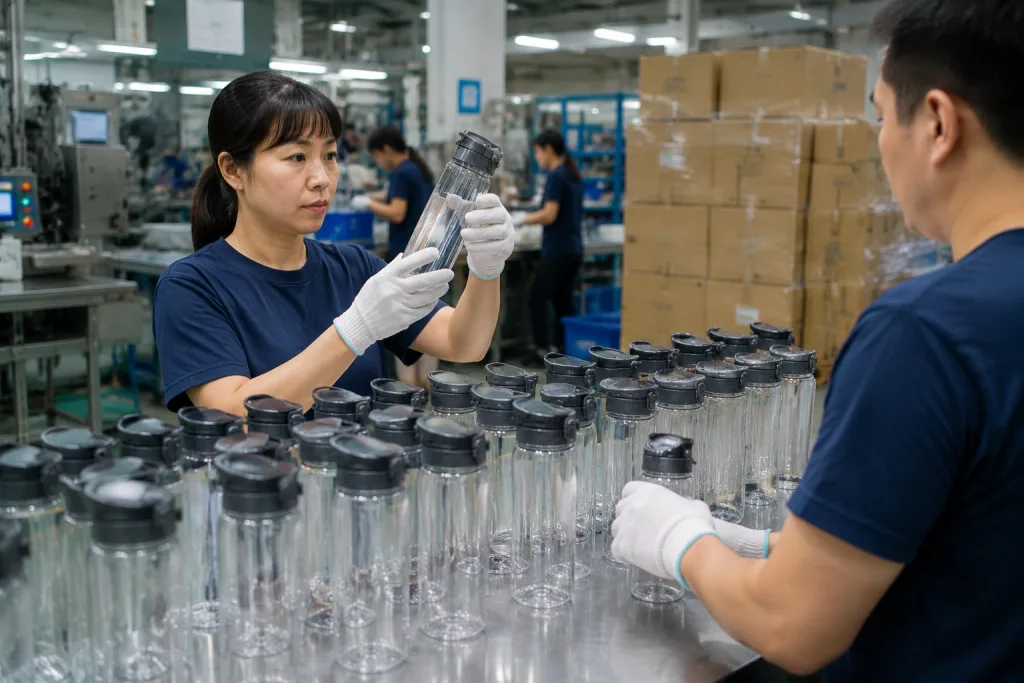
The fix is a clean spec, a lead time that matches the line, and a factory that knows where tritan bottles break in production. At BottleForge in Hangzhou, Zhejiang, we run more than 600,000 units per month across multiple bottle lines, with a typical MOQ of 3,000 pieces and a standard lead time of 20-30 days after sample approval. QC pulled the sample on a 1.0 mm wall bottle last Thursday, and the cap torque failed on the first pass. We ship around that kind of miss before it turns into a warehouse claim. The math does not work otherwise.
Where tritan jobs actually fail
The bottle shape is rarely the problem. The line fails in three spots: resin lot control, lid fit, and decoration. Tritan gives more room than cheap copolyester, but if we mix grades, push regrind past 5%, or chase cycle time, QC pulls bad parts by the tray. For custom drinkware into the U.S. market, ask which resin grade we run, whether the supplier logs melt flow index, and whether one lot covers the full run.
For a promotional tritan bottle america order, the complaint is usually cosmetic. Haze shows up. Stress lines show up near the shoulder. A logo that looked clean on white sample photos turns pale on the real bottle. The second failure is leakage, and the math does not work if you ignore a 0.3-0.5 mm thread or gasket mismatch after hot/cold cycling. A good canteen factory should show lid torque data and sample-drop results, not glossy renders. We saw this go sideways on a 2,000-piece PO with one wrong cap code.
If you are comparing a canteen supplier, do not ask only for unit price. Ask for the defect map. A serious factory can tell you where its first-pass yield sits: 96-98% on injection molding, 92-95% after printing, and lower when you add complex packaging. That is the real baseline in China, and in Zhejiang we ship fast enough that people confuse speed with control. The buyer flagged a 0.2 mm print shift on one lot, and the fix was a screen frame change, not a discount.
Spec the bottle, not the sample
Samples help. They also hide a weak spec. We had a hand-polished 550 ml bottle clear the buyer desk, then blow up on the line at 3,000 pcs because nobody wrote the body draft into the PO. Put the dimensions, resin grade, finish, decoration, and pack-out in the purchase order. For a standard promotional bottle, call out wall thickness at 1.8-2.2 mm, body height tolerance at +/-0.5 mm, and a cap seal that survives a 1 meter drop on concrete after 24 hours at room temperature.
If you need a canteen customizable product or a customizable canteen format, write the spec around the use case. A gym bottle needs one-handed opening. A campus bottle needs a secure loop and a print area that still looks clean after abrasion. For a custom canteen tied to distributor programs, lock carton pack count, master carton burst strength, and whether the unit must hang on retail peg hooks or carry FNSKU labeling for Amazon. The buyer flagged a missing carton mark on one PO; that typo cost us 7 days, and this is the wrong question to ask if you think the sample will catch it.
In Zhejiang, we run molds fast, but not every canteen manufacturer will tell you when the idea is too thin-walled or too ambitious. If the wall drops under 1.6 mm on a large body, distortion shows up fast. If the lid uses soft parts, ask for silicone hardness at 50-60 Shore A. QC pulled the sample on a 2.0 mm bottle once and found 1.4 mm ovality at the shoulder with a go/no-go ring gauge. That is the spec language that keeps a customized drinkware order repeatable.
Prints fail before bottles do
Decoration fails first. We saw a 1.5 mm logo drift on a 5,000-piece run because the jig was not locked after lunch, and the buyer flagged it on the first carton open. If your order includes a canteen promotional graphic, ask for print registration tolerance, ink cure method, and abrasion resistance. For screen printing, clean edges matter; for laser, you want depth and legibility; for heat transfer, get the temperature and dwell time on paper, not “factory standard.”
Do not let anyone call decoration “just branding.” It is a line step with scrap attached. A vendor who handles customizable drinkware well will show you an acceptance standard: no ghosting, no pinholes, no color shift beyond Delta E 2.0-3.0, depending on ink system. For a U.S. promo run, that matters more than a slick render. If you are buying from a canteen vendor or canteen vendors list, ask how many seconds the print line needs per unit and what happens when the artwork has thin serif text. We run into that pushback all the time, and the math does not work if they promise speed without a recheck at the pad printer.
Practical rule: if the decoration cannot survive 50 dry rub cycles without visible loss, the bottle is not ready for retail or field promotion.
Lid design causes the returns
Most bottle returns start at the lid. The body passes, then the cap leaks, drags on the thread, or splits at the hinge after a few weeks on the line. We see it on a custom growler, a sports bottle, and a promo tritan bottle in the U.S. market. The usual culprits are thread mismatch, gasket compression set too low, or a hinge pin built for looks, not 3,000 cycles.
Ask your canteen manufacturer for cycle testing. For a promo run, 3,000 to 5,000 open-close cycles is the floor, and we have had buyers push back on that until QC pulled the sample and found the cap loose after 2,400 cycles. If the bottle uses a flip top, check whether the hinge is polypropylene or a softer blend, and whether the spring or lock point still holds after repeated abuse. For a customizable growler in tasting rooms or a customized growler for retail, the closure has to handle carbonation pressure, not just still water. The math does not work otherwise.
One detail buyers miss is gasket geometry. A flat gasket can look fine and still fail after a 35°C truck ride or a tight carton pack-out. Ask for a section drawing, not a product photo. A strong canteen supplier will give you the 1.8 mm seal thickness and the compression ratio in writing; we once caught a PO typo where the buyer wrote 18 mm, and that lid would have shipped wrong. That is the gap between a clean repeat order and a carton of returns.
Paperwork that saves your shipment
For Europe and North America, paperwork is not optional. A tritan bottle headed to the U.S. usually needs supplier declarations tied to FDA-contact expectations, plus REACH files for EU buyers. We run this check before the line starts, because a 0.5 mm print shift on the carton can trigger a buyer flag later. If the bottle carries coatings, inks, or soft-touch parts, the file gets bigger fast. A weak canteen distributor program usually falls apart there.
Ask for material declarations, test reports, and carton markings before production starts. On private-label customized canteen and customized drinkware orders, the factory should tell you whether it works to ISO 9001, how it checks incoming resin, and what it uses for final QA, AQL 2.5 for major defects and 4.0 for minor defects, or another standard. We’ve seen buyers accept “we check everything,” and that answer is useless. QC pulled the sample, measured the neck at 28.2 mm, and the math still failed if the inspection plan was not written down.
In Zhejiang, export-ready factories treat documents as part of the product. If a supplier cannot send inspection photos, lot traceability, and packing confirmation, it is not a real canteen distributor relationship; it is just a quote. One PO typo on a 5,000-piece order cost a week of back-and-forth, and the buyer flagged it before booking the vessel. For U.S. buyers, that mistake gets expensive once freight and warehousing land on the same invoice.
Price only makes sense with volume
A tritan bottle quote without volume is noise. Same shape, different math. At 3,000-5,000 pcs, a standard promotional bottle lands around USD 1.15-1.80 FOB China. Add a fancier closure, multi-color print, or a special insert, and it moves to USD 2.20-2.80. We run this every week in Hangzhou. The cap assembly jig is where the cost shows up first, and the math shifts fast once tooling, print count, carton style, and a new mold are in the deal.
If you are comparing canteen suppliers, ask what sits inside the line item. One logo side or two? Hand assembly on the cap? Polybag, white box, or retail carton? Is the quote for a distributor drinkware program, or for a retail pack with barcode and hangtag? QC pulled the sample with a 1.2 mm cap gap last month, and the buyer flagged it after the PO said “white box” but meant printed carton. Cheap quotes hide labor, and the buyer pays for that later.
For distributors, match MOQ to forecast. A line can turn 3,000 units faster than 30,000, but once tooling, print screens, and packing materials are spread across the run, the unit price changes. We saw this go sideways on a 500-piece ask; the reorder at 12,000 came back with a different carton cost and a 7-day schedule slip. A practical canteen distributor order should be priced against break-even volume, not a first-order discount.
The buyer checklist that matters
Before you release a PO, lock the items that start disputes. We do not need a 40-page spec; we need the right 12 lines. Write resin grade, bottle capacity, wall thickness, lid type, gasket material, print method, artwork position, carton count, drop test requirement, inspection standard, lead time, and incoterm. That is enough to protect a custom canteen, a custom drinkware launch, or a repeat canteen promotional program. Last month, QC pulled the sample at 580 ml against a 600 ml order. The buyer flagged it before shipment. A PO typo like “560” instead of “600” will waste a week. That is the wrong question to ask.
- Capacity tolerance: +/-3% on a 600 ml bottle
- Body clarity: no haze beyond approved master sample
- Leak test: 30 minutes inverted at room temperature
- Carton drop: 6 sides, 1 meter, no structural collapse
- Inspection: AQL 2.5 major, 4.0 minor, unless your channel demands tighter
Working with a serious canteen factory in China means the PO has to read like a production sheet, not a shopping cart. We run the line on these details every day, and a 2 mm lid mismatch will show up fast on the torque tester. The math does not work any other way. Factories in Zhejiang that ship cleanly answer faster when the buyer is exact, and they keep the same result on reorder for a customizable canteen or customized canteen. We’ve seen this go sideways on a 24 mm gasket callout that never made it into the order file.
Get a factory quote that matches your spec
Send your target volume, artwork, lid style, and market. We will price the bottle, flag QC risks, and tell you where the order can break.
Frequently asked questions
What MOQ should I expect for a promotional tritan bottle America order?
For most private-label tritan bottles, the practical MOQ is 3,000 pieces. If the lid is standard and the print is simple, some Zhejiang factories can quote 1,000-2,000 pieces, but unit cost rises fast. At 3,000 pcs, FOB China often lands around USD 1.15-1.80. Once you add a special closure, insert card, or retail carton, USD 2.20-2.80 is normal. The key is not chasing the lowest MOQ; it is matching MOQ to your sell-through forecast and avoiding leftover stock.
How do I know if the bottle is really Tritan?
Ask for the exact resin declaration, not just the word Tritan on a quotation. A serious supplier should provide material traceability, production lot control, and if needed a third-party test report tied to the resin specification. For U.S. and EU programs, many buyers also request REACH and food-contact support documents. If a factory cannot name the resin grade, cannot show incoming inspection records, or avoids lot-level paperwork, you should treat the claim as unverified.
What QC failures should I test before approval?
Focus on the failures that create returns: leakage, lid crack, print rub-off, and body distortion. A useful pre-shipment set is 30-minute inverted leak testing, 1 meter drop test, and a 50-cycle open-close test on the lid. For decoration, ask for abrasion testing and confirm logo alignment against a signed sample. In practice, these checks catch the problems that matter long before cartons hit your U.S. warehouse or distributor network.
Can I use the same bottle for Amazon FBA or retail distribution?
Yes, but you need the pack format right. For Amazon FBA, the carton and individual unit labeling must support FNSKU, barcode placement, and case pack rules. For retail, you may need hangtags, retail cartons, or shelf-ready packaging. A bottle that works for distributor drinkware may fail FBA if it ships loose or lacks scannable labeling. Tell the factory the channel at the quote stage, because changing pack-out after production starts is expensive.
What lead time should I budget for a custom canteen order from China?
For a standard decorated order after sample approval, 20-30 days is realistic. If you need new tooling, add 15-25 days depending on mold complexity and revision count. Shipping from Zhejiang to the U.S. or Europe adds another 15-35 days depending on ocean routing and destination. If your launch date is fixed, build in buffer for sample corrections, compliance review, and carton proof approval. Tight schedules fail when the buyer leaves no time for a second sample.