Key Takeaways
- Promotional travel tumbler MOQ starts at 500 units for screen printing, 1000 for laser engraving.
- 18/8 stainless steel is the industry standard for bulk coffee mugs; verify with ASTM A240 certification.
- Lead time for custom bulk travel mugs from Chinese factories averages 25–35 days for first orders.
- AQL 2.5 inspection is standard for promotional bulk travel tumblers; request 10% pre-shipment sampling.
You need a promotional travel tumbler that carries your logo at trade shows, corporate events, and on retail shelves. Easy to say. Hard to source well. The market is crowded, and we have seen a buyer reject a 10,000-piece PO because the lid spec on the draft matched the wrong size. That mistake ate a week. The wrong question to ask is “can you print the logo?” The real test is whether the cup, lid, and carton all match before the line starts.
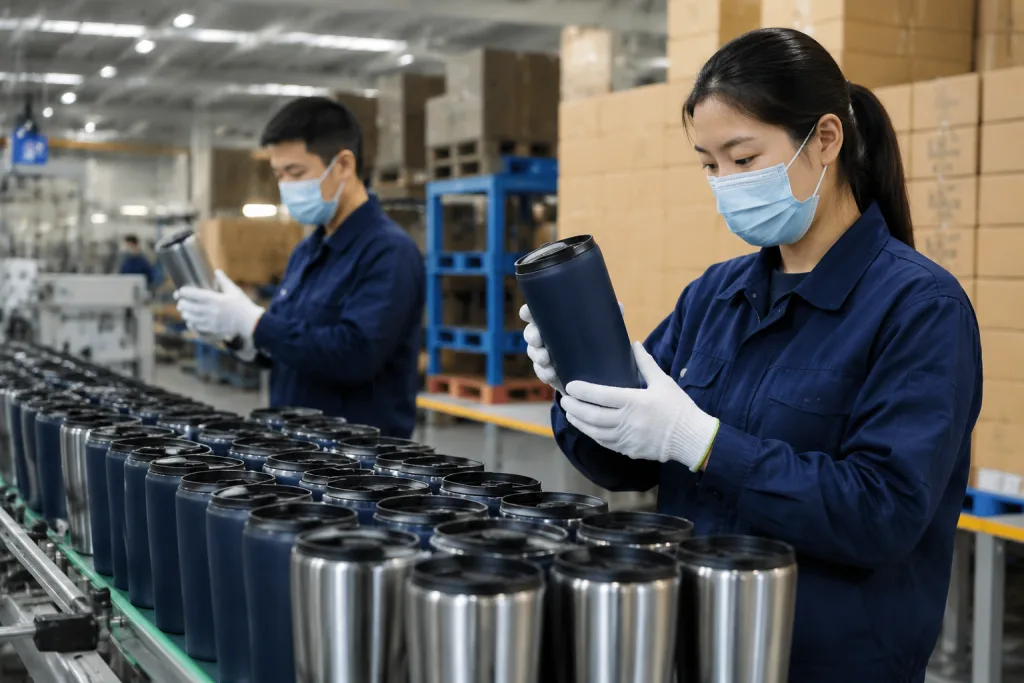
This guide covers the questions we get on the line every week. We run over 500,000 travel tumblers a month in Hangzhou, Zhejiang, and QC pulled the sample for a 0.3 mm wall check before we packed the first carton. From material choice to outer carton marking, we map the sourcing steps for a bulk coffee tumbler order so you can judge MOQ, lead time, and print risk with real numbers, not guesswork. We ship this stuff every day, and the math does not lie.
What Defines a Promotional Travel Tumbler?
A promotional travel tumbler is a daily-use item with a logo on it. That is the point. It is not a cheap bulk coffee mug. A decent unit runs double-wall vacuum insulation, a lid that stays shut in a commuter bag, and an exterior finish that takes scuffs on the line. For B2B buyers, we check wall thickness, lid seal type, and coating durability first. The common spec is 0.4–0.5 mm wall, a silicone gasket instead of a loose push-on lid, and powder coat instead of basic paint. We have seen buyers push unit price down and then get complaints after 2 weeks of use. The math does not work.
When we source from a coffee mug factory in China, ask for a spec sheet with material grade, capacity, cup diameter, and insulation hold time. Use exact figures: 18/8 stainless steel, ml and oz, a diameter that fits standard car cup holders, and a hold time such as 6 hours hot and 12 hours cold. QC pulled the sample on a 75 mm cup holder gauge before approval, and that check saves headaches later. We run a pre-production sample of 10 units before mass production. A buyer once sent a PO with the wrong oz value by one digit. We caught it before the line started.
Bulk Coffee Mug MOQ: What to Expect
MOQ, or minimum order quantity, is the first number procurement asks for, and the math changes fast once decoration changes. For promotional travel tumblers, screen printing usually starts at 500 units and lands around $2.50–$4.00 FOB per piece. Laser engraving runs at 1000 units, closer to $3.00–$5.00. Full-color pad printing or UV printing usually starts at 2000 units. We had a buyer flag a PO with “500 pcs” in the notes, then ask for full-wrap UV. That does not work. If you need a small run, some coffee mug manufacturers will take 200 units for a one-color logo, but the unit price usually jumps 20–30% because setup and packing cost stay the same.
Once you add custom packaging, the MOQ moves to 3000 units for branded boxes or sleeves. At our Zhejiang factory, we run a separate line for promotional orders under 5000 units, and QC pulled the sample at 20 days on a screen-printed bulk travel mug order last month. The buyer pushed back on that MOQ, then changed the lid color to black matte, which forced a new stock check on the line. Check the MOQ in writing. Some coffee mug suppliers post a low number online, then raise it for certain colors or finishes, and the math does not work if you leave that open.
Customization Options for Bulk Coffee Travel Mugs
Printing Methods
- Screen printing: We run this for 1-2 color logos on powder-coated cups. It stays low cost, and a 60 mm logo on the line comes out clean. Fine shading is the wrong ask.
- Laser engraving: This leaves a permanent mark on stainless steel or coated surfaces. No ink. No peeling. QC pulled a sample after 500 cycles and the mark still read sharp. That is why buyers keep it for higher-end promotional bulk coffee mugs.
- UV printing: This gives full-color, photo-level graphics, but it needs a glossy or white base coat. MOQ is higher, and the buyer flagged it once because a dark base killed the color. For complex brand art, this is the better call.
Finishes and Colors
You can pick matte, glossy, metallic, or textured powder coat. Pantone matching is standard once the order passes 1000 units. For bulk coffee mug private labeling, we push matte first; it hides fingerprints and small scratch marks better than gloss. Custom color matching adds $50-$100 per color and 3-5 days to lead time. The math does not work on a small order, and we have seen buyers get burned by a typo on the PO. We checked one run with a gloss meter at 85 GU, and the buyer still asked why the sample looked softer under warehouse light.
Lid and Accessory Options
Lids fail more than the cup body on promotional travel tumblers. Choose flip-top, screw-top, or push-button. Flip-top is easy to use but harder to wash. Screw-top seals better but slows the hand. Push-button sits in the middle. All lids should be BPA-free and pass 360-degree leak testing. For coffee mug promotional products, splash-proof is usually enough; full leak-proof makes sense when the tumbler goes into a laptop bag or a delivery kit. We ran a lid test on a 50 m drop rack last week, and that is where the weak hinge showed up first.
Quality Standards Every Buyer Should Know
For a promotional travel tumbler order, we check three things first: material safety, line consistency, and carton protection. For stainless steel, ask for ASTM A240 or ISO 8442-2 paperwork. For coatings, request REACH and RoHS. We keep the cert pack in the file room and pull it before the buyer signs off. If a supplier stalls on the paperwork, we treat that as a warning. This is where bad lots start.
Inspection is where the math gets real. We run AQL 2.5 (normal level II) on bulk travel tumblers. On a 10,000-unit order, QC pulled 315 samples with the caliper on the line table. Up to 10 major defects is the line in the sand: dented cups, scratched logos, leaking lids. Over that, we stop the lot. A third-party visit usually lands around $200-$400, and we budget for it because one bad pallet costs more than the inspection fee. The buyer flagged a 12 mm lid gap once. That batch never shipped.
Our factory holds a first-pass yield of 98.5% on bulk travel mugs. Less than 15 defective units per 1000 produced. We share monthly yield data with returning buyers.
Lead Times and Shipping for Bulk Coffee Tumblers
For a first promotional travel tumbler order with a custom logo, we usually run 25-35 days from artwork sign-off to packed cartons. Repeat work on the same print file often drops to 15-20 days. Rush jobs can land in 10-15 days if the line already has stock tubes and lids, but the surcharge is usually 15-20%. The buyer pushed for a 12-day promise on one PO last month. The math does not work.
FOB Shanghai or Ningbo is the usual booking point. On a 20-foot container, we load about 12,000-15,000 bulk coffee mugs, depending on wall thickness and carton size. Sea freight to Los Angeles often sits at $1,500-$2,500, while Rotterdam is closer to $2,000-$3,500. Air freight runs 5-8x higher, but it lands in 5-7 days. For promotional orders under 5000 units, LCL shipping makes more sense; the rate is charged by cubic meter, usually $50-$100/m³. QC pulled the sample carton and found one 3 mm packing gap. That is how damage claims start.
For customs, we ship with a commercial invoice showing HS code 9617.00 (vacuum flasks) and a certificate of origin if the buyer wants tariff relief under a free trade agreement. Our logistics team in Zhejiang handles the export file pack, and that includes the invoice, packing list, and booking docs. The buyer once flagged a PO typo on the consignee name. That kind of slip can hold clearance for a day or two, and nobody wants that at port.
How to Choose a Coffee Mug Supplier in China
Not every coffee mug maker runs the same line. You want a factory that lives on insulated drinkware, not a general housewares plant turning out bowls in the morning and tumblers at night. We check for a vacuum tumbler line, in-house logo tooling, and export files for Europe and North America. Ask for references from promotional product buyers, not just retail accounts. That is the first filter.
These are the red flags. No factory tour, virtual or on-site. No BSCI or Sedex audit report. MOQ changes after the quote lands. On our line, QC pulled a leaking sample at 2 mm off spec, and that miss is why we keep the rules in writing. A solid coffee mug supplier should give free samples, with freight on your side, payment at 30% deposit and 70% before shipment, plus a signed quality agreement. We have shipped bulk coffee mugs for promotional distributors since 2012 and hold a 95% on-time delivery rate. The math does not work if those basics are loose.
If you buy coffee mug private label, ask direct questions about OEM. Can they hit a Pantone match, engrave the logo on the base, or build a new lid shape? The buyer flagged a PO typo on a 5000-unit order once, and that small mistake turned into a week of email back-and-forth. Our tooling shop can cut custom molds for orders over 5000 units, with mold costs from $800 to $3,000. We ship clean when the drawing is clear.
Cost Breakdown for Promotional Travel Tumblers
Here is the clean cost split for a 3,000-unit order of 12 oz promotional travel tumblers: 18/8 stainless steel, powder coat, one-color screen print, standard lid, no custom packaging. We run this quote on the line all the time. If the spec stays locked, the math stays sharp.
- Unit cost: $3.20 FOB
- Mold/artwork setup: $150 one-time
- Sample (10 pcs): $50 + shipping
- Inspection (third-party): $300
- Packaging (bulk, no branding): included
- Total FOB: $9,600 + $150 + $50 + $300 = $10,100
Add freight to the US West Coast: about $1,800 for LCL. Landed cost lands near $11,900, or $3.97 per unit. For bulk coffee mug custom packaging, a branded sleeve or box adds $0.30-$0.80 per unit, depending on print and insert work. Once the order moves past 10,000 units, we usually push FOB down to $2.80-$3.00. QC pulled the sample last week and found a 1.2 mm lid gap on a similar run; that kind of miss shows up after booking if nobody checks it early.
The cheapest quote is the wrong question to ask. A $0.20 gap per unit turns into real money fast, and we have seen it go sideways on leaks, late boats, and compliance headaches. One PO came in with "stainless steeL" in the item line, and the buyer flagged it before we cut the print plate. Good catch. We ship a lot of promotional travel tumbler orders, and the clean ones are the jobs where the lid, print, and carton spec match before production starts.
Checklist for Your Next Bulk Travel Mug Order
Run this list before you place the order with a coffee mug supplier for promotional travel tumblers:
- ☐ Ask for material certs, ASTM A240 or ISO 8442-2 for stainless steel, and match them to the heat code on the coil tag. We had one buyer flag a coil tag typo on 304, and the mill report kept the order alive.
- ☐ Confirm the MOQ for your decoration method, screen print, laser, or UV. On one line we run 3,000 pieces for print and 1,000 for laser, and that spread moves the unit price fast.
- ☐ Ask for lid leak test data, the 360-degree, 24-hour test, because a sample that passes on the bench can still drip in a courier bag. QC pulled one lid after a 50 cm drop test and the gasket showed the weak spot.
- ☐ Verify coating durability with a coin scratch test and a 100-hour salt spray test. QC pulled one cup with a hairline mark after 18 minutes on the abrasion wheel, so this is not box-ticking.
- ☐ Get the lead time in writing, plus a penalty clause for late delivery. A PO typo once turned 20 days into 32, and the buyer flagged it when the ship date slipped.
- ☐ Order a pre-production sample and print your actual logo on it, not a blank cup, since we have seen artwork shift by 1.5 mm on the line and the brand team catches that fast.
- ☐ Arrange third-party inspection, AQL 2.5, before shipment, and ask for the inspector's count sheet, not just the pass/fail note. We ship cleaner when the count sheet shows the defect map.
- ☐ Confirm packaging type, bulk, polybag, or branded box, plus carton dimensions. One carton spec was off by 8 mm, and the pallet math broke on the warehouse floor.
- ☐ Check the BSCI or Sedex audit report for social compliance, then confirm the audit date and factory name on the first page. We've seen the wrong factory name sit on a copied PDF, and that is the kind of miss that burns time.
- ☐ Review payment terms, 30% deposit and 70% after inspection, because the math does not work if the final balance is due before QC closes. We run this with a 48-hour hold on release when the buyer needs one more check.
We built this from shipping over 2 million promotional bulk coffee mugs to clients in 30 countries. It keeps you out of the usual messes: wrong lid fit, late cartons, and samples that look fine until the buyer opens the box. One bad carton spec can wreck a pallet plan in 12 minutes.
Get a Quote for Your Promotional Travel Tumbler Order
Send us your logo and desired quantity. We will reply within 24 hours with MOQ, unit pricing, and lead time.
Frequently asked questions
What is the minimum order quantity for a custom promotional travel tumbler?
For screen-printed logos, MOQ is typically 500 units. Laser engraving starts at 1000 units. Full-color UV printing requires 2000 units. Some coffee mug manufacturers in China offer lower MOQs (200 units) for simple designs but at a higher per-unit cost. Always confirm MOQ in writing, as some suppliers list lower quantities online but require minimums for specific colors or finishes.
How do I verify the quality of bulk coffee mugs from a Chinese factory?
Request material certifications (ASTM A240 for stainless steel), ask for a pre-production sample, and arrange third-party inspection using AQL 2.5 standards. For a 10,000-unit order, that means inspecting 315 pieces and rejecting the lot if more than 10 major defects are found. Also ask for coating durability test results—100-hour salt spray test for powder-coated surfaces. Reputable factories will share these without hesitation.
What is the typical lead time for promotional travel tumblers from China?
First orders with custom artwork take 25–35 days. Repeat orders with existing artwork can be 15–20 days. Rush orders (10–15 days) are possible with a 15–20% surcharge. Lead time includes material sourcing, production, drying, and packaging. Always factor in 5–7 days for sea freight to Europe or North America. We recommend placing orders at least 8 weeks before your event or campaign launch.
Can I get a custom color match for my bulk coffee tumbler?
Yes, most coffee mug factories offer Pantone matching for orders over 1000 units. There is a one-time setup fee of $50–$100 per color, adding 3–5 days to lead time. For smaller orders, choose from standard color catalogs—typically 10–15 colors like black, white, navy, red, and silver. Matte finishes are recommended for promotional use as they hide fingerprints and scratches better than gloss.
What certifications should a coffee mug factory have for export to Europe or North America?
For Europe: REACH and RoHS compliance for coatings and plastics. For North America: FDA food-grade compliance for stainless steel and BPA-free certification for lids. Social compliance audits like BSCI or Sedex are often required by European retailers. A factory that exports regularly will have these documents ready. Our factory in Zhejiang maintains BSCI audit reports and can provide them to buyers upon request.