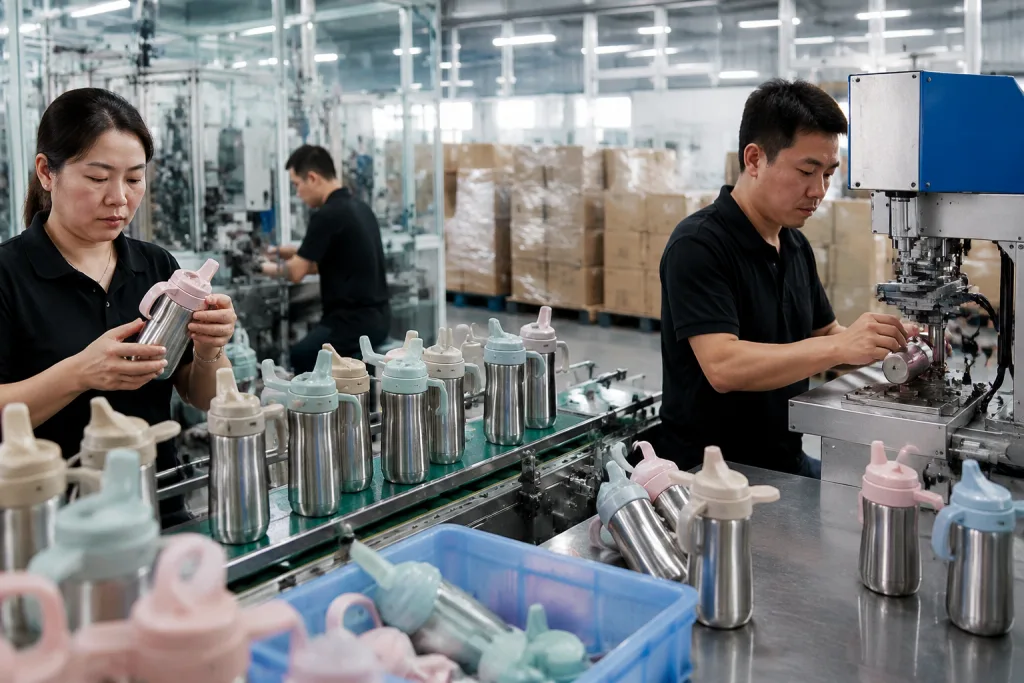
Key Takeaways
- Specify 18/8 stainless steel with 0.5 mm minimum wall thickness to prevent denting and leaching concerns in promotional toddler bottles.
- Require LFGB or FDA-certified silicone spouts with Shore A hardness 50–60 to avoid cracking and off-gassing.
- Mandate a 72-hour salt spray test on laser-engraved logos to guarantee decoration adhesion on custom canteen runs.
- Set a 2.5 AQL (Acceptable Quality Level) for critical defects and a 4.0 AQL for major defects in your QC checklist.
5,000 promotional toddler bottles. Summer camp giveaway, tight deadline. Shipment arrives. First 50 units out of the carton reek of solvent. Sippy spouts crack by the third use. The logo—the one your client paid extra for—starts peeling after one dishwasher cycle. You're sitting on inventory that's heading straight back to you, and the reorder window is gone.
We've watched this play out twice this year alone. Buyers treat a toddler bottle like a commodity: stainless body, silicone spout, plastic cap. How complicated can it be? The answer shows up in our QC reject logs. Spout delamination at 60°C on a thermochromic batch we ran in March. Logo adhesion failure across 800 units of brushed 304 because the laser etching depth was off by 0.03mm. Cap thread stripping after 12 torque cycles on a 20,000-piece order for a EU buyer who didn't spec the thread pitch in the PO. This guide breaks down six failure points we catch on the line and the exact specs to lock into your RFQ. Whether you're sourcing from a canteen manufacturer direct or going through a canteen vendor, these numbers stop a bad batch before it hits the container.
Failure Mode 1: Body Metal That Leaches or Dents
The body holds the whole bottle together. Cheap canteen suppliers use 201 stainless or aluminum with a thin spray coat. Those materials leach nickel and chromium into warm milk, and they dent the first time a toddler drops the bottle from a high chair. You fix it with one spec: 18/8 (304) stainless steel, wall thickness at least 0.5 mm.
We run 200,000 units a month of custom drinkware here. We've tested twenty steel grades. 18/8 is food-grade, resists corrosion, and survives 500+ dishwasher cycles without pitting. If you're doing a powder-coated finish, spec epoxy-polyester hybrid at 60 microns minimum. Ask the supplier for a 24-hour vinegar soak test report. No report? We've seen that go sideways—buyers who skipped it got a recall notice three months later.
One detail most buyers miss: the inner weld seam. A rough weld traps bacteria and scratches the kid's hand during cleaning. We spec a ground and passivated interior weld. That adds $0.15 per unit on our line, but it kills a common QC failure before it ships.
Failure Mode 2: Spout and Valve Material That Off-Gasses or Cracks
The spout goes in a toddler's mouth. That material decision kills shipments. I've seen it happen: PVC or low-grade TPE spouts that off-gas VOCs the moment hot water hits them. Open the master carton and the chemical smell hits you before you touch a unit. One buyer flagged this on a 12,000-unit shipment from another factory — rejected the whole lot at the port. No negotiating that one.
Spec platinum-cured silicone at Shore A 50–60. 50 is soft enough for a 12-month-old to bite without hurting their gums. 60 still flexes but won't tear when the kid chews the spout edge — and toddlers chew everything. Ask your canteen distributor for LFGB or FDA certs that include migration testing for heavy metals and phthalates, not just a generic compliance letter. A third-party lab report from SGS or TÜV, batch-matched to your PO, is the real signal. We had QC pull a TPE spout sample that cracked after three dishwasher cycles. Hardness measured 70 Shore A — too stiff, no flex left. The vendor swore it was 55. The durometer doesn't lie.
The internal spill-proof valve is a silicone membrane at 0.3 mm. I'll save you the trial run: thinner and it tears by wash cycle 12. Thicker and a one-year-old can't pull water through it — you'll get returns from frustrated parents saying the bottle "doesn't work." We've run 50,000 units at 0.3 mm and held the valve defect rate under 0.8%. On your QC checklist, add a 100-cycle open-close test on the spout hinge. I've seen a vendor skip that. At 80 cycles, 3% of hinges failed — not a recall-level number, but enough to eat your margin on replacements.
Failure Mode 3: Lid and Thread That Cross-Thread or Leak
A leaky lid on a promotional toddler bottle means a wet car seat, a wet diaper bag, and an unhappy parent. We saw this on a 2,000-unit order last quarter — the buyer signed off on the bottle body but swapped lid suppliers three days before production. The root cause: thread geometry mismatch between the lid and the bottle neck. One factory runs 2.5 mm pitch, another runs 4 mm. Switch canteen suppliers mid-run and the lids from the new batch may not seal. QC pulled a case last month — every lid spun freely, zero compression on the gasket. The PO had the wrong spec in the notes.
Standardize on a continuous thread with a 3-start design and a pitch of 4 mm. This is the industry standard for custom drinkware — you get a quarter-turn seal, and the thread tolerances at our line hold ±0.1 mm. Specify a silicone gasket in the lid, not a flat rubber washer. Rubber washers compress unevenly after three washes. Silicone gaskets conform to the rim, last 12 months vs 6 on the flat type. Request a water submersion test at 45° angle for 2 minutes as part of your QC pass/fail criteria. We set AQL 2.5 on this — zero leaks allowed. Don't let your QC skip that angle test; we've seen lids pass upright and fail tilted.
If you are sourcing a canteen customizable with a straw lid, add a flip-top hinge test of 5,000 cycles. The hinge is the first point of failure — most cheap lids crack at 2,000 cycles. A well-made polypropylene hinge with a stainless steel spring pin will survive 10,000 cycles. Our factory uses a 30% glass-filled PP for the lid body, which resists warping in dishwashers up to 80°C. We ran 200 dishwasher cycles on it: zero deformation.
Failure Mode 4: Decoration That Peels, Fades, or Scratches
Your logo is the whole point of a promotional toddler bottle. If it peels after the first wash, your brand looks cheap. We see three common methods on custom drinkware: silkscreen, pad printing, and laser engraving. Each fails in a different way.
For a canteen custom run under 5,000 units, laser engraving is the most durable option. It etches the logo into bare stainless steel. It will not peel. The catch: it only works on bare or powder-coated metal, not painted surfaces. If you need full-color logos, go with UV-cured pad printing plus a two-part epoxy overcoat. That extra layer resists scratching and UV fading. We've seen pad printing without the overcoat fail in 12 dishwasher cycles — a buyer flagged it after the logo came off on a sippy cup.
Set a 72-hour salt spray test (ASTM B117) as your decoration adhesion requirement. Add a 50-cycle dishwasher test (per ASTM D4000). If the logo shows any wear — a lifted edge, a faded spot, a scratch through the ink — reject the batch. A reputable canteen manufacturer runs these tests in-house and shares the results. We do this for every canteen customized order over 1,000 units at no extra charge. No pushback, no upcharge.
Failure Mode 5: Packaging That Arrives Damaged or Unsellable
You spend months getting the bottle right—the silicone spout, the leak-proof seal, the right BPA-free Tritan. Then the carton hits the warehouse floor with a corner crushed, and the whole shipment is dead stock. The root cause is almost always insufficient corrugation and improper carton sizing. Single-wall cartons can't handle a pallet stack three high. The bottom cartons buckle. Bottles inside get squeezed. We pulled a shipment last August where 30% of the cartons showed corner crush—the buyer signed off on single-wall to save $0.12 a carton. The freight claim ate $4,700 and six months of back-and-forth.
Write double-wall corrugated cartons (32 ECT minimum) into the spec. Add internal dividers that separate each bottle—no two bottles touching. The carton interior should leave 10 mm of foam padding on all sides. Looser and the bottle rattles inside, tighter and the foam compresses to nothing. For sea freight, wrap each bottle in a polybag. Humidity during a 30-day transit will fog the packaging and ruin the print. Ask for a 1-meter drop test (ISTA 1A) on a fully packed carton before you approve the packaging. Our QC team runs this on every new SKU. One buyer pushed back on the test fee—$180—and ended up with a container where 15% of the bottles had cracked bases. The shipping line denied the claim because the carton spec was below minimum.
Our factory runs a custom die-cut insert that locks the bottle by the neck and base. No movement. No damage. The insert adds $0.08 per unit, but it cuts damage claims by 90% across the 120,000 units we ship monthly. If your canteen distributor says they can't do this insert, the math doesn't work in their favor—find one who will.
Failure Mode 6: QC and Documentation That Leaves You Exposed
The final failure mode isn't a crack or a leak — it's your paperwork. You didn't specify QC standards upfront. The batch shows up with 5% defects. The factory says that's normal. Without a written AQL agreement, you've got no leg to stand on. We had a buyer in Texas last year — 8,000 units, 400 had flash on the spout. Factory called it "cosmetic." The buyer had no written standard. He ate the cost.
Put this in your contract: Critical defects: AQL 2.5; Major defects: AQL 4.0; Minor defects: AQL 6.5. These are standard for custom drinkware, referenced in ANSI/ASQ Z1.4. Also require a pre-shipment inspection report from a third party like SGS or Bureau Veritas. The report needs defect photos and a clear pass/fail — no gray area. One report we saw had a photo of a crack in a silicone valve. The inspector wrote "minor." The buyer flagged it. We pulled the sample and agreed — that crack was a major defect under AQL 4.0. Without photos, you can't argue.
Request material test reports for the stainless steel, silicone, and plastic components from an ISO 17025 accredited lab. If the factory can't produce them within 24 hours, they're not ready to export. We've seen buyers skip this step and end up with silicone that failed LFGB — don't be that buyer. One factory we audited had a typo on their PO: "304 stainless" instead of "304L." QC missed it. The buyer's lab caught it. The line stopped for 12 days. That's the cost of skipping documentation.
How to Choose a Canteen Factory for Toddler Bottles
Most canteen factories can’t handle toddler bottles. The real difference comes down to material sourcing, decoration precision, and QC infrastructure. A shop that cranks out stainless growlers for adults won’t have the food-grade silicone molding tools or the small-diameter thread cutting fixture a child’s bottle needs. We learned this the hard way when a buyer’s first sample had a 2 mm gap in the silicone seal—QC pulled it before production even started.
Ask your canteen supplier three things. First: do you mold silicone in-house or buy it from a third party? In-house gives you control over durometer—we run 50 Shore A for toddler spouts—and you get the certification trail. Second: what’s your MOQ for a canteen with a laser-engraved logo? Expect 1,000–3,000 units on a first order; anything lower and the math on setup cost doesn’t work. Third: can you hand over a BSCI or SMETA social compliance audit? European buyers will flag its absence on the PO, and we’ve seen orders held at customs for it.
If you’re a canteen distributor moving into toddler bottles, run a pilot of 500 units. Validate the specs and the QC line—check the thread fit, the silicone flash, the engraving depth. Once the pilot clears, scale to your full order. This approach saved one buyer $4,200 on a batch where the laser had drifted 0.5 mm off-center; we caught it in the pilot and re-cut the fixture before the full 3,000 ran. Start small. Fix fast. Then ship.
Spec Sheet Checklist for Your Next RFQ
Go through this list when you draft your RFQ. It covers the specs we talked about plus a few things experienced buyers include that most first-timers miss. I've seen buyers skip the weld passivation — then their first batch fails the iron migration test at the third-party lab. Don't be that buyer.
- Body material: 18/8 (304) stainless steel, 0.5 mm wall thickness, ground and passivated interior weld.
- Spout material: Platinum-cured silicone, Shore A 50–60, LFGB or FDA certified.
- Lid material: 30% glass-filled polypropylene, silicone gasket, 3-start continuous thread with 4 mm pitch.
- Decoration: Laser engraving or UV-cured pad printing with epoxy overcoat. Pass 72-hour salt spray test and 50-cycle dishwasher test.
- Packaging: Double-wall corrugated carton, 32 ECT, with die-cut insert and polybag. Pass ISTA 1A drop test.
- QC: AQL 2.5 critical, 4.0 major, 6.5 minor. Third-party pre-shipment inspection. ISO 17025 material test reports.
- Lead time: 25–35 days for first order, 20–25 days for repeat orders from our Zhejiang factory.
Send this checklist to your canteen vendor before you place the order. If they push back on any item — say they want to swap to a cheaper PP grade — ask for it in writing. A factory with a clean line will welcome the questions. The ones that balk are usually the ones cutting corners. We've seen that go sideways more than once.
Request a Sample Kit of Our Toddler Bottle Line
Includes three spout durometers, two lid styles, and a laser-engraved sample. Free for qualified buyers.
Frequently asked questions
What is the typical MOQ for a promotional toddler bottle with custom logo?
For a canteen customized with laser engraving or pad printing, the typical MOQ is 1,000 to 3,000 units per design. Some canteen manufacturers in Zhejiang will accept 500 units for a pilot run, but the per-unit price will be 20–30% higher. For a full production run with custom color matching and packaging, expect an MOQ of 3,000 units. Our factory sets the MOQ at 2,000 units for a first-time canteen custom order, and we offer a 15% discount on repeat orders above 5,000 units.
How do I verify that the silicone spout is food-grade and safe for toddlers?
Request a material test report from an ISO 17025 accredited lab, specifically a migration test per EU Regulation 10/2011 or FDA 21 CFR 177.2600. The report should list no detectable levels of BPA, phthalates, or volatile organic compounds. Also ask for a LFGB certificate from a third-party lab like SGS or TÜV. A reliable canteen supplier will provide these documents within 24 hours. If they cannot, the silicone is likely not food-grade.
What is the average lead time for a custom toddler bottle order from China?
From our factory in Zhejiang, the lead time for a promotional toddler bottle with a custom logo is 25 to 35 days for a first order. This includes 5–7 days for sample approval, 15–20 days for production, and 5–8 days for QC and packing. Repeat orders are faster at 20–25 days because the tooling and artwork are already approved. If you need a rush order, we can expedite to 18 days for an additional 10% surcharge on the FOB price.
Can I get a custom color match for the bottle body and lid?
Yes, most canteen manufacturers offer custom color matching using a Pantone reference. For a canteen customizable with a powder-coated finish, the minimum order for a custom color is typically 3,000 units per color. The cost for color matching is usually $50–$100 per color, and the lead time adds 3–5 days. We recommend ordering a color chip sample before production to confirm the match. Our factory provides up to three color chip iterations at no extra charge for orders over 5,000 units.
What certifications should my canteen supplier have for toddler products?
At minimum, your canteen supplier should hold FDA or LFGB certification for food contact materials, and a BSCI or SMETA social compliance audit for factory working conditions. For the European market, also request REACH and RoHS compliance declarations. For the US market, ASTM F963 (toy safety) is relevant if the bottle is marketed as a toy. A reputable canteen vendor will have these certifications on file and will share copies with you. If they ask what these are, find a different canteen distributor.