Key Takeaways
- A workable MOQ for promotional thermos USA orders is usually 500-1,000 pcs, with FOB China pricing often starting around USD 2.40-4.80 per unit depending on capacity and decoration.
- Double-wall 304 stainless with 0.5-0.6 mm inner wall and vacuum insulation is the baseline if you want a real custom thermos, not a souvenir-grade bottle.
- Plan 7-10 days for samples and 25-35 days for mass production from a thermos factory in Zhejiang when artwork is already approved.
- Use AQL 2.5 for major defects and 4.0 for minor defects, and test at least 3 pcs per lot for leak, vacuum retention, and carton drop resistance.
I've shipped over 40,000 custom thermoses to US promo distributors in the past three years. The orders that go sideways all share the same root problem: the buyer treated it as a swag order instead of an engineered product. A thermos is a pressure vessel with a welded seam, a vacuum gap measured in microns, and a lid gasket that has to survive 1,200 open-close cycles. Respect that, and the project runs clean.
Here's what actually matters: can the factory hold ±0.2 mm on the stainless tube OD so your wrap-around print registers correctly? Will the vacuum integrity survive a 1-meter drop test onto concrete—twice? Is the carton spec locked before the PO is cut, or are you going to discover the master carton was 5 kg overweight for LTL palletization after the BOL is printed? I've seen a $12,000 order of 3,000 units get rejected at the port because the buyer OK'd a logo proof but never specified AQL 2.5 on the decoration audit. The factory shipped with streaking on 15% of the bottles. No spec, no recourse.
Promotional thermos USA sourcing doesn't need to be painful. Get the material certs (304 stainless, not 201), nail the pre-production sample, and put a QC gate at the factory floor before the container seals. The rest is just logistics.
Start With The Use Case
Define the job before you ask for a quote. A 500 ml promotional thermos handed out at a golf tournament is a completely different build from a custom 750 ml bottle destined for an REI shelf. I've watched buyers blast the same RFQ to five factories, get back samples that look fine sitting on a desk, then field a panicked call because a rep couldn't pop the lid one-handed on a dusty job site. Capacity, lid mechanism, exterior finish, packing specs—every choice shifts depending on where the bottle actually lives. Skip this step and you burn a sample round. That's 18 days of lead time gone.
Outdoor retailers consistently move 500 ml, 750 ml, and 1,000 ml. For promotional brands, 500 ml is the sweet spot: roughly 0.45 kg per unit keeps freight manageable, and the perceived value lands above a cheap giveaway without blowing the budget. When a buyer tells me "I need a custom thermos for retail," I push back with one question: who's holding it? Hiker. Commuter. Field tech. Truck driver. Each answer changes the lid spec and the finish. We had a buyer spec a 1,000 ml bottle for a corporate event, then discovered shipping ate 22% of their margin. The math didn't work. A tighter brief upfront cuts two rounds of revisions later.
A practical brief hits these points:
- Capacity: 500 ml, 750 ml, or 1,000 ml
- Material: 304 stainless is standard; 316 stainless for salt-spray or industrial use
- Insulation target: 12 hours hot / 24 hours cold is the baseline we test against
- Finish: powder coat (most durable), polished (fingerprints show fast), or spray paint (budget option, higher defect rate)
- Decoration: silk screen, laser engraving, UV print, or emboss label
If your buyer is reselling—not gifting—you also need carton quantity, retail-ready labeling, and clarity on FNSKU or U.S. compliance stickers. A supplier who knows what they're doing asks these questions on the first call. A weak one quotes a low number and leaves the rest vague. We've seen that go sideways at inspection when QC pulled a sample and the label wasn't even in English.
Choose The Right Stainless Build
For a custom stainless thermos, the construction matters more than the brochure language. Use 304 stainless steel for the inner and outer walls unless your customer specifically needs a more corrosion-resistant upgrade. In practical terms, 304 is the standard for most promotional thermos USA programs because it keeps cost under control and passes normal food-contact expectations when made correctly. If the application is harsher, 316 can be justified, but it adds cost without helping every buyer.
Ask for actual wall specs. A reliable thermos factory will state something like 0.5 mm inner wall and 0.4-0.5 mm outer wall, depending on the shape. Vacuum gap consistency is what gives you stable insulation, not a glossy catalog photo. If a manufacturer thermos quote is suspiciously cheap, check whether they are using thinner steel, weaker vacuuming, or a simpler lid. That is where the savings usually come from.
For most bulk thermos projects, the value stack is:
- 304 stainless for mainstream promotions
- Powder coat for grip and scratch resistance
- PP or Tritan lid parts depending on budget
- Silicone gasket with a tested seal path
China and Zhejiang factories can produce very consistent bottles when the spec is disciplined, but consistency is not automatic. Make the supplier provide a section drawing, steel grade, and test report references before you issue a PO. If they cannot explain the build in plain terms, you are not dealing with a serious thermos supplier.
Decoration That Survives Shipping
Decoration is where thermos customization programs get overdesigned. A promotional thermos is a utility item, not a poster. We ship thousands of these, and the best-looking logo on day one is worthless if it flakes off after 20 courier handlings and a few dish cycles. Keep the method simple and matched to the finish. On powder-coated bodies, laser engraving gives a durable contrast — we've run 5000 units with zero ink wear complaints. On polished stainless, silk screen works well if the artwork is not too detailed. Our QC pulled a sample last month where a 4-color gradient bled at the seam; the buyer flagged it and we had to redo 800 pieces.
For a custom thermos with one-color branding, laser engraving is usually the cleanest choice. For a distributor thermos program that needs stronger shelf impact, a 1-2 color silk screen or UV print does the job. If the artwork has small text below 5 pt, simplify it. That is not a creative compromise; it is a production reality — the line can't hold registration tighter than 0.5 mm on a curved surface.
Do not approve decoration without asking for:
- Actual logo placement dimensions in mm
- Print tolerance, usually +/- 1.5 mm
- Color standard if Pantone matching is required
- Durability expectation: rub test, alcohol wipe, or dishwasher exposure
China-made thermos promotional work is competitive because the decoration lines in Zhejiang are efficient, but only if the artwork is production-ready. If you are ordering thermos bulk for retail kits or campaign packs, ask for a pre-production sample with the exact decoration method, not a plain white sample with a note attached. Those are not the same thing. We've seen this go sideways — a buyer approved a plain sample, then the silk screen on the actual run misaligned by 2 mm. The math doesn't work for reprints at 5000 units.
Pricing, MOQ, And Lead Time
Buyers start by asking for the cheapest FOB number, but that's the wrong question. For promotional thermos USA orders, price depends on capacity, steel grade, lid complexity, finish, and decoration. A simple 500 ml 304 stainless model with one-color print lands around USD 2.40-3.20 FOB China at 1,000 pcs. A powder-coated version with laser engraving and upgraded lid components moves closer to USD 3.60-4.80. We had a client last year who ordered 3,000 units, and the QC team pulled the first 50 samples because the lid seal didn't match the spec sheet — that cost us 12 days to correct.
Typical MOQ from a working thermos factory in Zhejiang is 500-1,000 pcs per design and color. Some thermos manufacturers will stretch lower for repeat buyers, but the math doesn't work under 300 units. Lead time runs 25-35 days after sample approval for a standard order, and 40-50 days if you need custom packaging, multiple colors, or special lids. If someone promises 10 days for a new customized thermos order, they are probably skipping steps — like the 72-hour drop test or the salt spray check — that you will later pay for.
Use these commercial terms in your RFQ:
- Price basis: FOB Ningbo or FOB Shanghai
- Payment: 30% deposit, 70% before shipment
- Inspection: third-party or factory final inspection to AQL 2.5
- Packing: polybag, inner box, master carton, drop-test requirement
A serious thermos supplier gives you a price ladder at 1,000, 3,000, and 5,000 pcs. That is useful because promotional brands buy in waves. A supplier thermos quote that only makes sense at one quantity is incomplete — and you will find that out when the second batch hits.
Sample Before You Commit
Skip the PDF. Bulk thermos orders go wrong when you skip the sample step. You need to verify three things: the structure holds up, the decoration lands right, and the thermos actually keeps coffee hot past lunchtime. If the shape is new to the line, ask for a plain structural sample first. Once artwork and packing specs are locked, request the decorated pre-production sample. This sequence saves us both from rework. We've seen buyers approve a full production run off a mockup photo — then QC pulled the sample and found a 2mm gap in the lid seal.
Here's a sample checklist that catches the common misses:
- Leak test with 95°C hot water for 24 hours — we run this on every sample unit
- Lid open-close cycle at least 500 times on sample units
- Thermal retention test against your target hours — 6 hours is the minimum we recommend for promotional use
- Logo placement checked against the approved dieline — one buyer flagged a 1.5mm shift on the last order
For promotional thermos USA campaigns, the mistake I see most often: approving a sample that looks great on the desk but fails on the user. Wrong lid torque. Awkward drinking angle. The end user needs two hands to open the cap — that kills a distributor thermos program fast. Or the lid sweats under normal use, and the buyer's marketing team panics. Ask your manufacturer thermos team for two samples minimum: one for approval sign-off, one kept as a retained reference. The math doesn't work if you only have one and it gets lost.
In Zhejiang, good factories turn a sample in 7-10 days when tooling already exists. New tooling? Expect 18-25 days. A solid supplier thermos partner will tell you that on day one, not after you've already committed to the campaign launch date.
QC Gates You Should Not Skip
QC protects margin on thermos custom jobs. We start with incoming 304 stainless, then semi-finished bodies, then final packing. On a line that is set up right, QC checks steel thickness, weld seams, vacuum hold, lid seal, logo position, and carton crush strength. If the factory only shows the packing table, that is not enough. We saw this go sideways after the buyer flagged a leaking lid in the second carton, and the line had already burned half a shift.
For a shipment into the United States, ask for test references that match REACH and food-contact requirements where they apply. Some buyers want LFGB, some want FDA-oriented declarations. Pick the ones that fit the channel. Do not stack papers for show. The math does not work if the goods pass documents and fail the first compliance check at customs. We had one PO where the buyer typed “thermo” instead of “thermos”; QC still caught the carton mark before we shipped 1,200 pcs.
Use a practical inspection standard:
- AQL 2.5 for major defects
- AQL 4.0 for minor defects
- 3 pcs per 500 pcs lot for leak and thermal checks
- Random carton drop test from 80 cm for export packing
A Zhejiang thermos line can put out solid goods, but only if the inspection spec is written down. We run a torque wrench on lid threads and check 0.2 mm wall variation before release. A good thermos manufacturer likes that discipline because it cuts arguments later. A weak one says “no problem” and hopes you do not inspect. That is the wrong question to ask.
Shipping Into The United States
Freight eats margin fast if you ignore cube. A stainless thermos feels light in hand, then turns into a stack problem once the printed gift box goes on. For promotional thermos USA quotes, we check gross weight, carton size, and how the pallet sits on the floor. A 500 ml bottle may weigh 320-420 g each, but the packed carton drives the bill. We ran a 39 x 29 x 28 cm master carton last month, and the freight quote moved on that one change. The math does not lie.
For U.S. import jobs, lock the trade term before the line starts. FOB China, DDP to your warehouse, or delivery to an Amazon prep center are different jobs, and they price differently. If Amazon is part of the plan, send the FNSKU, carton marks, and case pack spec before production. One buyer flagged a PO typo on the case pack, 24 pcs written as 42 pcs. QC pulled the sample, and the repack quote landed 12 days later. For distributors, carton efficiency and pallet pattern usually matter more than the bottle finish. This is the wrong question to ask if you only stare at unit price.
Practical freight points:
- FOB works well if you have your own forwarder in Ningbo or Shanghai
- DDP fits buyers who want one landed number and no surprise duty bill
- Air freight is for urgent samples or a 500 pcs launch
- Sea freight is the normal choice for thermos bulk orders above 1,000 pcs
China export shipping from Zhejiang is routine, but the paperwork has to match line by line. Commercial invoice, packing list, and carton marks need the same item name, qty, and carton count. If the supplier thermos team prints 480 pcs on the invoice and 500 pcs on the packing list, the customs broker will stop it. We have seen that go sideways on a 20 ft container with 8,400 pcs, and the broker does not care whose typo it was. We run this check against the packing list before cargo leaves the line.
What A Solid Factory Looks Like
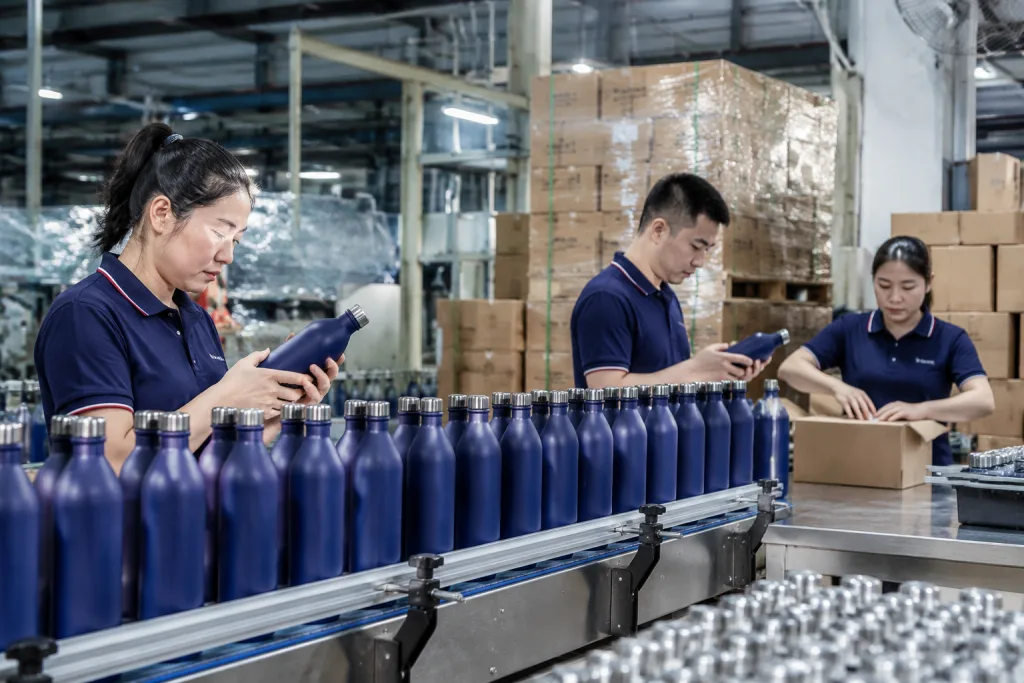
You do not need a giant showroom. You need a thermos factory that can show process control. A real thermos manufacturer should state monthly output, machine count, and the inspection flow without stopping to make up numbers. In one Zhejiang plant we run, the line sat at 240,000 units a month, with separate vacuum sealing, deco, and packing stations. That setup matters when a buyer wants a rush order for a promotional thermos USA program.
Ask straight questions: how many lines are live, how many QC staff are on each shift, and what happens when a lot fails leak testing. A responsible thermos supplier gives a direct answer. A serious thermos manufacturer also shows rework records, scrap rate, and retained samples. On one 500 ml run, QC pulled the sample and found a 1.2 mm cap gap; that kind of miss tells you more than a polished deck. Show me the 500 ml sample and the leak test report. This is the wrong question to ask if you only care about the showroom.
Look for these signals:
- BSCI or equivalent social compliance audit on file
- Material traceability by lot
- Retained samples for every order
- Clear responsibility for claim handling after shipment
For outdoor retailers and promotional brands, the best thermos suppliers are the ones who cut your workload. In Zhejiang, that means a factory that treats documentation and inspection as part of the product, not an afterthought. We shipped one PO where the buyer flagged a typo on the carton spec before loading; that saved a warehouse mess. Get that right, and your customized thermos program stays repeatable instead of fragile.
Get a real quote on your thermos program
Send your capacity, artwork, and target landed price. We’ll spec the right custom thermos, confirm MOQ, and quote from our Zhejiang line.
Frequently asked questions
What is the usual MOQ for a promotional thermos USA order?
Most thermos manufacturers in China will set MOQ at 500-1,000 pcs per design and color. If you want custom packaging, multiple print locations, or a new lid mold, the minimum can rise to 3,000 pcs. For repeat orders, some Zhejiang factories will accept lower quantities because tooling and artwork are already approved. The key is to separate MOQ for the bottle, MOQ for decoration, and MOQ for packaging. That is how you avoid paying a hidden setup charge on a supposedly simple custom thermos order.
How much should I budget per unit?
For a basic 500 ml promotional thermos USA program, expect roughly USD 2.40-3.20 FOB China at 1,000 pcs. If you add powder coating, laser engraving, upgraded lid parts, or gift packaging, the number often moves to USD 3.60-4.80. Larger thermos bulk quantities usually reduce the unit price by 8-15 percent. Do not compare only the bottle cost; ask for carton count, inner box cost, and freight cube. On a customized thermos project, those extras can change the landed price more than the decoration itself.
Which decoration method holds up best on stainless thermos?
Laser engraving is usually the most durable option on a powder-coated or painted body because it does not rely on ink adhesion. Silk screen is fine for one or two colors if the surface is prepared correctly and the logo is not too small. UV print gives more flexibility but needs tighter QC. For a distributor thermos program, I would avoid tiny text under 5 pt because it tends to blur or wear faster than buyers expect. Always request a pre-production sample with the exact decoration method, not a blank body with a print mockup.
What documents should I ask for from a thermos supplier?
At minimum, ask for commercial invoice, packing list, specification sheet, material declaration, and inspection report. If your channel or compliance team needs it, request REACH-related declarations, food-contact support, and any social compliance audit like BSCI. For Amazon or retail programs, add carton labels, FNSKU placement details, and master carton dimensions. A good thermos supplier in Zhejiang will have these ready without a long delay. If they cannot produce a clear spec sheet with wall thickness, steel grade, and capacity tolerance, that is a warning sign.
How long does production take from approval?
For a standard factory thermos order with approved artwork, plan 25-35 days for mass production. Samples usually take 7-10 days if tooling already exists. If the project needs a new cap mold, new packaging, or a complex print layout, the timeline can stretch to 40-50 days. Add 20-35 days for ocean freight to the U.S., depending on port and season. If your promotional thermos USA launch is date-driven, lock artwork, carton specs, and shipping terms before you issue the PO. That is the part buyers most often underestimate.