Key Takeaways
- MOQ for a standard custom thermos program is often 500 units per SKU, with 25-35 days lead time after sample approval.
- A 304 stainless body is common; 316 liner or food-contact upgrade adds cost, often USD 0.30-0.90 per unit.
- For US promo use, ask for REACH, FDA food-contact declarations, and AQL 2.5 inspection on critical defects.
- Laser engraving is usually cleaner for a customizable thermos than full-color wrap, especially on 18/8 steel surfaces.
If you are buying a promotional thermos flask USA program, the hard part is not finding a bottle. The hard part is finding the right stainless thermos that survives shipping, decoration, and field use without turning into a warranty problem. A 500 ml bottle can look clean on the sample bench and still fail after a buyer drops it in a trunk, a warehouse, or a trade-show bag. We have seen that go sideways. QC pulled a sample with a dent at the base after a 1.2 m drop test.
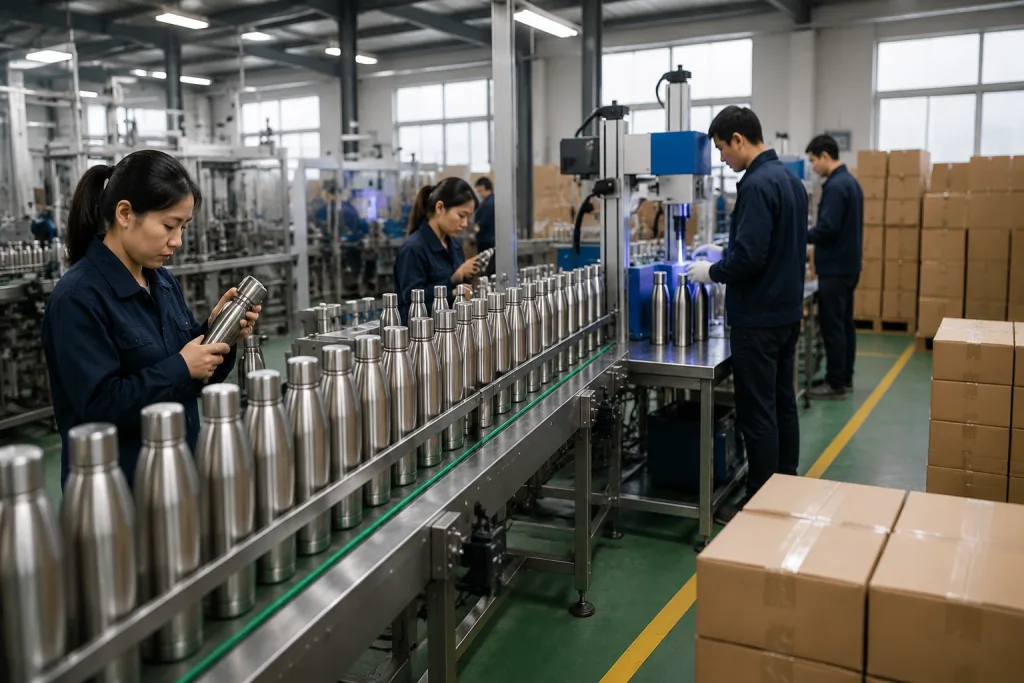
For outdoor retailers and promotional brands, the decision comes down to margin, lead time, and how much loss you can carry on bulk thermos orders. A good thermos manufacturer in China should talk steel grade, vacuum performance, decoration limits, and carton loading in plain numbers. We run these orders in Zhejiang, and the useful talk is usually MOQ 500 units per SKU, 25-35 days for standard production, and what changes when you move from a 304 body to a 316 liner or add a powder coat. The buyer flagged a typo on one PO last month, and that changed the pack count. That is the real work. This is the wrong question to ask if you only compare sample price.
What buyers usually get wrong
The first mistake is treating every stainless bottle as fit for a promotional thermos flask USA program. It is not. We ran a lid through 3,000 open-close cycles and the seal went flat; the buyer also flagged carton crush after a 1.2 m drop test. Buy for the use case. Not the render.
Start with the spec sheet, not the hero photo. For bulk thermos buying, ask for:
- Body material: 304 stainless is the baseline; 316 gives better corrosion resistance, which matters for coastal accounts and acidic drinks.
- Wall structure: double-wall vacuum, usually 0.4-0.5 mm inner and outer walls. QC pulled the gauge on the line.
- Capacity: 350 ml, 500 ml, 750 ml, and 1 L are the common commercial sizes.
- Heat hold: 6-12 hours is realistic for factory thermos models, depending on lid design, fill temperature, and whether the buyer wants hot coffee or just warm water.
If a supplier cannot state these numbers plainly, keep looking. The math does not work any other way. A serious thermos supplier in Zhejiang or elsewhere in China should hand over test data, not slogans. For promo work, the bottle has to fit the campaign, the carton, and the buyer’s return tolerance. We ship to those three points, or the order goes sideways.
Specs that actually matter
Procurement teams often stare at capacity and miss the specs that drive scrap and returns. For a custom thermos order, three points matter more than headline volume: steel thickness, vacuum quality, and closure design. We run 0.4 mm shells all the time. They can pass if the forming is clean, but they dent faster in field distribution. A 0.5 mm wall adds weight and usually USD 0.15-0.35 per unit, depending on the model. QC pulled a sample with a thumb dent after a 1 m drop, and the buyer flagged it on the next round.
Vacuum performance is not a marketing line. Ask for a boil test or thermal retention test under fixed conditions: ambient 20-25°C, preheated bottle, 95°C fill, cap closed. For a mid-range customizable thermos, we quote 6 hours above 70°C and 12 hours above 55°C, but cap style and fill ratio move those numbers. “Keeps hot all day” is the wrong spec to write. We had a PO with that phrase on it, and the line spent two days chasing a number nobody could test.
Check the lid last, and check it hard. A sip lid, screw cap, or push-button top changes leakage risk and the way the bottle gets used in the field. For a promotional thermos, a simple screw cap or insulated lid usually beats a clever mechanism that adds another USD 0.60 and doubles complaint risk. The better move is boring. On one job, the buyer wanted a push-button top for a 10,000-piece run, then came back after the first pilot because the hinge tolerance was off by 0.3 mm. In Zhejiang, on a high-volume line, we ship the stuff that closes clean and survives the truck ride.
Decoration without trouble
Decoration is where a lot of custom thermos jobs go sideways. We run a sample board on the line before we quote: one-color screen print, laser engraving, or UV print. The call comes down to the art file, the target price, and whether the bottle needs to read as premium merch or a low-cost giveaway. Clean logo? Screen print keeps cost down. Stainless that will get daily wear? Laser engraving usually wins. A big wrap can take UV print, but the art tolerance gets tight fast, and that is where buyers start pushing back.
Typical decoration costs for a promotional thermos flask USA order look like this:
- Laser engraving: often USD 0.20-0.45 per unit
- One-color screen print: often USD 0.10-0.25 per unit
- Full-color UV print: often USD 0.35-0.80 per unit
Judge it by abrasion, not by the mockup. QC pulled the sample on a gym order and the print started scuffing at the 300-rub test mark. That buyer was not impressed. For event kits, laser engraving gets fewer complaints because there is no ink layer to peel. For a short campaign, a powder coat with pad print can still do the job. The math does not work any other way. A decent thermos factory should give you the logo area limits before art approval, because a curved 0.2 mm line on stainless will distort fast. We have seen that go sideways on a PO with one typo in the artwork note.
MOQ, lead time, and pricing
Buyers ask for price first. That is the wrong question. Price only makes sense at a fixed qty, because a 500 ml 304 stainless thermos at 1,000 units does not price the same way as a 5,000-unit run. On our Hangzhou line, a plain stock-style build usually lands at USD 2.10-3.40 FOB China, and once you add engraving, a gift box, and color coating, the same item moves to USD 3.20-5.20. QC pulled the sample, checked the coating thickness at 0.03 mm, and the buyer still wanted the lower number. We’ve seen that go sideways.
For a real production plan, use these reference points. The MOQ is 500 units per SKU for stock-style custom thermos builds, which works for a first U.S. promo order if the artwork is locked. Lead time is 25-35 days after sample approval for standard colors, and sample time is 5-10 days for existing tooling or 12-18 days for new tooling. A mid-size Zhejiang thermos line can run 200,000-400,000 units per month, but only if the deco section and packing station stay in step. One PO came through with the logo code off by one letter, and that typo burned a day. The math does not care about optimism.
Do not ignore freight. A thermos bulk shipment in master cartons is dense, so ocean freight usually works well, but palletization and carton strength still matter. For U.S. distribution, ask for carton dimensions, gross weight, and loading qty per 20GP and 40HQ. We ship better when the buyer gives a real warehouse plan instead of guessing at the carton count. One buyer pushed back on the 2 mm carton spec until we dropped a filled carton from 1.2 m and showed the crush mark. That changed the conversation fast.
Compliance for the USA market
If you sell into the United States, compliance is not busywork. A promotional thermos flask USA order needs a food-contact declaration, REACH paperwork for restricted substances, and an FDA materials statement for every part that touches the drink. We run this check on the line before packing. If the buyer flags a cap liner or silicone gasket, the order stops until the file is clean.
For outdoor retailers and distributor thermos programs, we ask for these records:
- AQL standard: 2.5 major, 4.0 minor for appearance and function checks
- Drop test: 1.0 m or 1.2 m onto carton corners, depending on your channel
- Leak test: inverted soak and pressure check on assembled units
- Packaging test: inner box and master carton compression review
Not every thermos supplier in China will hand this over without a push. Ask for it. A serious thermos distributor relationship runs on traceability, batch control, and written inspection records; we saw one PO typo move the print position by 3 mm, and QC pulled the sample before shipment. The math does not work if you chase the lowest unit price and then eat an audit failure later. A cheap item that fails a retailer check is not cheap anymore.
Checklist before you approve
Set a hard gate before you place a custom thermos PO. It cuts out costly surprises fast. We run this check on every promo job, and QC pulled one sample last month that missed logo height by 2.5 mm. One unchecked PO typo can burn a week. I would not approve a promotional thermos without product, packing, and shipment items on file.
Product checklist
- Material confirmed: 304, 316, or specified recycled content
- Vacuum retention data from the actual production sample, not a lab nice-looking sheet
- Lid photos and exploded drawing, if the closure has multiple parts
- Logo proof with exact placement and size in millimeters
Packing checklist
- Drop-tested inner box
- Barcodes or FNSKU labels if your channel requires them
- Master carton mark format approved
- Carton count and pallet pattern verified
Commercial checklist
- FOB terms and port named clearly
- Lead time written in the PO
- Quality standard attached, usually AQL 2.5
- Spare parts policy for lids, gaskets, or straws where applicable
For a thermos customized for a US promo campaign, force the details before deposit. The math does not work when the buyer flags logo position after tooling starts. We saw that go sideways on a 5,000-piece run, and the line sat idle while people argued over a PO typo. A factory thermos team that answers these items in one email is easier to run than one that answers after production starts. That holds whether you buy from a thermos manufacturer, a thermos supplier, or a thermos factory in Zhejiang or elsewhere in China.
Choosing the right partner
You do not need the lowest quote. You need the partner who can ship the same bottle twice. That is the gap between a one-off number and a thermos manufacturer we can keep on repeat orders. Ask for export history, inspection photos, and a clean production record. BSCI or a similar social audit matters if your brand or retailer asks for it, but audit papers do not pass a lid torque test. QC pulled a sample at 120 g fill, and the leak was still there.
A good thermos suppliers shortlist should answer these questions fast. No waiting.
- What is the real MOQ by color and by decoration method?
- How many units can you ship per month without blowing our slot?
- Which tests run on every lot, and which ones only run on every order?
- What changes when you move from a stock blank to thermos custom tooling?
In practice, a thermos factory in Zhejiang with a stable line, clean QC records, and export packing know-how saves more money than a cheaper reseller who has to check everything twice downstream. We run this math a lot on the shop floor. For outdoor retailers, fewer claims. For promotional brands, the logo still looks intentional after the boxes open. A buyer once flagged a PO typo on “304 stainless” and asked for a rework quote; the line had already packed 1,200 pcs. The math does not work on a thermos custom order.
Request a thermos quote with real specs
Send your size, decoration, quantity, and target price. We will return a production-ready quote, carton data, and lead time.
Frequently asked questions
What is a realistic MOQ for promotional thermos flask USA orders?
For a standard custom thermos program, 500 units per SKU is a normal MOQ in China. If you want multiple colors, each color may need 300-500 units. New tooling or complex lids can raise the minimum to 1,000 units. For a stock model with simple logo work, some Zhejiang factories can accept 300 units, but the unit price usually climbs by 10-20%. Ask the thermos supplier to quote by exact decoration method, because laser engraving, screen print, and full-color wrap all change the order floor.
How much should I budget per unit FOB China?
For a 500 ml 304 stainless promotional thermos, a realistic FOB China range is USD 2.10-3.40 at 1,000 units for plain stock, and USD 3.20-5.20 with logo, coating, and gift box. A 316 liner, matte powder coat, or premium lid can add USD 0.30-0.90 per unit. Freight and duties are separate. If your distributor thermos program depends on landed cost, ask for a full carton spec, because carton volume changes the ocean cost more than many buyers expect.
What decoration method lasts longest on stainless thermos products?
Laser engraving is usually the most durable for a customized thermos because the mark sits in the metal surface rather than on top of it. For simple branding, it holds up well against abrasion, washing, and handling. Screen print is cheaper and fine for short campaigns, but it can wear faster. UV print offers more color, but it needs good surface prep and careful handling. If you sell to outdoor retailers, laser is often the safest choice for a thermos customized program.
Which compliance documents should I request for the US market?
Ask for a food-contact declaration, REACH compliance statement, and written confirmation of materials used in contact with beverages. If the item has coatings or printed graphics, request relevant migration or heavy-metal test data where available. For many programs, an AQL inspection report at 2.5 major and 4.0 minor defects is also useful. If you plan to ship into retail, ask for carton labeling and barcode verification too. A reliable thermos supplier in China should provide these without drama.
How long does production usually take after sample approval?
For a standard promotional thermos flask USA order, 25-35 days is a fair lead time after sample approval and deposit. If the order needs new tooling, specialty lids, or custom packaging, plan for 35-50 days. Sample lead time is usually 5-10 days for existing molds and 12-18 days for new development. A Zhejiang factory with a 200,000-400,000 units per month line can move faster, but only if your art, specs, and carton data are finalized early.