Key Takeaways
- A workable promotional thermos flask US order usually starts at 1,000 pcs MOQ and 25 to 35 days lead time after sample approval
- For daily-use insulation, 18/8 stainless with a 0.5-0.6 mm inner wall is the practical baseline, not a marketing claim
- Plan for AQL 2.5 major / 4.0 minor, REACH documentation, and lid leak testing before shipment
- A real bulk thermos quote should show product, logo, carton, and freight separately, with FOB China often the cleanest starting point
You are not just buying a thermos. You are buying ship date, margin, and a bottle that has to sit in a commuter bag without leaking. For a promotional thermos flask US program, the failure points are plain and expensive: the lid feels flimsy, the logo rubs off, the carton misses FNSKU placement, or the supplier quotes a low unit price and adds freight and rework later. We saw a buyer flag a 2 mm gap at the cap seat on a pre-shipment check. That kind of miss burns days fast.
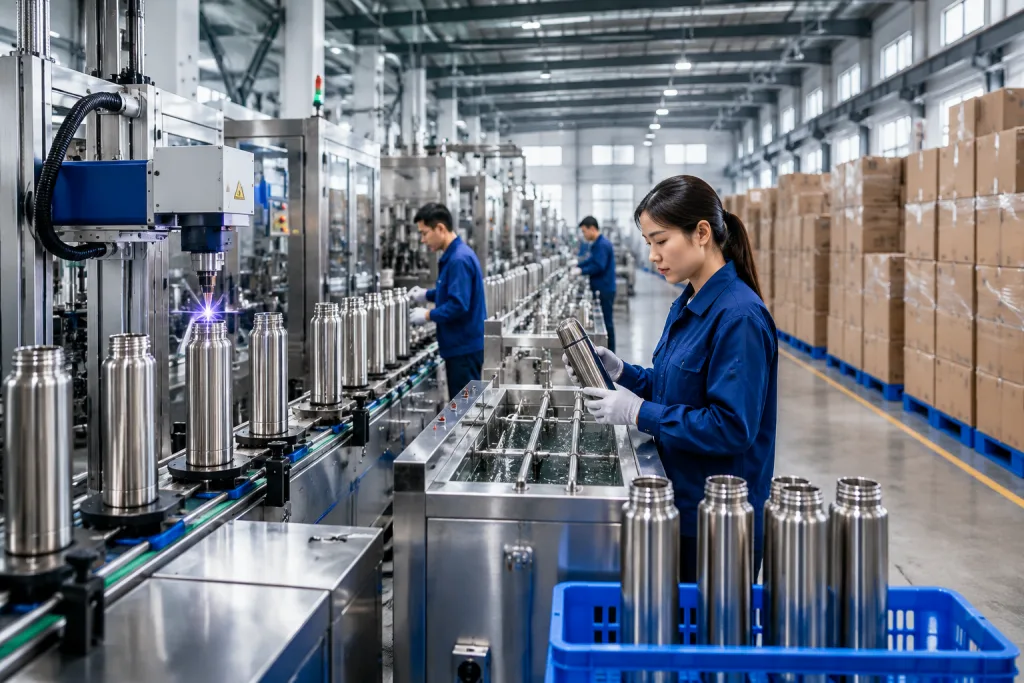
If you source from China or Zhejiang, the job is to turn a loose promo idea into a controlled order. Pick the stainless grade, wall build, lid, decoration method, and test plan before you argue about color. At BottleForge in Hangzhou, Zhejiang, we run stainless thermos production at about 300,000 units per month, with a typical MOQ of 1,000 pieces and a lead time of 25 to 35 days after sample approval. QC pulled the sample with a caliper, and the math does not work any other way.
Start With the Use Case
Before you ask for a price, lock the use case. A 500 ml stainless thermos for outdoor retail is a different order from a 750 ml promotional thermos for a trade show giveaway. One has to hold coffee hot on a trail, fit a pack pocket, and survive repeat hand washing. The other needs a clean box, a sharp print, and a landed-cost target that actually clears. If the use case is fuzzy, the quote drifts. We saw that go sideways on the line.
For US buyers, we start with four items: capacity, insulation target, logo method, and packing. A normal outdoor retail spec is 500-750 ml, 18/8 stainless steel, double wall vacuum, and 6 to 12 hours hot retention depending on the lid. If you are buying for distributors or promo brands, ask for a sample with the exact lid and the exact print method, not a lookalike shell. QC pulled a sample last month and the buyer flagged a 0.3 mm cap insert gap. That killed the order.
Write the buying brief like this: capacity, finish, lid style, logo area, carton count, and test standard. That gives a manufacturer thermos factory something it can quote against. It also tells you whether you need a promotional thermos or a higher-end custom thermos with room for margin. The math doesn't work any other way. We run that check before we open a new mold.
Choose the Right Stainless Build
For a promotional thermos flask US job, the shell spec drives more than most buyers expect. We run 18/8 stainless on both the inner and outer shells as the base build. It stands up to coffee, tea, and daily carry, and it clears REACH and food-contact checks in Europe and North America. On the line, I want the inner wall at 0.5 to 0.6 mm and the outer wall at 0.4 to 0.5 mm. The neck draw changes the call, so we set that by size, not guesswork. A 500 ml body and a 750 ml body do not behave the same.
Do not chase the lowest gauge number. The math doesn't work. Go too thin and the bottle dents, rejects climb, and distributors start complaining after the first drop test. Go too thick and cost jumps, then the 500 ml promo bottle lands above the market's weight target. A normal finished weight is 285 to 340 g. If a sample lands far below that, we ask what got cut; usually it is wall thickness or lid fit, and QC pulled the sample to check it with calipers. We've seen this go sideways on a 1,000 pcs run.
Good buyer checks:
- Ask for the steel grade on both inner and outer shells
- Confirm whether the bottle is powder coated, spray painted, or bare brushed
- Request a cross-section photo of the weld and vacuum seam
- Check if the base has a vacuum plug and whether it is sealed after leak test
If you are comparing custom thermos options from several suppliers, this is where the real manufacturer shows up. A trading-only vendor can talk all day; a factory has weld photos, wall readings, and a leak report. We saw a PO last month where 0.4 mm was typed as 0.04 mm. That one did not ship. The buyer flagged it, and the numbers did the rest. This is the wrong question to ask if you only want the lowest quote.
Design for Logo and Color
Your decoration choice changes the product story and the scrap rate. On one 5,000-piece run, the line lost 3.2% to misregistered pads because the logo file had a thin stroke. Screen print is the lowest cost for most promotional thermos orders, laser engraving holds up best, and heat transfer sits in the middle. A one-color logo on matte black runs clean, but we still ask for a rub test before it goes into retail cartons. Outdoor buyers usually ask for laser on brushed stainless. It looks cleaner than a big print patch that starts to chip after bag contact.
We usually tell buyers to keep it to one main logo area and one small secondary mark. The math does not work once you stack too many placements. On the shop floor, that means more jig changes, more chance of a 1 mm shift, and an approval loop that stretches from 12 days to 18 days. A customizable thermos does not need six print hits to feel premium. It needs tight registration, solid ink curing, and a process we can run every day without QC pulling samples every hour.
For color, powder coating is the practical choice when you want a tougher surface. A 60 to 80 micron coating is a normal range, and it gives better abrasion resistance than a thin paint layer. Ask the supplier thermos factory for a salt-spray or abrasion reference if the finish matters to your retail price point. We had a buyer flag a gloss black batch because the PO said "matte" and the sample label said "satin" - small typo, big headache. If you are ordering thermos bulk for a distributor program, keep colors to one or two SKUs. Too many shades clog the warehouse and raise the odds of a mixed-pallet mistake.
Use the most durable method when the logo is the hero. Keep branding smaller when the bottle finish is doing the heavy lifting. That is the better call for promotional thermos, thermos custom, and thermos customized programs sold through outdoor retail. We ship that way for clients who want fewer complaints back from the channel.
Set the QC Plan Early
QC starts before we quote. On a 500 ml stainless thermos run, we lock the incoming steel check, vacuum leak test, logo check, and carton audit into the PO, because fixing it after the line starts burns time and scrap. QC pulled one sample with a 0.35 mm lid gap last month; the buyer flagged it, and that saved a rework round. We ask for the golden sample record and one retained sample. No excuses.
For acceptance, I write AQL 2.5 for major defects and 4.0 for minor defects. That is the baseline for a thermos supplier or thermos manufacturer. Leakage, missing logo, heavy denting, and lid misfit sit in major. Slight print shift and small cosmetic marks outside the critical view area sit in minor. If a factory says it does not run to AQL, the math does not work. We’ve seen that go sideways on a 3,000-piece order when the buyer tried to sort it after packing.
Ask for these tests:
- 24-hour upright and inverted leak test
- Hot water retention test at 95°C start temperature
- Drop test for carton and bottle, usually 1 meter
- Odor check after cleaning and drying
For China supply, I want a compliance folder on the table before shipment: REACH for material exposure, food-contact declaration, and carton pack-out details. If the order is for Amazon, the outer carton and unit label need to match the FNSKU and case-pack plan from day one. We ran one 1,000-unit MOQ where the PO had a wrong label code, and the buyer caught it at booking. The bottles were fine. The pack-out was not.
Price the Order Correctly
Price shopping only works when the quote is split cleanly. A real promotional thermos flask US quotation should show bottle cost, logo cost, inner box, master carton, test fees, and shipping terms on separate lines. Last month a buyer flagged a PO because the “all-in” number hid a $0.18 lid upgrade. That is the wrong question to ask. If the factory will not split the quote, you do not know whether you are buying a sharp custom thermos or paying loose charges. On our Zhejiang line, FOB is the cleanest starting point because it keeps the factory scope clear.
For a plain 500 ml stainless promo bottle with one-color print, we ship around USD 3.20 to 4.80 FOB, depending on finish, lid, and carton spec. Add laser engraving, a premium lid, or a two-piece gift box, and the number can jump to USD 5.50 or more fast. QC pulled the sample on a run where the lid insert was 1.2 mm too loose, and that small miss turned into full rework. It is cheap only if the retailer margin supports it. If you planned a giveaway item and bought a gift item by mistake, the math does not work.
Freight can flip the math. A thermos bulk shipment looks cheap at the factory gate and still blows budget if the carton size is sloppy. A 48 x 32 x 28 cm case packed tight saves cube cost; a bulky pack does not. For a US program, ask for carton dimensions and gross weight before you approve the PO. We once caught a typo where the buyer wrote 540 g as 450 g, and the shipping estimate went sideways. One check saves real money.
Quote the order in the same structure you plan to receive it: bottle, decoration, carton, compliance, freight. If one line is missing, somebody pays later.
Walk the Sample Through Approval
The sample stage protects the order — or kills it. Approving from a photo works for plain plastic cups, never a stainless thermos. I want one pre-production sample in hand: the final lid, final finish, final logo size, and final packaging. If you are running a distributor thermos program, send that sample to the person who handles returns or retail complaints. They spot handling issues faster than marketing does. QC once flagged a lid thread that stripped after 12 cycles — marketing would have missed it.
Check the sample in this order: fill test, carry test, logo rub test, lid thread engagement, carton drop. For outdoor retailers, pour boiling water, close it, and check for pressure release and handle comfort after 5 minutes. If the lid has a silicone gasket, remove it and inspect the seating. Cheap gaskets create bad field feedback fast. We had a buyer whose gasket popped out after three dishwasher cycles — the math on that return cost them 18% margin.
For custom thermos projects, I confirm the exact print location with a tape measure. A logo shifted by 3 to 5 mm can look fine in a factory photo and still be unacceptable on shelf. A good manufacturer thermos team freezes the sample as the golden reference and attaches it to the production file. If the factory will not do that, you are asking them to improvise at scale. That is not a smart plan for promotional thermos, thermos promotional, or thermos customizable runs.
Handle Packaging and Compliance
Packaging is part of the product, not an afterthought. For the US market, unit cartons should protect the finish and make the item easy to receive at the warehouse. If you need retail-ready, specify barcode placement, warning copy, and whether the carton needs to survive a 1-meter drop. If you need promo-ready, the box can be simpler, but it still has to survive export transit from China without scuffing the surface.
For a thermos supplier, the usual mistake is to focus on the bottle and ignore pack-out. Outer cartons should fit pallet dimensions cleanly, and the case pack should not be so loose that the bottles bang into each other. A 6-pack or 12-pack master carton is common, but the right count depends on size and retailer setup. Ask for a packing list that includes net weight, gross weight, and carton volume. That is basic, but it is where experienced buyers save money.
On compliance, keep your file lean but complete: REACH declaration, material statement, food-contact declaration, and test report reference numbers. If you are buying from a factory thermos producer in Zhejiang, ask who holds the report and how long it is valid. Reports tied to old material batches are weaker than buyers think. A real thermos manufacturers file should be easy to audit. If it is not, the order is not ready.
Build your thermos order with real numbers
Send your capacity, logo, carton, and target price. We will quote the right stainless thermos spec, not a guess.
Frequently asked questions
What MOQ should I expect for a promotional thermos flask US order?
A realistic MOQ for a custom stainless thermos is usually 1,000 pieces per design, sometimes 3,000 if the lid or color is highly specific. For simple logo-only programs, some factories in Zhejiang can support 500 pieces, but the unit price will usually rise by 10% to 20%. If you need multiple colors, count each color as its own SKU. For US promotional brands, 1,000 to 3,000 pcs is the practical range if you want a stable FOB quote and predictable lead time.
How long does production take in China?
After sample approval, standard lead time is 25 to 35 days for a normal stainless thermos order. If you add new tooling, special packaging, or a busy season slot, you can easily move to 40 to 45 days. Shipping from China to the US adds roughly 18 to 35 days by sea depending on port and route. If your launch date is fixed, build at least 8 to 10 weeks from PO to warehouse receipt. Rushed orders usually cost more than the margin they protect.
What insulation performance should I ask for?
For a practical promotional thermos, ask for hot retention measured at a 95°C fill temperature, then request the remaining temperature after 6 hours and 12 hours. A decent 500 to 750 ml bottle often stays hot enough for daily use over 6 to 8 hours, with better performance if the lid seals well. Do not accept vague claims like 'keeps hot all day' without a test method. Ask the thermos manufacturer for the testing setup, ambient temperature, and lid configuration so you can compare apples to apples.
What is the best decoration method for retail and promo use?
Laser engraving is the most durable and usually the cleanest on brushed stainless or dark powder coat. Screen print is cheaper for large runs and works well when you want color branding. For a retail-facing custom thermos, laser or a well-cured multi-color print is usually safer than a cheap decal. Expect laser to add roughly USD 0.20 to 0.60 per piece depending on logo size. For a thermos bulk order, choose one method and keep it consistent across cartons so your fulfillment team does not mix variants.
How do I check if a thermos supplier is reliable?
Ask for business license, export history, photos of the vacuum line, test records, and a sample with your exact logo. A serious thermos supplier should be able to show a clear production flow, AQL inspection procedure, and packaging spec. If the factory says yes to every request but cannot give dimensions, material thickness, or lead time in writing, treat that as a risk signal. For China sourcing, a supplier with documented REACH, food-contact declarations, and a 300,000-unit monthly capacity is a much better starting point than vague promises.