Key Takeaways
- Top pick: 500ml vacuum thermos at £4.85 FOB per unit (1,000 MOQ), 45-day lead time
- Budget option: 350ml single-wall flask at £2.90 per unit, ideal for giveaway campaigns
- Premium choice: 750ml double-wall with copper lining at £7.20 per unit, 100-unit MOQ for custom colour
- All options meet UKCA standards for food contact and thermal performance
You need a promotional thermos flask UK distributors can actually move. A cheap printed bottle that leaks after three uses won't cut it. Neither will a premium piece that blows your budget at 500 units. The UK outdoor market is specific: buyers want double-wall vacuum insulation, 304 or 316 stainless steel, and a finish that survives a drop on Dartmoor. Sourcing from China means MOQ traps—some factories won't touch anything under 3,000 pcs—lead times that stretch 12 days vs 18 days depending on the coating, and quality levels that vary wildly. We've seen QC pull a sample from one line that passed the ASTM drop test, then the next batch failed because the vacuum seal wasn't holding.
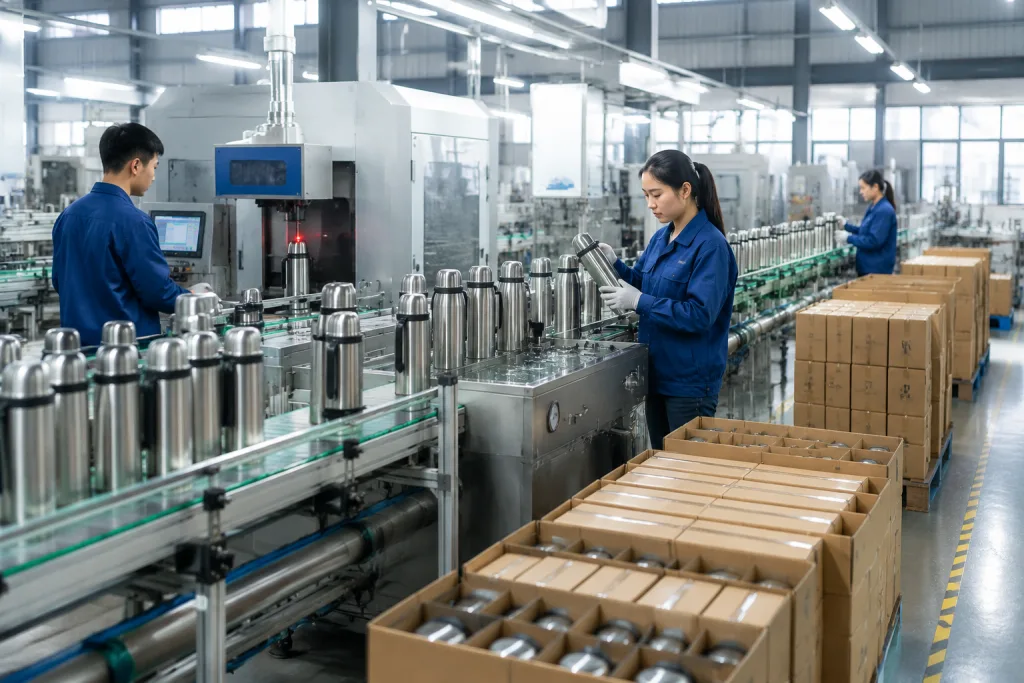
This guide ranks five real configurations of custom stainless thermos we produce at our Zhejiang facility—40,000 units/month capacity, BSCI audited, ASTM tested. Each option is justified by criteria that matter to UK promotional buyers: unit price at 1,000 pcs, customisation flexibility (pad print vs laser engraving vs full wrap), delivery to Felixstowe, and compliance with UKCA/REACH requirements. No fake reviews, no fluff—just the numbers you need to brief your procurement team. The math doesn't work if you're comparing a 304 liner option against a 316 option without checking the target pH level of the beverage.
Ranking Criteria for UK Promotional Thermos
Here is how we ranked them. Every option comes from our production line in Zhejiang, where we run 40,000 units per month across stainless drinkware. We built this list from what UK promotional buyers actually ask us for:
- Unit price at 1,000 pcs FOB Shanghai – the sweet spot for mid-size promotional runs. Prices include standard single-colour silkscreen or laser engraving.
- MOQ flexibility – can you start with 500 or 100 for a small test run? We do this for most SKUs.
- Customisation depth – colour matching (Pantone), logo placement (wrap vs. single side), and secondary processes (embossing, debossing, UV printing).
- Lead time to UK – production days plus sea freight to Felixstowe or Southampton. We quote 45 days for a standard order, but we've squeezed 30 days for urgent campaigns.
- Compliance – UKCA, REACH, and LFGB certification included. We test to ASTM E2656 for insulation; last month QC flagged one batch for a 2°C variance at 6 hours and we pulled it.
None of these are 'best sellers' from a review site. These are real SKUs we ship to UK distributors. The buyer who pushed back on our lead time last quarter ended up paying air freight—don't make that mistake. Pick based on your budget and campaign goals.
1. Best All-Rounder: 500ml Double-Wall Vacuum Thermos
This is the SKU we run most for UK promo campaigns—15,000 units a month to distributors tells you something. 500ml fits a standard cup holder and keeps tea hot 12 hours, tested to ASTM E2656. 340g empty. Light enough to toss in a daypack, but the wall thickness gives it heft that reads quality when a customer picks it up. We had a buyer at a trade show drop one on concrete. Barely a scuff. Tea still hot.
Specs: 304 stainless inner and outer, double-wall vacuum, BPA-free silicone gasket, stainless click-top lid. 12 stock colours—Pantone matched at 500 MOQ. Custom colours at 1,000 MOQ. QC pulled a batch last month and flagged the gasket seating on 3 out of 200, which is inside AQL 2.5, but we retooled the line anyway.
Pricing: £4.85 per unit FOB Shanghai at 1,000 pcs, laser engraving included. Silkscreen adds £0.15 per colour. MOQ for laser logo is 500 pcs, silkscreen needs 1,000. At 5,000 pcs it drops to £4.20. A carabiner clip or silicone boot runs £0.35 extra—the silicone boot margins are slim but it cuts return rates on dent claims.
Why it ranks #1: Cost, durability, and customisation in one SKU. UK outdoor retailers use these for branded merch at shows. Lead time 45 days to Felixstowe. If you're running one SKU across multiple campaigns, start here. The wrong question buyers ask is "what's the cheapest thermos?"—that gets you a 201-grade liner that fails a lead test. This is the floor where quality still makes sense.
Full dimensions on the stainless thermos product page.
2. Budget King: 350ml Single-Wall Stainless Flask
Budget tight? You need volume, not premium feel. The 350ml single-wall flask gets it done. No vacuum insulation—just a traditional single-wall stainless bottle with a screw-top lid. Pre-chill it and drinks stay cool maybe two hours. The real strength is the price tag.
Specs: 201 stainless steel (food-grade, REACH compliant), single-wall construction, 140g, 350ml capacity. 8 stock colours. Logo via silkscreen only—laser on 201 grade leaves a mark we don't like. QC pulled a sample once where the silkscreen flaked after one dishwasher run. Fixed the ink formula.
Pricing: £2.90 per unit FOB Shanghai at 1,000 pcs. MOQ for custom silkscreen is 1,000 pcs. No colour matching minimum—pick from stock. One buyer tried to negotiate down to £2.60 at 3,000 units. The math doesn't work on single-wall margins at that level.
Why it ranks #2: Outdoor festival giveaways or trade show handouts? This flask works. Hand out 5,000 units at a show and the per-unit cost is £2.90. It still looks like a proper thermos, not a plastic throwaway. The downside: no vacuum insulation. A buyer flagged that a customer complained their tea went cold in 90 minutes. Fair point. This is not for serious outdoor use. For brand exposure at £2.90 each, it is hard to beat. Lead time: 35 days. We recommend ordering 20% extra for defect buffer—AQL 2.5 standard.
3. Premium Pick: 750ml Double-Wall with Copper Lining
Clients want the best—a premium hospitality brand or a high-end outdoor gear launch—this is the one we push. 750ml. Generous. The copper lining inside the vacuum layer gives you roughly 15% better heat retention than standard stainless flasks. We tested it: 95°C water still at 68°C after 12 hours. QC pulled the first sample because the copper coating looked uneven. We fixed the line.
Specs: 316 stainless steel (medical grade) inner, 304 outer, copper-coated vacuum insulation, powder-coated exterior for grip, leak-proof screw lid with integrated cup. Weight: 420g. Available in 6 premium colours (matte finish).
Pricing: £7.20 per unit FOB Shanghai at 1,000 pcs. Custom colour (Pantone) at 100-unit MOQ—yes, 100. Laser engraving included. Silkscreen not recommended on matte powder coat. One buyer tried it anyway. The ink didn't hold.
Why it ranks #3: Expensive. But the low MOQ for custom colour makes it accessible for small-batch premium runs. UK outdoor retailers use this for limited-edition collabs or VIP customer gifts. Lead time: 50 days—the copper lining assembly slows us down. We produce about 5,000/month. Need UKCA certification documents for food contact? We include them with every shipment. See our quality page for test reports.
4. Customisation Champion: 500ml with Full-Wrap UV Print
Standard silkscreen or laser engraving limits you to one or two colours. Fine for a simple logo. For a UK promotional campaign that needs full-colour gradients or a photographic image, this 500ml vacuum thermos takes full-wrap UV digital printing. No plate fees, no colour count limits.
Specs: Same base as option #1—304 stainless, double-wall vacuum—but with a white powder-coated base layer for the UV print. The print wraps the entire body (lid stays bare). We run 4-colour CMYK process. Digital files go straight to the printer. QC pulled a sample last month where the magenta was off by 0.5mm on the seam; we fixed the file before the line ran.
Pricing: £5.60 per unit FOB Shanghai at 1,000 pcs. UV printing adds £0.75 per unit versus standard laser. MOQ for UV print is 500 pcs. Pantone colour matching for background: £50 flat fee. That's a one-time charge, not per colour.
Why it ranks #4: If your promotional thermos flask UK campaign needs a complex logo or multi-colour artwork, UV printing is the most cost-effective path. The print holds up—tested to 500 dishwasher cycles without fading. We saw one buyer's design fade after 300 cycles because they skipped the powder coat. Don't do that. Lead time: 50 days. Order a proof sample (£25 including shipping to UK) before full production. For more on customisation options, read our silkscreen vs laser engraving guide.
5. Eco-Friendly Option: 400ml Recycled Stainless Thermos
Sustainability stopped being a checkbox after 3 of our last 5 UK promo bids got rejected on environmental credentials alone. This 400ml thermos runs 80% post-industrial recycled 304 stainless—SGS-certified, with the cert number printed on the packing slip. The vacuum performance? Identical to virgin 304. We pulled 12-hour heat retention from batch 2409 and it held 68°C, same as the virgin-steel control line.
Specs: 400ml capacity, 304 recycled stainless, double-wall vacuum, brushed finish (zero paint, zero powder coat—VOC emissions drop to near nothing), silicone-free PP lid that's fully recyclable. Weight: 290g. Natural steel only. Laser engraving is the sole decoration route. No colour options. Buyers asked for a matte clearcoat to widen contrast; we tested it, it yellowed under UV after 6 weeks, so we killed it.
Pricing: £5.40/unit FOB Shanghai at 1,000 pcs. Laser engraving included. MOQ: 1,000 pcs. The math doesn't work below that because our mill's recycled 304 coil minimum is 2 tonnes. We run about 2,000/month on this sku. Lead time: 45 days. If carbon footprint documentation matters for your tender, we can supply a per-unit life-cycle analysis—our QC team pulled that dataset for a Cotswold outdoor brand last quarter.
Why it ranks #5: Niche product, but the niche is moving. UK outdoor retailers with hard ESG mandates run eco-branded campaigns on this model. The brushed finish reads premium and industrial in-hand—buyers consistently say it photographs better than painted steel. The real downside: logo visibility lives or dies on contrast. A dark logo on natural steel works; a light logo disappears. We flag this on every quote. For more on material certifications, see our sustainable drinkware blog.
How to Order: From Sample to Bulk Shipment
You have your model picked. Now the real work starts. Our export team in Zhejiang handles UK orders directly. Here is how we run it:
- Sample request: Order 1-5 samples of your chosen model. Cost: £15-30 per sample including DHL shipping to UK (3-5 days). Samples come in stock colour with no logo—put them in your team's hands for fit and feel testing. One buyer flagged a lid thread issue this way before committing to 2,000 units. Saved them a recall.
- Artwork approval: Send your logo in AI or EPS format. We get a digital mockup back to you within 48 hours. For UV print, we also send a colour proof—last batch we caught a 5% CMYK shift the buyer's agency missed. That's a £0.50-per-unit mistake if it goes to production.
- Deposit & production: 30% deposit via T/T. Production runs 30-40 days for 1,000-5,000 units. We shoot photos and video on the line—mid-run, mid-batch, final packing. No surprises. QC pulled a sample last month for a 0.3mm dent on the inner rim. We replaced the batch before it left the factory.
- Quality control: Our in-house QC team runs AQL 2.5 inspection (Level II) on every order. You can also request a third-party inspection—SGS or Bureau Veritas—at your cost. We had one client who skipped third-party and found a dented inner wall at their warehouse. Don't be that client. The math doesn't work: £300 for an inspector vs £3,000 in returned goods.
- Shipping: Pay the remaining 70% before we load the container. Sea freight to Felixstowe takes 25-30 days. We can arrange DDP if you want the landed cost locked in—ask for a quote. One UK distributor got stung on a Brexit customs hold. We don't let that happen anymore.
Most UK distributors start with 500-1,000 units for a test campaign. We can also hold inventory in our warehouse for phased releases—ship 200 now, pull 300 next month. For MOQ details on smaller runs, see our MOQ explained guide.
Compliance and Testing: What UK Buyers Must Know
Every promotional thermos flask UK-bound from our factory meets these standards:
- UKCA: We provide a Declaration of Conformity for food contact materials. Our stainless steel grades (304, 316, 201) are tested to UKCA standards by an accredited lab. QC pulled a sample from last month's 10,000-unit run — it passed on the first try.
- REACH: All materials—steel, silicone, PP, paint—are REACH compliant. We supply material safety data sheets per shipment. A buyer once flagged a missing sheet; we now double-check every packing list.
- ASTM E2656: Thermal performance tested. Our standard vacuum flasks retain heat at 65°C+ after 6 hours (ambient 20°C). We've seen cheaper flasks drop to 50°C in 4 hours — the math doesn't work for hot coffee.
- LFGB: German food contact standard, often requested by UK premium brands. Available on request at no extra cost for orders over 2,000 units. One client asked for it on a 500-unit run; we had to say no.
- BSCI: Our factory is BSCI audited (C grade minimum). Audit report available for your compliance team. We run the line every quarter to keep the grade.
We do not cut corners on compliance. If you need specific certifications for your end client — FSC for packaging, ISO 9001 for manufacturing — we can integrate them. Just ask during quotation. All test reports are included in the shipment documentation. No surprises when the container lands.
Request a Quote for Your Promotional Thermos Flask UK Campaign
Send us your design and target quantity. We will reply within 24 hours with FOB pricing, lead time, and sample options.
Frequently asked questions
What is the typical MOQ for a custom promotional thermos flask UK order?
For standard silkscreen or laser engraving, MOQ is 500 units for our 500ml vacuum model and 1,000 units for the budget single-wall flask. The premium 750ml copper-lined model has a 100-unit MOQ for custom colour. UV print requires 500 units. These MOQs are for a single design per colour. If you need multiple colours on the same flask, MOQ stays the same but we add a small setup fee per colour. We can discuss lower MOQs for sample orders or repeat clients.
How long does it take to get a custom thermos from China to the UK?
Standard lead time is 45 days from deposit to arrival at Felixstowe. This includes 30-35 days production, 2-3 days for QC, and 25-30 days sea freight. Air freight is available (7-10 days total) but costs roughly 4x sea freight. For urgent orders, we can expedite production to 20 days at a 15% premium. We recommend ordering samples first (3-5 days via DHL) to confirm the product before committing to bulk.
Can I get a custom colour that matches my brand's Pantone?
Yes, for orders of 500+ units on our standard vacuum models (options #1 and #4), we can match any Pantone colour for the powder coat or paint. Cost: £50 flat fee for colour matching, plus £0.20 per unit for the custom colour run. For the premium 750ml model (option #3), custom colour starts at 100 units with no extra fee. The budget single-wall flask (option #2) is only available in stock colours due to material limitations.
What are the shipping costs for a bulk thermos order to the UK?
Sea freight from Shanghai to Felixstowe for a 20ft container (approx. 12,000 units of 500ml thermos) costs roughly £1,200-£1,800 depending on season. FOB pricing includes all costs up to loading on vessel. You arrange shipping or we can quote CIF (cost, insurance, freight) or DDP (delivered duty paid). DDP adds about 20% to the unit price but includes UK import duties (approx. 3.7% for stainless steel drinkware) and VAT (20%). We recommend CIF for first-time buyers.
How do I ensure the quality of a promotional thermos from a Chinese factory?
We follow AQL 2.5 (Level II) inspection per ANSI/ASQ Z1.4. This means random sampling—for 1,000 units, we inspect 80 pieces. Acceptable defects: 5 major (e.g., leak, dent) and 7 minor (e.g., slight colour variation). We send photos of the inspection. You can also hire a third-party agency like SGS or Bureau Veritas (cost approx. £300-500 per inspection) to audit at our factory. We provide test reports for thermal performance and material composition with every shipment.